Tag Archive: gardening


PIC00103Moving to a new house with a garden that needs whipping into shape? Need help with an idea for improving part of your established garden? Or maybe you want to completely overhaul your current plot and need a masterplan for achieving your ideas over a number of years?

If you live in the Norfolk area and want to develop your ideas and design skills, in the company of like-minded people, I might be able to help.

I’ve been running a series of short courses to inform, inspire and improve the design skills of gardeners for some years, and I’m planning to kick off the next one in a few weeks time.

I’ve taken the opportunity of a new venue to review the content and programme of the course, also building on the positive feedback I’ve had from previous participants. I’m thrilled to be able to offer a course that’s based at the wonderful Blickling Hall Estate near Aylsham, and hope to take full advantage of it’s fantastic gardens to illustrate and reinforce some key ideas.

WP_20150716_12_09_50_ProAnd as well as visits to the gardens I’ll be using a combination of presentation, group discussion, one-to-one support, handouts, books to borrow and links to further information. You won’t need any special knowledge or skills in garden design or gardening; just the germ of an idea or plan for your garden, or maybe just a general interest in finding out more about garden design.

Venue: The Old School, Blickling Estate, near Aylsham, Norfolk

Times and dates: 10am -12 noon Tuesdays from 2nd February – 22nd March inclusive (excluding 16th February)

Cost: £70 (including refreshments)

For an outline of the Programme take a look here. If you want to find out more about me then take a look at the Page ‘About Me’ on this blog. If you’d like to discuss the course, how it might meet your needs or want to register, please call me on 01603 754250, or leave me a message via the contact form below.

alliums and laburnumI want participants to have the space, time and attention to address their individual needs, so places will be limited; if you’re interested, please get in touch soon!

Old School Gardener (Nigel Boldero)

← Back

Thank you for your response. ✨

OK, this is cheating bit, I suppose. I wanted my fifth object to capture several things; but all of them involve cutting. Finally I decided on  a plant, or rather a plant treated in a particular way; topiary. In this case at Levens Hall, Cumbria.

levens hallPruning plants is a key gardening task; to stop or promote growth, to shape plants, to remove dead or diseased material, to propagate – and of course we should include grass cutting here.

I could equally have chosen a pair of secateurs or perhaps a lawnmower, but the clipped shapes of yew, box, or other species capture for me this important garden task and also symbolise what you might call the core ingredient of gardening; the conscious act of doing something to enable a plant to grow and to grow in a particular place or way.

Topiary’s clipped shapes transform the wayward beauty of nature into forms and masses which can add structure and give pleasure; when standing alone or providing a foil for swaying grasses, nodding allium heads or cottage garden favourites.

I know there is one school of thought that says this, sometimes drastic, technique seems unnatural, which is certainly true. But then again gardening is about the directing, guiding and controlling of nature. And I have to say, as a fan of topiary, it can make a garden fun. Just look at this combination of geometric shapes at Levens Hall, some of them centuries old. And when you search for topiary on the internet- which I suggest you do- you see all manner of human, animal and other forms, cleverly cultivated and maintained for our enjoyment.

One might almost say topiary puts a smile into any garden…

Old School Gardener

Old School Garden – 31st December 2015

Dear Walter,

It was great seeing you and Lise over Christmas and we hope you had a wonderful time with your nearest and dearest. As you know, my time in the garden has been limited this month as I tried to finish off the major redecorating in one end of the Old School. I’m pleased to say that’s done and I’m now developing detailed plans to fit out a couple of rooms with some built in furniture. Alas, my plans for the outside are moving slowly, though there’s been a bit of progress I can report.

Dogwoods starting to put on their winter colours

Dogwoods starting to put on their winter colours

We had a few hours cutting up the fire wood we’d saved from the major tree surgery on our Black Poplar a couple of years ago, and this is all now stacked in the woodshed. At the same time I reorganised the outside storage area (with pallets and angle irons), in anticipation of getting some new logs from our neighbours (who have some Ash trees that have fallen foul of Ash die back).

Awaiting logs (left) and a new leaf mould bay (right)

Awaiting logs (left) and a new leaf mould bay (right)

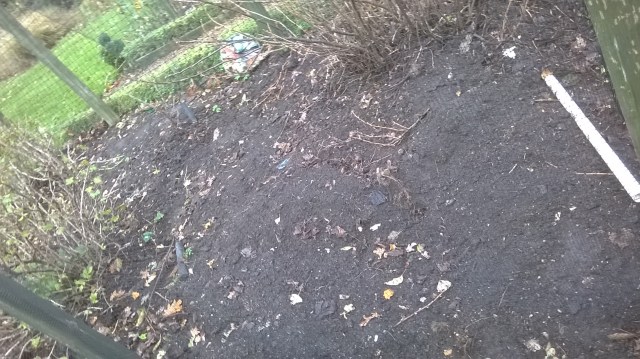
I’ve built alongside (using more pallets of course!) a leaf mould bay, which in the summer will also serve as a good spot for the grass clippings. As you know, in the past I’ve deliberately mixed these two materials together and had some good organic material to add to the soil. Gathering up the final loads of leaves from around the garden has been the other major task this month, though there are a few stubborn oak leaves still to fall. This minor reorganisation in the rear garden area has started to tidy it up, and so I can get to grips with further spring planting in the area with a nice view to the church (where I plan to put another bench).
WP_20151218_09_11_38_Pro

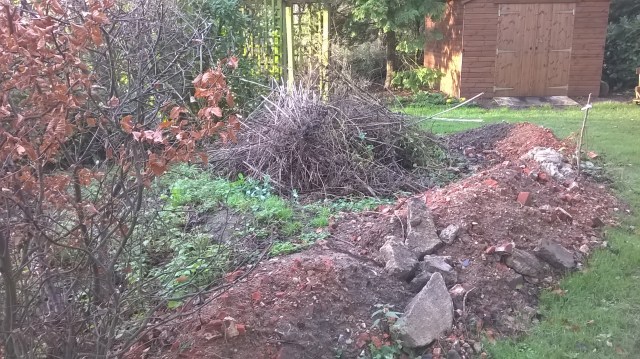
A work in progress- rubble from one of the shed floors used to begin sculpting a basin for the pond garden…

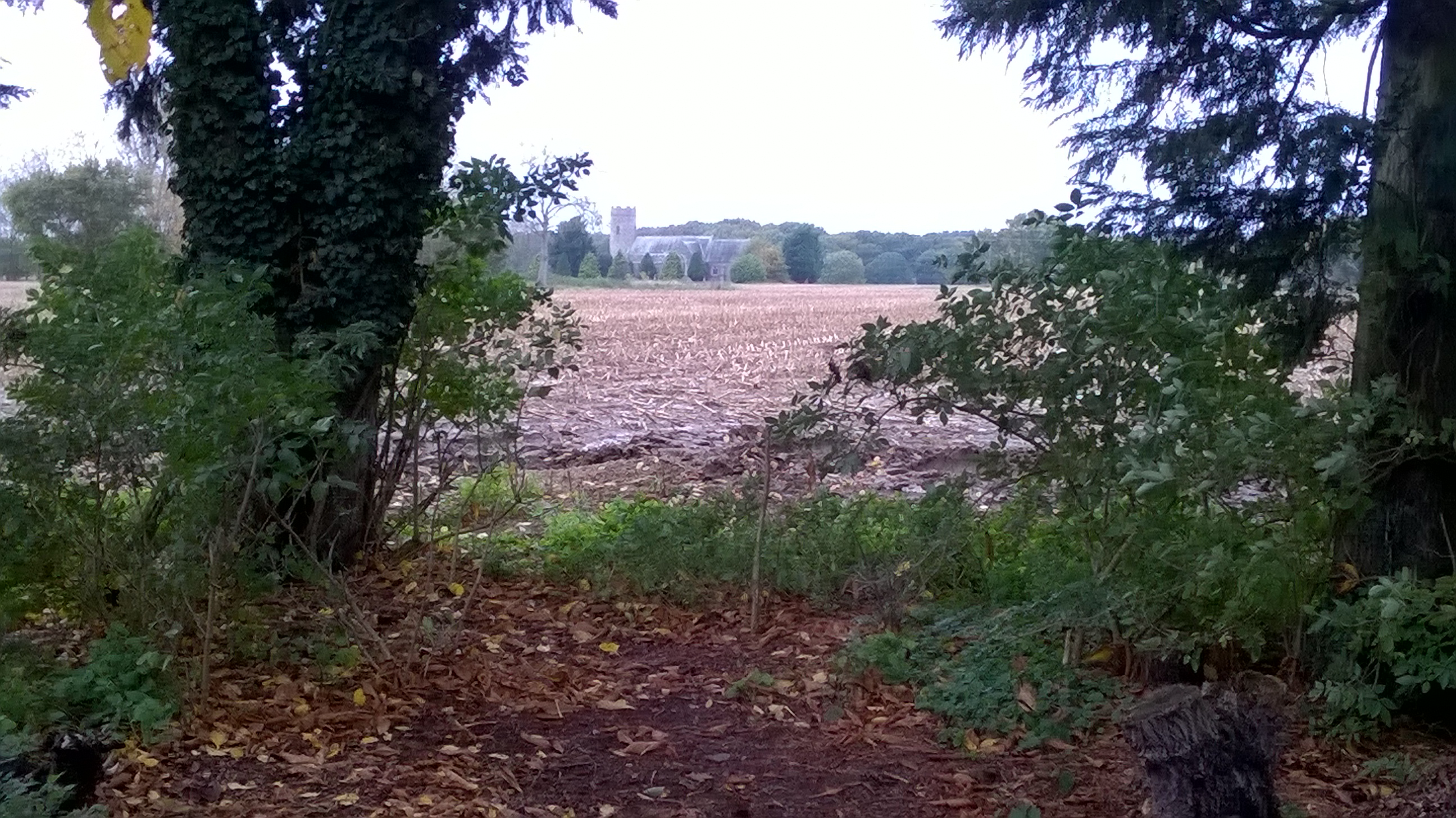
New possibilities- the view across fields to the church is crying out for a bit of organisation, including a new bench.

New possibilities- the view across fields to the church is crying out for a bit of organisation, including a new bench.

I’ve also potted up the cannas (but not yet the dahlias as it’s been so mild here), and planted up the pots they were in with some violas and a range of tulips and other spring bulbs- we should have a great show next spring.

I’ve cleared and planted up the front circular border with the rather ‘whippy’ selection of Wallflowers and Sweet Williams I sowed earlier in the year. I also took the opportunity of swapping over the centre piece shrub here; out came the Star Magnolia and in went another Magnolia (‘Merrill’), which will grow a bit larger than the one it’s replaced and so be a better counterbalance to the large magnolia we have on the other side of the drive. So the Star Magnolia is in a pot for now until I decide it’s final location, somewhere in the pond garden.

Not much to look at right now, but the round border tidied and planted out with a new Magnolia and some spring colour- I hope!

Not much to look at right now, but the round border tidied and planted out with a new Magnolia and some spring colour- I hope!

The table top planter- good early growth, but a bit of weeding required too!

The table top planter- good early growth, but a bit of weeding required too!

The kitchen garden is looking tidier, too, though without much of interest as you might expect. I’m pleased with the progress of the table top planter, though; the unseasonably mild weather has really got the shallots, garlic and broad beans well underway.

You know how in Autumn and early winter you can pick up some plant bargains (the ones that are past their best, but will nonetheless put on new growth if looked after)? Well, I picked up a few trays of violas to fill my ever increasing containers and at the same time got three pots of Pennisetum, reduced to well below their original price- they don’t look much at present, but with a bit of spring care and potting on/ planting out, should do well.

A plant bargain
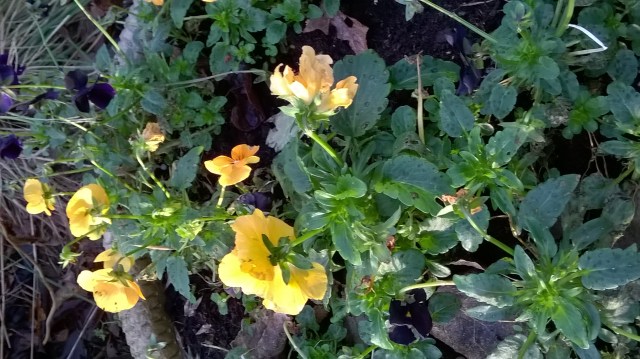
A plant bargain

Violas starting to pick up

Violas starting to pick up

I spent a couple of sessions over at Gressenhall focusing on leaf clearing, cutting back and digging over some of the borders, so that will probably be my last time there for now.

One of my jobs in the next couple of weeks will be to finalise the marketing material for my new Garden design course, which hopefully will begin in early February at Blickling. I’ll put details in a page on my blog early in the New Year for anyone interested.

WP_20151218_09_15_22_ProWell, as we come to the end of another year, I’m grateful that the garden here seems to have survived pretty well, despite less attention than normal; but the ground elder awaits and this and the other weeds will need attention in a couple of months time before the growing season really gets underway! 

Very best gardening wishes for 2016,

Old School Gardener


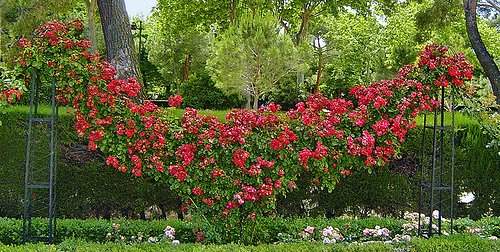
roses round the doorStart right…

Buy well-branched plants and train immediately after planting to create a framework that is easy to prune and that will flower where you want it. After that here’s what to do in each season…

Autumn/ Winter

Leave the main pruning of repeat flowering climbers to spring, but if you have long, whippy new growth trim this back a little and tie it in temporarily to prevent wind damage. If roses have suffered mildew or black spot, clear leaves to prevent spores overwintering. To rejuvenate rampant ramblers on large structures, cut them back to 1.2 metres from ground level.

Spring

Just before growth begins, prune repeat-flowering climbers by removing dead and exhausted shoots. To get flowers all along the stems, tie in large shoots horizontally in a rough fan shape, once growth starts. Over the growing season, spread out and tie in new shoots.

PUB0006438_416111Summer

Deadhead ramblers, where possible, and once-flowered climbers by removing old flower heads with 15cm of stem- or 30-45cm if vigourous. To get new growth on old ramblers, cut a few old, spent flowering shoots to ground level.

rose-garden-climbersSource: ‘Short cuts to Great Gardens’- Reader’s Digest 1999
Further information:

Rose Gardening Made Easy.com

RHS- Pruning Climbing Roses

Old School Gardener

5053LW

Number four in this new series of posts took a bit of pondering. I wanted to capture the importance of ‘cutting out the competition'(weeding) and at the same time find an object to stand in for all those other tools of cultivation we gardeners use to loosen, till and maintain the soil; for seed sowing, planting, and incorporating stuff to benefit plants- manure and other organic matter as well as inorganic fertilisers. So I went for probably my favourite tool in this category, a hand fork.

The image above also shows my preferred model in this wide range of available hand forks; one with a shaped handle and relatively short, stainless steel prongs.

Apart from the effort to kneel or crouch (my back and knees aren’t what they were), weeding with a hand fork (or by hand) must be one of the most satisfying of gardening jobs. Taking out shallowly rooted weeds and other unwanted growth around your preferred specimens, especially in sandy loam soil like we have here in Old School Garden, it is a relatively easy task too.

And once those rows of veg, stretches of mixed border or pots of spring bulbs have been cleared you can stand back and admire how you’ve improved the presentation of your plants; the finely worked, bare soil also provides a wonderful foil to all that fresh foliage and, later, the hues of the flowers and fruit.

And we mustn’t forget those other cultivation and weeding tools; the forks, spades, rakes and tillers that all help to keep your soil healthy, alive and weed free.

Old School Gardener

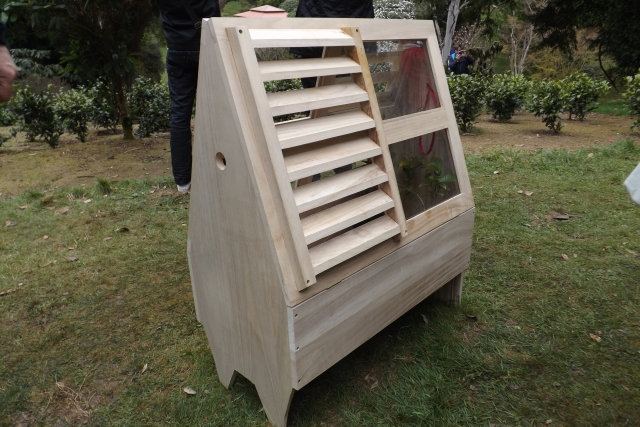
The third object in this series is of historic importance. The Wardian Case, originally designed by Nathaniel Bagshaw Ward in 1829.

A modern reproduction of a Wardian Case at Tregothnan Gardens, Cornwall. Picture by Rosie Reeve

A modern reproduction of a Wardian Case at Tregothnan Gardens, Cornwall

It became a vital tool for those intrepid plant hunters of the 19th century. Without it, many of the exotic plants that now thrive in the U.K. would not have survived even half their journey from the far corners of the world.

Early plant hunters had been actively searching the world for new exotic plants from the end of the 16th century. But transporting their discoveries as seeds and dry roots because of the dehydrating sea air and a substantial lack of fresh water caused many plants to perish. The Wardian Case provided protection from the salty wind, created a mini greenhouse where the plants could use sunlight and produce their own water through condensation.

And the Case is not only of historic importance in explaining the wide range of plants now available in the U.K. It also symbolises the ways in which gardeners try to create micro climates to nurture an exotic plant or even a range of plants. They do this by growing them under glass (and a few years after Ward’s invention an explosion in greenhouse manufacture began), sheltering them from the excesses of sun, wind and rain or creating plant colonies which support each other, possibly altering the soil too.

 Old School Gardener

My second object is small, but none the less important- a plant label. The plant label symbolises gardeners’ efforts to propagate from seed and bring on plants into a state where they can ‘look after themselves’.

It also represents the importance of knowing what you’ve sown, where. It can be a right pain if you don’t and you forget what’s where until you’ve dug up your offspring rather than weeds!

I try to reuse my plastic labels by rubbing off the ‘permanent’ ink with some wire wool each year, which does the job well, though it can mean your next written label is a tad more smudgy than the first as the ink will spread in the fine scratches you create. Still it is the sustainable way to go! (Wooden labels are even better of course and you can also get other kinds, e.g slate).

Copper labels are useful for permanent labels on trees and shrubs and the likes- by impressing rather than inking in the name in the surface you don’t risk losing it to weathering.

Old School Gardener

Some of this year's squash harvest- should keep us going for a few weeks.

Some of this year’s squash harvest- should keep us going for a few weeks.

Old School Garden – 29th November 2015

Dear Walter,

As we move towards winter, this month has been one of small steps forward, old friend. We had our first frost last week, and I managed to get the tenderest plants under cover in the greenhouse.

Tucked away from the frost...

Tucked away from the frost…

I’ve noticed that the leaves on the Cannas have started to brown so it won’t be long until they and the Dahlias are also brought in. I won’t be cutting down or removing much else as I like to see the grasses and many herbaceous stems stand over winter- I think this is also good for wildlife.

Cannas on the turn- soon to be dug up and replanted in the greenhouse

Cannas on the turn- soon to be dug up and replanted in the greenhouse

The piles of leaves continue to grow, and though many have fallen, there’s still a lot of oak to float down and then be gathered up. I’ve already cut back and placed most of the Pelargoniums into trays for over wintering and once the remaining pots on the terrace are empty, I’ll plant out the four or five packs of tulips I have in the shed.

Tulips ready to go in some of the other terrace containers and borders

Tulips ready to go in some of the other terrace containers and borders

In the kitchen garden I’ve pulled the remaining carrots- they are a well-sized and tasty crop. The parsnips and a few leeks are all that remains for winter vegetables, with the promise of Purple Sprouting Broccoli to come in spring. As I reported last month, I’ve used my latest batch of compost to mulch the fruit bushes, strawberries and raspberries and added some manure over the rhubarb and asparagus bed, which hopefully might give us a few spears next year.

I dug up one of the remaining two blackcurrant bushes the other day and took this in to the local Primary School, where I was helped by 7 pupils to divide it and plant it out in their developing fruit garden. It was fun to be back among some familiar (if older) faces and they were very responsive and involved in the hour we spent talking about roots, stems, water and so on.

Awaiitng a Redcurrant, to go alongside White and Black!

Awaiitng a Redcurrant, to go alongside White and Black!

So, here we’re left with one large blackcurrant bush (after having three for several years – the freezer is still bulging with the last few year’s crops). I’m now waiting on the arrival of some bare root red currant and raspberry canes at the local nursery, so that I can fill out the summer fruiting raspberries and replace the blackcurrant, which will give us one each of Red, White and Black currants.

Looking ahead, my friend Steve volunteered to order me some seed potatoes, so I’ve gone for some first and second earlies which should be here for ‘chitting’ in January. I also recently ordered some seeds from the RHS scheme for members, which is good value for money. With the seeds I purchased on my visit to Wallington Gardens in September (as well as some harvesting at other gardens we’ve visited), I can see that February will be a busy time (as usual), propagating a new range of interesting flowers for the borders; including one ‘long wanted’ variety,  Cephalaria gigantea.

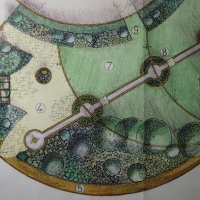
My Pond garden project is moving ahead slowly, with the reclamation of some large York stone flags from one of our outside sheds (we’ve had a new concrete floor put in here to replace the stones) and the use of the stony soil from under these to build up the surrounds of the pond area. Before going much further outside on this I want to firm up my design on paper, so the drawing board is out again and I’m sketching out some ideas, including a stepping stone bridge (this is what some of the flagstones will be used for), boggy borders and a ‘beach’. My collection of plants for this area is growing nicely so I’m factoring these into the design too.


On a broader front, I went over to Gressenhall the other day and began to clear up for winter (including some overdue shearing of the lavender and leaf clearing) and planted out some Catmint I took out of the courtyard planters at Old School Garden. Together with the new plants I purchased recently these will make a good show in a number of half barrel planters we have there.

You’ll have also seen something of my regular visits to Blickling Hall, where the winter clear up and preparation for next season is well underway. Did I tell you that I’m hoping to run a new Garden Design course at Blickling? Based on the one I’ve run in the past at Reepham, it will be slightly extended but will still focus on helping participants to design their own garden or area. I hope for a good level of interest, especially as we shall be able to use the gardens at Blickling as a showcase for many of the ideas and concepts I’ll be covering. If I get the numbers I need this will begin in early February.

Having just replaced the broken glass in our wood burner I think its time to light it and get something to drink!

Very best wishes,

Old School Gardener


Inspired by recent examples of ‘capturing the essence’ of things by crystallising them into a dozen or so objects, I thought I’d do something similar for gardening. So, here’s the first in a new weekly series of my personal take on gardening essentials (in a sort of logical order)…

compost-heapThe humble compost heap doesn’t look much, but it symbolises gardeners’ efforts to maintain or improve their soil and to help meet the nutritional needs of plants. Home made compost is just one, important source of organic material that both enriches the soil and improves its texture- whether your soil is light and sandy or heavy clay (the former being ‘the least back ache, the most heartache’ and the latter, vice versa!).

Do you make your own compost? I do, but don’t really have enough for a garden the size of the one here at The Old School!

I tend to use my two cubic metres a year  on the plants that are the hungriest- principally fruit bushes, canes and strawberries- and supplement it with manure (for roses, rhubarb etc.). And I do get a pretty good supply of leaf mould, which, though relatively low in nutrients, is a good winter mulch to protect bare soil, and can be turned in at spring time to improve soil texture.

Compost bins, like the one pictured, can be made from ready-to-buy kits or from recycled pallets and other wood. It’s useful to have removable slats at the front to make it easier to turn the pile and remove the finished compost.

Old School Gardener

WP_20151030_13_49_00_ProOld School Garden – 30th October 2015

Dear Walter,

Well, this month I can say that I’ve just about caught up with the routine jobs that Old School Garden needs at this time of year, though my bigger projects of pond and shed still await some serious attention.

I’ve spread a large pile of leaf mould in the new woodland garden I’m creating and mixed this with the topsoil and ashes from the old bonfire site I’d deposited there a few months ago. The soil is at least starting to deepen and hold some moisture. Into this mix I’ve planted a lot of ground cover and slightly larger perennials from around the garden as well as many spring bulbs – in waves that should hopefully make a bit of an impact next March and April.

The new woodland garden...promise of things to come.

The new woodland garden…promise of things to come.

I’ve also dug over the main kitchen garden beds and added some leaf mould and compost; the latter around the various fruit bushes. It all looks nice and tidy and should help to enrich the soil as well as cover it over the winter. I also finally got around to cleaning up the greenhouse and am about to add its winter insulation before putting in the various tender plants that I try to over winter.

I also plan to buy some bare root summer fruiting raspberries and a redcurrant bush- I’ve decided to reduce further our stock of blackcurrant bushes to one and donate the other to the local Primary School; how we ever dealt with three bushes I don’t know! (the first one went to Gressenhall Museum last year).

The table planter I created this year has also been stocked with a mix of garlic, shallots and broad beans that should get going and give me a chance of early crops next year. And a mix of white and red onions have also been planted out for the same reason.

Leaves, leaves everywhere

Leaves, leaves everywhere

Elsewhere in the garden its been leaf collecting time, and having cleared last year’s leaf mould pile, I’m slightly reorganising the storage areas to accommodate a new supply of firewood (yet to be cut and collected) from our near neighbours. In doing this I’ve opened up a new vista towards the church..maybe a spot for another bench methinks?

New view...one to take advantage of with a new seat?

New view…one to take advantage of with a new seat?

I had hoped to have shown you some pictures of the beautiful leaves on the Sumachs, but once again a little breeze and they soon disappear! It’s also been a time of hedge cutting and I’m pleased that this big job- with the added task of reshaping the big Laurel hedge in the main garden- has now been completed, as has fence painting. I spent one morning spreading 7.5 tonnes of shingle we had delivered which certainly improves the look of the drive, though in places it’s rather like Sheringham beach!

I recently made start on some plant moving, specifically a large white rose bush that was being crowded out by a vibrant Choisya and Viburnum. This helps to plug a gap in one of the mixed borders. I’ve also been mentally logging which other plants need to be shifted, including a Myrtle (which I’ll leave until early spring) and some other shrubs I’ve earmarked for the new pond garden. The plants I now have for this area – including some purchases earlier in the year – are now making a nice little collection and I can’t wait to finalise my design and get on with the pond and its surrounds.

Some of the plants I've been collecting for the new pond garden

Some of the plants I’ve been collecting for the new pond garden

I also have a big bag of tulips of various kinds as well as some Alliums I want to get into some of the containers we have and some in the borders. A job for next month.

As you’ll read in my other posts I’ve been putting in some sessions at Blickling Hall and also went over to Gressenhall museum last week to plant up some tubs with some drought tolerant perennials; two varieties of Cistus and a compact Buddleja, to be precise, with a few small ivies to add ‘edge interest’.

I gave a talk to a local gardening group the other night on the basics of garden design. This went well and I took the opportunity to plug my new garden design course (‘Your Garden- your Design’) I’m hoping to run at Blickling Hall from February next year.

The switchover has begun...the tender plants formerly in these pots are on their way to the greenhouse..to be replaced by Carex elata aureum ('Bowles Golden Grass') and tulips to come..

The switchover has begun…the tender plants formerly in these pots are on their way to the greenhouse..to be replaced by Carex elata aureum (‘Bowles Golden Grass’) and tulips to come..

I do hope you and Lise are in good health as the days shorten and the temperatures drop. No doubt you’re enjoying watching someone else do the autumn tasks now that you’re getting some extra gardening help!

All the best old friend,

Old School Gardener


Finding Nature

Nature Connectedness Research Blog by Prof. Miles Richardson

Norfolk Green Care Network

Connecting People with Nature

Discover WordPress

A daily selection of the best content published on WordPress, collected for you by humans who love to read.

Susan Rushton

Celebrating gardens, photography and a creative life

Unlocking Landscapes

Writing, photography and more by Daniel Greenwood

Alphabet Ravine

Lydia Rae Bush Poetry

TIME GENTS

Australian Pub Project, Established 2013

Vanha Talo Suomi

The Journey from Finnish Rintamamiestalo to Arboretum & Gardens

Marigolds and Gin

Because even in chaos, there’s always gin and a good story …

Bits & Tidbits

RANDOM BITS & MORE TIDBITS

Rambling in the Garden

.....and nurturing my soul

The Interpretation Game

Cultural Heritage and the Digital Economy

pbmGarden

Sense of place, purpose, rejuvenation and joy

SISSINGHURST GARDEN

Notes from the Gardeners...

Deep Green Permaculture

Connecting People to Nature, Empowering People to Live Sustainably

BloominBootiful

A girl and her garden :)