It was our last full day in Portugal and having visited two grand Baroque gardens in Caxiasand Oleiras we stopped off in stylish Cascais for lunch. It was also a chance to take a look at a very different garden, one very much more domestic in size and with a more informal air.
Casa da Pergola (‘The Pergola House’) is a mediterranean – style mansion or Manor House, near the centre of Cascais. I viewed the charming and well kept front garden from outside the locked entrance gates, not having the time (or courage) to ask if I might be let in to look around. Still, I could see enough to be impressed.
The hotel website shows pictures of elegant white marble floors and staircases, beautifully decorated bedrooms with “bas relief” stucco ceilings. The house has been owned by the same family for over a century and its beautiful facade, adorned with hand painted tiles, has been the delight of both amateur and professional photographers. Here’s my take on it!
Here’s a handy guide to the numbers of food plants to grow per square foot. This is a useful technique for small food gardens or containers but can also be used in larger plots to ensure a mixture of veg in smaller quantities, so avoiding gluts.
Molehills seem to be springing up at a rate of knots in Old School Garden!
Letter from Old School Garden 23rd December 2013
Dear Walter,
As I write this a major storm is sweeping across the country,disrupting travel, cutting power from homes and maybe even bringing further local flooding. I hope that you aren’t in danger from this.Fortunately we seem to be missing the worst of it, but nevetheless the winds are ferocious and I’m wondering if we can complete out planned Christmas family gathering later today, as I’m due to collect my eldest daughter and her boy friend from Norwich Station. Let’s hope they are able to get a train before the cancellations set it in at 5pm.
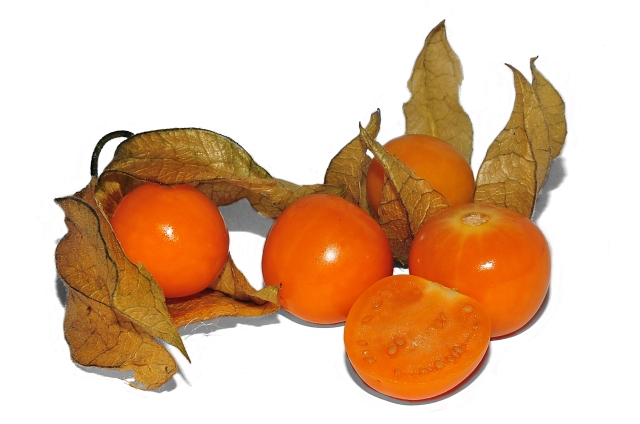
Setting the current ‘excitement’ aside, it’s been a pretty quiet time here at Old School Garden in recent weeks. I’ve been collecting Physalis fruit, Rose hips and Crab apples (‘Red Sentinel’) for festive decorations and rather good they look too. The other day I was pleased to discover that my local nursery had its supply of seed potatoes in, so rather than wait and possibly miss out on my favourite variety (‘Charlotte’), I bought a bag of these and one of Maris Bard (second and first earlies respectively). Once Christmas is over I’ll be setting these out on trays to ‘chit’ (sprout).
Festive Decoration- Physalis
We’ve also had some new french doors fitted and I managed to grab the old glazed doors which I hope to use for cloches to warm the soil/protect tender crops in the new season. I really haven’t done as much as I’d hoped in the garden this past few weeks. As I said last month, the weather has been quite mild so I should have taken advantage of this to move things around, but all I’ve managed to do is extend a border and moved a few perennials to here and one or two other places. I still have some larger clumps of Achillea and Echinops to split and move.
I’ve just about managed to keep on top of leaf collection, but have noticed how the grass has kept growing, so at some point I shall have to venture out with the mower to keep it to a reasonable height. Having said this, mole hills seem to appear almost as I’m clearing the old ones away!
The last month has seen some gorgeous autumn colour- the Euphorbia palustris was especially brilliant, and I’m looking forward to seeing the various groups of Dogwoods as their bright stems liven up the winter garden.
Red Sentinel crab apples
The greenhouse is now fully set up with electric heater, insulation and tender plants all in- though I’ve still to get the Dahlias properly potted up for winter. I’ve ordered some flower seeds and these have arrived. I’ve gone for few more exotic- looking varieties of flowers this year and also some extras which I’ll use for an extended ornamental area in kitchen garden. I’ll turn to more detailed planning of these areas and my propagation schedule in the next week or two. I’ve also re-potted some house plants and I’m trying to care for these a little better, by thinking about their placement and trying not to over water them!
On the wider front, I’ve been approached by a Norfolk High School about tutoring a group of students on the School gardening plot, probably for a couple of sessions a week.This sounds interesting and something I’m keen to do, so will be visiting the School garden in early January to discuss plans in more detail. Meanwhile, I’ve continued to help at my local primary school. The mild weather has meant that we managed to plant out some leek ‘survivors’ from a sowing earlier in the year- hopefully it will remain mild enough for them to get settled. The children have also been busy collecting a lot of leaves for leaf mould. I’ll probably be back with them after February half term to get on with some seed sowing, amongst other things
Rose hips
I’ve also heard that I may have a new garden design commission in the New Year and I’ve agreed to meet up with the Head Gardener at nearby Salle Park Gardens to discuss her plans for turning over a portion of their 2 acre walled garden to ornamental rather than food production ( a bit like my own plans but on a much larger scale!).
As I mentioned last month my courses in Garden Design and Grow Your Own Food seem to have been successful and I’m hoping that we can run another set beginning in February, though once more subject to numbers of course.
Well, old friend I hope that you and Lise are safe in this rough weather and that you have a wonderful Christmas time with your family, tucked up in that lovely old house of yours. All the best to you and them at this special time and here’s to a productive gardening year in 2014!
As we roll on towards Christmas, you might be lucky to receive a present of some bare rooted shrubs like George Wellbeloved from the Scottish highlands:
‘I’ve been given a birthday present of some shrubs but the ground is frozen in the garden and I’m not sure what to do with them. Can you advise me?’
A belated Happy Birthday George, what a great idea for a present! Most shrubs and climbers, and especially deciduous ones sent out by mail order, are despatched with bare roots, not in containers. If they dry out they will die, so when they arrive, and there is not soil at all on the roots, stand them in a bucket fo water for a day or two in a cool, frost-free place until the soil is in a fit sate to plant them. Alternatively, store them for longer periods with their roots in damp compost – this can be ‘spent’ (old) rather than new if you have some (from emptying out summer flowering hanging baskets or other containers, for example).
If the plants arrive with some soil, on the roots, probably wrapped in netting, these are best watered carefully with a can fitted with a fine rose and then stored in moist compost. As soon as possible after arrival, dig a trench in a vacant bed of soil, lay in their roots, and replace the earth. ‘Healed in’ like this the shrubs will stay in good condition for many weeks until the planting site is frost-free, fully prepared and in good condition.
When planting shrubs there are two schools of thought. The traditional method is to mix a good supply of well-rotted manure with loosened soil from the bottom of the planting hole, but if you can’t get hold of this, try using your own compost, or spent growing bags (you might be able to get hold of these from commercial tomato growers). Spent mushroom compost is also a possibility, as it usually contains some manure, but as it also contains chalk it should not be used for lime hating plants. Lastly, you can use shop-bought composts or bulky organic materials, though the latter can be pricey. Add a few handfuls of bone meal to the material you use to encourage root development.
The alternative method is to raise the fertility level of the soil around the planting site so that the plant’s roots are encouraged to spread out and so lead to more vigourous growth as the roots are encouraged to seek out nutrients more than if all the goodness is concentrated in the planting hole. Of course for ‘belt and braces’ job you can do both, or use your judgement about whether and how much fertility needs to be added to the site of the planting. Increasing fertility in the space surrounding the planting hole may be impractical where there are already plants in this area or where you’re planting into a lawn. Here’s a useful guide to planting bare rooted trees.
You can also consider adding Mycorrhizal fungi in the planting hole. These are now widely available in Garden Centres and online. As the RHS says:
‘Mycorrhizas are beneficial fungi growing in association with plant roots, and exist by taking sugars from plants ‘in exchange’ for moisture and nutrients gathered from the soil by the fungal strands. The mycorrhizas greatly increase the absorptive area of a plant, acting as extensions to the root system.
Phosphorus is often in very short supply in natural soils. When phosphorus is present in insoluble forms it would require a vast root system for a plant to meet its phosphorus requirements unaided. It is therefore thought that mycorrhizas are crucial in gathering this element in uncultivated soils. Phosphorus-rich fertilisers are widely used in cultivated ground and not only reduce the need for this activity but are thought to actually suppress the mycorrhizas. For this reason it is best not to use phosphorous rich fertilisers in conjunction with mycorrhizal fungi.
Neither fungi nor plants could survive in many uncultivated situations without this mutually beneficial arrangement. Mycorrhizas also seem to confer protection against root diseases.’
Root tips showing mycorrhizal fungi (the white coating)
Our October visit to Portugal concluded with a day packed with garden visits to the west of Lisbon and in the regal suburb of Sintra to the north- home to many a splendid palace and garden.
We began at a restored baroque garden in the riverside town of Caxias. The Quinta Real de Caxias is located quite close to the train station (direct services to and from Lisbon). It was a leisure residence of Queen D. Maria I, as well as the home of King Luís for a few weeks, before he moved to the Ajuda Palace (which we’d visited a few days before).
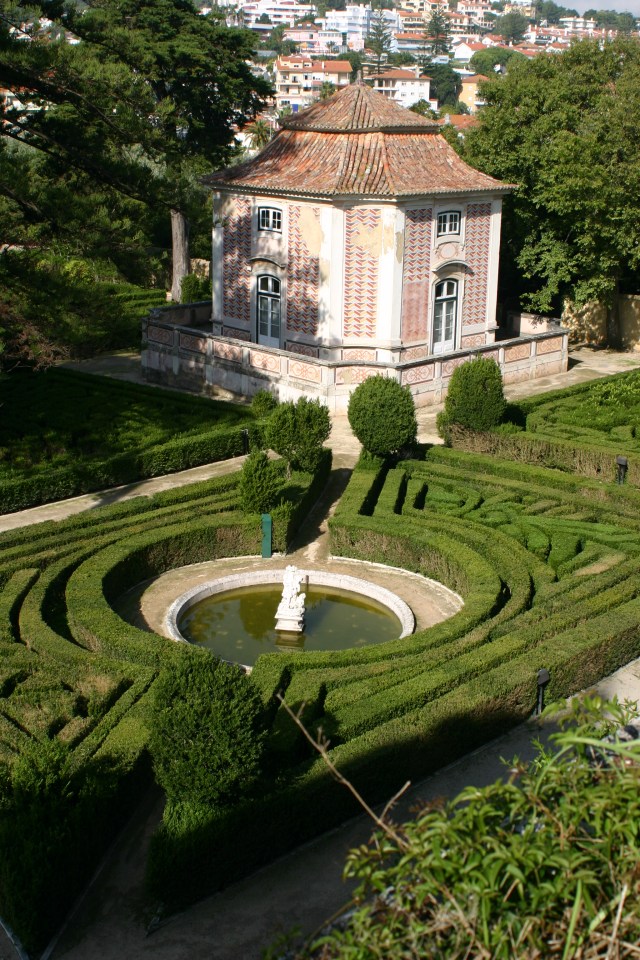
Inspired by the gardens at the Palace of Versailles, the formal parterres- woven in intricate patterns – are interspersed with various water features, statuary and tall Brazilian pine trees.
The waterfall, ornamented with terracotta statues (of the Machado de Castro school), is the centre piece. Set out at the end of the principal avenue the fountain itself (made out of weather – beaten limestone), is flanked by two wings of tiered terracing, accessed by staircases at either end – the perfect spot form which to view the patterns of the box parterres.
Awarded a European Prize for the Recovery of Historical Gardens, the local Council has done a superb job in restoring much of the baroque splendour of this ‘off the beaten track’ haven. I could have spent hours here ‘chilling out’ – and it would have been even more alluring if the water features had been in operation. Maybe that’s something for the next phase of restoration?








 As we roll on towards Christmas, you might be lucky to receive a present of some bare rooted shrubs like George Wellbeloved from the Scottish highlands:

 Our October visit to Portugal concluded with a day packed with garden visits to the west of Lisbon and in the regal suburb of Sintra to the north- home to many a splendid palace and garden.





 Old School Garden