
Picture by Len Gun
‘The fair-weather gardener, who will do nothing except when wind and weather and everything else are favourable, is never a master of his craft.’
Tag Archive: garden

I had a great day’s gardening with various groups of children at Cawston Primary School, Norfolk, last week. They made great progress with digging over the various borders, watering and transplanting- as well as each sowing runner bean seeds in aid of Dr. Barnardo’s. But in addition to these rather more mundane activities it was also possible do some ‘instant gardening’.
An old willow tree stump, removed from the side of the former pond to make way for the new one a couple of years ago, lies near the entrance to the garden and was, to be honest, a bit of an eyesore. Mrs. Brett, the ‘learning outside the classroom’, co-ordinator had a great idea to make this a feature by planting it up, so I bought various bulbs, primulas, anenomes and ferns, using some of the money raised from opening up Old School Garden to the public last year.
Ann, one of the parents, and I helped the children turn this into an attractive feature. We cleared around the old stump and used other old branches to create ‘planting pockets’ in addition to those created by the roots of the stump and filled these with old soil from a nearby spoil heap. The plants were well watered in and there’s now a colourful, rather beautiful ‘floral sculpture’ to welcome us as we enter the garden!


Old School Gardener

Calochilus paludosus- the Red Beard Orchid
Old School Gardener

‘Every Monday Morning, he must walk about the whole place to observe what needs doing, what is amisse, before he does any other work….Make regular checks on beehives, seed and root boxes; clean, sharpen and repair tools in wett weather and put away every night.
Stir heaps of dung and mould; clip hedges, mow lawns, prune fruit and murral trees and vines when stated.
Ask every night what rootes, salading, garnishing wil be needed next day, and bring it to Cook in the morning and informe her from time to time what garden provision and fruite is ripe and in season to be spent….
Gather and bring in all fruit… He may not dispose of any fruit or sell any vegetables, flowers or plants without first asking leave of master or mistress. He must show broken and worn out tools to the master before buying new ones.’
John Evelyn- Directions to his gardener at Saye’s Court, 1687
Further Information:
Saye’s Court and John Evelyn
Old School Gardener

Picture via GrowVeg
Guest article by Elizabeth Grey
Mothering Sunday is fast approaching, this year falling on 30th March. If your mum or granny is a keen gardener, there’s plenty of scope to get her a much more interesting present than the typical flowers, chocolates, perfume or smellies, and a gardening related gift is something that can be treasured for years to come.
Even if your mother has a shed bursting with much-loved gardening tools and there’s not room for another cutting in her garden, there are still a wide selection of thoughtful green-fingered gifts which she will be delighted to unwrap.
For the gardener who likes to read
 Mr McGregor’s Garden at Hill Top Farm, Cumbria

If your mum enjoys curling up with a book or magazine, consider treating her to a horticultural read so she can carry on immersing herself in her passion even when it’s not possible to be out in the garden.
Beatrix Potter’s books are some of the most charming children’s books ever written, and if you have fond memories of reading Peter Rabbit with your mum as a child, Marta McDowell’s Beatrix Potter’s Gardeners Life might be an ideal gift. Beautifully illustrated, the book explores the link between Potter’s Lake District gardens and her work.
Slugs are the bane of gardeners’ lives, so this book about 50 Ways to Kill a Slug is a good fit for a gardener who enjoys a humorous look at dealing with one of their least favourite molluscs.
A gardening magazine subscription provides your mum with a year round source of inspiration and the chance to discover what’s going on in some of the country’s most interesting gardens. Subscriptions can come with added bonuses, for instance, if you subscribe to The Garden magazine you get membership of the Royal Horticultural Society (RHS) and all the benefits which that brings.
For the gardener who likes to explore
 Chelsea Physic Garden. Photo credit: Karen V Bryan
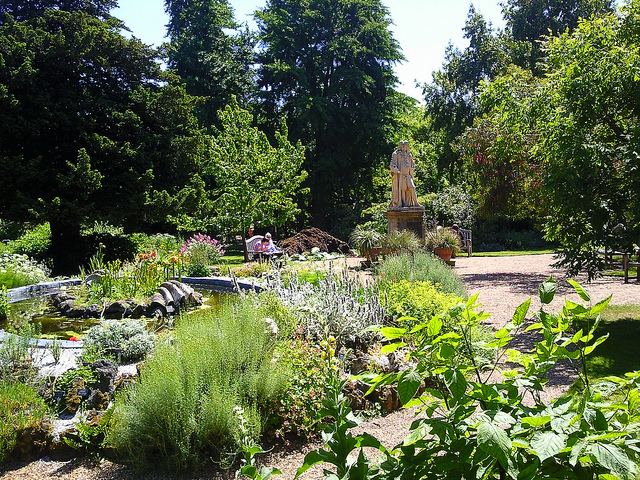
The UK is very lucky to have so many beautiful and unusual gardens, and taking your mum to visit one of these can create treasured memories as well as being an enjoyable day out. Many gardens also put on special child-friendly fun and learning days, which can be a wonderful day out for three generations – perhaps you could surprise your mum afterwards with a framed photo showing her introducing her grandchildren to her favourite hobby.
In London, the Chelsea Physic Garden in home to over 5,000 plants, many of which have a medicinal purpose, that flourish in the Garden’s mild microclimate. It’s a refreshing retreat from the capital’s hustle and bustle, and hosts regular family days throughout the year.
The Trebah Garden in Cornwall is rated in the top eighty garden globally, and is somewhere that no keen horticulturalist should miss out on visiting. Some highlights include the water garden, which in late spring is carpeted with Arum lilies; the hydrangea valley, which covers two acres of riverside garden with unusually vivid flowers; and its own secluded private beach, complete with complimentary buckets and spades.
For the gardener who likes bees
 Photo credit: Andreas.

The worldwide decline in bee numbers is cause for concern as they pollinate about a third of all food crops, while 90% of all wild plants need insect pollination to survive. As a result, many gardeners are trying to make their gardens havens for bees in order to reduce this trend.
If your mum is one of these gardeners, a bee box would be an appreciated and thoughtful gift. The boxes, which are often attractive features in their own right, give shelter to solitary bees like the Red Mason and Leaf Cutter.
Bees love traditional British garden plants like roses, lavender, hollyhocks and edible herbs. So if your mum has space in her garden, one of these plants is a good gift. Pots of edible herbs are a particularly good choice if your mum also enjoys cooking, or is gardening is a small space.
For the gardener who likes to entertain

Photo credit: Kew on Flickr
There’s little more enjoyable than inviting friends over to take afternoon tea outdoors or spending a warm night relaxing in your garden with wine, food and good company. If your mum loves to host garden get-togethers there are plenty of entertaining accessories that make lovely gifts. Prices on these start at pocket-money levels, and there’s often a selection of matching goodies, so it’s easy to buy a set of gifts from all the family.
Solar powered garden lights have quickly become a must-have garden accessory, and fairy lights create a particularly special atmosphere when they’re interlaced around a trellis panel. For anyone sitting outside after dark, citronella candles are an essential accessory to repel bugs. Ones that come in brightly coloured buckets make a feature out of a necessity.
If you really want to splash out on a mother’s day gift, a garden swing seat adds a touch of luxury and style to any garden and is always popular with guests. Wooden swing seats are suitable to be outside in all weathers, so your mum can turn the seat into a permanent focal point, or even hang the seat from a plant-covered pergola.
Thanks to Elizabeth for some great ideas – you can follow Elizabeth on Twitter https://twitter.com/ej_grey
Old School Gardener

Pub in london via Love Britain
Old School Gardener
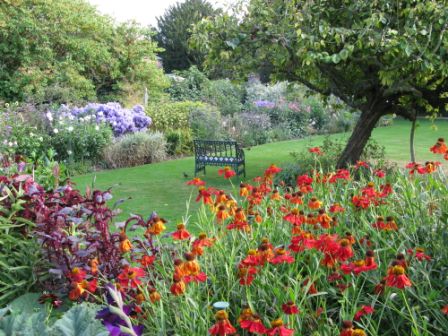
- Herbaceous borders at Peckover House, Wisbech

Now’s the time to set about creating new borders in your garden and I’m grateful to Hyde N. Seik from Plymouth who asks:
‘I’ve seen some wonderful borders at a National Trust property near me. I enquired about these and was told that they are ‘herbaceous borders’. Can you tell me what this means and how to go about creating one, please?’
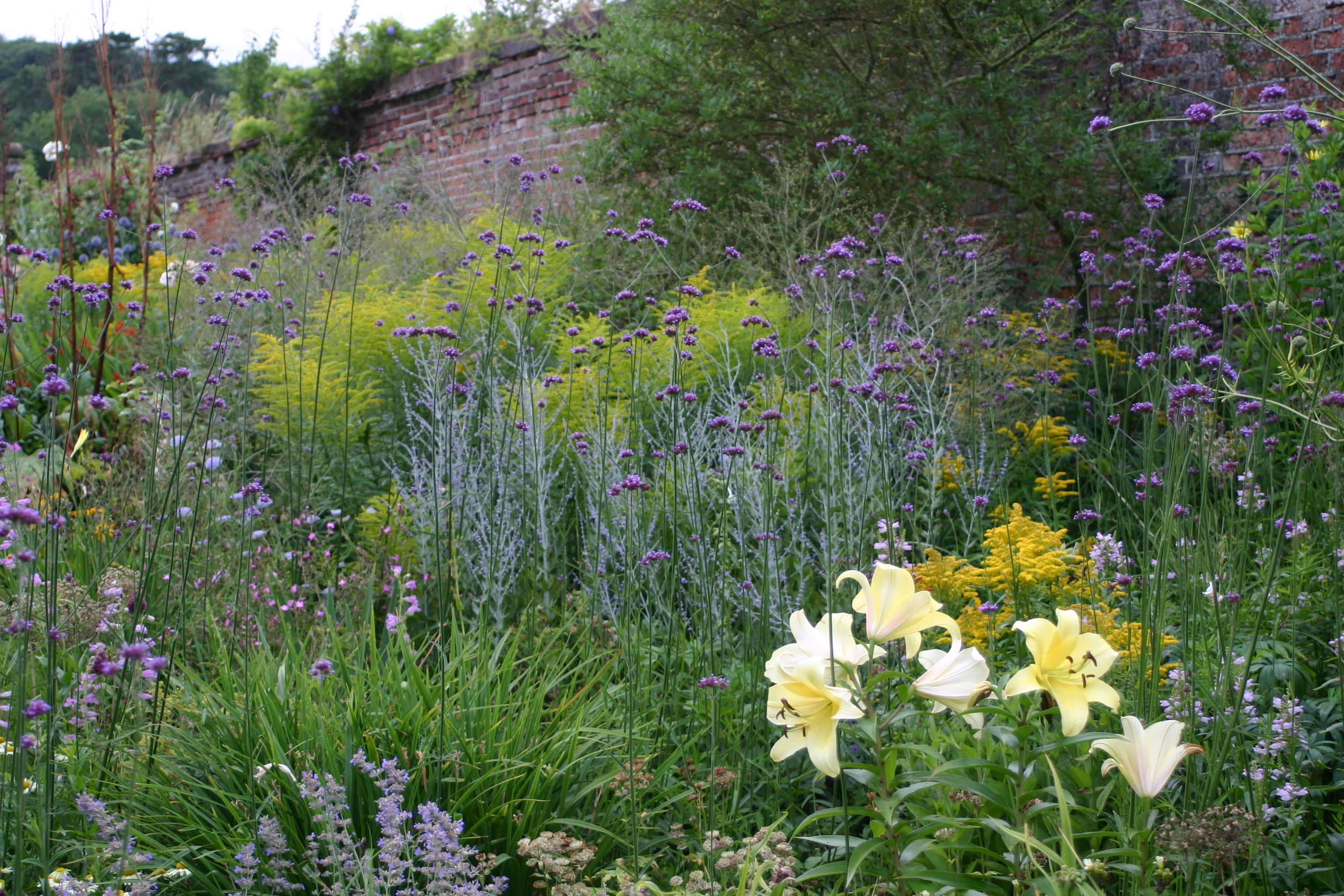
Hyde, there’s perhaps nothing as quintessentially English as an Herbaceous border (it became especially popular in the late 19th and early 20th century garden), and many of those associated with our great historic houses are some of the best examples around. This is usually a rectangular border (or twin borders with a lawn or other path running between them), traditionally at least 3 metres wide and about 12 metres long, usually backed by an evergreen hedge. The lengths and widths do vary, but the usual dimensions maintain a ratio of 4:1 (length to depth). The border is planted entirely with herbaceous perennials (plants that grow for more than one year and die back above ground after flowering). The border is designed to be of interest when viewed from the front or along its length and looks its best from late spring to late summer.
These days the amount of work needed to maintain such borders – staking of taller plants to provide support, pruning back dead stems and foliage, feeding and dividing the plants every few years- might be too much for many gardeners and so herbaceous borders can be rather smaller and more irregular in shape, or alternatively have a mixture of planting (including evergreen shrubs, grasses, and annuals) to reduce the workload and provide more structural interest during the winter.
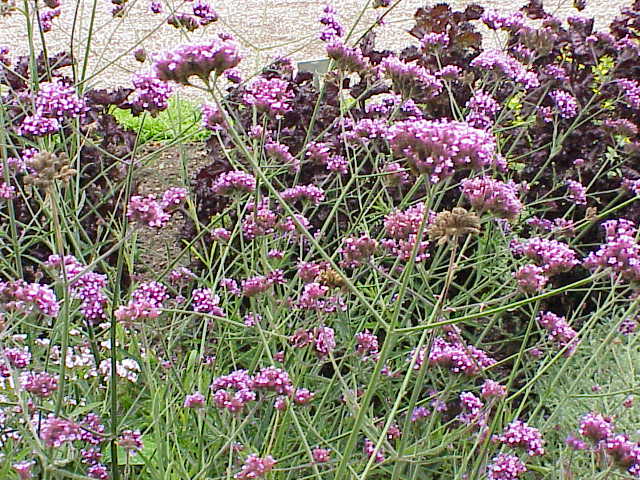
Herbaceous borders are usually planted with clusters of each type of plant, in odd numbered groups of 3, 5 or 7 plants- the tallest are usually at the back of the border and the shortest at the front. However, in recent times this approach has been challenged as borders can look more interesting if some taller plants are placed nearer the front of the border; especially if they add height but are not too dominant, such as Verbena bonariensis and many grasses.

- The airy stems of Verbena bonariensis
As your plants are likely to be in the same place for some time, it pays to prepare the soil thoroughly. Remove all weeds, especially the perennial types with deep roots, by digging, hoeing (or you could use a suitable weedkiller such as Glyphosate in the growing season). Then fork the soil to a depth of at least 150mm adding organic matter such as compost or manure, rotted bark, or other manures such as those from hops or mushroom growing. Lime might also be needed if the soil is very acid (peaty) or in generally very poor condition.
This should be applied in autumn or spring, one month before planting or adding organic material, and at least 2-3 months before adding manure (lime and manure should never be applied at the same time). Incidentally, nearly all herbaceous perennials grow well in most soil types, provided they are neither very acidic or alkaline- by manuring and liming regularly, the soil can be kept at a fairly neutral pH, and regular mulching with organic matter will keep the soil nutrient levels up, avoiding the need for artificial fertilisers or feeds.
If possible, leave the freshly dug soil for a couple of months to allow it to settle, then rake over the surface to produce a reasonably fine, crumbly surface.
Whilst you’re waiting for the soil to be readied it’s worth planning the border planting in some detail. Using a sheet of graph paper, draw on it (to scale) the shape of the border (you could of course have begun with an outline plan on paper for this and then scaled this up to create the new border). Then select your plants from a catalogue, book or online information resource which not only describes the plants but gives their height and ultimate spread/width. Think about the different flower shapes, leaf textures as well as colours in composing your border planting plan and also when the plants flower or have other interest (e.g. leaf colour, berries or other fruit) – to ensure a balanced spread of flowering or other interest throughout the seasons.
 Mixed borders at Old School Garden- looser feel with evergreen shrubs, grasses and mixed hedges as a backdrop

Mixed borders at Old School Garden- looser feel with evergreen shrubs, grasses and mixed hedges as a backdrop
Allow for the plants to be grouped in clumps of 3’s or 5’s (odd numbers tend to create informal looking groups whereas even numbers tend to lead to a more formal, regimented layout). These groups can be drawn on your plan with a circle guide or compasses and then a line enclosing the group drawn around them. If you use a set of colour pencils or crayons to draw these groups according to their flower/leaf colour it will help give you an idea of the colour scheme you are creating. Other information – height, flowering time etc.- can be written on your plan and help to check the overall design and ensure that there is no period in the year without interest of some sort (this can extend to winter interest created from strong shapes such as evergreens and grasses as well as some herbaceous plants that hold on to their dead flower heads or foliage).
The best time to plant your herbaceous border is in the autumn or spring, although plants grown in containers can be planted at any time, provided they are kept well watered and the ground is not frozen or flooded. If you buy by mail order, the nursery will send you plants at the right time for planting, although the roots will probably have little or no soil on them (‘bare rooted’). If you can’t get them planted on arrival, store them in a cool place in damp, sandy soil or put them in a trench in the garden (so called ‘heeling in’). However, do try to plant them out as quickly as possible provided the ground is workable.
If the plants seem dry on arrival, soak the roots in water for 24 hours; if any are damaged in transit, let the nursery know as soon as possible, so that they can be replaced.
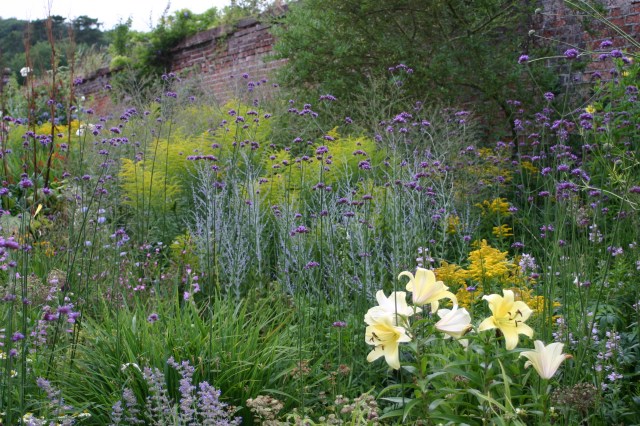
- Herbaceous border at Copped Hall, Essex
Planting is best done with a trowel. Set the plants out in the planting positions on the soil surface and then move them around to make sure they are in line with your plan which should suit their final growing widths. Dig holes under each plants big enough to accommodate the roots of the plant without cramping them. Work from the back of the border (or centre if it is an island bed). Always plant to the same depth as the soil mark on the stems of the plants.
Hoe carefully to remove footmarks, and water in the plants with a thorough but gentle sprinkling. Don’t forget to label each group of plants, as once they die down you may forget where they were – though your reference plan should help with this. Most herbaceous perennials will spread outwards, gradually dying off from the original centre, so every few years these plants will need dividing, repositioning and mulching. And some of the taller ones will need staking to support them, at least in the early years before those around them provide some mutual support.
Old School Gardener

Disguise your ugly garden structures with vertical planting!





 Old School Garden
