
‘…the snail, whose tender horns beign hit,
Shrinks backward in his shelly cave with pain,
And there, all smother’d up, in shade doth sit,
Long after fearing to creep forth again:’William Shakespeare
Tag Archive: garden
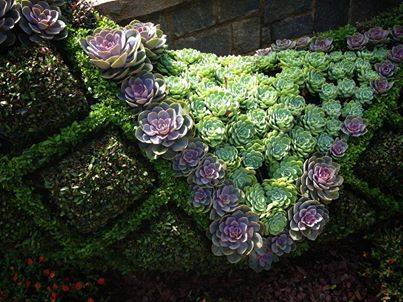
Patterned succulents from Argentina
Old School Gardener
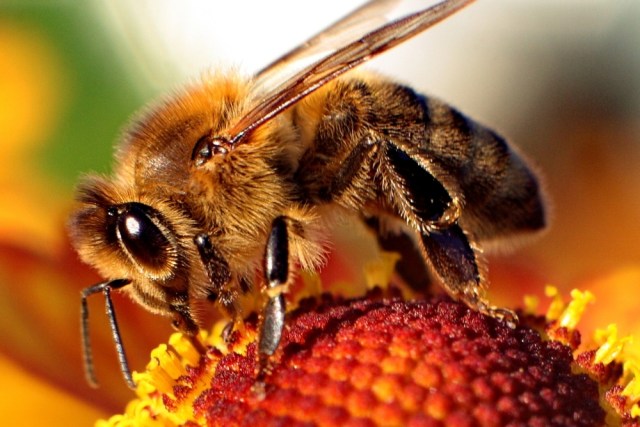
Keeping the bees happy is one aspect of planting a wildlife garden
The latest round of RHS Garden Shows winds it’s way around the country – Hampton Court is next up and opens 0n 8th July. I’ve been to this show twice before and I reckon that most if not all of the show gardens (and this is probably true of the other shows too), tend towards what you might call the ‘middle ground’ of design (perhaps considered a ‘safe bet’?) What I mean is that they usually combine that tried and tested formula of ‘formal structure, informal planting’ – what you might call the classic Arts and Crafts/ English Country House style.
Don’t get me wrong, this is a style I love myself and is what I’m trying to create here at the Old School Garden. But every now and then its refreshing to see something at one of the ‘design extremes’- the sort of creation that pushes you into thinking again about structural features or particular planting choices and combinations in your own garden, or even more fundamentally, what you expect your garden to do.
At this year’s Hampton Court Show one garden looks set to do this and at the same time get across some important messages about the potential food value of gardens- and in particular the wide range of good quality food that nature puts on the menu. ‘The Jordans Wildlife Garden’ has been created to reflect a long-term commitment from Jordans to the British countryside. With a colourful variety of features from edible wild flowers, trees and hedges to oats, fruit and nuts – all of which can be foraged from the countryside – the garden provides a natural ‘larder’ to share as a shelter for birds, bees and butterflies. Its unveiling celebrates the belief that great tasting food comes from working closely with nature, as well as aiming to inspire gardeners everywhere to support British wildlife.
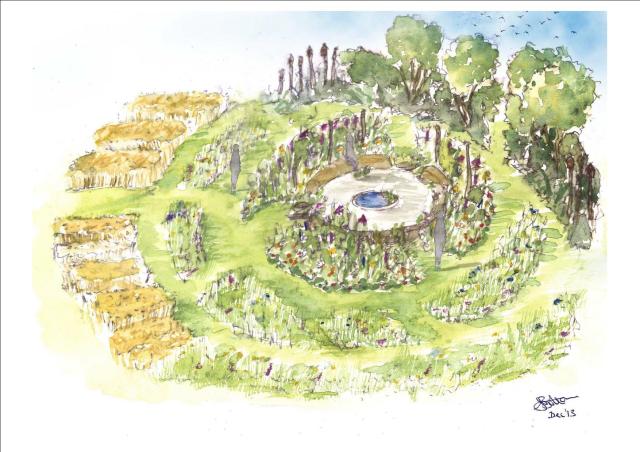
The Jordans Wildlife Garden Design
This Garden is set to showcase the importance of sustainability and protecting the British countryside to RHS visitors from across the country. Oat fields, inspired by Jordans’ farms, outline the sides of the garden, moving through to mown paths of species rich meadow, which curve through the space. Swathes of meadow alongside the paths give a close connection to nature. The garden is surrounded by a cut log wall and grassy banks, which form a wildlife friendly edge to the garden and a habitat for wildlife. A nut terrace that provides an edible treat for both people and wildlife surrounds the elegant, reflective pool in the centre of the garden. There are also sculpted straw benches, created by willow sculptor Spencer Jenkins, that provide a place to rest and enjoy the relaxing atmosphere. Mixed native hedgerow and fruit and nut trees will surround one side of the garden, providing more edible treats for people and animals.
The Garden features have been designed to support local wildlife, including thatched insect hotels, birdhouses and feeding stations. These were all custom crafted for the Garden and add a unique beauty to the space. Design elements such as cut wood stepping-stones, created by chainsaw artist Ella Fielding, will provide further material for animals to make their homes in, whilst the meadow flowers themselves house a beehive – a core feature of any wildlife garden.
All the sustainable elements of the Garden also represent a commitment by Jordans to The Prince’s Countryside Fund, which works to support the people that take care of our countryside and ensures a sustainable future for British farmers and rural communities. And it just shows the ease with which these elements can be brought into compact garden spaces, whilst still supporting local wildlife.
Selina Botham, a passionate wildlife and garden enthusiast, designed the Garden. She has won numerous awards for her beautiful and considered approach to gardening, from Gold Medal to Best In Show for her first ever garden at the RHS Hampton Court Palace Flower Show. And as part of its British countryside celebrations this July, Jordans has enlisted the taste expertise of Great British Bake Off winner, Edd Kimber, to create a series of foraged food recipes inspired by The Jordans Wildlife Garden.

- Selina Botham
Long-term supporters of wildlife habitats and increased biodiversity, Jordans’ cereal farmers devote at least 10% of their farmed areas to supporting wildlife. These sustainable practices are at the centre of the company’s ethos and their pioneering work in this area helps to create a more diverse countryside by encouraging up to five times more wildlife in agricultural spaces.
As a daily consumer of their fruity Muesli, it’s nice to know that they promote sustainable farming practices!
Links for further information:
Jordans Cereals and the Wildlife Garden
Up to date coverage of the Jordan’s Wildlife Garden at the RHS Hampton Court Flower Show – on Facebook and Twitter
Old School Gardener

‘Lavender Labyrinth’ at Kastellaun, Germany. Imagine the ‘scentsation’ of walking this route!
Old School Gardener

Old School Garden
30th June 2014
To Walter Degrasse
Dear Walter,
As I sit looking out at the courtyard here at Old School Garden, the sun has returned after a series of heavy showers that have dominated the weather here over the last few days (some have been thundery). The last month has been a mix of sunshine and rain, the heat building, but not yet above the low 20’s Celsius- quite pleasant, though.
The month in the garden has been typical – the bulk of the ‘heavy’ work was completed in May and this month I’ve been rather focused on ‘preening and planting’ (when the weather permits). Having said that I did undertake a project to reinforce the ‘Fruit Fence’ I erected a few years ago. You might remember seeing this in the kitchen garden. It sits on the northern boundary of the garden next to a wood and effectively forms the edge of a raised bed I created to make use of some surplus soil and create an elevated space for food growing.
I have a Cherry and Plum I’m training into fans against this fence, but over time the posts have leaned over and some work was needed to strengthen this and put in a proper edge to the raised bed (I used sleepers on the other edges). Having got hold of some pallets I decided to try to use these, along with landscape fabric, to create the edge and add in some further posts to buttress the existing ones. I’m pretty pleased with the outcome (see pictures below). As you know, old friend, I’m a fan of recycling in the garden, and especially if it involves those modular wooden wonders, pallets.

The new storage area behind a pallet wall

Detail of the retaining wall made of pallets cut in half and ‘wrapped’ in landscaping fabric
The project involved digging out holes next to the four uprights and screwing these to the existing posts. I then cleared an area of nettles and dug out a trench on the woodland side to receive the pallets, which I’d earlier cut into halves. I fixed a length of batten to the frame to which I could then fix the pallets, I used landscaping fabric to ‘wrap’ the pallet sections along the length of the frame, and then extended this for a couple of metres over the adjacent woodland floor, to provide a new storage area for things like plastic plant trays, baskets and chicken wire.
Finally, I used plastic green shading fabric to provide a full backdrop to the frame. I reckon this should help both to shelter the plants a little, as well as providing a dark surface to absorb the sun and so warm the area for the fruit. The additional storage area, which is screened from the main garden, is a real boon and I plan to clear a further area of nettles to keep the woodland edge at bay. And talking of ‘recycling’, you may have also seen my recent post on the old bike rack I converted to a plant stand or ‘theatre’, on which now sit six rows of pelargoniums, nicely lined up in small terracotta pots.

The finished ‘Plant Theatre’
The last couple of weeks has seen the first crops of fruit and veg from the garden; we’ve had Raspberries, Strawberries, Calabrese, Broad beans, Chard, Mangetout and early Potatoes in good quantities, testimony to the mild and wet winter and spring we’ve had. Here are some pictures from the Kitchen Garden…
The potatoes were a real surprise. I left the first earlies in the ground and waited for the flowers to die down before investigating – a bit too late as it turns out as when I dug up the first row I was amazed at the size of some of them – as the pictures below show, we had some real whoppers! However the first row (which was the one receiving the most sun) was as productive as the other three rows put together! Two rows of second earlies, harvested at the same time, have produced an equivalent amount of better- sized potatoes. The first of these (‘Charlotte’) were delicious the other day.
However, I’m disappointed with the apples this year- I think the mild and wet weather brought a dose of ‘blossom wilt’ (as well as some insect damage), so there are relatively few fruits developing on the trees. In contrast the pears and plums are looking good, and we’ve had the first crop of (large) Gooseberries. The blackcurrants are already dripping from the bushes, so that’ll be a another harvesting job for the coming week (we’re still eating last year’s harvest from the freezer!). We’ve also had a couple of ‘ridge’ cucumbers grown outside in a pot and more are on the way, as are the tomatoes, mainly growing in the greenhouse. Here are some pictures of the produce and the kitchen garden.
Pest control has never been far from my mind, recently. The new ‘plastic owl’ bird scarer I bought seems to have had little effect, I’m sorry to say, so the only sure-fire method of keeping the birds (mainly wood pigeons but also blackbirds and smaller birds) at bay is netting. I’ve adopted and adapted an old-fashioned method of protecting bush fruit by using some lengths of ‘Enviromesh’ draped over the Raspberries and this seems to have been pretty effective. I believe that in days gone by old net curtains were used to achieve the same result! I’ve also netted the Strawberry patch over some more plastic hoops and this is working well.
Apart from birds, slugs and snails seem to have been effectively reduced (I must admit to using an emergency dose of pellets to cure this particular problem a few weeks ago), although the Hostas in the courtyard seem to have suffered a little. The other main problem is moles – they seem intent on re-creating a scene from World War 1 on the edges of the lawn and in the borders too, undermining newly planted flowers and creating, ridges, trenches and mole hills in all sorts of places! I think it may be time to recruit a mole catcher to deal with this particular issue which is getting out of hand!

Moles are creating havoc across the lawn and into borders

‘Enviromesh’ covering the raspberries from the birds- quite a succesful and easy way of reducing pest damage/theft!
But I mustn’t really complain, as the ornamental aspects of the garden are looking good, if not quite at their peak as I write. We bought three large terracotta pots yesterday and these now provide homes for three tender, exotic looking specimens and together add a nice feature at one end of the Terrace Lawn. You recall that I mentioned the amount of flower buds on the Philadelphus which I moved around 10 years ago and which hadn’t flowered since? Well, it’s now beautifully covered in the small white flowers of this super shrub and of course the citrus fragrance of ‘mock orange’ is a delight. Here’s a gallery of the latest images from the ornamental gardens.
On a broader front I’ve continued with my support of gardening at two schools. As I write it looks uncertain if the project at Fakenham Academy will continue however, due to budget cuts- a shame as I was starting to think the at least some of the youngsters were ‘getting into gardening’ and actually looking forward to their sessions outside. You may recall that I’ve been working with three groups of ‘foundation skills’ students from years 7, 8 and 9? Next week sees what will effectively be the last sessions this term, so we’ll focus on harvesting the potatoes and doing some general tidying up, I think.
Here are pictures of the Fakenham set up ‘before’ and ‘after’ to give you some idea of the amount of work involved in getting these plots back into production. First, how things looked back in January…
And now the scene in June. six months later….
At the other School where I help, Cawston, we had an interesting twilight training session run by the RHS Regional coordinator for their Campaign for School Gardening. This saw just under 20 teachers and volunteers from local schools hearing tips about school gardening and outdoor learning and I was able to contribute a little about how the school gardens and grounds have been developed. Here, too, attention is now turning to harvesting; potatoes as well as autumn – sown broad beans, onions and garlic.
On Saturday I did a stint on manning the Norfolk ‘Master Composter’ stand at an event at Sheringham Park, run by Victory Housing Trust- effectively a ‘garden party’ for its tenants from across north Norfolk. This was a lively and well- attended event (and included free ice cream!). I talked to several people who are interested in starting composting at home and it’s always fun showing the children the Wormery and the ‘products’ from this, including a bottle of ‘worm wee’ as well as the beautiful, fine compost they leave behind.
Well, the sun beckons Walter, so I must get outside and shear back a few early flowering perennials and do a number of other ‘odd jobs’ before the rian returns this afternoon. I hope you and Ferdy are faring well, and looking forward to some sun too- especially as I believe you’ve had rather more rain than us – as usual!
Al the best for now,
Old School Gardener

Do you have any amusing tomatoes?
Old School Gardener
A few weeks ago I posted a brief article about how I’d converted an old wooden bicycle rack (saved from the bonfire, as it was being disposed of by the local Primary School) into a sort of vertical plant stand cum ‘Plant Theatre’.
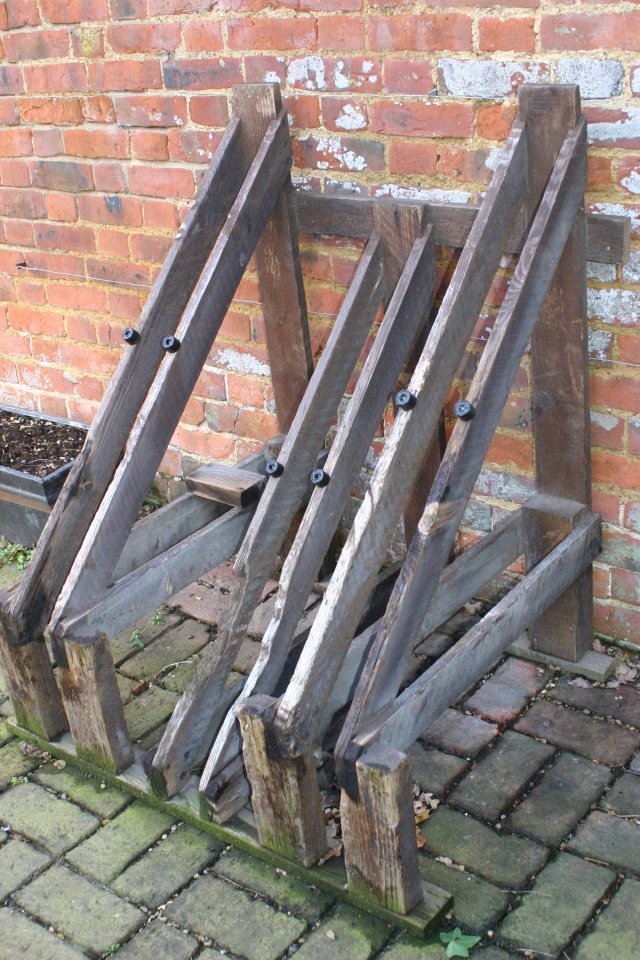
- The old Bike Rack before it’s makeover
I decided that the first display would be of a range of Pelargoniums. Having bought a number of small terracotta pots, and used a mix of old and new plants, I set it up and nurtured my new ‘creation’. Well here’s how it’s looking at the end of June – most plants are now in flower and providing an eyecatching, vertical splash of colour in the courtyard here at Old School Garden. What do you think?
- The finished ‘Theatre’
I must now start thinking about what to do for a spring display, next year. I’ll try to over winter the pelargoniums and use them again in the summer. For spring, perhaps I’ll tryt o get hold of a range of that plant that typifies ‘Plant Theatres’, the Primula auricula.
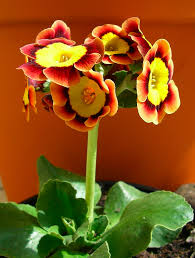
- A Primula auricula- something for the ‘Theatre’ in Spring 2015?
Old School Gardener

Old School Gardener
‘Sometimes we try to be a bit too clever in this world. Take the poor old gardener who’s plagued by blackfly. He’ll spend a small fortune on sprays and things when all he need do is take a little soil from the bottom of the plant and sprinkle it like powder all over those blessed blackfly. That’ll finish them off…it gets in their teeth you know!’




 Old School Garden