
Tag Archive: garden
![WP_20140622_001[1]](https://audaxdesign.org/wp-content/uploads/2014/06/wp_20140622_0011.jpg?w=677&h=1205) Stepped planters seen outside a hotel in Maida Vale, London, last week.
Stepped planters seen outside a hotel in Maida Vale, London, last week.
Beautiful window box planting pattern by Deborah Silver and Co.
Old School Gardener
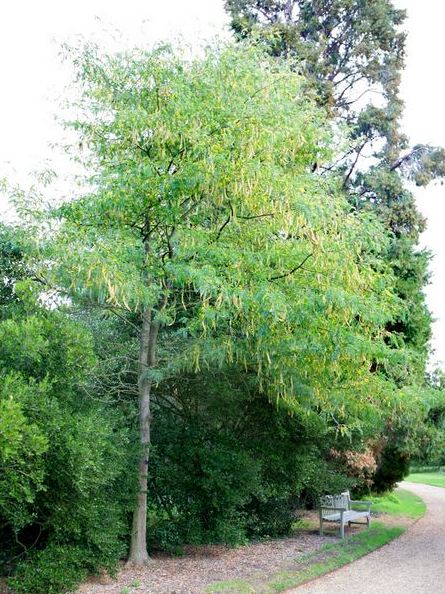 I bought a Gleditsia triacanthos ‘Sunburst’ some years ago as a young plant through the post. It’s now about 2 metres tall and beginning to find its feet in Old School Garden. I love its bright yellow foliage which is a great contrast to the maroon foliage of plants like Lysimachia ciliata ‘Firecracker’.
Common name: ‘Honey Locust’ or ‘Thorny Locust’
Native areas: A deciduous tree native to central North America, it is mostly found in the moist soil of river valleys ranging from southeastern South Dakota to New Orleans and central Texas, and as far east as eastern Massachusetts. It was introduced into Britain in 1700, with the cultivar ‘Sunburst’ introduced in the 1950’s.
Historical notes: The Honey Locust, despite its name, is not a significant honey plant. The name derives from the sweet taste of the legume pulp, which was used for food by Native American people, and can also be fermented to make beer. The long pods, which eventually dry and ripen to brown or maroon, are surrounded in a tough, leathery skin that adheres very strongly to the pulp within. The pulp—bright green in unripe pods—is strongly sweet, crisp and succulent in unripe pods. Dark brown tannin-rich beans are found in slots within the pulp. Honey locusts produce a high quality, durable wood that polishes well, but the tree does not grow in sufficient numbers to support a bulk industry; however, a niche market exists for honey locust furniture. It is also used for posts and rails since it takes a long time to rot. In the past, the hard thorns of the younger trees have been used as nails! The tree has been used in traditional Native American medicine.

- Gleditsia triacanthos ‘Sunburst’ in Old School Garden– with Lysimachia ciliata ‘Firecracker’ in front and Monarda ‘Cambridge Scarlet’ and Crocosmia ‘Lucifer’
Features: A large, oval and elegant tree growing to 20 metres plus and quick growing. It’s leaves resemble fronds and when mature, it looks most striking with its shiny, long seed pods. Leaves are bright green turning to golden yellow in autumn. The variety ‘Sunburst’ has bright yellow foliage in early summer and this turns greener as the season progresses.

Gleditsia triacanthos new foliage

Gleditsia triacanthos- mature thorns

Gleditisia triacanthos- thorns on branches

Gleditsia triacanthos ‘Sunburst’ foliage

Gleditsia triacanthos- unripe seed pod
Uses: A wonderful choice for heavily polluted environments prone to vandalism and a good choice for parks and industrial areas, it is also a great garden tree, doing well on most types of soil. It’s fast growth rate and ease of transplanting make it a good choice for new gardens where shade or a feature is wanted relatively quickly. The tree needs careful handling though, because of its thorns (however, most cultivars are thornless). The cultivar ‘Sunburst” has gained the RHS Award of Garden Merit (AGM). This cultivar grows to 15-20 metres and has a rounded, rather spreading form, a good substitute for the rather more damage-prone Robinia pseudoacacia ‘Frisia’.

- Gleditsia triacanthos – autumn colour
Growing conditions: The cultivars (e.g. ‘Sunburst’, ‘Skyline’, ‘Inermis’) are popular ornamental plants. It tolerates urban conditions, compacted soil, road salt, alkaline soil, heat and drought. The popularity is in part due to the fact that it transplants so easily, its fast growth rate and tolerance of poor site conditions. It is also great where shade is wanted quickly, such as new parks or housing developments, and in disturbed and reclaimed environments, such as mine tailings. It is resistant to gypsy moths but is defoliated by another pest, the Mimosa Webworm. Spider mites, cankers and galls are also a problem with some trees.

- Gleditsia triacanthos ‘Sunburst’
Further information:
Wikipedia- Gleditsia triacanthos
RHS- Gleditsia triacanthos ‘Sunburst’
Barcham trees directory
Old School Gardener

Planting in cylinders. Perhaps using lengths of painted, plastic drain pipes (with cut outs), wire and clips? Via the Gardening Club
Old School Gardener
 Summer fruiting raspberries are just about coming to the end here at Old School Garden, but Lee Mason of Whetstone has had a disappointing harvest:
‘I planted some ‘Malling Promise’ raspberry canes back in February. They’ve grown pretty well, but the harvest has been disappointing and the new growth looks to be weak. Would a fertiliser feed help?’
Malling Promise canes (and any other summer fruiting raspberries for that matter), planted in February would have benefitted from cutting down in their first season to 100 mm (4 inches) high canes back in March to encourage strong new root development, as well as new canes for fruiting in the following season. In short, Lee, you’ve ‘got a bit ahead of yourself’! I suggest that you cut down all growth next March. You will lose a season’s cropping, but the sacrifice will be worth it in the long run. Giving the canes a good mulch of organic matter or a general fertiliser like fish, blood and bone should also help, if applied next spring.
Raspberry flavour
Have you been disappointed with the flavour of your raspberries? Sulphate of potash is a good fertiliser to use to enhance raspberry flavour, but only if the raspberry variety you grow has some natural flavour of it’s own. Varieties like Malling Admiral have little natural flavour, whereas Malling Jewel or Malling Promise are better.
Shrivelled fruit
Are your raspberries shrivelled up? This might be because you’ve been a little too enthusiastic in digging around the canes! Avoid digging over the ground near the roots, as raspberries are surface rooters and don’t like any cultivation anywhere near the canes. This breaks the roots- which can spread out quite a way- and as a result the plants will be unable to cope with the extra stress at fruiting time. If you restrict your cultivation to the use of a Dutch hoe and follow this up with a good deep mulch of organic matter in the spring this will do wonders for the quality of your fruit.

- Cut down the canes of autumn fruiting raspberries in early March
Pruning Autumn (and Summer) raspberries
The first autumn raspberries are starting to appear here at Old School Garden (earlier than normal probably due to the mild winter and spring). It looks like we’ll have a good harvest. With these, the fruit comes on canes produced in the current season, so after fruiting (which can last into October) the old canes need to be cut back, but when is the best time to do this? Well not immediately after harvesting, apart from damaged or broken canes. It’s best to leave the rest until the following spring (early March), when all the remaining canes can be cut down almost to ground level. This ensures that some protection for the newly emerging canes is provided over winter. In July weak growth can be removed so that only the strongest canes are left for fruiting.
With summer fruiting varieties it’s best to cut down the canes that have fruited immediately after harvesting has finished and to select the strongest new canes and tie these into wire supports to protect them over winter. In spring the tops can be cut back by about 6 inches or alternatively these can be looped over and tied into the top wires.
Old School Gardener
If you’ve enjoyed reading this post and others on this blog, why not comment and join others by signing up for automatic updates via email (see side bar, above right ) or through an RSS feed (see top of page)?

Food crop circles- looks lovely, but is it as easy to maintain as straight lines?
Old School Gardener
 A Norfolk community designs a show garden for the Hampton Court Flower Show. Click here to get the video.
Old School Gardener
‘The towering clouds recede; the storm has fled;
The dark and angry sky grows clear again.
The thunder faintly rolls, and slowly dies,
And skylarks twitter gladly as they rise.
Now many a flower hangs low a dripping head,
And here and there a patch of levelled grain
Recalls the violence of the summer storm.
The sun returns, the rain-soaked earth grows warm.
Slow and ungainly by the waterside
A solemn toad plods forth, and small snails glide,
Their shining shells enriched by golden rings.
A dragon-fly with wide and wondrous wings
glows like a jewel there among the reeds,
Above the tangle of the water-weeds.’
John (Jack) Kett
from ‘A Late Lark Singing’ (Minerva press 1997)


 Old School Garden