Tag Archive: garden


FB_20160213_17_31_39_Saved_Picture

brick pedestalThe simplest ornament has more impact if it is raised. Keep your costs down by making your own pedestal; use a length of clay drainpipe, about a third taller than it is wide. Alternatively use some old bricks to make a pedestal. Place a paving slab on a level bed of sand; cement the pipe or place the bricks on top of it. Fix a slightly smaller slab on top with cement and finish off with your ornament; this could be a large sea shell, bird bath or whatever….

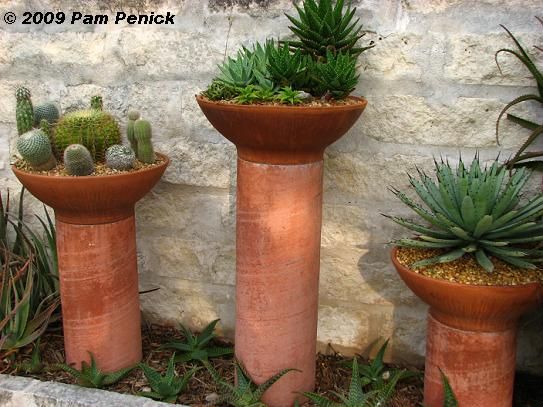
You can also use 10- and 18-inch-diameter PVC pipes cut to varying heights to serve as bases for applying a mosaic surface. Overturned terra-cotta saucers turn two of the pipes into pedestals; the third cradles a flowerpot….

mosaic pillarsAnother idea is to make your own concrete pillars, stain them terracotta and put terracotta planters atop them….

stained concrete pillarsChimney pots can also make great planters or pedestals….

chimney pot planterAnd why not some sawn off tree trunks or chicken wire gabions filled with stones…

Or some simple sticks stuck around a piece of wood…

bundle sticks pedestalSources:

‘Good Ideas for your Garden’- Reader’s Digest, 1995

Pinterest

Old School Gardener

The newly refurbished Bothy is nearing completion; a home for gardening volunteers, office and shop for the produce to come

The newly refurbished Bothy is nearing completion; a home for gardening volunteers, office and shop for the produce to come

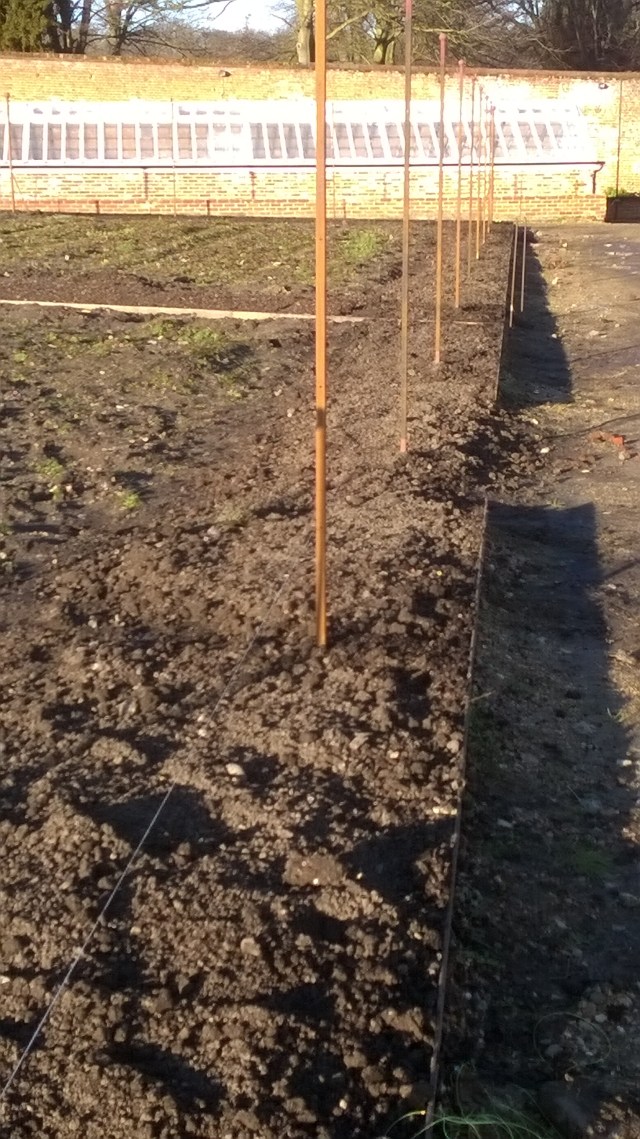
I worked with recent volunteer recruit, Peter (another Peter, this one with an Australian accent), in this week’s voluntary gardening at Blickling. Whilst the other Peter got on with some welding of the metal edging in the walled garden, ‘Aussie’ Peter and I double dug some stretches of soil where new fruit bushes will be planted and trained into espaliers along wires.

Not much evidence of our hard wrok, but these stretches of soil are now ready to be planted up with fruit trees

Not much evidence of our hard work, but these stretches of soil are now ready to be planted up with fruit trees

The rest of the volunteers did some more tidying of the borders in the Orangery Garden. To the crackle of welding torch and a digger (driven by ‘Dud’), which Mike had got in to dig over the surface of the top beds, Peter and I got into some serious ‘Yakka’, as Peter called it.

I gather this is an aboriginal term for ‘hard work’. Well it was. Not helped by a slight back ache I’d had for a few days (after overloading the firewood basket at home). Still, we soon got into a rhythm and entered ‘into the zone’- that wonderful mental state where the unconscious mind takes over and you do things on ‘autopilot’. But this didn’t stop us having a good natter, exchanging life and family backgrounds, football and so on.

Meanwhile Project Manager, Mike and Gardener Rob were trying to install some of the remaining metal edging alongside the northern border, which the other Peter duly helped cut up into the right lengths.

A couple of days earlier I’d attended the Blickling ‘Mid Winter Meeting’ at the local High School. This is an opportunity for staff and volunteers to hear from Heads of department about plans for the coming season (the House reopens on 5th March). I thoroughly enjoyed this event, which had some fun, unusual and inspiring talks to get us fired up for the year to come.

My wife has been sorting out our family photos and similar stuff, and came across this old postcard of Blickling among several I’d bought many years ago. I think it dates from 1907  – and includes a brief, cryptic message to a ‘Maude Meachen’ together with franked Edward VII stamp. It shows the rather fussy parterre before its major redesign in the 1930’s – see how small the Yew trees are, which today are the huge ‘acorns’ that are the major structural element in todays garden.

Further Information:

Blickling Hall website

Blickling Hall Facebook page

A 360 degree tour of Blickling Hall

Old School Gardener


Twitterb7f290c

PicPost: Turban Unwrapped

Wild Tulip- pic by Stephanie Veronique

Wild Tulip- pic by Stephanie Veronique

Camperdown Elm in Leamington, Ontario, Canada. Picture: jim5870

Camperdown Elm in Leamington, Ontario, Canada. Picture: jim5870

As we come to the end of this A-Z the options open become rather constrained; so today I’ve chosen a neat and compact variety of the Wych Elm, which can also be resistant to Dutch Elm disease.

Common name:  Camperdown Elm

Native areas: Ulmus glabra (Wych elm or Scots elm), the parent of this variety, has the widest range of the European elm species, from Ireland eastwards to the Urals, and from the Arctic Circle south to the mountains of Greece; it is also found in Iran. The tree was by far the most common elm in the north and west of the British Isles and is now acknowledged as the only indisputably British native elm species.
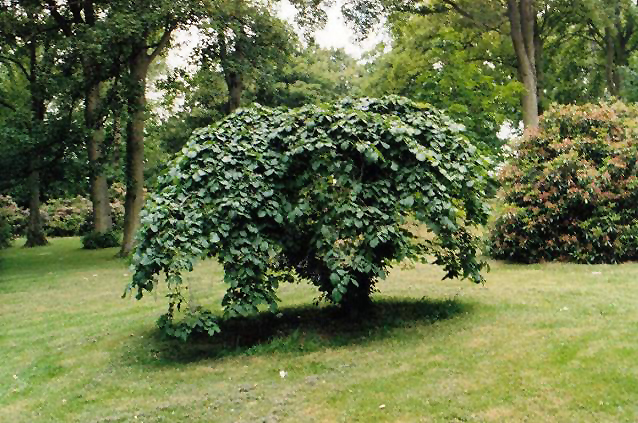
The original sport in Camperdown Park, Dundee. Picture: Peter Bourne

The original sport in Camperdown Park, Dundee. Picture: Peter Bourne

Historical notes: About 1835–1840, the Earl of Camperdown’s head forester, David Taylor, discovered a young contorted elm tree (a sport) growing in the forest at Camperdown House, in Dundee, Scotland. The young tree was lifted and replanted within the gardens Camperdown House where it still remains to this day. The original tree is less than 3 m tall, with a dramatic weeping habit and contorted branch structure and grows on its own roots. The earl’s gardener is said to have produced the first of what are commonly recognised as Camperdown elms by grafting it to the trunk of a Wych Elm (Ulmus glabra). Every ‘Camperdownii’ is descended (as cuttings taken from that original sport) and usually grafted on a Wych elm trunk.  Other grafting stock has been used. In Dundee, Scotland, there are two well established Camperdownii Elms at the gated entrance to a private residence on Constitution Terrace. Both trees have grown so they intertwine with each other and create the illusion of one tree in the summer months. The tree is likely to have been cultivated around 1850, the same age as the Victorian mansion situated in the grounds which was built around 1850. 

Ulmus_glabra_Camperdownii in Québec-Coulonges. Picture: Gilbert Bochenek

Features: The grafted Camperdown Elm slowly develops a broad, flat head that may eventually build as high as 4 m (13 feet) and an incommensurately wide crown with a contorted, weeping habit. The tree is often confused with the much taller ‘Horizontalis’ (Weeping Wych elm) owing to both being given the epithet ‘Pendula’ at some stage. It does not reproduce from seed. Neat and compact, it produces clusters of attractive hop-like flowers in the spring and its lustrous leaves add to its overall effect.

Uses:   Camperdown Elms satisfied a mid-Victorian passion for curiosities in the ‘Gardenesque’ gardens then in vogue. Many examples were planted, as ‘rarities’, in Britain and America, wherever elite gardens were extensive enough for tree collections. There are many on university campuses, often planted as memorials. Camperdown Elms are used in stately landscaping of American university campuses and others feature in townscapes. A small weeping tree with a dome shaped head, it looks good growing  as a specimen in a lawn in parks and gardens.

Growing conditions:  Camperdown Elm is cold hardy, suffering more from summer drought than winter cold. ‘Camperdownii’ can be susceptible to Dutch Elm disease, however there are still many examples to be found in parks and gardens across the British Isles as it often avoids detection by the Scolytae beetle (a major vector of Dutch Elm Disease) because of its diminutive height. Grow in average, medium moisture, well-drained soils in full sun. Tolerant of light shade. Prefers rich, moist loams. Adapts to both wet and dry sites. Generally tolerant of urban conditions. Non-suckering. 

Further information:

Wikipedia

Ulmus glabra ‘Camperdownii’– Missouri Botanical Garden

Old School Gardener

Primula vialli- pic by John Aspley

Primula vialli- pic by John Aspley

Blickling Hall and The Parterre looking splendid in a low winter sun

Blickling Hall and The Parterre looking splendid in a low winter sun

I worked with the ladies away from the Walled Garden in my latest Blickling session. The Dell was our target- a bit of ‘TLC’ with light weeding and clearing dead stems and leaves to reveal the wonderful Snowdrops and Hellebores.

Head Gardener, Paul tells me that the slopes here are not conducive to the Hellebores rooting, so its an annual task to plant up new ones. Paul says some terracing is needed. I think this would need to be done quite subtly, as it could spoil the natural look of the space.

We worked around the sloping sides of the Dell – well I kept to the top path and the slightly less pernickety areas. The lady volunteers seem to have the finger skills and eyesight needed to tease out the weeds from around the plants and at one stage looked like (in the nicest possible way), a herd of mountain goats stretched up the slope. I contented myself with the more straightforward leaf raking, limited weeding and path clearing work above, as well as emptying weed-full trugs into the waiting trailer.

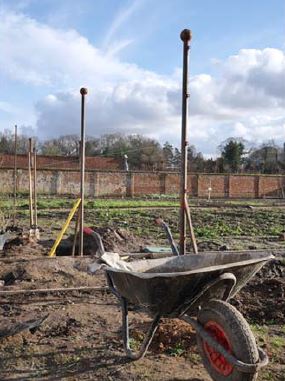
A major milestone has been reached this week in the walled garden. Project Manager Mike reports that all of the metal posts (76 of them in total) have now been installed, so we now wait on wires going in and then fruit tree planting in a few weeks time.

Posts all in- 76 have been set into concrete around the walled garden. Picture Blickling Estate

Posts all in- 76 have been set into concrete around the walled garden. Picture Blickling Estate

Oh, and my wife and I paid a visit to the gardens on Sunday, where we indulged in one of the restaurant’s special Valentine’s Day Cake Platters…

WP_20160214_15_32_46_ProFurther Information:

Blickling Hall website

Blickling Hall Facebook page

A 360 degree tour of Blickling Hall

Old School Gardener


Morning Glory and Black Eyed Susan- pic by Ellen Zillin

Morning Glory and Black Eyed Susan- pic by Ellen Zillin

Hellebore- pic by Ann Stochaj

Hellebore- pic by Ann Stochaj

Finding Nature

Nature Connectedness Research Blog by Prof. Miles Richardson

Norfolk Green Care Network

Connecting People with Nature

Discover WordPress

A daily selection of the best content published on WordPress, collected for you by humans who love to read.

Susan Rushton

Celebrating gardens, photography and a creative life

Unlocking Landscapes

Writing, photography and more by Daniel Greenwood

Alphabet Ravine

Lydia Rae Bush Poetry

TIME GENTS

Australian Pub Project, Established 2013

Vanha Talo Suomi

The Journey from Finnish Rintamamiestalo to Arboretum & Gardens

Marigolds and Gin

Because even in chaos, there’s always gin and a good story …

Bits & Tidbits

RANDOM BITS & MORE TIDBITS

Rambling in the Garden

.....and nurturing my soul

The Interpretation Game

Cultural Heritage and the Digital Economy

pbmGarden

Sense of place, purpose, rejuvenation and joy

SISSINGHURST GARDEN

Notes from the Gardeners...

Deep Green Permaculture

Connecting People to Nature, Empowering People to Live Sustainably

BloominBootiful

A girl and her garden :)