Tag Archive: garden


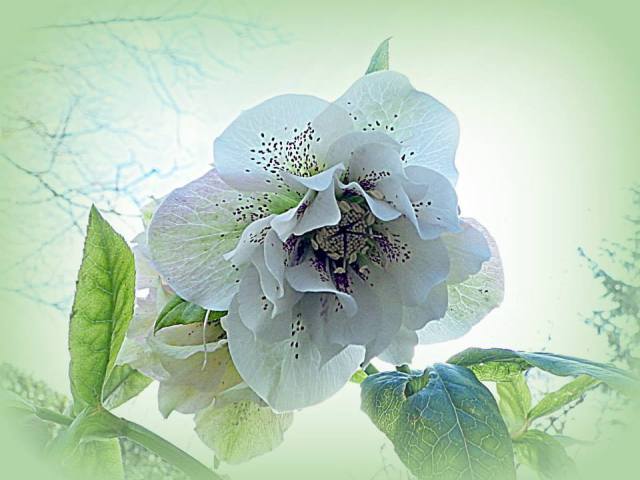
Hellebore: picture by Colin Garratt

Hellebore: picture by Colin Garratt

Oh dear, first mud on a nice new floor...

Oh dear, first mud on a nice new floor…

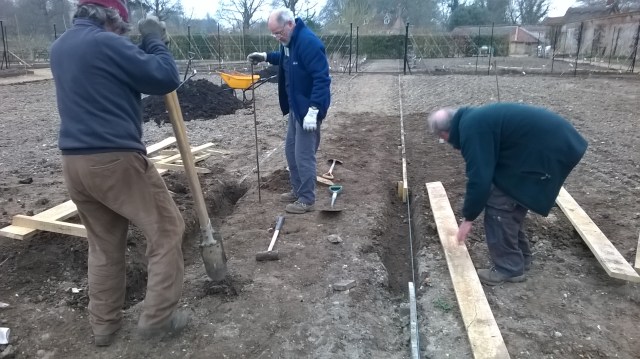
My second Wednesday at Blickling was focused on the Walled Garden. Joined by three other volunteers (one of whom was also a newcomer to Wednesdays), we finished off shifting top soil onto the beds to level them up to the path edges.

So, more barrowing and raking for starters. The available soil had been shifted by the gardeners from the piles in the orchard next door, so we didn’t have far to go. But it was pretty strenuous, nonetheless. The space created will soon be (temporary) home to 100 tonnes of crushed Carr Stone- which will be used to surface the main paths in the Walled Garden.

Since my last session here, the Walled Garden has taken some further big steps forwards; rows of Catmint have been planted along some of the paths which will give a colourful, fragrant and insect-attracting floor to the trained fruit bushes, some of which had also been planted by the canes I had helped set out a few weeks ago.

The other big step is the finishing off of the new Bothy, from where, around mid morning, Project Manager Mike shouted ‘Tea time Team!’- I think this might have been the first time it had been used for refreshments (but probably not the first time Mike had made tea for the volunteers). I duly christened the new room -with it’s shiny spotted grey flooring specially chosen by Mike to hide the dirt!

'Tea time Team!'- Mike in the new Bothy...will it be too comfortable for our own good?!

‘Tea time Team!’- Mike in the new Bothy…will it be too comfortable for our own good?!

After lunch (taken, for now in the old bothy near the double borders), we finished off shifting manure to the beds where the soft fruit (Raspberries, Strawberries and the like) will soon be planted. I may be on trenching in this lovely stuff in my next session (back to Thursday). To finish off the day a couple of us raked over the new soil to avoid the expected rain panning the surface. Another group were finishing off the oak path edging which looks tremendous. Mike tells me he’s decided to turf these grass paths so that they can be used this season.

The final stretch of oak edging to the grass paths in the Walled Garden

The final stretch of oak edging to the grass paths in the Walled Garden

As I left for the day I had a quick word with gardener Rob in the car park, where he was about to deliver half a dozen large oak trunks to a sawmill in nearby Hevingham; these are going to be shaped into the posts for the lines of Raspberries, Blackberries, Tayberries etc.  which will be tied into wires strung between them.

So, some more lovely ‘home grown’ oak will add a touch of class (and longevity) to the Walled Garden. Mike says he’s glad that, at long last, he can soon stop being a builder and start being a gardener once again!

Further Information:

Blickling Hall website

Blickling Hall Facebook page

A 360 degree tour of Blickling Hall

Old School Gardener


10325697_982777501801372_7311470606305894278_n

Washingtonia robusta in the National Garden, Athens, Greece

Washingtonia robusta in the National Garden, Athens, Greece

Whilst there are a few trees with common names beginning with ‘W’ (e.g. Whitebeam, Willow) the choice on botanical names is once more limited. So you could argue that my choice is really a large (very large), grass rather than a tree, and a bit of a rarity in the U.K. But as the Washingtonia palm can be grown as an ornamental garden tree, I think I might just get away with it…

Common name: Named after George Washington, there are two species:

  • Washingtonia filifera, known also as California Washingtonia, Northern Washingtonia, California fan palm, or Desert fan palm.

  • Washingtonia robusta also known as Mexican Washingtonia, Southern Washingtonia or Thread Palm.

Native areas: Washingtonia is a genus of palms, native to the southwestern United States and northwest Mexico Both Washingtonia species are commonly cultivated across the southern USA, Middle East, southern Europe and north Africa, where they have greatly hybridized. The filifera species is also attempted in cooler climates, including the milder parts of the southern British Isles.
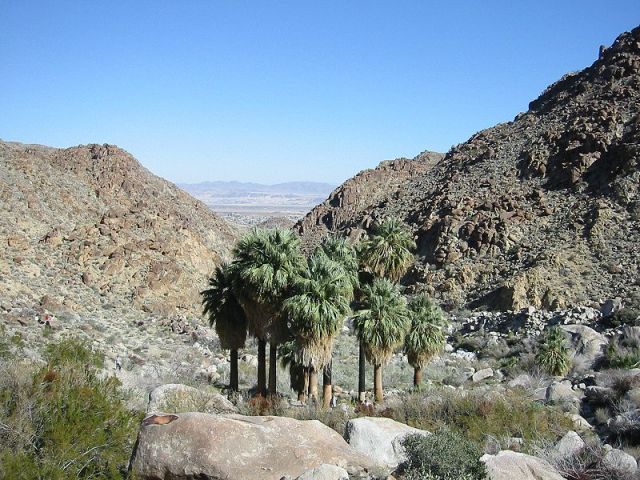
Washingtonia in a natural setting by Jim Harper

Washingtonia in a natural setting by Jim Harper

Historical notes: There is a persistent myth that these palms were brought to the Americas by the ancient Egyptians and their seeds were distributed in the waterways of the Western Californian area. The fruit of the Washingtonia was eaten raw, cooked, or ground into flour for cakes by native Americans. The Cahuilla and related tribes used the leaves to make sandals, thatch roofs, and baskets. The stems were used to make cooking utensils. The Moapa band of Paiutes as well as other Southern Paiutes have written memories of using this palm’s seed, fruit or leaves for various purposes including starvation food.

Features:  They are fan palms, with the leaves with a bare petiole terminating in a rounded fan of numerous leaflets. The flowers are in a dense inflorescence, with the fruits maturing into a small blackish-brown drupe 6–10 mm diameter with a thin layer of sweet flesh over the single seed. W. filifera can grow to around 23 metres tall, whilst robusta gets up to 25 metres. W. filifera has white flowers and large leaves and robusta pale orange-pink flowers, smaller leaves and narrower trunk. The fruit are eaten by birds, which disperse the seeds in their droppings after digesting the fruit pulp.

This slideshow requires JavaScript.

Uses: Both species are cultivated as ornamental trees, as specimens, or more often in groups along side roads, in parks and other such open spaces. W. robusta is suitable for coastal gardens.

Growing conditions:  W. filifera is very hardy in a dry climate and able to survive brief temperatures in the vicinity of -15 °C (5 °F), provided the air and soil are not too wet, and the afternoon temperatures are not too cold. Intolerance of wet, prolonged cold is the main reason the filifera species cannot grow properly in temperate marine climates. W. robusta is less sensitive to moisture than filifera, grows faster, but is far more easily damaged by cold. Grow outside in fertile, well-drained soil in full sun.

Further information:

Wikipedia

Old School Gardener

Green-eyed Rudbeckia: picture by Ellen Zillin

Green-eyed Rudbeckia: picture by Ellen Zillin

Picture: Dario Fusario

Picture: Dario Fusaro

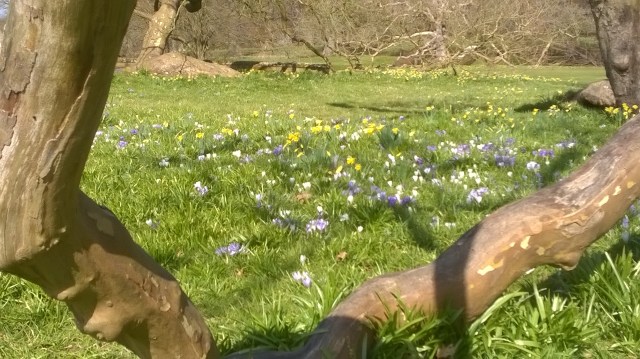
Crocuses looking good in the sun under the Oriental Plane Trees

Crocuses looking good in the sun under the Oriental Plane Trees

I had to change my day at Blickling this week, so was working alongside the Wednesday volunteers, some of whom have been in the gardens for over 10 years, and some, like me, have been inspired more recently by the project to regenerate the Walled Garden.

Our focus was the parterre. Gardener Ed gave us a quick course in rose pruning and we set off around the edges of four main beds.

Previous sessions had replaced the aging Catmint (Nepeta) which runs along side the rose beds. These contain a mixture of floribunda types, several of which are quite old and have lost their vigour…hmm, know what they feel like?

We made good progress, and by the end of the day we had pruned the roses, replaced about 50 old, weak specimens, watered them in (in bucket fulls of water taken from the central fountain) and I hoed over a quarter of the beds to finish off.

I gather from Project Manager Mike, that the fruit trees have arrived, so it could be that next week we’ll be focussed on planting them in the walled garden I’m also taking over my Garden Design group to do a practical session on transferring designs onto the ground.

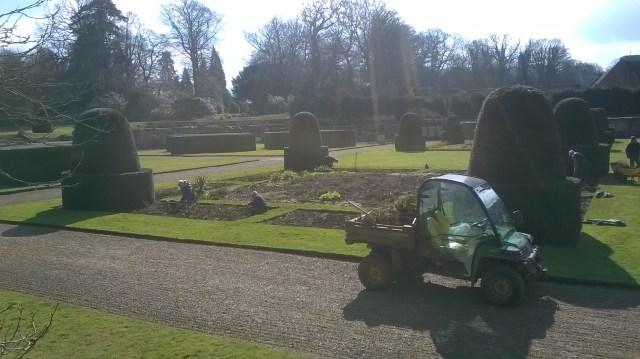
The end of a sunny spring day..

The end of a sunny spring day..

Further Information:

Blickling Hall website

Blickling Hall Facebook page

A 360 degree tour of Blickling Hall

Old School Gardener
 

Picture: Derk de Witt

Picture: Derk de Witt

There's such a choice of  containers to grow in!

There’s such a choice of containers to grow in!

It’s getting to that time when we plant up containers – with annuals, or perhaps longer lasting plants. Which type of compost should you use?

There are two main types of compost: soil-based (John Innes) and soil-less, which may be based on peat or a peat substitute such as coir or perhaps recycled household waste. In addition, depending on the drainage requirements of the plants you’re placing in containers, you’ll need to add some horticultural grit, Pearlite or similar. And some plants- bulbs for example- like a mix which is less nutrient rich, light and leafy- so add in plenty of leaf mould.

All containers need some means of letting excessive water escape- in most pots there’s a hole in the bottom and permeable liners (or a few holes punched in a piece of plastic) in hanging baskets will achieve the same result. But don’t forget to rest some pieces of broken pot or tile over the drainage hole in the bottom of the pot to avoid the compost washing out.

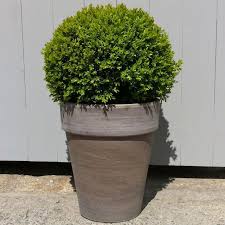
Plants like this Box ball requires a soil-based compost to thrive long term

Plants like this Box ball requires a soil-based compost to thrive long term

Soil-based composts

These are heavy, retain water well and provide a long-lasting supply of nutrients. They are the best choice for permanent plants in containers and for plants that grow tall and are top heavy. For permanent displays, use john Innes Number 3 because of its high level of nutrients.

Soil- less composts

These are lightweight, clean and easy to handle, but dry out quickly and contain few nutrients. Soil-less composts are best for temporary displays, such as bedding plants and hanging baskets. Peat-based composts are the most consistent in quality, though alternatives are improving all the time (especially some of the recycled organic matter types) and do not deplete the landscape like peat-based types.

Plants like Pelargoniums (these are in the courtyard at Old School Garden), require a very gritty soil-less compost.

Plants like Pelargoniums (these are in the courtyard at Old School Garden), require a very gritty soil-less compost.

Source: ‘Short cuts to Great Gardens’- Reader’s Digest, 1999

Old School Gardener


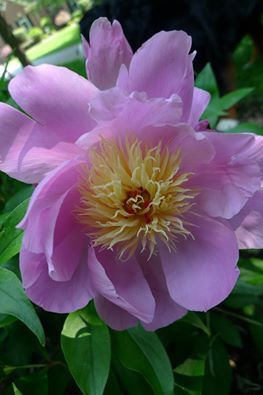
Peony- picture byEllen Zillin

Peony- picture by Ellen Zillin

Finding Nature

Nature Connectedness Research Blog by Prof. Miles Richardson

Norfolk Green Care Network

Connecting People with Nature

Discover WordPress

A daily selection of the best content published on WordPress, collected for you by humans who love to read.

Susan Rushton

Celebrating gardens, photography and a creative life

Unlocking Landscapes

Writing, photography and more by Daniel Greenwood

Alphabet Ravine

Lydia Rae Bush Poetry

TIME GENTS

Australian Pub Project, Established 2013

Vanha Talo Suomi

The Journey from Finnish Rintamamiestalo to Arboretum & Gardens

Marigolds and Gin

Because even in chaos, there’s always gin and a good story …

Bits & Tidbits

RANDOM BITS & MORE TIDBITS

Rambling in the Garden

.....and nurturing my soul

The Interpretation Game

Cultural Heritage and the Digital Economy

pbmGarden

Sense of place, purpose, rejuvenation and joy

SISSINGHURST GARDEN

Notes from the Gardeners...

Deep Green Permaculture

Connecting People to Nature, Empowering People to Live Sustainably

BloominBootiful

A girl and her garden :)