Tag Archive: design


This is the fourth in a series of ‘snippets’ that try to capture the essence of a particular garden style. today, ‘modernist’ gardens – I prefer this term to ‘contemporary’ as it is less laden with connotations of what is deemed to be ‘fashionable’ – so a more neutral term, hopefully!

Modernist gardens are crisp and clean. They rely on scale and proportion to provide a dramatic setting and there is simplicity and an absence of ornamentation or embellishment. They often have a strong geometric layout and are open and uncluttered. Sharp lines – whether straight, angled or curved – reinforce the contrast between verticals and horizontals, which are created by the use of structures (walls, pergolas, arbours, seating etc.) and planting (especially those with strong ‘architectural’ forms). Other key features include:

  • asymmetry

  • subtle but clear changes in level

  • modern materials (e.g. concrete, steel, glass, plastics)

  • planting in blocks

  • contemporary furniture

  • reflective water

Let me know what you think makes a Modernist style garden, and if you have some pictures I’d love to see them!

Sources and further information:

Jilly Welch article on modernism

Living-gardens.co.uk

Other posts in the series:

Formal Gardens

Mediterranean Gardens

Cottage gardens

Old School Gardener

If you’ve enjoyed reading this post and others on this blog, why not comment and join others by signing up for automatic updates via email (see side bar, above right ) or through an RSS feed (see top of page)?

PicPost: Through the Garden Gate

Photo from Grow Veg

The ‘Education Garden’ at Gressenhall Farm and Workhouse Museum, Norfolk, was in need of a ‘refresh’. As part of my one year Heritage Garden Traineeship I came up with a new design, having consulted staff and volunteers. The agreed design was carried out in 2012 by me and other volunteers at the Museum. It features some minor adjustments to the former planting areas, terraces and grass and also includes an area designed for pre – school children, known as ‘Curiosity Corner’.

‘Curiosity Corner’ is deliberately child – sized, with a winding bark and pebble path and deep borders that sometimes rise above and fall below the path. There are living structures – a willow tunnel and two entrance arches. A ‘pebble mountain’ and a series of wooden features are complemented by a low level mirror, as well as a number of metal and wooden birds, insects, butterfly and a cat, windmills and other ‘oddities’ such as a ‘fossil slab’ set in grass and a wall mask of a ‘small friendly giant’- the idea is to provide unusual things for the the children to spot and stimulate their imaginations.

The planting is varied and includes species with interesting leaves (e.g. Stachys byzantina or ‘Lambs Ears’, ferns and grasses) and last year children planted Sunflowers which grew to an enormous height! There is also a turf seat and a half barrel water feature (complete with metal frog). The garden has now seen a full season of ‘wear and tear’ and has stood up reasonably well – it seems to have been a popular addition to the Museum. However, some adjustments are needed to prevent children accessing the inner path from the terrace, strengthening the enclosed feel of the space and replacing the turf seat which has not really withstood the wear – it has turned into a mound for running up and down rather than sitting on! These changes will be carried out soon.

Old School Gardener

If you’ve enjoyed reading this post and others on this blog, why not comment and join others by signing up for automatic updates via email (see side bar, above right ) or through an RSS feed (see top of page)?

Two projects in the village of Cawston, Norfolk enabled me to ‘cut my teeth’ on designing playful landscapes.

Both were completed about 6 years ago and largely on a voluntary basis. I remain involved at the local Primary School, helping them with their School Gardening activities, but my early involvement was in designing, sourcing planting and organising the creation of an ‘Eco Park’ – basically to try and diversify the habitats and play opportunities in a bland, mown grass playing field with a solitary multi function play unit. The design features a curved mixed native species hedge (which is now over 2 metres high) and a haven for wildlife, several groupings of native trees such as Silver Birch, Hazel, Douglas Fir, Beech, Oak, Feild Maple, Mountain Ash and Black Poplar, and some areas of shallow mounding.

The planting has been used to create several different spaces, and grass within these has been left to grow long both to provide varied habitats and interesting play areas. In addition a ‘Nectar Bar’ of insect – friendly herbaceous and other flowering plants has been created alongside the school, including a painted pergola which both helps to privide shade to the south – facing side of the school and added planting interest.

The second project involved working on commission for the Parish Council and a local charity to design, seek funding, consult local people and supervise the creation of a new play landscape at the ‘Oakes Family Field’ located to one side of the village. The design was constrained by the need to retain areas for cricket and football pitches and to avoid placing play areas close to housing on one side of the field. There is a mix of landscape features including a large mound (with a slide), timber play equipment for balancing and enclosed social areas, as well as a selection of traditional play equipment in two main areas, one for younger, one for older children. Over £100,000 was raised from various sources and so a wide range of play equipment and features has been possible.

Old School Gardener

If you’ve enjoyed reading this post and others on this blog, why not comment and join others by signing up for automatic updates via email (see side bar, above right ) or through an RSS feed (see top of page)?

Managing risk in play provision- free guide

Play England’s no nonsense guide on how to balance safety and challenge in play area design and management.

This is the first of a series trying to capture the essence of different garden styles. ‘Style Counsel’ will be a series of snippets – just a few words and images. I’d love to hear your comments on these and please add your own thoughts on what makes up these different styles – and if you have some pictures to add that’s even better. So, what is a Cottage Garden?

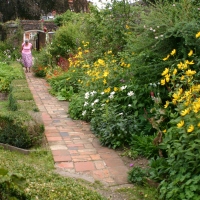
Cottage gardens have layouts that are simple and often geometric, though many have a more sinuous layout with twists and turns, especially as the garden moves further away from the cottage /house, where more natural, wilder planting can prevail.

Key characteristics include:

  • Profuse planting featuring many herbaceous perennials such as Delphinium, Stocks, Hollyhock, Lupin, ‘signature’ annuals such as Sweet Peas and Marigolds and a few evergreen shrubs for winter interest and structure
  • Rustic furniture made out of rough timber
  • ‘Roses round the door’, and on arbours or other structures
  • Weathered paths often made from old bricks or rammed earth with simple, if any, edging tiles or boards
  • Vegetables, fruit and herbs often mixed in with the flowers

cottage garden 1 cottage garden 2 cottage garden 3

Old School Gardener

If you’ve enjoyed reading this post and others on this blog, why not comment and join others by signing up for automatic updates via email (see side bar, above right ) or through an RSS feed (see top of page)?

PicPost: Rabbit - proof fence

Inclusive Play Design Guide

Produced for the US play world by Let Kids Play, this Guide nevertheless includes some very useful ideas of wider relevance, especially on the layout and access to play areas and enriching the play experiences of all children, including those with some form of disability. Free download.

From Alex at Norfolk Master Gardeners: ‘Great idea for raised beds – easy, quick and a nice working height for people who have back problems. And with a touch of paint, could look very good in a garden too.

An added idea, is to adjust the depth of the bed, by moving the base pallet down a notch or two. This would be better for deep rooted crops such as potatoes, sweet potatoes, etc’

PicPost: running, weaving & whirling with soldiers and herring

‘A quick guide for brick patterned garden paths and patios. Can you get your hands on some old bricks?’

From Growveg

Finding Nature

Nature Connectedness Research Blog by Prof. Miles Richardson

Norfolk Green Care Network

Connecting People with Nature

Discover WordPress

A daily selection of the best content published on WordPress, collected for you by humans who love to read.

Susan Rushton

Celebrating gardens, photography and a creative life

Unlocking Landscapes

Writing, photography and more by Daniel Greenwood

Alphabet Ravine

Lydia Rae Bush Poetry

TIME GENTS

Australian Pub Project, Established 2013

Vanha Talo Suomi

The Journey from Finnish Rintamamiestalo to Arboretum & Gardens

Marigolds and Gin

Because even in chaos, there’s always gin and a good story …

Bits & Tidbits

RANDOM BITS & MORE TIDBITS

Rambling in the Garden

.....and nurturing my soul

The Interpretation Game

Cultural Heritage and the Digital Economy

pbmGarden

Sense of place, purpose, rejuvenation and joy

SISSINGHURST GARDEN

Notes from the Gardeners...

Deep Green Permaculture

Connecting People to Nature, Empowering People to Live Sustainably

BloominBootiful

A girl and her garden :)