Tag Archive: design


This slideshow requires JavaScript.

Old School Gardener

Flooding- How Permacuture Design can help

from-bottom-of-garden.jpg

An interesting article about one person’s experience of ‘extreme weather events’ and how permaculture design helped to redesign a garden and home. Click on the title for the weblink to the article.

You might also be interested in the series of articles I wrote about Gardening and Climate Change last year- have a look in the ‘Four Seasons in One Day’ category of articles in the right hand column.

Old School Gardener

Large Gardens can be broken up into smaller spaces, but these can be held together by features such as water channels, paths and planting, as here in a scheme by Audax Design

Large Gardens can be broken up into smaller spaces, but these can be held together by features such as water channels, paths and planting, as here in a scheme by Audax Design


Garden Design is concerned with creating spaces which both meet the functional needs of their users (relaxing, entertaining, playing, growing food, getting washing dry etc.) and which are appealing to the senses, especially vision.

The latter is about achieving concepts like harmony and unity – the design ‘hangs together’- and using layout and structure (the features, plants and other things which are the visual backbone of the garden) to achieve variety and interest.

Some gardens have shapes which pose particular design challenges, but various approaches can be taken to get the most from them. Here’s a list of some of these and ways to lay out the garden for maximum effect. All the examples assume that you are looking at the garden from the back of the house.

Triangular 

Challenge: These plots typically are wide near the house and the sides taper away to converge to a point and this is exaggerated through perspective, making the garden appear smaller than it is.

Solution: Try to disguise the garden boundaries, especially the narrow point at one end. Focal points can also be used to draw the eye away from the corner, or if a focal point is used near the end make sure it is brought well forward. Another approach is to use sweeping curves and not follow the lines of the boundaries.

triangular garden after

After- showing good use of floorscape at an angle and a pergola to break up the view to the end. Picture- Fiona Edmond. Designed by Fiona Edmond of Green Island Gardens

trianglegardenoverheadsmall

A triangular garden – before Picture-Fiona Edmond


Rectangular

Challenge: The boundaries can dictate the internal layout which can be rather formal and symmetrical – what if you don’t want formal?

Solution: Try to hide the boundaries, especially the horizontal fence line with a mixed planting of trees, shrubs and climbers. You could make use of sweeping curves, especially circles or part circles, or alternatively use a 45 degree/60 degree grid.

L- shaped

Challenge: This is an interesting shape which can potentially allow for the creation of a ‘secret area’. However, like the rectangular plot it can become rather formal if you follow the boundaries in the internal layout.

Solution: Unless you want a formal garden, use either a layout based on a 45 degree grid to the boundaries or sweeping curves to take the eye away from the sides of the plot. Oh, and of course think about varying this in the ‘dog leg’ of the shape to create a diffferent if not ‘secret’ space. Another option is to use the part of the ‘L’ that’s out of the main view from the house to hide things like bin areas, sheds or play spaces (though you might want areas for younger children to remain in sight from the house).

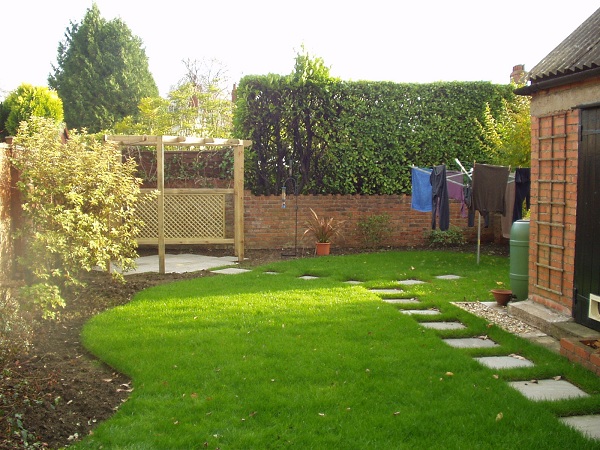
An L shaped garden which has been designed to hide utilities such as washing line and water butt, and at the same time introduced curves and a focal point seating area - designed by Dewin Designs

An L shaped garden which has been designed to hide utilities such as washing line and water butt, and at the same time introduced curves and a focal point seating area – designed by Dewin Designs


Large gardens

Challenge:The scale of the challenge can be overpowering so the designer does very little or nothing; the result is often a plot which lacks interest; large open expanses of grass with thin borders around the edges, for example.

Solution:These give the designer lots of scope for creating a series of smaller spaces within one larger plot. It is quite a common technique to divide the garden into three; first, the area near the house is normally more ‘architectural’ and formal (with hard lanscaping features like terraces, steps, archways); the second is a transitional space; the third is more informal so it blends in with the landscape beyond.

A large garden can be broken up into a series of more interesting spaces using arches, hedges, screens etc.

A large garden can be broken up into a series of more interesting spaces using arches, hedges, borders, screens etc.


Long and narrow

Challenge: These can create a ‘tunnel’ effect, making the space seem claustrophobic.

Solution: One way to rectify this is to divide the garden into two or three smaller spaces, each linked together but with its own theme or function: this then prevents you seeing straight down the garden. Another option is to put in a long serpentine lawn/open gravelled area with certain features on the insides of the bends to block the view, or you could design in a path that zig zags across the garden from left to right and then back again. In this type of plot it is important to screen the boundaries so it is not so obvious how narrow the plot is.

A design for a long and narrow garden which shows paving placed at an angle to the sides, plus a curved path -these help to widen the impression of the space

A design for a long and narrow garden which shows paving placed at an angle to the sides, plus a curved path – these help to widen the view of the space – design by Albert’s Garden


Wide and shallow

Challenge: The view to the end of the garden is foreshortened, so if you see the back boundary you know that the plot is shallow and you see the whole plot at once- pretty uninteresting .

Solution: Avoid using the boundaries as the guide to internal layout as this will emphasise the foreshortening even more. Only use the boundaries if you are creating a formal garden. Try to disguise the far boundary fence/ wall so that you are not aware of how close it is. This can be achieved by introducing a false archway or by using tall planting between the house and the boundary to draw the eye to the middle distance. Use layouts based on the diagonal axis and/or use circles, curves, rectangles, ovals or ellipses to define a strong internal shape that draws the eye. An alternative approach is to use a narrowing shape towards the short end to give a false sense of perspective and so give the impression of greater distance to the rear boundary (e.g. edges of paths/ lawn and a focal point like a statue, structure or feature plant).

A design for a triangular community garden showing how paths and various features draw the eye into the central space.

A design for a triangular community garden showing how paths and various features draw the eye into the central space.

Photo credits: Fiona Edmond, Green Island Gardens (see link below)

Further information:

Albert’s Garden- design examples

Triangle Community Garden

Green Island Gardens- design

Old School Gardener

Using focal points- including the more unusual- is an effective way of drawing the eye away from the edges of a space

Sometimes, especially with awkwardly shaped or smaller gardens, it makes sense to try and draw the eye from the outer boundaries and create a more pleasing and, apparently larger space. Here are seven ‘top tips’ for achieving this:

1. Put square and rectangular patios and lawns at 45/30/60 degrees to the side boundaries or use shapes for these and other flat areas which contrast with the outer shape of the garden.

2. Set paths to run at an angle to the garden boundaries in zig zags or dog leg style.

3. Make paths curved, meandering from side to side.

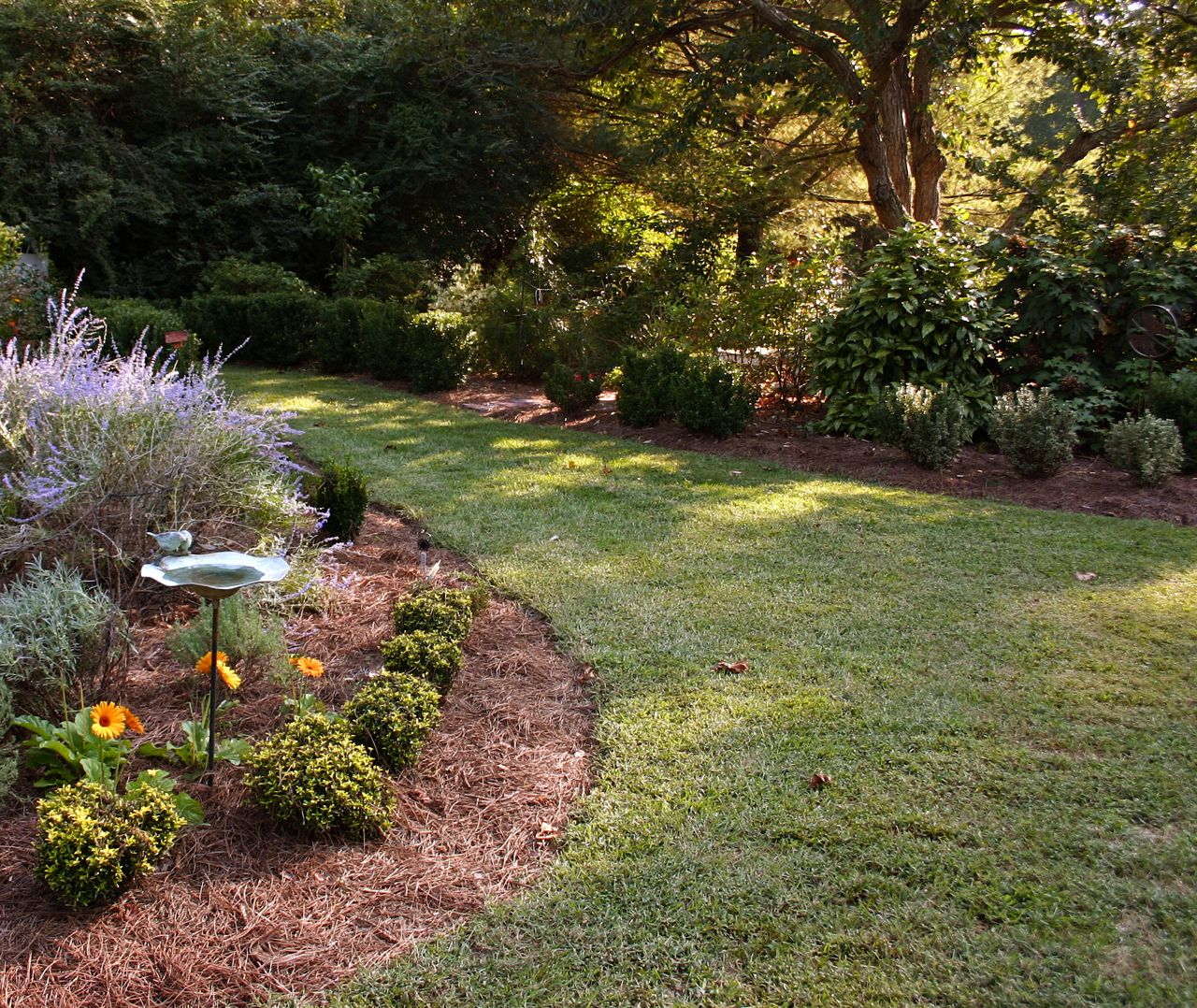
Paths- including grass- and the border edges they create can be meandering to take the eye on a journey..

4. Fix structures such as trellis, pergolas and arches or plant hedges across the garden to interrupt the view and to create separate compartments.

5. Place groups of tall shrubs or trees at intervals in the line of sight to block views across or down the garden.

6. Use climbers and large shrubs, especially evergreens, to disguise solid formal boundary fences and to break up the straight lines, particularly the horizontal ones of fence/ wall tops.

7. Carefully place focal points to draw the eye in various chosen directions, positioning them so that they can be seen from different places in the garden.

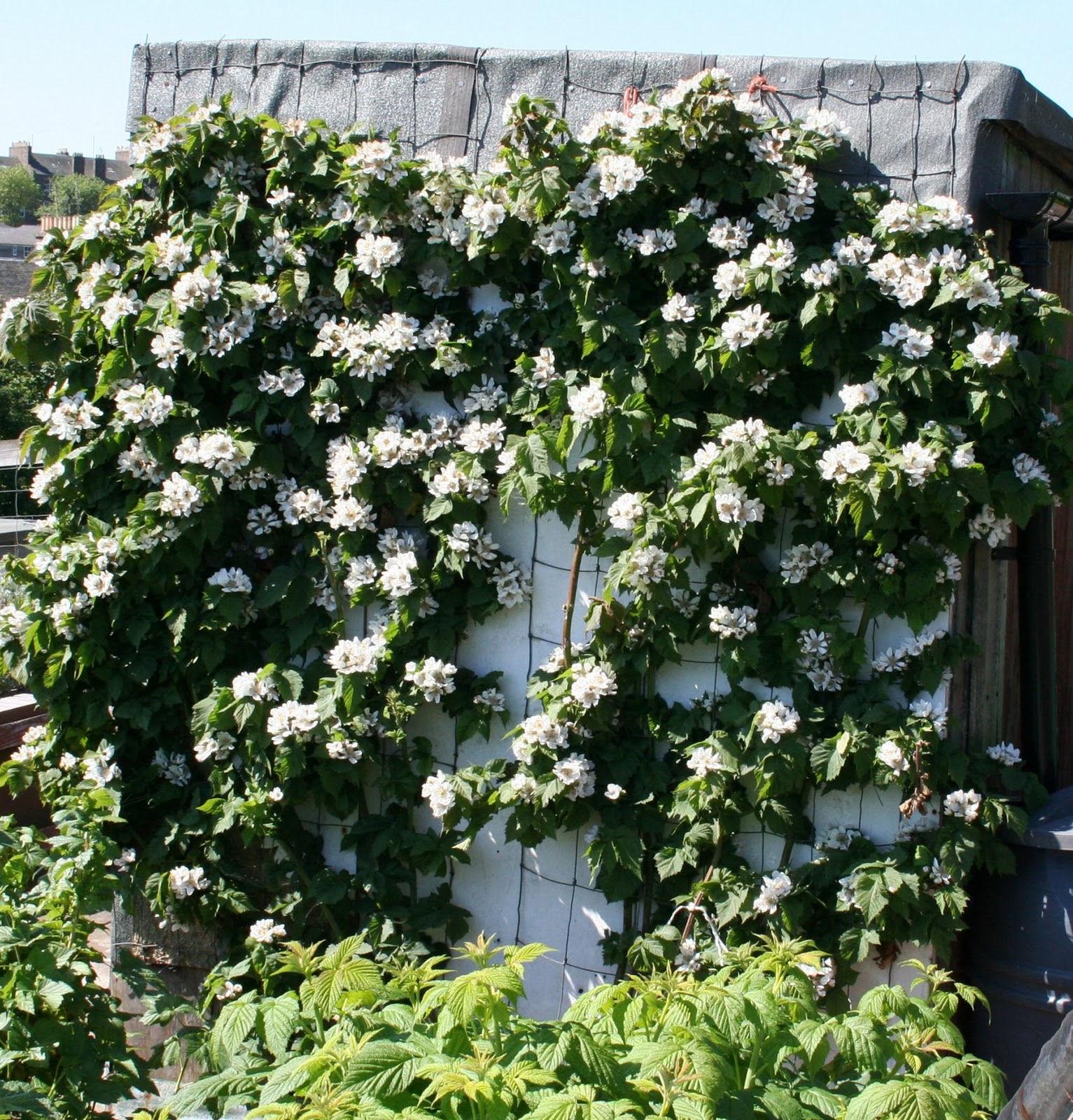
Use climbing plants to cover up and soften hard boundaries

Use climbing plants to cover up and soften hard boundaries

Related article: Arbours and Pergolas in the Garden- 7 Top Tips

Old School Gardener

Rethinking Parks

Brooklyn Bridge Park, New York, USA

‘Over the next two years, Nesta, The Heritage Lottery Fund and The Big Lottery Fund will back a small number of pioneering innovations, with a focus on finding the new business models that will enable our parks to thrive for the next century.

For example, what if parks made the most of temporary installations to generate income – like open air cinemas, food festivals or art showcases? What if communities took on the maintenance of parks, or real-time user data from smartphones was used to inform maintenance regimes? 

If you’ve got an idea to reimagine the way your local park is used, maintained or run, we want to hear from you.’

The Garden- man made artifice?

‘Let us, then, begin by defining what a garden is, and what it ought to be. It is a piece of ground fenced off from cattle, and appropriated to the use and pleasure of man: it is or ought to be, cultivated and enriched by art, with such products as are not natural to this country, and consequently, it must be artificial in its treatment, and may, without impropriety, be so in its appearance; yet, there is so much of littleness in art, when compared with nature, that they cannot be well blended; it were, therefore, to be wished, that the exterior of a garden should be made to assimilate with park scenery, of the landscape of nature; the interior may then be laid out with all the variety, contrast, and even whim, that can produce pleasing objects to the eye.’

Humphry Repton- ‘Observations on the Theory and Practice of Landscape Gardening’, 1803

Hmmm. what do you think? Repton’s advice about blending the edges of a garden with it’s surrounding landscape has become a tenet of garden design, but what about his words on making the garden itself a clearly ‘man made’ feature? Is the phrase ‘natural garden’ a contradiction in terms?

Old School Gardener

succulent steps

Grasses and autumn leaves are looking good in Old School Garden

Grasses and autumn leaves are looking good in Old School Garden

28th October 2013

To Walter Degrasse

Dear Walter,

I hope you and Lise are well. I guess you’ve been experiencing the warm autumn like us over the last few weeks? This has done wonders for prolonging the flowers and colour in Old School Garden and the combination of these with the golden glow of grasses in the mixed borders looks super- especially in that low October sun.

But it’s also meant that I’ve been hanging on and waiting for things to finish their show so that the ‘autumn clear up’ can truly begin (though I do like to leave some plants whose stems, seed heads or shape survive to provide eye catching winter interest). I’ve just started to get tender things inside for over wintering as well as replacing summer annual displays with something to give us winter and spring colour. The main annuals beds and containers have been cleared and planted up with a combination of spring bulbs, along with Pansies, Violas and Bellis. I’ve also cleared out the greenhouse of the remaining cucumbers and (mostly green) tomatoes, the latter are now resting in a fruit bowl along with a banana to encourage ripening! The harvest has continued with lots of delicious apples, some very good black grapes and runner beans, chard and the last of the courgettes. It’s also been a busy sowing and planting time- crops of Broad Beans, yellow and red Onions, Garlic as well as green manures have all been put in, and I’m having another go at growing Asparagus.

Scabious still looking good in the courtyard garden

Scabious still flowering in the courtyard garden

As you read this we’ll be away visiting our daughter Madeleine and our son-in-law, Diego, in Portugal. So, many other things – bringing in the dahlias, pruning the climbing roses, keeping on top of the leaves, selective cutting back of perennials and dividing and moving some – will all have to await our return. A little late perhaps, but hopefully the mild weather will continue for a couple of weeks!

I’m still helping at the local School with their ‘outdoor learning’ (specifically in the School Garden). I think virtually every child (apart from the very young), has learned about tools and tool safety and harvesting (the School cook had a lovely supply of Red Cabbage, Courgettes, Runner Beans and Carrots to weave into her daily menu). It’s been inspiring to hear their enthusiasm as they open up a runner bean pod and discover the little pink and purple jewels that can become next year’s seeds and how they love to find worms and other critters in the soil! One mum told me the other day how excited her son had been when he brought home the bean I’d let him take away!

They have also learned about the different types of seed and their dispersal, what we do in the Autumn to prepare the soil, and sow and plant certain things, as well as the importance of composting, including looking after the school wormery. The other day this half term’s efforts culminated in an open day focusing on ‘outdoor learning’. Parents linked with their children and took part in a range of activities around the school site including den building and bug hunting. I was mainly involved in fuelling the fire pit where we did some ‘campfire cooking’ (bread and marshmallows on hazel sticks), and helping with:

  • some gardening (the boys particularly like a bit of digging),

  • weather monitoring (we managed to reach 19 degrees C on a beautiful sunny day)

  • making ‘elf houses’ and furniture (and a few elves too),

  • making recycled paper pots and sowing broad beans in them.

I think this event has helped to raise awareness of the good work being done in the ‘outside classroom’ at the school and may even encourage some parents to volunteer to help out at one of the regular ‘garden gang’ days or in other ways. Here are some pictures I took to give you a flavour of what was a  fun and successful day.


The other major activity I’ve been involved with recently is teaching.

As you know from my last letter, I’ve been running a second Garden Design course at the local High School and this is now in its last couple of weeks. The eight participants, have a wide range of different garden design challenges in front of them. They are an enthusiastic group who it’s been a pleasure working with. They are now firming up their design ideas and creating scale drawings of what they want to achieve, and the final evening will focus on how to go about realising these on the ground.

I’m also pleased to say that my first ‘Grow Your Own Food’ course for beginners and novices is running locally, too. Tuesday mornings in a nearby village hall (Foulsham), sees 6 relatively new food growers coming together and both sharing experiences and exploring the ‘keys to success’ in food growing. The second week involved a visit to Old School Garden where I shared (‘warts and all’) my own experiences of food growing, some of the ideas and tips I’ve used and some of the issues confronting me – not least being the need to ‘downsize’ my food production to avoid gluts and surpluses! I shall be introducing a greater level of ornamental planting in the kitchen garden to achieve this, so reducing the productive areas by about a third.

My blog continues to grow both in terms of followers and also in the feedback and ‘conversations’ its enabling around the world. I’ve recently topped 1500 followers on all ‘social media platforms’ and since starting it back in December last year have had over 33,000 views of pages on the site. These are currently averaging about 800-1000 per month at present. Its been especially pleasing to have positive feedback from people who have enjoyed particular articles or items (recycling in the garden seems to be especially popular). Continue reading

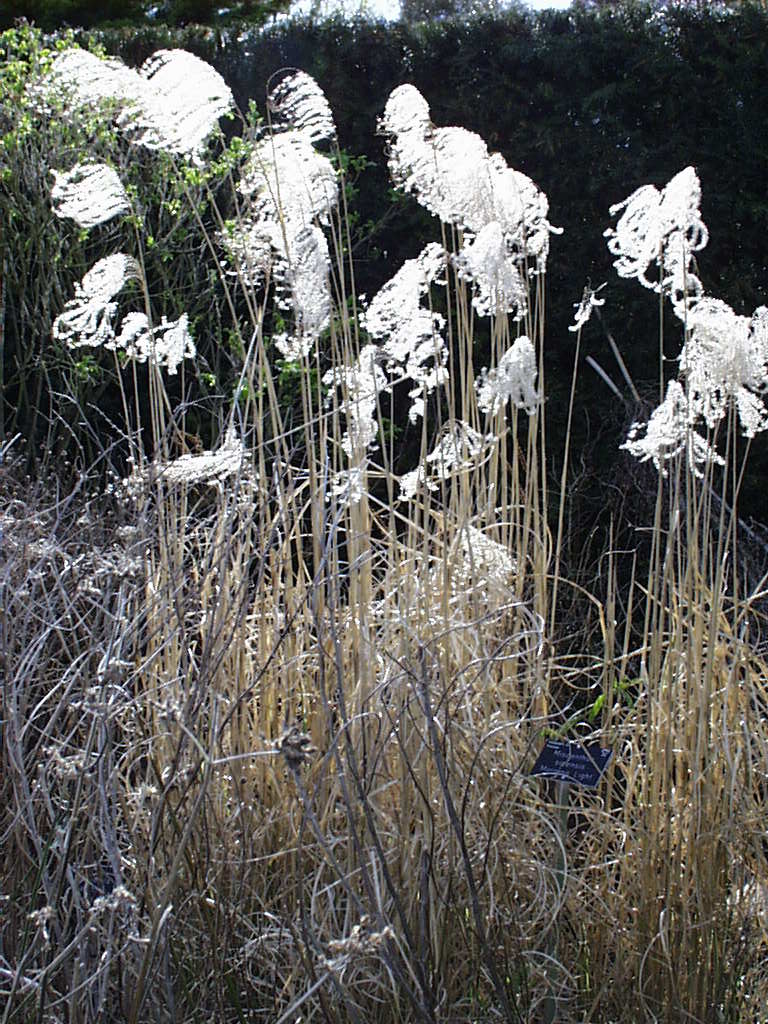
Dried flowers and stems of Miscanthus sinensis 'Morning Light' providing interest at RHS Garden Hyde Hall in March

Dried flowers and stems of Miscanthus sinensis ‘Morning Light’ providing March  interest at RHS Garden Hyde Hall

My previous post set out the background to the growth in popularity of grasses as border plants. I’ve come to appreciate their simple beauty and the way they can add a different dimension to the traditional herbaceous and mixed border and at the moment some of them are looking great in Old school Garden, especially as the low autumn sun catches their golden stems and heads.

So what are the ways you can use grasses to best effect in your garden?

They contribute in a number of ways – texture, light, colour and as structural elements in your overall garden framework (and some sound lovely as the breeze finds its way through them or their seed heads are rattled like mini maracas). Here are some thoughts gleaned (no pun intended) from the very useful book, ‘Grasses’ by Roger Grounds.

Texture

Most grass stems and leaves provide strong vertical or curved lines and are best used in contrast:

  • With other perennial broad – leaved plants (often most effective if seen from a distance),

  • With strong vertical lines like clipped Yew or the corners of buildings (where the grass has a curved or arching stem),

  • More subtle, unusual combinations (e.g. with Ferns),

  • Contrasting the ‘fuzzy’ flower heads of many grasses with those plants that have a more linear or defined form e.g. Digitalis, Lythrum, Achillea, Phlomis russelliana, Echinops and Allium giganteum

  • With other grasses that have different leaf form; e.g. the narrow leaves of Miscanthus sinensis ‘Gracillimus’ with the broad bold leaves of Arundo donax, or the wide, short leaves of Panicum alopecuroides.

  • At the front of borders to act as ‘veils’ through which other plants or a more distant landscape can be revealed.

Annual  grasses- complete their growth cycle in one growing season. Hardy varieties can withstand frost and most can be sown in autumn to over winter in the ground and germinate in spring. Tender grasses need to be sown once all risk of frost has passed. Many of these are perennial in frost-free climates.

Light

  • Position grasses to catch the sun, preferably against a dark backdrop to ‘light up’ the wider garden.

  • Use grasses to take advantage of the different tonal values of light as it changes from season to season and at different times of the day – especially the more mellow light of autumn and also early and late in the day as these are the times when the richest colours are revealed. I’ve positioned some Stipa gigantea (‘Golden Oat Grass’) to catch the low sun of late summer and autumn, and close to the house where we can see the full

  • Associate grasses with seasonal changes in perennials and foliage; e.g. in spring the foliage of grasses is more prominent so think about using bold coloured grass leaves as foils for spring flower colour- the yellow of Bowle’s Golden Grass with the blues of Bluebells for instance.

Cool season grasses- these start into growth in autumn, grow through the winter and flower in spring or early summer. Best planted among winter or spring- flowering perennials. Plants grown for their foliage, or among spring and early summer bulbs. Most then become dormant/semi dormant and so can be planted where summer flowers or other grasses can grow up to conceal their faded foliage. They can be divided or transplanted in spring or autumn.

Colour

  • Use the ‘washed out’ or subtle colours of grasses as a counterpoint to the richer colours in surrounding plants.

  • Grasses with coloured leaves can be used to reinforce a particular colour theme- reds with reds, blues with blues etc. As they last longer than many of the flowers around them, grasses help to maintain continuity in colour themed borders. Blues from grasses such as the varieties of Panicum virgatum, reds from Imperata cylindrica ‘Rubra’ (Japanese Blood Grass) and the yellow of Hakone grass (Hakonechloa macra ‘Aureola’). Yellow is the dominant colour of many grasses’ flower panicles, especially as they fade and the seed heads ripen to shades of amber, straw and gold.

Massing, grouping and markers

  • Grasses look best when grown in groups of three or more- though few gardens have the scope for mass planting. They can also be effective as specimens. Grasses planted as masses or groups should be spaced closer together than in smaller groups.

  • Many low growing grasses make excellent ground cover, and this can be an effective way of massing them in smaller gardens.

  • Taller grasses, or those with strong colouring can act as successful specimens or ‘markers’ in a garden, either planted by themselves or as accents in a border. Clumps of grasses can have a similar impact if planted to contrast with other surrounding grasses or plants.

  • More subtle ways of creating a focus include using grasses with distinctive flower or foliage forms; e.g. Calamagrostis brachytrica with its elongated ovoid flower panicles.

  • A repetition of specimen grasses in a strict rhythm along a border – especially if placed towards the middle of front of it – will impel the eye along its full length. A similar effect, but with less impact, can be achieved with taller grasses placed at the back of the border; e.g. Stipa gigantea.

Warm season grasses- these do not start into growth until late spring or early summer, so they are best planted among other perennials or shrubs that flower from midsummer to autumn. They can be left standing through winter to provide interest- especially when they are covered with raindrops, dew or frost. They should be transplanted or divided in early spring, once they have started into growth.

Seasons and sitings

  • Think about the ‘plant partners’ to go with your grasses, and use the key features of both to complement each other at different times of the year. For example combine a range of strong flower forms which use the structure of grasses to greatest effect; Umbellifers like Anthriscus; Spires like Veronicastrum virginicum; Ball-like or pincushion flowers like Echinops  and Knautia macedonica; loosely structured heads like Astilbe; daisy-like flowers such as Rudbeckia. If possible go for those with the longest flowering period.

  • Use grasses in special sites; e.g. as part of a meadow; as a larger scale ‘prairie’ planting or border; in woodland or shade; at the water’s edge.

Sedges, Rushes and Cat tails – though they generally look like grasses, these plants have taken a different evolutionary path and so vary in leaf and flower details, and also their growing needs. Sedges are large family of diverse plants, mostly from the cool temperate regions, enjoying cooler and damper conditions than most of the true grasses. Rushes are a smaller family with few garden-worthy plants though the woodrushes are often decorative as well as useful, for example as ground cover. Cat tails (or reedmaces or bullrushes)are a single genus family with aquatic or marginal plants that have conspicuous flower heads.

Source: ‘Grasses’ by Roger Grounds (RHS and Quadrille Publishing)

Linked article: Design my Garden: Grasses- first the background…

Further information: Garden design with grasses

Old School Gardener

If you’ve enjoyed reading this post and others on this blog, why not comment and join others by signing up for automatic updates via email (see side bar, above right ) or through an RSS feed (see top of page)?

agrilife.orgThis is the first in a new series of articles aimed at providing some tips on using design successfully in your (or someone else’s) garden.

Do you have a disability? Maybe someone in your family isn’t as mobile as they were? Perhaps normal ageing processes are reducing your ability to garden in the way you once did? 

Disability can take many forms – it might affect someone from birth or early life or perhaps is the result of an accident or the processes of ageing. The UK Equality Act 2010 (which replaced the Disability Discrimination Act 1995) talks about a person having a disability ‘if you have a physical or mental impairment that has a ‘substantial’ and ‘long-term’ negative effect on your ability to do normal daily activities.’ The Act requires the providers of services to make ‘reasonable adjustments’ for a disabled person in any place which members of the public are permitted to enter, which includes public parks, gardens and other open spaces.

The Equality Act and associated design guidelines, which seek to remove obstacles to access, enjoyment and use of public spaces, is also a useful starting point when considering the design of a private garden or open space for someone with a disability. This covers people who are wheelchair users, have restricted mobility, sensory impairments or a learning disability, but also those who might be affected by the conditions that are associated with the normal process of ageing; e.g. loss of stamina, arthritis, declining vision and hearing and reduced balance.

Public parks are making it easier for disabled users

Public parks are making it easier for disabled users

As with any garden design project asking the client what he/she wants to do in their garden is the starting point – and absolutely essential if the client has a disability of some kind. Detailed assessment of their abilities, interests and disabilites can be obtained through more specific follow up questions:

  • how far can you walk?

  • how far can you bend?

  • has everything to be done from a wheelchair?

  • what do you see?

  • what can you hear?

As well as these questions it is important to observe the client in the garden, around the house etc. to see how they walk, bend, the shape of their body, how they make a cup of tea (lifting, holding, carrying skills). Often people with arthritis have coped for so long they can no longer describe how they move, so it’s important to watch them. So, taking careful and detailed note of the individual’s abilities and desires is the critical starting point  for any assessment and design of a garden for someone with a disability.

At this point its worth asking – is the disability of an order or kind that means their current garden can be suitably adapted, or do they need to think about moving or perhaps becoming involved in more communal gardening activity which is more in line with their ability and physical strength?

If the answer is that they can ‘stay put’, then options open include not only physical changes in the garden , but getting outside help for tasks like lawn care, hedge cutting, or one off construction projects. This might be paid contractors but could also be helpful friends, relatives or neighbours. When looking at the garden, it might also be possible to change a person’s gardening routines and practices, such as installing raised beds if they can’t bend over or are wheelchair bound; installing automatic irrigation systems; making paths easier to use by putting lights along them, clearing vegetation away from them and perhaps putting in more defined edges as well as levelling uneven surfaces to make routes more obvious and less of a ‘trip and slip’ hazard.
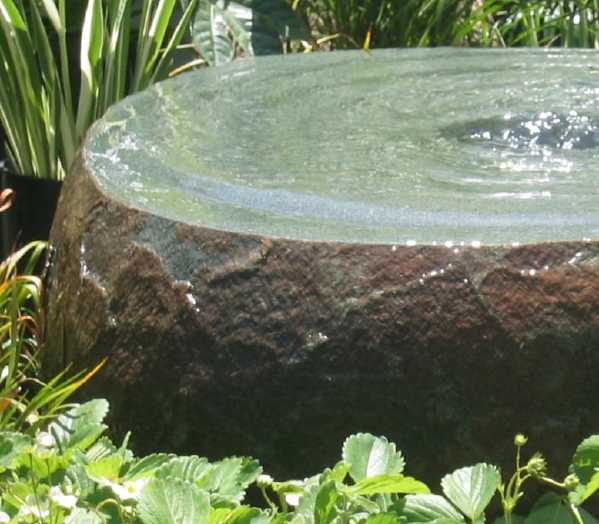
Water features can be important in gardens designed to stimulate the senses

Water features can be important in gardens designed to stimulate the senses

Paths and seats

But it’s also important to look carefully at things like the gradients of paths. Following recommended standards can result in ramps or other structures which do not meet the wider or particular needs of the individual. For instance whilst a ramp might be perfectly in line with the standards, the user might be wary of using it because they are afraid the ramp will make them lose control of their wheelchair and they will go crashing into a low wall at a T junction at the end of the ramp’s run. A more suitable alternative might be to install a longer ramp (with a gentler gradient) going in a different direction and/or removing the low wall.

Path widths are another area that will repay close attention. A 1.2 metre wide path may not be wide enough for someone in a wheelchair who is being pushed – try to imagine pushing the person and trying to constantly get past the chair to talk to the person face to face, rather than constantly taking to the back of their head! With restricted or no sight, or a hearing impairment, a muffled or hidden face heightens the level of disability. And think about  a space where the wheelchair (or perhaps someone with a guide dog) can stop  and there is comfortable space for the carer/assistant/friend to sit alongside the wheelchair user for a chat. So think a parking space for the wheelchair alongside a conventional seat might be a good idea.

Paths also need spaces where turning is possible for both pushed and self propelled wheelchairs. If the client has restricted mobility but does not use a wheelchair, think about seat heights and surrounding space to allow for comfortable descent and ascent from the seat. The number of seats in a garden for someone with arthritis may need to be increased to make it easy for them to take frequent rests while walking about or gardening.

Path and other hard surfaces shouldn’t be totally smooth and slippery (especially when wet), but also not so ‘riven’ that they give a bumpy wheelchair ride. Resin – bonded gravel works well and looks good, though it is relatively expensive. Ensure that the client can get in and out of their house comfortably- how do they lift their legs over a door threshold? What surface do their feet connect with? Risers may need to be lower than the standard 150mm, and people with inflexible ankles may need steps rather than ramps.

'Disability' extends way beyond wheelchair users

‘Disability’ extends way beyond wheelchair users

Beds and borders

Design beds and borders with the abilities as well as the interests and desires of the client in mind. Checking the ability to bend over comfortably (including from a wheelchair or mobility scooter) is critical in deciding the height and size of any raised beds, For some garden tasks – clipping low hedges for instance – the wheelchair/scooter user may already be at the perfect height!

When it comes to planting, the usual considerations apply:

  • what’s the climate (and any microclimates) like?

  • what space is there?

  • what is the aspect?

  • what sort of soil is there?

  • what are the irrigation options?

But it’s also especially important to think about the senses of the disabled client and respond to their abilities as well as disabilities. So, can heightened attention be given to specific sensual experiences in the garden’s planting? For example planting  herbs for smell, planting things to touch – e.g. furry leaves such as Stachys byzantina (‘Lamb’s Ears’),things to taste straight from the plant (vegetables, fruit, flowers, leaves etc.) and planting grasses and other plants that create interesting sounds (and maybe also things that help to reduce noise pollution from outside the garden). It’s also worth thinking about how your planting will support wildlife. Getting any ‘free’ helpers in the garden by planting nectar rich plants or those that provide a habitat will all help to reduce the gardening burden for the disabled person. Planting should also be chosen which gives a range of visual interests – textures of foliage, bark etc; seasonal changes in leaf, bark and form; different heights and shapes by the way plants are grouped and massed.

Down sizing

But what if the client’s garden is just too big and can’t be easily managed? The option of garden ‘down sizing’ (perhaps coinciding with a reduced size house too) is a choice that suits many people, especially as age related disability starts to affect them. One option might be to offer part of the garden to a friend or neighbour to manage as a sort of allotment, What remains or perhaps a new, smaller garden area, can still provide varied and interesting gardening. Patios, courtyards, terraces and balconies all offer possibilities through container gardening (the larger the better to reduce the need for watering).

These containers should be frost proof and of a weight when full of soil and plants that means they can be moved (if this is required) – or perhaps they can be mounted on wheeled platforms available from garden centres. Window boxes are another useful option for balcony railings or window sills. These ‘shrunken gardens’ can be planted to give all year round interest (perhaps including some evergreen shrubs for instance) as well as low maintenance plants (e.g. bulbs and shrubs), height variation (perhaps by adding a trellis to the back of a container to allow a climber to be grown), using hanging baskets with pulley systems to make it easier to lower and raise them for watering (and/or using a ‘watering wand’).

Communal gardening

Finally, it may be that the client is no longer able to manage the full range of garden tasks and a more communal approach is appropriate. Sheltered, supported housing and residential homes often provide a communal gardening space which the residents maintain, perhaps with some outside help. Just as with the individual disabled person, where communal gardens are being  set up or developed it is important to involve the residents in the design process. Spending time talking to and understanding them and teasing out what sorts of garden they would like is vital, as is the involvement of care staff who will have another perspective on the way the garden can be used. For example, a garden with lots of hard landscaping might make sense for clients with a restricted mobility or who are wheelchair users. Similarly the planning of routes around the garden and the views out of individual bedrooms/ apartments are important design considerations

For the individual a more communal style of gardening offers scope for learning new knowledge and skills as well as sharing their own. This ‘garden therapy’ can extend into bringing in specialist assistance and advice, creation of libraries of gardening books/ other resources and provision of meeting places and outings to maintain and foster residents’ interest in the garden and gardening.

An accessible water feature

An accessible water feature

Different disabilities lead to different design responses and focuses, and whilst it’s tempting to focus on the needs of those who are wheelchair users, there are other conditions that are just as important. For example:

  • Arthritis reduces bodily strength, endurance and flexibility so start by looking at adapting tools, get special devices and modify gardening routines to cope – e.g cushioned hand grips, adjustable handles, different sizing options on tools. in time more fundamental changes to the layout of the garden may be needed.

  • Hypertension can be helped through gardening activity and so reduce the risk of heart disease – 30 minutes of moderate exercise a day is recommended!

  • Visual impairment may lead to a loss of focus or sense of depth, so ‘fine tune’ the garden: perhaps add ramps; improve storage of hoses; and refine gardening  tasks. Taping different tools in different colours can aid recognition – and retrieval from borders!

  • Reduced balance suggests a need for smooth walking surfaces, with good grip/traction, hand rails. Levelling uneven grass and paved surfaces, adding raised beds and seating at key points in the garden may all help.
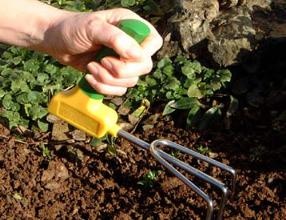
Special tools can be useful for the disabled gardener

Special tools can be useful for the disabled gardener

To sum up – talking to the disabled person and achieving a detailed understanding of their desires, interests and abilities as well as their disabilities is critical when considering the design of a new garden or adaptation of an existing one. There are many ways of making the garden easier to access and easier to use and garden in. The client must know that you have listened and the design must show this and be owned by the client – even if that’s a close relative or yourself!

Sources:

‘The Age Proof Garden’ – Patty Cassidy (Arness Publishing 2012)

‘Go Easy’ – Bella D’Arcy (Garden Design Journal November 2008)- see an extended article here

Further information:

Thrive- ‘Carry on Gardening’ – tips on garden design for disabled people

Gardening grants for the disabled

Accessible Gardens for persons with a disabilities- US Extension Learning Network

Raised bed gardening- Wiklipedia

Videojug videos on gardens for physically impaired people and others

Study of Sensory Gardens

Alzheimer’s Disease garden planning- Ask

Garden Design for all disabled gardeners – Pinterest

Equality Act 2012

Gardening for Disabled Trust

Old School Gardener

If you’ve enjoyed reading this post and others on this blog, why not comment and join others by signing up for automatic updates via email (see side bar, above right ) or through an RSS feed (see top of page)?

Finding Nature

Nature Connectedness Research Blog by Prof. Miles Richardson

Norfolk Green Care Network

Connecting People with Nature

Discover WordPress

A daily selection of the best content published on WordPress, collected for you by humans who love to read.

Susan Rushton

Celebrating gardens, photography and a creative life

Unlocking Landscapes

Writing, photography and more by Daniel Greenwood

Alphabet Ravine

Lydia Rae Bush Poetry

TIME GENTS

Australian Pub Project, Established 2013

Vanha Talo Suomi

The Journey from Finnish Rintamamiestalo to Arboretum & Gardens

Marigolds and Gin

Because even in chaos, there’s always gin and a good story …

Bits & Tidbits

RANDOM BITS & MORE TIDBITS

Rambling in the Garden

.....and nurturing my soul

The Interpretation Game

Cultural Heritage and the Digital Economy

pbmGarden

Sense of place, purpose, rejuvenation and joy

SISSINGHURST GARDEN

Notes from the Gardeners...

Deep Green Permaculture

Connecting People to Nature, Empowering People to Live Sustainably

BloominBootiful

A girl and her garden :)