

Make your own Christmas Wreath?
December’s key gardening tasks may seem a little like November’s (and January’s too). But it’s important to be determined and to keep on top of some routine jobs, especially leaf raking (and leaf mould making), and clearing away spent stems and leaves from areas where, if left, they will encourage pests and diseases (but don’t be too tidy). On the other hand, the pace of activity has definitely slowed, so you can afford to take it a bit easier this month (well I suppose that should read transferring your energies from gardening to christmas shopping, putting up christmas decorations etc.).
Here are a few ideas to help you stay connected to your garden during the onset of winter.
1. Digging (and mulching)
Continue to dig over beds and borders and incorporate as much organic matter as you can (spade work in heavier soils, or border forks in lighter soils like that in Old School Garden). This will not only help to prepare the soil for next year, it will reduce some pests by exposing them to hungry birds. If conditions are too wet or the ground frozen, avoid digging and instead spread a good layer of organic mulch- and let the worms do the work for you over the winter.
2. Clearing
It’s important to clear away old plant debris to prevent slugs and snails setting up home in the warm and damp conditions layers of leaves and stems can create. Take special care to remove leaves around alpines – they will die if covered up in damp material. It’s also worth covering bare patches around these plants with a top up of gritty compost to aid new growth. But don’t be too tidy as you’ll remove valuable cover and shelter for hibernating animals and insects.
3. Planting
From now through until March is a great time to plant deciduous hedging (bare – rooted whips can be bought from nurseries). Some varieties – Beech and Hornbeam for example – will retain their old leaves over the winter, and provide good screens. Hawthorn is good for a traditional country hedge and provides a natural, dense barrier (you can add in dogwoods, maple, dog rose and guelder rose to increase the wildlife value). To plant hedging first dig a trench a week or two before planting. This will allow the soil to settle. Then plant out your whips when the ground is moist (but not waterlogged or frozen). If the right conditions are a little while coming either ‘heel in’ your plants somewhere temporarily or keep them in compost in containers. Other trees and shrubs can also be planted – but again, wait for the right conditions.
It’s also a good time to take cuttings from rhododendrons, azaleas, and other evergreen shrubs. New growing tips should be cut to about 10-15 cms long, just below a leaf node, strip off most of the lower leaves and place the cuttings in pots of gritty compost in bright light, keep them moist and at a temperature of around 21 degrees C.

Hedge planting- now’s the time to get started
4. Protecting
Mulch Hellebores with wood chips to protect their flowers from rain splashes and remove any black spotted leaves (a fungal disease).
Lift any Dahlias in potentially cold and wet positions and store them in a gritty compost or vermiculite somewhere dry, cool but frost-free for the winter. It’s best to leave these (and any begonias you want to keep) in the ground for as long as possible to fatten their tubers- lift after the foliage has been blackened by frost.
Keep an eye on temperatures and if there’s a sudden drop forecast, then erect a temporary cover for tender flowering plants like Rhododendrons, Camellias, Azaleas and Daphne. A few stakes driven into the soil around the plant and a covering of fleece or a sheet should do the job. But make sure the material doesn’t touch the plant and remove the cover as soon as the temperature rises.
Avoid your hose freezing and splitting by stretching it out with both ends open, so allowing water to drain completely. It can then be coiled up and put away somewhere frost free. Likewise make sure any outside taps are covered to protect them from freezing.
Prevent your compost bin from getting too wet or frozen (and so slowing the decomposition process), by covering it with old carpet or plastic sheeting.
5. Decorating
Why not cut some shoots and branches for Christmas decorations and maybe make your own wreaths? Add in cones, dried orange slices, cinnamon sticks, and broad, wired ribbon.
If you normally have an artificial or cut Christmas tree, why not consider buying a rooted one this year? They don’t cost that much more and can be planted out to add a feature to your garden as well as saving a living tree! Make sure that you water a living tree well before bringing it inside and limit the tree’s ‘indoor holiday’ to no more than 10 days, making sure you keep it watered and ideally not in a warm room. Here’s a link to advice on caring for your tree.

A living Christmas Tree this year? In some places you can rent them!
6. Feeding
Now’s when birds start to go short of natural food, so provide good quality bird food and fat or suet balls, ensuring that feeders are out of the reach of cats. And make sure clean water is available and remains unfrozen.
7. Pruning- or not
Have a quick whisk round trees and shrubs and cut out dead, diseased or dying branches. The spurs on smaller fruit trees can be thinned out, and new horizontal tiered branches on Espaliers can be tied in. Apples, pears, quinces and medlars can be pruned. Cut down the canes of Autumn fruiting raspberries (or leave these in place until February if they are in an exposed position) and prune gooseberries, red and white currants.
Now is the time for coppicing native trees and shrubs. This technique is good for limiting the size of trees in small gardens, turning a tree into a multi-stemmed shrub. It will also provide shelter for wildlife and a breeding ground for butterflies, and lets more light through to the surrounding plants that would otherwise be shaded out by a bigger tree. This opens up the possibility of planting bulbs and ground cover plants around the tree. Pollarding involves pruning to create a single main trunk, with cutting back of higher level stems. If you are growing shrubs for winter stem colour- e.g Cornus, then wait until spring to cut back the stems to the base.
Avoid cutting back all your perennials as they can provide food and shelter for wildlife in the winter. Anyway, many perennials (e.g. Agapanthus and Rudbeckia) have attractive seed heads and so add a little interest to the winter garden. I particularly like to leave the bleached stems of deciduous grasses in Old School Garden.
8. Harvesting
If you have them, these crops should all be ready for harvesting:
-
Beetroot
-
Turnips
-
Parsnips (best left until the weather has been frosty)
-
Brussels sprouts
-
Celery
-
Swedes
-
Cabbages
-
Leeks
9. Watering
Rain or snow might tempt you to think you don’t need to water your plants, but those which are growing underneath large evergreens or the eaves of the house or in other ‘rain shadows’, may become very dry. A lack of water in winter can be the death knell for these plants.
10. Winter projects
The weather may be good enough for you to complete a special project to enhance your garden:
-
Add a few native trees and shrubs into your borders and more exotic plantings
-
Build a compost heap – use old pallets to get the cheapest, most effective and sturdiest result
-
Feed hedgehogs with tinned dog food (but not bread and milk)
-
‘Create’ a pile of sticks and logs to make a wonderful ‘des res’ for hibernating hedgehogs and the like
-
Make a leaf container out of chicken wire and posts to make leaf mould out of fallen leaves (it normally takes about 1 – 2 years to rot down). Alternatively they can be stored wet in large black plastic sacks pierced with a fork to make holes
-
Dig a wildlife pond



 I wrote about my last working session at Blickling a couple of days ago. I thought I’d add one further post about our visit to the place on Sunday, to see how staff and volunteers had dressed it for Christmas; especially the house. The theme- ‘Putting on the Glitz’, a return to the inter war years of stellar dinner parties, silverware and champagne cascades…
 We were impressed (and smiled widely) as we did the normal tour route of the house… to see a wonderful rendition of a Lord Lothian Christmas complete with costumed staff (and celebrities), dinner menu and place cards and a wonderful range of floral displays. Here’s a gallery of some of the best bits…
 Further Information:




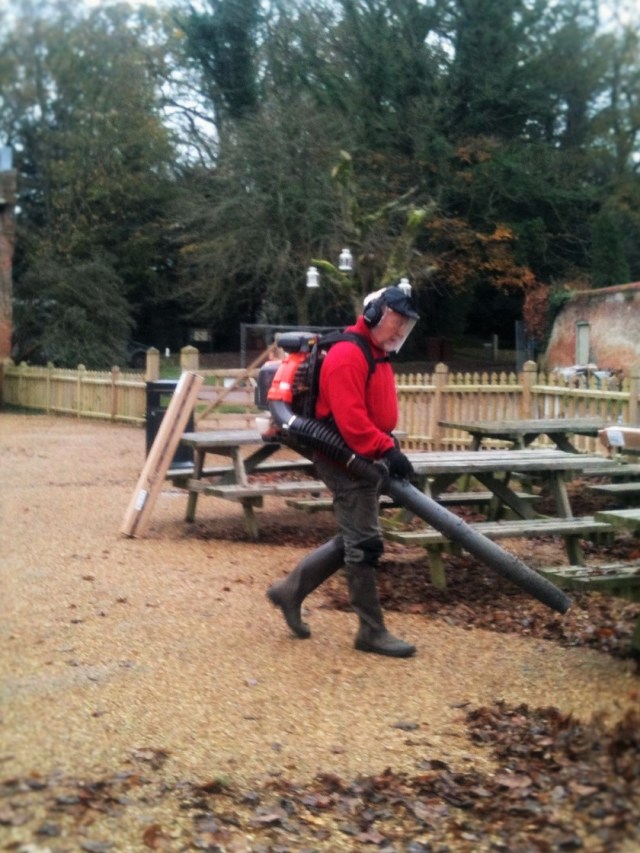 O.K. it’s me in there (captured by my wife on one of her walks)…and yes, it isn’t Ghostbusting (as my daughter suggested), but rather leaf blowing at Blickling this week!
 Ed took me through the machine for the day – a very powerful petrol-powered back pack blower which was a bit on the heavy side, especially after a couple of hours! But, moving in a line, Peter, Ed (who had an even more powerful trolley blower) and I managed to get the leaves ready for Ed to bring round the tractor with a powerful vacuum cleaner attachment to suck up and shred the leaves ready for dumping on the leaf mould pile.

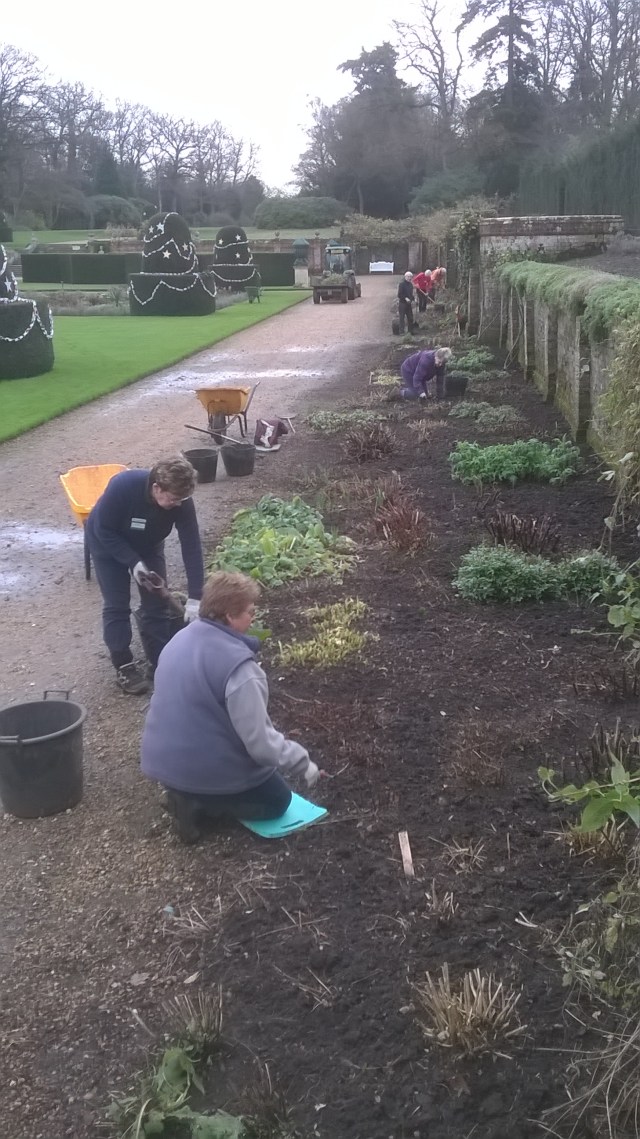
 The run up to Christmas with Blickling ‘Putting on the Glitz’ is starting to come together, and we also helped lift furniture in the courtyard where a fire pit, lanterns and other features look set to create wonderful centre piece. Staff and volunteers have been out decorating the Acorn Yews in the Parterre Garden and the traditional avenue of illuminated Christmas Trees looks wonderful once more. This year there is even a ‘Christmas Tree’ alight on the island in the lake.


 Old School Garden