Tag Archive: children


Two projects in the village of Cawston, Norfolk enabled me to ‘cut my teeth’ on designing playful landscapes.

Both were completed about 6 years ago and largely on a voluntary basis. I remain involved at the local Primary School, helping them with their School Gardening activities, but my early involvement was in designing, sourcing planting and organising the creation of an ‘Eco Park’ – basically to try and diversify the habitats and play opportunities in a bland, mown grass playing field with a solitary multi function play unit. The design features a curved mixed native species hedge (which is now over 2 metres high) and a haven for wildlife, several groupings of native trees such as Silver Birch, Hazel, Douglas Fir, Beech, Oak, Feild Maple, Mountain Ash and Black Poplar, and some areas of shallow mounding.

The planting has been used to create several different spaces, and grass within these has been left to grow long both to provide varied habitats and interesting play areas. In addition a ‘Nectar Bar’ of insect – friendly herbaceous and other flowering plants has been created alongside the school, including a painted pergola which both helps to privide shade to the south – facing side of the school and added planting interest.

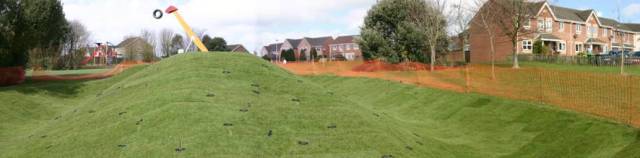
The second project involved working on commission for the Parish Council and a local charity to design, seek funding, consult local people and supervise the creation of a new play landscape at the ‘Oakes Family Field’ located to one side of the village. The design was constrained by the need to retain areas for cricket and football pitches and to avoid placing play areas close to housing on one side of the field. There is a mix of landscape features including a large mound (with a slide), timber play equipment for balancing and enclosed social areas, as well as a selection of traditional play equipment in two main areas, one for younger, one for older children. Over £100,000 was raised from various sources and so a wide range of play equipment and features has been possible.

Old School Gardener

If you’ve enjoyed reading this post and others on this blog, why not comment and join others by signing up for automatic updates via email (see side bar, above right ) or through an RSS feed (see top of page)?

Street play- winning out over the car…

Go-cart_STREET_PLAYArticle about residents in Colchester who have won permission to close their street to traffic for two hours every day so that their children can play outside.

  • Streets closed to cars for children who don’t have access to green space

  • Organisers hope it will help boost community spirit among neighbours

  • Similar schemes running across Bristol where idea was first mooted

Managing risk in play provision- free guide

Play England’s no nonsense guide on how to balance safety and challenge in play area design and management.

PicPost: Fairy Ladder

From: Growveg

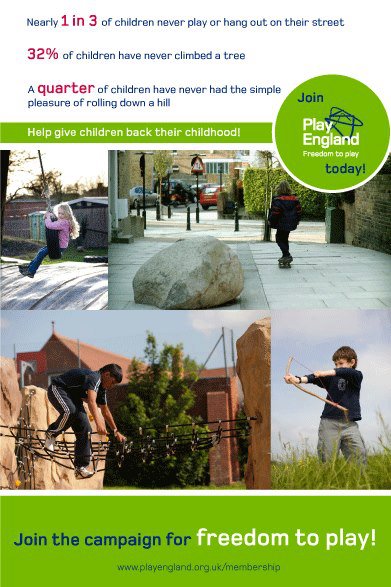
You can campaign for play

Join up at http://www.playengland.org.uk/membership

 Picture1

This steeply sloping, grass site in the Norfolk town of North Walsham is surrounded on all sides by housing and has areas of mature trees and scrub. I was commissioned by North Norfolk District Council to provide design, specifications, procurement advice and project management. The budget was around £60,000, funded by the Government Playbuilder Programme and local Housing Associations.

 Local consultation was undertaken by the Council and helped to inform the final design. The overall design concept was to enhance the parkland feel of the site and use large species trees to achieve a stronger organisation of spaces which are of general interest and which provide different play opportunities in keeping with the overall character of the site.

The objectives for the design were:

  1. Provide a wide range of play opportunities, including suitably challenging ones, for the target age range (8-13) and others if possible

  2. Reflect the results of local consultation in the overall design and play opportunities created

  3. Use manufactured play equipment and other design features to enhance the attractiveness and ‘parkland’ feel of the site

  4. Use the existing vegetation and topography to provide play opportunities where possible

  5. Improve pedestrian and wheelchair access to the site

  6. Ensure active play areas are at least 10 metres from residential property boundaries

The final scheme features a large turfed mound and ditches at it’s centre with an aerial cableway off one end of this. A multiplay unit is located in a crescent of existing trees. Other play equipment, football and basketball nets also feature. There are Log slices for stepping stones and seating etc. A new formal avenue of Limes and Red Horse Chestnut Trees was also planted.  The scheme was completed in May 2010.

Old School Gardener

PicPost: Emergency landing

Picpost: Great Garden @ Alnwick Castle

‘The Alnwick Garden is being created by Jacques and Peter Wirtz, celebrated international garden designers from Belgium.

In design terms it is fair to say that The Alnwick Garden pushes the boundaries, and this is due in no small part to the Duchess of Northumberland herself, who has always believed that almost anything is possible if you get the right people involved. Her original concept was to produce a garden design framework and then to bring in the specialists, the experts, the best in their field, to ensure that each individual garden and concept was cutting edge in terms of both design and technology.

The Garden is a place where the imagination can run wild and the element of surprise is everything. This is created not just by the imaginative design of The Garden as a whole, but the attention to detail which is apparent in every aspect of it and of the many features it contains.Water is the lifeblood of this garden….’

Source: Anwick Garden website

Inclusive Play Design Guide

Produced for the US play world by Let Kids Play, this Guide nevertheless includes some very useful ideas of wider relevance, especially on the layout and access to play areas and enriching the play experiences of all children, including those with some form of disability. Free download.

You can grow things that can be harvested before the summer holidays - if you start early enough and with the right varieties

You can grow things that can be harvested before the summer holidays – if you start early enough and with the right varieties

You’ve got a functioning School Garden and it’s going well. How do you keep it that way? Today’s post looks at top tips for managing and maintaining your School Garden.

Managing the children

  • Model behaviour in the garden – children need to be encouraged to be calm, watchful, focused, attentive and interested. Encourage reflective learning as children undertake informal activities in the garden – eg picking flowers for the school reception.
  • Mentoring – encourage children to act as mentors to younger, less experienced colleagues and perhaps have others with key responsibilities in the garden, e.g. for tool issue, checking and gathering. This will encourage learning – and reduce the work required of the Garden Coordinator!
  • Divide whole classes into smaller groups to allow for more in depth learning on more complex tasks and to avoid children tripping over each other in particular parts of the garden
Jobs like building 'bug hotels' and laying paths are best left to 'Garden Gang' days when you can get a good level of adult support for a few hours

Jobs like building ‘bug hotels’ and laying paths are best left to ‘Garden Gang’ days when you can get a good level of adult support for a few hours

Managing the garden

  • Be prepared – set aside time for planning gardening sessions. Use a robust book in which to plan and record lessons and reflect on what happened.
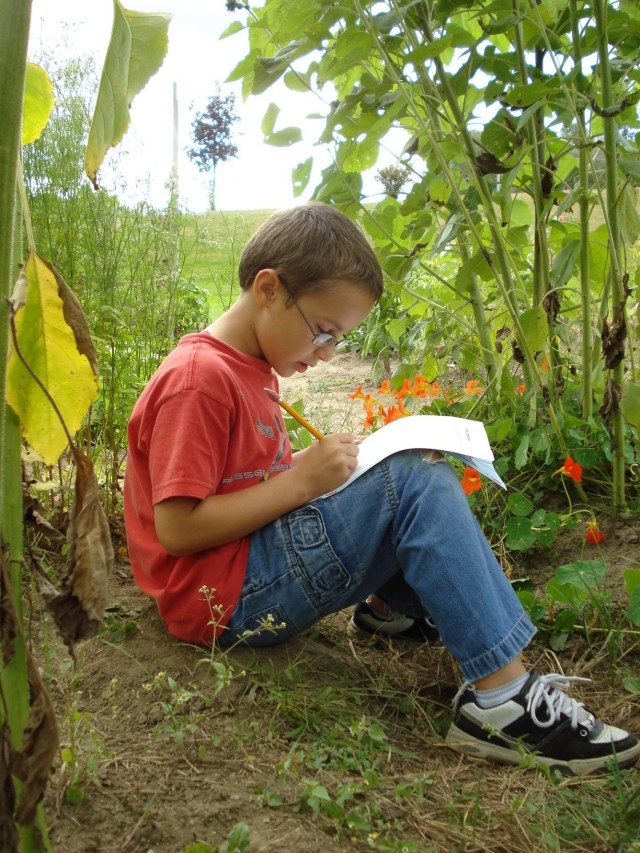
  • Make sure children take notes and regularly write up what they have been doing and learning in the garden, and encourage them to take ownership of it by contributing to its planning and management
  • ‘Garden gangs’ – schedule longer sessions of a few hours when parents and other volunteers as well as children can come in and do more substantial tasks in the garden – path or pergola building, greenhouse construction etc.
  • Look out for bargains or second hand tools and equipment – a local ‘freecycle” website or similar could be worth a look.
Taking notes

Taking notes and helping to plan for next year…

Maintenance

  • Make ‘rainmakers’ out of yoghurt or juice bottles – cut off the necks and make holes in the bottom. These can be filled from larger buckets of water around the garden and then used to mimic the gentle effect of rain. This avoids the dangers of over watering the plants (and the children!)  if watering cans or hoses are used. As plants mature you can use other, larger plastic bottles (with the bottoms removed and the necks plunged into the ground alongside the plant) – these can be filled with water (from watering cans) to get water to the plant’s roots.
  • Keep clean – have a suitable boot scraper/brush and mat outside the school, to avoid bringing mud into the building and havea suitable place to store boots (maybe on a trolley).
  • Plan for summer –  either grow things that can be harvested before the holidays (and replace these with a mulch or grow a ‘green manure’ to both cover and feed the soil); arrange special summer holiday activities which can also enable basic garden maintenance to be done, or arrange a schedule of parents and others who can come in over the holidays and water, weed etc. Perhaps get people committed to this at an end of term event or meeting. And you could use a combination of all three approaches!
  • Maintain a record of parent/ community skills and assets (diggers, power equipment, trailers etc.) which can contribute to the garden at different times.
Have somewhere children can wipe their feet off and store boots

Have somewhere children can wipe their feet off and store boots

Generating support

  • Give presentations at parent events and especially those for reception children, whose parents might be new to the school.
  • Ask for donations – unused tools or materials, or funding for specific items like a wheelbarrow.
  • Celebrate – have a spring garden party or other events during the year to celebrate your achievements and generate further support.

    Ask for unused tools and equipment for the School

    Ask for unused tools and equipment for the School

The final post in this series will look at ways of involving children in planting and nurturing the School Garden and what to do at harvest time, including cooking in the garden.

Other posts in the series:

Growing Children 5: Top tips for School Garden activities

Growing Children 4: AAA rated School Garden in Seven Steps

Growing Children 3: Seven tips for creating your dream School Garden

Growing Children 2: Seven Design tips for your School Garden

Growing Children 1: School Garden start up in Seven Steps

School Gardening – reconnecting children and Nature

Source & Further information:

How to grow a School Garden’ – Arden Bucklin-Spooner and Rachel Kathleen Pringle, Timber Press Books

School Gardening Club- ideas

Budding Gardeners- lots of advice and info

Garden planner tool

Planning your school garden

Food & Agriculture Organisation School Garden Planner

California School Garden Network Guide to School Gardening

School Gardening Wizard

School garden fundraising

Garden Organic support for schools

Old School Gardener

If you’ve enjoyed reading this post and others on this blog, why not comment and join others by signing up for automatic updates via email (see side bar, above right ) or through an RSS feed (see top of page)?

Finding Nature

Nature Connectedness Research Blog by Prof. Miles Richardson

Norfolk Green Care Network

Connecting People with Nature

Discover WordPress

A daily selection of the best content published on WordPress, collected for you by humans who love to read.

Susan Rushton

Celebrating gardens, photography and a creative life

Unlocking Landscapes

Writing, photography and more by Daniel Greenwood

Alphabet Ravine

Lydia Rae Bush Poetry

TIME GENTS

Australian Pub Project, Established 2013

Vanha Talo Suomi

The Journey from Finnish Rintamamiestalo to Arboretum & Gardens

Marigolds and Gin

Because even in chaos, there’s always gin and a good story …

Bits & Tidbits

RANDOM BITS & MORE TIDBITS

Rambling in the Garden

.....and nurturing my soul

The Interpretation Game

Cultural Heritage and the Digital Economy

pbmGarden

Sense of place, purpose, rejuvenation and joy

SISSINGHURST GARDEN

Notes from the Gardeners...

Deep Green Permaculture

Connecting People to Nature, Empowering People to Live Sustainably

BloominBootiful

A girl and her garden :)