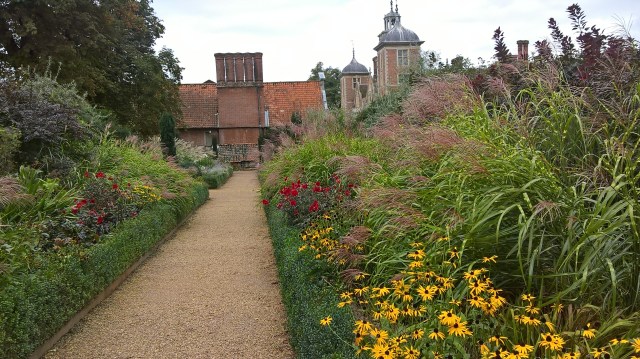
Tag Archive: autumn


wp_20161013_15_48_01_proThis week it was a concerted effort to cut back and tidy up the hedge that runs along the ‘ha ha’ on the northern boundary of the gardens at Blickling.

The hedges that run along the ha ha, backed by a wire fence for security, are a bit of a bone of contention. Some are pretty consistent (like the one that was cut back this week- it’s mainly Beech), but others are a real mixture of different hedge plants and hedge plants that want to grow into trees (especially Sycamore). And in some places the hedge has grown out to reduce the space between it and the fence which makes it almost impossible to get in alongside with a strimmer to keep the undergrowth down.

If I had my way I think it would be worth spending time to grub them out completely, as they perform no useful security role, but take  a lot of maintenance if they are to be kept in a reasonably tidy state. Of course they are of value to nature (as nesting sites and food sources for birds) and I must say gardeners Ed and Rob did make a nice job of cutting back the northern hedge so that it should, hopefully sprout forth with new life next spring.

wp_20161013_11_55_59_pro

After cut..looking a bit of a mess….?

Anyway, our session involved finishing off cutting back the hedge and its immediate surrounds and then ‘feeding the wolf’ that is the industrial scale shredder. By the end of the morning, having brought up all the brashings from the hedge to the path above the ha ha the shredder had finished its first pass.

After lunch we tidied up the last few cuttings and then moved on to finish off the hedge at its steepest descent from the path. An earlier attempt at cutting this area had been halted as a wasp’s nest had been discovered. Despite the wasps still being active, gardener Rob proceeded to cut the remaining hedge back…only to disturb the wasps and get attacked for his efforts! A few stings later (one on the head seemed to be especially painful), Rob paused for thought…and we gingerly tidied up as much as we could, but staying well away from the wasps, until the nest can be properly dealt with.

All told it had taken Gardeners Ed, Rob, Rebecca and Jane plus half a dozen volunteers virtually all day to complete the job. But it does look tidy, if bare- the hedge has been drastically reduced in height and girth, and hopefully is back to a manageable size. Now will the next stage be to tackle the east and southern boundaries, or would that be a hedge too far….?!

Further Information:

Blickling Hall website

Blickling Hall Facebook page

A 360 degree tour of Blickling Hall

Old School Gardener

wp_20160929_13_42_00_proBack to Thursday at Blickling this week. An interesting, if not particularly tiring day helping to erect the new fruit cage that I thought might have been up already!

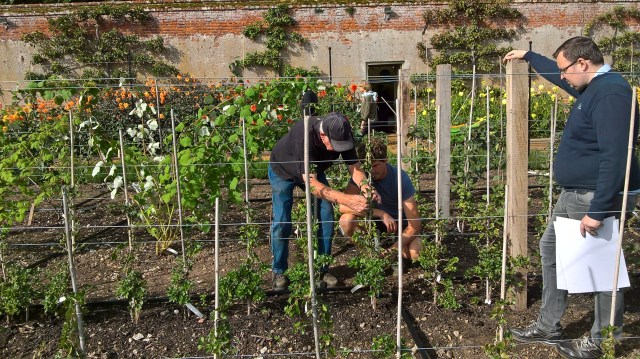
I’m not sure about why there had been a delay, but no matter, it was an enjoyable day working mainly with Project Manager Mike, Gardeners Ed and Rebecca, Norfolk Peter and a couple of guys sent over by the supplier to help.

Reminiscent of the task we had putting in the oak posts to support the raspberries, this involved lining up the posts, sinking receivers into the ground for the powder coated posts and then fixing the cross rails, making sure all were vertical and level as we went. We finished off with some corner braces to fix the outer posts rigid. The cage had been specially made to fit the irregular shape of the fruit bed, so I spent some time sorting out the different lengths of cross rail and placing them ready to be fitted.

Underway...

Underway…

After lunch I took a different route back to the Walled Garden; the sun was out and people were enjoying a late summer day by the lake…

Back to cage fighting! After a few moments of cursing at posts that wouldn’t stand straight or rails that weren’t level, with the aid of a sizeable rubber mallet and spirit level, we were able to ensure the structure looked neat and tidy. There was also a good standard of ‘garden banter’ on offer!

..near the end..of our tethers?!

..near the end..of our tethers?!

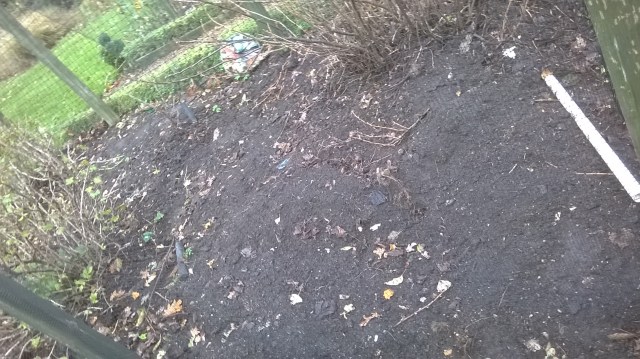
By the time I had to leave the bulk of the cage was up, leaving just one side to be put in. I think Mike is going to put the side netting on, but in case of heavy snow this winter, is leaving the roof off until the spring. I also had a spare ten minutes so I weeded the large piles of compost waiting to be put on the ground as mulch.

I also had the chance to speak with Mike about one or two matters I raised in last week’s post. First, I was right about the new compost bins- they are designed as ‘hot bins’ so don’t need any extra aeration. Mike tells me the temperature in the middle is already up in the 70’s fahrenheit! Second, he does plan to put in some green manure on the pumpkin beds, but it looks like its getting a bit late to sow any but a variety of grazing rye, so we shall see. I noticed that the beds had already been dug over following my clear up last week.

Ready for rye...

Ready for rye…

Today was the beginning of ‘sign up’ for the series of winter talks put on for volunteers here- a great idea. I’ve signed up to hear Mike talk further about the Walled Garden and also Assistant Head Gardener Steve, who is sharing his many year’s memories of working at Blickling….that should be ‘interesting’…

Further Information:

Blickling Hall website

Blickling Hall Facebook page

A 360 degree tour of Blickling Hall

Old School Gardener

wp_20160921_12_28_07_proI went in to Blickling on Wednesday this week and worked with Peter and Maurice clearing away the piles of pumpkin and squash greenery left behind after the previous day’s volunteers had harvested a fantastic array of squashes and pumpkins.
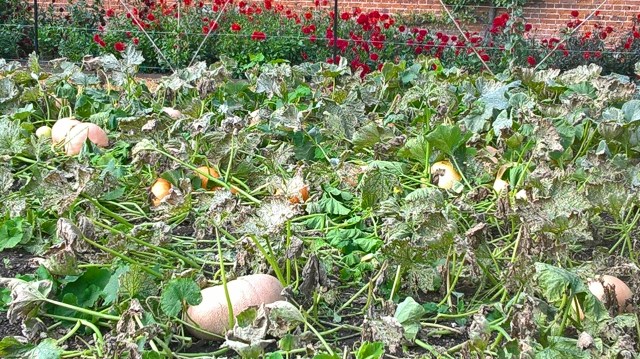
Some of the squash beds awaiting harvesting and clearing

Some of the squash beds awaiting harvesting and clearing

I was excited to see another wooden structure in the far corner of the Walled Garden- three new compost bins with removable, slatted fronts and panelled lids. These will be a great addition to the garden and reduce the need to transport piles of compost from the main dumping ground on the other side of the gardens.

The new compost bins

The new compost bins

I was initially puzzled to see no gaps in the sides fo these new bins as I thought they would be necessary to allow some air to get into the bins. However, on reflection, I think the theory might be that the amount of material, and with regular turning, these bins will be ‘hot’ bins creating usable compost within a matter of a few months. Mike, the Project Manager wasn’t around to clarify this, so that’ll be a question for next week’s session. As we were finishing off the clearing up, a couple of young children and their parents wheeled a couple of mini barrowfuls of material over to help us!

wp_20160921_11_23_58_proIn the remaining hour before lunch we hoed and stone picked around the soft fruit bushes, where, Assistant Head Gardener, Steve, told us that new fruit cages were to be erected the following day. I look forward to seeing these in place next week.

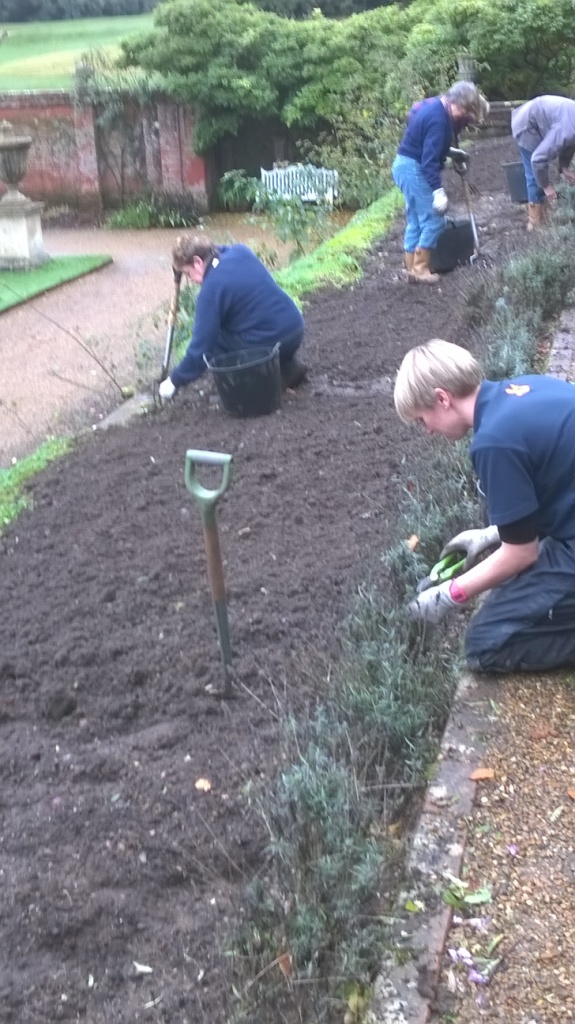
After lunch Maurice and I hoed across the pumpkin and squash beds to tidy them up. I think Mike plans to sow some green manures in these over winter. I hope so, as I’d be interested to see how this would look and what it would do to protect and add to the nutrients in the soil.

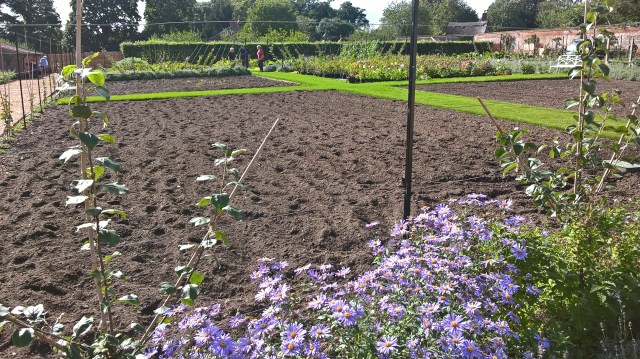
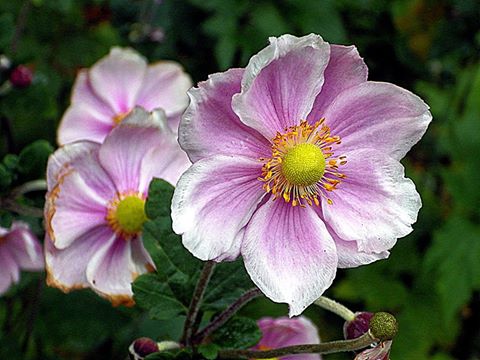
The Dahlias are continuing to put on a good show, and I noticed that the cyclamen were in full bloom just outside the Walled Garden.

We had plenty of visitors in the Walled Garden, and many stopped to chat and ask questions, as well as praising everyone’s efforts. One chap asked me what the difference is between a gourd and a squash…hmm after a quick thought I offered the view that they are different types of the same sort of plant, the gourd possibly being more of a climbing variety…As it turns out I wasn’t quite right, as this very helpful advice from the site Missouri Botanical Garden explains:

‘Pumpkins, squash and gourds are members of the enormously diverse Cucurbitaceae family, which contains more than 100 genera and over 700 species.  They have been providing mankind with food and utilitarian objects since before recorded history.  Various members of the genus Cucurbita are known as squash or gourds.

Names differ throughout the world, but in the United States, any round, orange squash used for pies or jack-o-lanterns is likely to be called a pumpkin.  But the term “pumpkin” really has no botanical meaning, as they are actually all squash.  Squash are divided into two categories: tender or summer squash, and hard-skinned or winter squash.  Examples of summer squash include zucchini, pattypan, straightneck, crookneck and other types.  Winter squash include small to medium hard-skinned squash such as the acorn, small hubbard, miniature pumpkin and spaghetti types, as well as the large hard-skinned types, including banana, butternuts, cheese pumpkins, cushaws, and large hubbards, among others.

Botanists use distinctive characteristics of leaves, seeds and fruit stalks to classify the different species.  The origins of these species are lost in time, but all are assumed to have originated in the Western Hemisphere, principally South and Central America and Mexico.  Variety selection for the many distinct shapes, sizes and colors has occurred in all cultures worldwide….

Gourds are defined as hard-shelled durable fruit grown principally for ornament, utensils and general interest….

Hardshell gourds remain green throughout the growing season, but dry to a brownish-tan when fully cured.  They have traditionally been utilized as bottles and containers for liquid and dry materials, as well as food, medicine, musical instruments, artistic media and many other uses.

Like the squash, cultivar selections in various shapes and sizes have continued from prehistoric times to the modern era.’

wp_20160921_12_28_39_proFurther Information:

Blickling Hall website

Blickling Hall Facebook page

A 360 degree tour of Blickling Hall

Old School Gardener

Picture by Colin Garratt

Picture by Colin Garratt

Old School Garden – 31st December 2015

Dear Walter,

It was great seeing you and Lise over Christmas and we hope you had a wonderful time with your nearest and dearest. As you know, my time in the garden has been limited this month as I tried to finish off the major redecorating in one end of the Old School. I’m pleased to say that’s done and I’m now developing detailed plans to fit out a couple of rooms with some built in furniture. Alas, my plans for the outside are moving slowly, though there’s been a bit of progress I can report.

Dogwoods starting to put on their winter colours

Dogwoods starting to put on their winter colours

We had a few hours cutting up the fire wood we’d saved from the major tree surgery on our Black Poplar a couple of years ago, and this is all now stacked in the woodshed. At the same time I reorganised the outside storage area (with pallets and angle irons), in anticipation of getting some new logs from our neighbours (who have some Ash trees that have fallen foul of Ash die back).

Awaiting logs (left) and a new leaf mould bay (right)

Awaiting logs (left) and a new leaf mould bay (right)

I’ve built alongside (using more pallets of course!) a leaf mould bay, which in the summer will also serve as a good spot for the grass clippings. As you know, in the past I’ve deliberately mixed these two materials together and had some good organic material to add to the soil. Gathering up the final loads of leaves from around the garden has been the other major task this month, though there are a few stubborn oak leaves still to fall. This minor reorganisation in the rear garden area has started to tidy it up, and so I can get to grips with further spring planting in the area with a nice view to the church (where I plan to put another bench).

WP_20151218_09_11_38_Pro

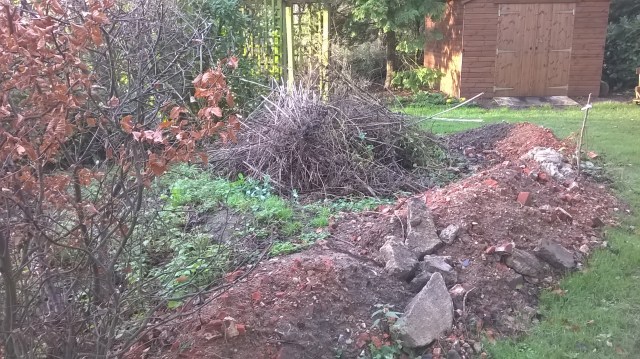
A work in progress- rubble from one of the shed floors used to begin sculpting a basin for the pond garden…

New possibilities- the view across fields to the church is crying out for a bit of organisation, including a new bench.

New possibilities- the view across fields to the church is crying out for a bit of organisation, including a new bench.

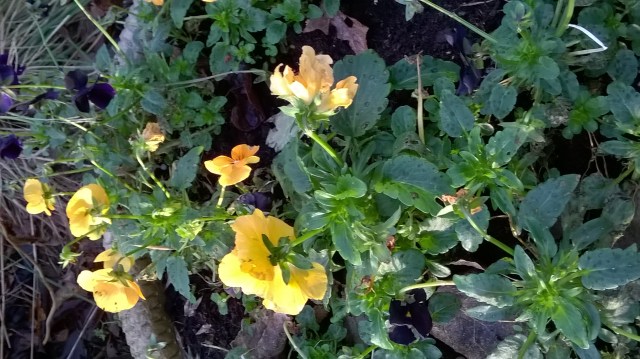
I’ve also potted up the cannas (but not yet the dahlias as it’s been so mild here), and planted up the pots they were in with some violas and a range of tulips and other spring bulbs- we should have a great show next spring.

I’ve cleared and planted up the front circular border with the rather ‘whippy’ selection of Wallflowers and Sweet Williams I sowed earlier in the year. I also took the opportunity of swapping over the centre piece shrub here; out came the Star Magnolia and in went another Magnolia (‘Merrill’), which will grow a bit larger than the one it’s replaced and so be a better counterbalance to the large magnolia we have on the other side of the drive. So the Star Magnolia is in a pot for now until I decide it’s final location, somewhere in the pond garden.

Not much to look at right now, but the round border tidied and planted out with a new Magnolia and some spring colour- I hope!

Not much to look at right now, but the round border tidied and planted out with a new Magnolia and some spring colour- I hope!

The table top planter- good early growth, but a bit of weeding required too!

The table top planter- good early growth, but a bit of weeding required too!

The kitchen garden is looking tidier, too, though without much of interest as you might expect. I’m pleased with the progress of the table top planter, though; the unseasonably mild weather has really got the shallots, garlic and broad beans well underway.

You know how in Autumn and early winter you can pick up some plant bargains (the ones that are past their best, but will nonetheless put on new growth if looked after)? Well, I picked up a few trays of violas to fill my ever increasing containers and at the same time got three pots of Pennisetum, reduced to well below their original price- they don’t look much at present, but with a bit of spring care and potting on/ planting out, should do well.

A plant bargain

A plant bargain

Violas starting to pick up

Violas starting to pick up

I spent a couple of sessions over at Gressenhall focusing on leaf clearing, cutting back and digging over some of the borders, so that will probably be my last time there for now.

One of my jobs in the next couple of weeks will be to finalise the marketing material for my new Garden design course, which hopefully will begin in early February at Blickling. I’ll put details in a page on my blog early in the New Year for anyone interested.

WP_20151218_09_15_22_ProWell, as we come to the end of another year, I’m grateful that the garden here seems to have survived pretty well, despite less attention than normal; but the ground elder awaits and this and the other weeds will need attention in a couple of months time before the growing season really gets underway! 
Very best gardening wishes for 2016,

Old School Gardener


WP_20151126_13_41_03_ProYet more strimming this week in my latest session at Blickling!

The ladies finished off planting the blue Hyacinths in the top borders. Remember the new trailer I mentioned last time? Well it seems it will be kept, but an additional ramp is to be supplied to make the gradient shallower for wheelbarrow-carrying gardeners and some better grip added to the surface.

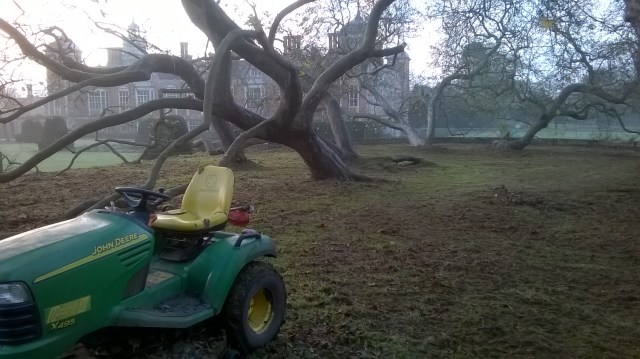
Peter and I moved across to the wonderful Oriental Plane trees and began strimming the undergrowth around these. I plumped for a large area where the rangy branches of several trees had extended their long spider-like legs. I had got about half way when gardener Ed appeared and suggested I use a ride-on mower to do most of the open grass – another bit of ‘kit’ I’m now able to use and it certainly speeded up my progress and at the same time turned the mix of leaves and grass into a finer mulch which will hopefully break down over the winter.

200 year old Oriental Planes after strimming and mowing...

200 year old Oriental Planes After strimming and mowing…

The weather was a little misty to begin with but the sun eventually shone through and it’s low angle provided some long shadows and definition to the garden features. One of these, the fountain that was being cleaned a week or two ago, is now wrapped up to prevent frost damage during the winter.

Wrapped up for Christmas...and beyond. The central fountain gets its frost proof cover.

Wrapped up for Christmas…and beyond. The central fountain gets its frost proof cover.

I gather from head gardener Paul, that money has been found to restore the gardeners’ bothy in the walled garden (to provide an additional base for the garden volunteers and staff) and also to renovate the second long glasshouse.

The Walled garden project seems to be gathering pace and next growing season will hopefully see the majority of the space turned over to food production. Current projects include finishing off the path edging (to be completed by contractors in the New Year), and putting up the wooden and wire supports for the wall-trained fruit (you may remember that measuring the lengths of wire and wood needed for this was one of my first jobs back in January).

I hope to get back into the walled garden again soon, but in the next few weeks all attention is being turned to ‘dressing’ the gardens for the Christmas celebrations at the Hall; ‘Putting on the Glitz’ seems to be the theme, as the place is turned back to the glamourous 1930’s.

WP_20151126_13_39_58_ProFurther Information:

Blickling Hall website

Blickling Hall Facebook page

A 360 degree tour of Blickling Hall

Old School Gardener


Some of this year's squash harvest- should keep us going for a few weeks.

Some of this year’s squash harvest- should keep us going for a few weeks.

Old School Garden – 29th November 2015

Dear Walter,

As we move towards winter, this month has been one of small steps forward, old friend. We had our first frost last week, and I managed to get the tenderest plants under cover in the greenhouse.

Tucked away from the frost...

Tucked away from the frost…

I’ve noticed that the leaves on the Cannas have started to brown so it won’t be long until they and the Dahlias are also brought in. I won’t be cutting down or removing much else as I like to see the grasses and many herbaceous stems stand over winter- I think this is also good for wildlife.

Cannas on the turn- soon to be dug up and replanted in the greenhouse

Cannas on the turn- soon to be dug up and replanted in the greenhouse

The piles of leaves continue to grow, and though many have fallen, there’s still a lot of oak to float down and then be gathered up. I’ve already cut back and placed most of the Pelargoniums into trays for over wintering and once the remaining pots on the terrace are empty, I’ll plant out the four or five packs of tulips I have in the shed.

Tulips ready to go in some of the other terrace containers and borders

Tulips ready to go in some of the other terrace containers and borders

In the kitchen garden I’ve pulled the remaining carrots- they are a well-sized and tasty crop. The parsnips and a few leeks are all that remains for winter vegetables, with the promise of Purple Sprouting Broccoli to come in spring. As I reported last month, I’ve used my latest batch of compost to mulch the fruit bushes, strawberries and raspberries and added some manure over the rhubarb and asparagus bed, which hopefully might give us a few spears next year.

I dug up one of the remaining two blackcurrant bushes the other day and took this in to the local Primary School, where I was helped by 7 pupils to divide it and plant it out in their developing fruit garden. It was fun to be back among some familiar (if older) faces and they were very responsive and involved in the hour we spent talking about roots, stems, water and so on.

Awaiitng a Redcurrant, to go alongside White and Black!

Awaiitng a Redcurrant, to go alongside White and Black!

So, here we’re left with one large blackcurrant bush (after having three for several years – the freezer is still bulging with the last few year’s crops). I’m now waiting on the arrival of some bare root red currant and raspberry canes at the local nursery, so that I can fill out the summer fruiting raspberries and replace the blackcurrant, which will give us one each of Red, White and Black currants.

Looking ahead, my friend Steve volunteered to order me some seed potatoes, so I’ve gone for some first and second earlies which should be here for ‘chitting’ in January. I also recently ordered some seeds from the RHS scheme for members, which is good value for money. With the seeds I purchased on my visit to Wallington Gardens in September (as well as some harvesting at other gardens we’ve visited), I can see that February will be a busy time (as usual), propagating a new range of interesting flowers for the borders; including one ‘long wanted’ variety,  Cephalaria gigantea.

My Pond garden project is moving ahead slowly, with the reclamation of some large York stone flags from one of our outside sheds (we’ve had a new concrete floor put in here to replace the stones) and the use of the stony soil from under these to build up the surrounds of the pond area. Before going much further outside on this I want to firm up my design on paper, so the drawing board is out again and I’m sketching out some ideas, including a stepping stone bridge (this is what some of the flagstones will be used for), boggy borders and a ‘beach’. My collection of plants for this area is growing nicely so I’m factoring these into the design too.


On a broader front, I went over to Gressenhall the other day and began to clear up for winter (including some overdue shearing of the lavender and leaf clearing) and planted out some Catmint I took out of the courtyard planters at Old School Garden. Together with the new plants I purchased recently these will make a good show in a number of half barrel planters we have there.

You’ll have also seen something of my regular visits to Blickling Hall, where the winter clear up and preparation for next season is well underway. Did I tell you that I’m hoping to run a new Garden Design course at Blickling? Based on the one I’ve run in the past at Reepham, it will be slightly extended but will still focus on helping participants to design their own garden or area. I hope for a good level of interest, especially as we shall be able to use the gardens at Blickling as a showcase for many of the ideas and concepts I’ll be covering. If I get the numbers I need this will begin in early February.

Having just replaced the broken glass in our wood burner I think its time to light it and get something to drink!

Very best wishes,

Old School Gardener


WP_20151112_14_20_33_ProThe ‘dynamic duo’ of Peter and I continued with strimming the avenues and connecting paths in the outer gardens at Blickling this week.
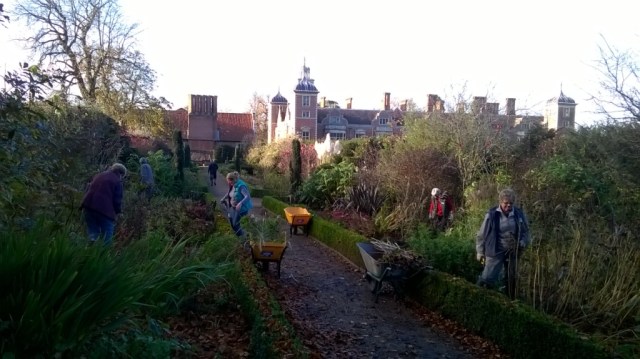
I arrived to find the gardeners and Peter gathered around a large, new trailer which had just been delivered. I later looked this over and had an interesting discussion about its features and how useful an addition it was going to be to the gardeners’ armoury….

Hmm...big, shiny, but how useful?

Hmm…big, shiny….

The ladies, meanwhile were finishing off cutting back and clearing the double borders, which only a few weeks ago had been resplendent in their late summer colours.

Cutting back the double borders on a beautiful autumn day

Cutting back the double borders on a beautiful autumn day

Having adjusted the belt on the strimmer I found I was really getting into my stride (or should I say ‘swing’?) with this useful machine- it was rather like old-time scything but without the muscle power needed for that. However, it was sweaty work clearing around trees and the edges of shrubs  where the mowers can’t reach.

After lunch I had an interesting chat with gardener Ed and Peter about the way the avenues of Beech, Oak and other trees have to be regularly cleared of fast-growing understorey trees and shrubs such as holly, yew and rhododendrons. The impact of letting these plants over grow the trees was evident in the bent over trunks of some examples (or ‘on the huh’ as we say in Norfolk!).

The maintenance plan involves every year or so stooling (or coppicing) these vigourous plants and so maintaining  space around the avenue trees. As Ed pointed out, there are some clear examples of where action is going to be required in the near future, so perhaps Peter and I will be moved on to chain saws soon!

Blickling has a new website, why not take a look at the link below?

A virtually deserted garden at a sun-scanned Blickling..

A virtually deserted garden at a sun-scanned Blickling..

Further Information:

Blickling Hall website

Blickling Hall Facebook page

A 360 degree tour of Blickling Hall

Old School Gardener


WP_20151105_12_20_46_ProMore strimming this week in my short session at Blickling.

The ladies were whisked away to pull up the Penstemons for over wintering and to make way for next spring’s display of Hyacinths.

WP_20151105_12_29_36_ProFellow volunteer Peter and I were sent to the wider gardens where the grass had been mown a few days before, but where the mower couldn’t go, we were to strim away the long grass around tree trunks and edges etc. There are several avenues of beech and other trees radiating away form the more formal gardens area and we worked our way along and around these.

As I’ve reported before, these strimmers are pretty strong and use a plastic-sheathed metal cord which is quite capable of cutting through pretty thick stems as well as grass. We were mindful of this and were careful not to go too near the trunks of the trees for fear of ‘ring-barking’ them, which causes wounds that are open to disease and rot.

WP_20151105_12_21_22_ProThe Hall has now closed for the winter (apart from special events and group visits) and the gardens are on shorter opening hours. The last colour of flower has now pretty much disappeared and the focus in the gardens is on cutting down, pulling out, dividing and mulching in preparation for winter.

Further Information:

Blickling Hall website

Blickling Hall Facebook page

A 360 degree tour of Blickling Hall

Old School Gardener


Sizergh Castle, Cumbria- picture via National Trust

Sizergh Castle, Cumbria- picture via National Trust

Finding Nature

Nature Connectedness Research Blog by Prof. Miles Richardson

Norfolk Green Care Network

Connecting People with Nature

Discover WordPress

A daily selection of the best content published on WordPress, collected for you by humans who love to read.

Susan Rushton

Celebrating gardens, photography and a creative life

Unlocking Landscapes

Writing, photography and more by Daniel Greenwood

Alphabet Ravine

Lydia Rae Bush Poetry

TIME GENTS

Australian Pub Project, Established 2013

Vanha Talo Suomi

The Journey from Finnish Rintamamiestalo to Arboretum & Gardens

Marigolds and Gin

Because even in chaos, there’s always gin and a good story …

Bits & Tidbits

RANDOM BITS & MORE TIDBITS

Rambling in the Garden

.....and nurturing my soul

The Interpretation Game

Cultural Heritage and the Digital Economy

pbmGarden

Sense of place, purpose, rejuvenation and joy

SISSINGHURST GARDEN

Notes from the Gardeners...

Deep Green Permaculture

Connecting People to Nature, Empowering People to Live Sustainably

BloominBootiful

A girl and her garden :)