Category: Wildlife and Nature


Recording wildlife near you

01 February 2013

Recording wildlife near you

This isn’t a strange safari group, but a request from Cambridgeshire and Peterborough Environmental Records Centre (CPERC) to help increase wildlife records across the county. Thanks to a grant of £40,400 from the Heritage Lottery Fund, CPERC have been running a recording project to help communities recognise and record their wildlife, which has already led to an increase of over 2,500 extra records from the general public in 12 months – more than 20 times what was submitted in 2011!

Although a year through this eighteen month project, there is still a lot to do and plenty of chances to get involved. CPERC’s Biodiversity Outreach Officer, Jane Andrews-Gauvain, explained:

We are extremely grateful to everyone who helped us record species last year, they did a fantastic job! We only have six months left, but we feel sure with help we can double our public records for last year in that time! There are plenty of opportunities for anyone to get involved, both in recording species near you (whether in your own garden, or out and about in the beautiful Cambridgeshire countryside with friends) and in surveying larger areas, particularly in Fenland District and east Peterborough. It doesn’t matter what your expertise are as there is training available and we can provide help with transport, all you need is an interest in wildlife and a bit of patience.

Toad and Frog Spotting
Toads and frogs are the first species CPERC want help recording as the weather warms up. CPERC are teaming up with Froglife and the Cambridgeshire and Peterborough Amphibian and Reptile Group (CPARG) to record these species. CPERC would like to hear from you if you are happy to just record when you see them hopping about, to let them know if your pond has frog spawn in, to help search for the species’, or to help at a Toad Crossing.

Specialist Training
Thanks to the Heritage Lottery Fund and support of several wildlife organisations and county naturalists, there is a chance for members of the public and organisations to learn about recording and identifying bats, butterflies, dragonflies, otters, water voles and several other species in Cambridgeshire. If you want to have this opportunity, make sure you contact CPERC!

Further details
To ensure you get all the latest information about events and how you can help, contact Jane Andrews – Gauvain on 01954 713572, or email jane.andrews-gauvain@cperc.org.uk.

You can find out more about ‘Recording Wildlife’ and see events coming up on CPERC’s website,www.cperc.org.uk and their Facebook page www.facebook.com/cperc and to find out more information about Toad Crossings and Toad patrols go to www.froglife.org/toadsonroads/

From Cambridgeshire Action for Communities in Rural England

Old School Gardener

moth on leafA new report charting the numbers of moths in Britain over forty years makes grim reading. Climate change and habitat loss are driving some to extinction – especially in southern Britain.

Moths are perhaps not as popular as butterflies. But they are an important ‘indicator’ of how our native ecology is faring, a significant pollinator and source of food for birds, bats etc. Whilst many are subtly coloured, others are as eye-catching as their cousins.

The Butterfly Conservation report  says that two-thirds of common and widespread larger species of moth (macro-moths) declined in the last 40 years, most seriously in southern Britain. The report suggests that the decline in habitats through development and agricultural practices are the factors behind the decline in the south, whereas it sees climate change (a gradual warming) as a key factor in the broadly neutral results in the north – declines in some species have been matched by increases in others.

And climate change is also the explanation behind the growth in new species in the country. More than 100 species have been recorded for the first time in Britain this century and 27 species have colonised Britain from the year 2000 onwards. However, the report says that three species have become extinct in the last 10 years and three more are at serious risk of extinction, having already declined by more than 90% in the last forty years.

What can gardeners do to create the right habitats for moths? The Royal Horticultural Society makes several suggestions about planting.

  • Night-flowering, nectar-rich plants, such as Nicotiana (Tobacco plant) and Evening Primrose (Oenothera) have evolved to feed night flying insects – and the wonderful evening scent of some is a bonus for any garden
  • Day flying moths can be served by plants such as Sea Lavender, Buddlejas, Red Valerian and Lychnis
  • It’s also important to provide food for caterpillars with plants such as Clarkia and Fuchsia. leaving a ‘wilder’ area of the garden with longer grasses, thistles and knapweeds will benefit smaller moths. Many native trees, hedges and ornamental plants also provide food sources fo moth caterpillars.
Garden Tiger Moth caterpillar

Garden Tiger Moth caterpillar

Kate Bradbury suggests:

‘Avoid using pesticides to give their caterpillars free rein on your plants (which will mostly only be nibbled a bit – so don’t worry).’

The website Mothscount says we also need to tolerate some untidiness in our gardens:

‘Moths and their caterpillars need fallen leaves, old stems and other plant debris to help them hide from predators, and especially to provide suitable places to spend the winter. It’s very helpful to delay cutting back old plants until the spring, rather than doing it in the autumn, and just generally be less tidy. If you want your garden to look tidy in the summer, try leaving some old plant material behind the back of borders or in other places out of sight…..’

All green form of the Red - Green Carpet Moth'

All green form of the Red – Green Carpet Moth

Further information:

Back Garden moth.org

Winners and losers in latest butterfly survey – 7 tips for gardeners

Old School Gardener

If you’ve enjoyed reading this post and others on this blog, why not comment and also join some other people and sign up for automatic updates via email (see side bar, above right ) or through an RSS feed (see top of page)?

sethsnap's avatarsethsnap

The moon, clouds and wind were on stage last night here in Ohio.  The moon and clouds danced to the howling song of the wind.  They gracefully interacted in ways that only two lovers could.  The intimacy, passion and chemistry enveloped all who saw and implanted wild and adventurous dreams which were to be realized, though not remembered, later that night in the deepest of sleep.

Visit my store.Visit my galleries.

View original post

Tamara Jare's avatarMy Botanical Garden

image

image

image

image

image

image

This morning I’ve found these fantastic floral patterns on windows of my car.And I was astonished again by the simple fact, that actually the geometry of the water molecule determines the beauty of the crystals to be formed. Very the same as in the live world of nature-the geometry of molecules as the constituents determines the final beauty we admire. Obeying physical laws of our universe the beauty of flowers, be in frost or those in the garden is determined in advance and inevitable .Means all this beauty is hidden in math, physic, chemistry……..

View original post

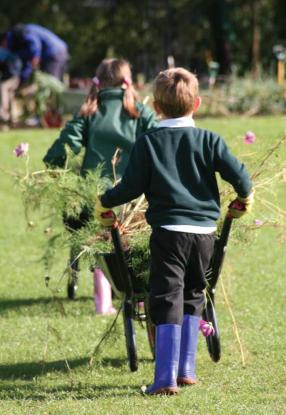
child with wheellbarrowAcross the developed world there is concern about a growing ‘disconnect’ between children and the natural world around them – increased time spent indoors, less time out playing – the scenario is well reported. School gardening projects are an important way to reconnect children with nature.

School gardening, like ‘growing your own’ seems to be on the increase in the UK as we look for ways of bridging the ‘ecological disconnect’, saving money, reducing ‘food miles’, improving food quality and strengthening local economies. There’s powerful evidence that school gardening is one, convenient and effective way of ‘learning outside the classroom’. A way of helping to engage children with the natural world and to deal effectively with some other important issues at the same time by:

  • raising academic achievement
  • promoting healthy eating
  • instilling a sense of responsibility for the world around us
  • encouraging social and community development and a ‘sense of place’
  • providing a place for unstructured, imaginative play

In Norfolk, England, the voluntary group of Mastergardeners is playing its part in supporting around 20 schools and many others are waiting to connect with a suitably trained volunteer in their area to develop new school gardening initiatives.

I’ve been helping a primary school to develop its school garden, which now has several raised planting beds (one for each class) and a recently completed wildlife pond with dipping platform and boggy planting areas. I tried to engage the children in growing food with a short session about the food they like to eat and where it comes from, why growing our own is important and the different types of fruit and veg we could grow. We ended up with each child making their own paper pot and sowing a broad bean seed – these were later transferred by the children to the school garden and formed a wonderful source of ‘free sweets’ during the summer!

making paper pots - an easy way to get children involved in 'growing their own'

Making paper pots – an easy way to get children involved in ‘growing their own’

The whole community– governors, staff, parents, children, local businesses together with ‘shopping voucher’ and grant schemes have played their part in creating this valuable resource. The new gardening year is about to kick off with a ‘Garden Gang’ (parents, children, staff and friends of the school) session on Saturday to get the beds ready, complete the greenhouse (made out of canes and plastic bottles) and plant some new apple trees.

Other Mastergardeners are playing their parts around the County. This includes several new and more established gardens at secondary and primary schools and a novel ‘inter – generational’ project in Norwich, where some spare ground behind a library has been turned into a food growing plot by children from a local school, library staff and older people from a sheltered housing scheme overlooking the site.

One secondary school gardening coordinator recently wanted to introduce children to the ideas of ‘veg families‘ and crop rotation. She printed out 56 small veg pictures and separate names – the first task was for the students to ID the veg. Then they looked at veg families (with the students placing  the different vegetables into different groups ) –  then they used their computers to create their own set of ‘Veg family prints’. Finally, they looked at crop rotation and by the end of the session they had come up with a basic 4 bed rotation over 4 years, along with a write-up explaining about why we rotate crops yearly.

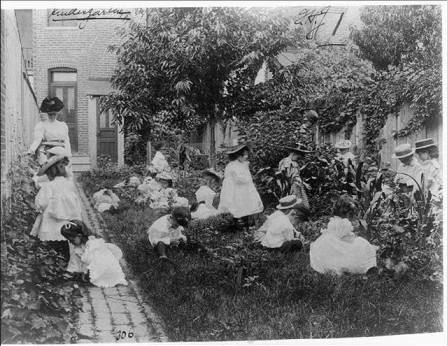
school gardening a century ago- birth of the 'kindergarten'

School gardening a century ago- birth of the ‘kindergarten’

School gardening has been around a long time – originally developing as part of the formal school curriculum at a time when many more households grew their own food. There were war – time efforts to boost food production at schools and the ‘Kindergarten’ movement saw playing and being creative in an outdoor setting as the heart of nursery education.

school gardening in wartime- US style

School gardening in war time- US style

Recently in the UK the Food Growing in Schools Taskforce, led by Garden Organic was established as a response to increasing concerns about the health and well-being of children and young people, and a confidence that food growing in schools is a successful way of dealing with these concerns, delivering many benefits. The Taskforce is made up of people representing a diverse set of interests, but all with a strong belief that food growing in schools is an important activity. You can read their findings here.

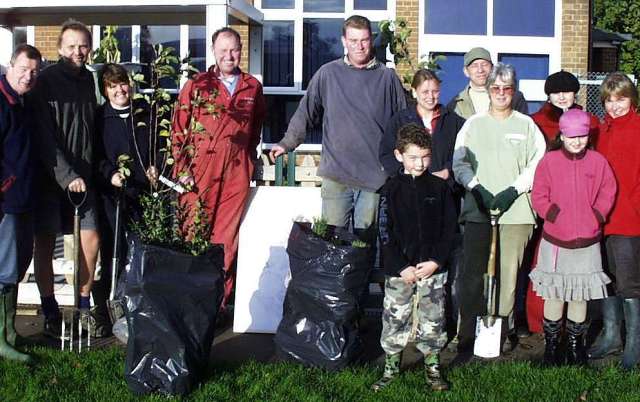
Getting the whole community involved in the school garden

Getting the whole community involved in the school garden

Over the coming weeks I plan to post a series of articles about how to go about setting up and developing a school garden, so if you have any experiences or ideas to share I’d love to hear from you!

Old School Gardener

If you’ve enjoyed reading this post and others on this blog, why not comment and also join some other people and sign up for automatic updates via email (see side bar, above right ) or through an RSS feed (see top of page)?

The Master's Garden as it looked in the 1970's

The Master’s Garden as it looked in the 1970’s- evidence of food growing when ‘Beech House’ old people’s home occupied the buildings.

In the second of a series about the gardens at Gressenhall Farm and Workhouse Museum, Norfolk, I explain how the former Workhouse Master’s garden has been turned into a wildlife oasis.

During the 19th and early 20th centuries the Master of the workhouse looked down on the walled garden from his family accommodation. There is no evidence of what it looked like or what was grown here then, but during more modern times, when the Workhouse became an Old People’s home, it seems that the area was used to grow food (see photograph).

Today the area is used mainly as a wildlife garden and was the subject of a major overhaul a couple of years ago with financial support from the Big Lottery and Friends of the Museum (totalling £13,000) as well as donations from local nurseries and others. Originally created in the mid 1980’s the Wildlife Garden has been the subject of several awards, but as time passed, with fewer volunteers  able to maintain it, the garden was less attractive and the thugs of the plant world rather took over. The pond liner was punctured and the plastic safety cover and overgrown water plants were throttling what life did exist!

The Wildlife Garden before it's recent makeover

The Wildlife Garden before it’s recent makeover

All in all the garden was looking very sad!

After a review it was decided to improve access to the garden by:

  • widening one entrance and adding another and a new path
  • renovating and re-laying the existing circular path with new infill material between the slabs
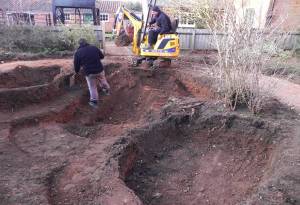
  • relocating and enlarging the pond to make it a central feature of the garden
  • strengthening the different types of habitat for wildlife
  • providing some seating and a wheelchair bay
  • improving interpretation for visitors so that they can appreciate what is in the garden and why.
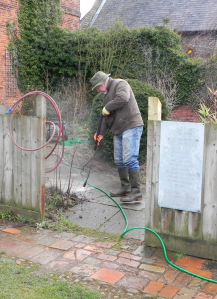
Cleaning the slabs that were later re-used

Cleaning the slabs that were later re-used

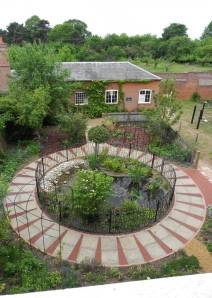
There is now a central pond (with shelved edges, a pebble beach and shallow water to act as portals for insects), and surrounding bog areas. Other habitats  are ranged on each side – a hot and dry gravel garden on the south facing side, a darker and damper shade garden towards the north-facing side. There are some other wildlife friendly features here such as bug hotels and bat and bird boxes which were originally installed in the 1980’s. There is a new attractive interpretation board encouraging visitors to look out for different types of wildlife, including the resident Newts (named either Nigel or Nigella- no one has got close enough to tell their gender!). I find it amazing how quickly amphibians, insects etc. have been attracted to the pond and surrounding areas, so that today a wide range of wildlife can be seen (if you’re patient and quiet).

Excavating the new pond

Excavating the new pond

The new garden under construction

The new garden under construction

The new Wildlife Garden

The new Wildlife Garden

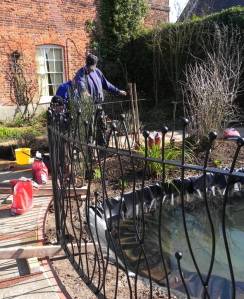
I designed and managed the project and with other volunteers put in the new plants and did some of the other renovation work. The main contractor for the new pond, borders and paths was Ian Chatten Ltd. and Kontorted Iron created the wonderful ‘organic’ fence around the pond, together with metal pergolas and an arbour– all in black wrought iron to link with other items in the Museum including the nearby old cattle- weighing machine, originally from Fakenham Market. The Gardening Team’s tool store and sheds are also ranged along one side. The arbour has taken advantage of an old ‘Rambling Rector’ rose growing in the corner of the garden – this has been pruned and tied around the frame of the arbour and provides both a wonderful sight and a romantic spot from where to view the garden in summer.

There’s also a  ‘Really Useful Patch’  of flowers, herbs and shrubs. Until very recently households had to be self-sufficient in flavourings, medicines, insecticides, cleaning products and so on. The plants in this garden were all used in the past by the housewife to keep her family healthy. The only other criterion for this area was that it was to cost nothing so all the plants have been grown from cuttings or division, or have been donated or ‘recycled’.

Installing the new wrought iron fence

Installing the new wrought iron fence

The new Wildlife Garden from the new entrance

The new Wildlife Garden from the new entrance

The coming season promises to see the planting and features mature further and hopefully the ‘critters’ will enjoy it too!

Quizzicals (courtesy of Les Palmer):

two more cryptic clues to the names of plants, fruit or veg…
  • The noise of a bird imitating a cat
  • How Australians describe English rock  

Old School Gardener (with thanks to Christine Walters for some of the photographs)

If you’ve enjoyed reading this post and others on this blog, why not comment and also join some other people and sign up for automatic updates via email (see side bar, above right ) or through an RSS feed (see top of page)?
The Mistle Thrush- photo RSPB

The Mistle Thrush- photo RSPB

The Mistle Thrush is in decline, warns a major bird charity today.

The RSPB Big Garden Bird Watch survey reveals that they are being seen in less than half the number of British gardens than 10 years ago, resulting in the species being given an ‘amber’ warning of it disappearing. Other birds have seen their numbers decline since 1979, when the survey began, but the numbers of Blue, Great and Coal tits, in contrast, have been on the increase.

The Mistle Thrush is the largest bird in the Thrush family and its name means literally ‘Mistletoe eating Thrush’. It can be seen romping across the garden or standing defiantly on the lawn, but is more likely to be heard perched high up in a tree singing its melodious song. Because it sings so loudly on exposed perches in bad weather it’s sometimes nicknamed the ‘Stormcock’.

Living in parks, woodland and gardens they build their cup-shaped nest in trees early in the year. Of some benefit for the gardener because they like to eat worms, snails, insects, and slugs, in winter they turn to fruit such as berries from trees- mistletoe, holly, yew, rowan and hawthorn. They can be quite combative too, defending ‘their tree’ against other thrushes! They will occasionally visit gardens for food particularly if they are provided with their favourites on a regular basis –  meal worms and suet seed mixes are a good bet.

The RSPB Big Garden Watch takes place this weekend and everyone can take part by recording the numbers of different birds they see in their garden. A handy recording sheet can be downloaded from the website here.

rspb survey

The RSPB Big Garden Watch survey sheet

There are also a number of events taking place around the country; e.g. A ‘Wild Weekend’ event at The Forum in Norwich will show how to garden for wildlife and there’ll be lots of family activities on offer. Norfolk Mastergardeners will also be on hand with wildlife gardening and grow your own food  tips and advice. For tips on making your garden butterfly friendly click here.

Old School Gardener

If you’ve enjoyed reading this post and others on this blog, why not comment and also join some other people and sign up for automatic updates via email (see side bar, above right ) or through an RSS feed (see top of page)?

The Small Tortoiseshell- under threat

The Small Tortoiseshell- under threat

The latest ‘Wider Countryside Butterfly Survey’ reveals that some butterfly species- notably the Meadow Brown- seem to have benefitted from last year’s wet summer, whereas others- such as the Common Blue and Small Tortoiseshell– were around 50% down on the previous year.

The Small Tortoiseshell was once prolific in Britain’s gardens, but it seems to have been one of the big losers in 2012. Last year’s weather  is only partly to blame, as wider agricultural policies and practices are a key driver behind a longer term decline in butterfly species and numbers and parasitic flies may also be part of the story. Around three quarters of the 59 native British species are now in decline.

So what can gardeners do to arrest this trend?

1. Think about providing year- round sources of food for emerging and mature butterflies. Examples of plants which feed butterfly caterpillars are: Dill, Antirrhinum, Columbine, Berberis, Marigold, Ceanothus, Cercis, Cornus, Foxglove, Wallflower, Ivy, Hop, Holly, Jasmine, Honesty, Ragged Robin, Crab Apple, Oregano, Cowslip, Rudbeckia, Thyme, Nasturtium, Verbascum and Pansy.

Species which are food sources for mature butterflies are: Achillea, Anthemis tinctoria, Bergamot, Buddleja, Columbine, Coreopsis lanceolata, Red Valerian, Ceanothus, Marigold, Echinacea, Globe Thistle, Knautia, Lavender, Tobacco plant and Hop.

2. Try to plant butterfly-attracting plants in groups– butterflies prefer to visit stands of brightly coloured flowers.

3. If you have room, choose a quiet but sunny area of lawn where the grass can be left to grow long – some butterflies such as the Meadow Brown prefer to lay eggs in long grass.

4. Allow a small patch of nettles (Urtica dioica) to grow unfettered– these will provide food for some of the more common butterflies such as Red Admiral, Painted Lady and Milbert’s Tortoiseshell.

5. If you have fruit trees, don’t be too tidy about windfalls– leave some rotting fruit as a source of food for some butterflies.

6. Try to provide a shallow, muddy puddle in a sunny spot– many butterflies love to drink from these and they also provide essential minerals and salts.

7. Avoid using chemical sprays to deal with insect pests and weeds– many will harm beneficial insects and butterflies as well as the pests.

Groups of butterfly- friendly plants such as Bergamot are better than single specimens

Groups of butterfly- friendly plants such as Bergamot are better than single specimens

Sources and further information:

Guardian online

Butterfly Conservation

UK butterflies

‘Wildlife Friendly Plants’- Rosemary Cresser

Quizzicals- two more cryptic clues to plant, fruit or veg names:

  • Our monarch continues to work hard
  • Nasty spot causing urination problems

Old School Gardener

Finding Nature

Nature Connectedness Research Blog by Prof. Miles Richardson

Norfolk Green Care Network

Connecting People with Nature

Discover WordPress

A daily selection of the best content published on WordPress, collected for you by humans who love to read.

Susan Rushton

Celebrating gardens, photography and a creative life

Unlocking Landscapes

Writing, photography and more by Daniel Greenwood

Alphabet Ravine

Lydia Rae Bush Poetry

TIME GENTS

Australian Pub Project, Established 2013

Vanha Talo Suomi

The Journey from Finnish Rintamamiestalo to Arboretum & Gardens

Marigolds and Gin

Because even in chaos, there’s always gin and a good story …

Bits & Tidbits

RANDOM BITS & MORE TIDBITS

Rambling in the Garden

.....and nurturing my soul

The Interpretation Game

Cultural Heritage and the Digital Economy

pbmGarden

Sense of place, purpose, rejuvenation and joy

SISSINGHURST GARDEN

Notes from the Gardeners...

Deep Green Permaculture

Connecting People to Nature, Empowering People to Live Sustainably

BloominBootiful

A girl and her garden :)