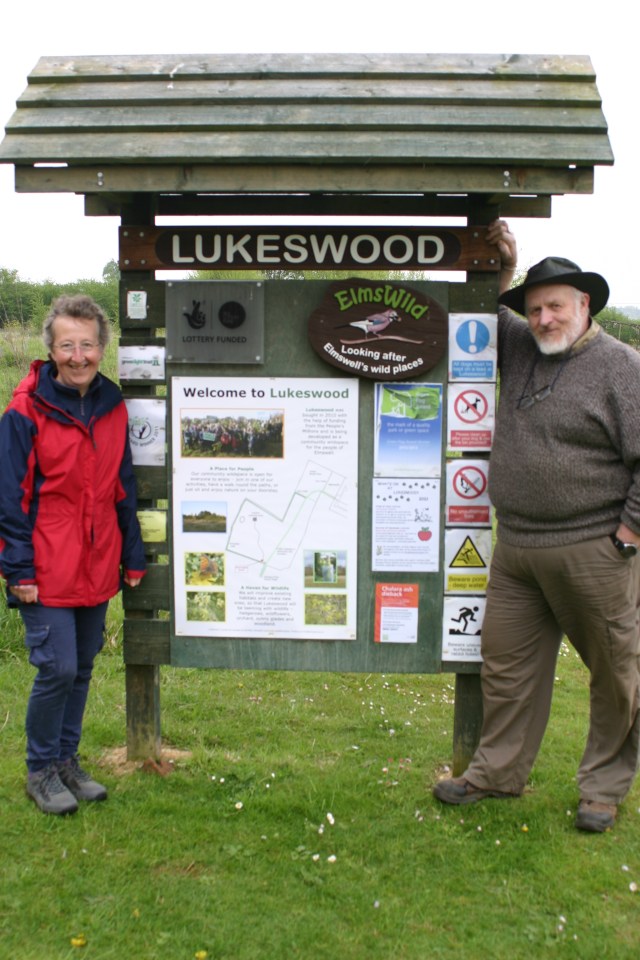
Lukeswood- Chair Mary Feeney and Vice Chair John Ibbetson
I’ve been a judge on the UK ‘Green Flag’ scheme for about 5 years now. Over the last week I’ve visited two open spaces to assess their applications so I thought I’d share something about the scheme and the sites I’ve visited, which are interesting examples of the sorts of place that are hoping to secure a ‘Green Flag’.
The Green Flag Award® scheme is the benchmark national standard for parks and green spaces in the UK. Currently run by the ‘Keep Britain Tidy’ organisation, it was first launched in 1996 to recognise and reward the best green spaces in the country. The first awards were given in 1997 and, 16 years later, it continues to provide the benchmark against which UK parks and green spaces are measured. It is also seen as a way of encouraging others to achieve high environmental standards, setting a standard of excellence in recreational green areas. Entries for the Green Flag Award® are open to parks or green spaces located in the UK, though the scheme is also being piloted in The Netherlands and Germany.
Green Flag Award® applications are judged against eight key criteria:
1. A welcoming place – when approaching or entering the park/green space, the overall impression for any member of the community – regardless of the purpose of their visit – should be positive and inviting.
2. Healthy, safe and secure – the park/green space must be a healthy, safe and secure place for all members of the community to use. Any issues that have come to light must be addressed in the management plan and implemented on the ground. New issues that arise must be addressed promptly and appropriately.
3. Clean and well maintained – for aesthetic as well as health and safety reasons, issues of cleanliness and maintenance must be adequately addressed.
4. Sustainability – methods used in maintaining the park/green space and its facilities should be environmentally sound, relying on best practices available according to current knowledge. Management should be aware of the range of techniques available to them, and demonstrate that informed choices have been made and are regularly reviewed.
5. Conservation and heritage – particular attention should be paid to conservation and appropriate management.
6. Community involvement – the park/green space management should actively pursue the involvement of members of the community who represent as many park/green space user groups as possible.
7. Marketing – a marketing strategy should be in place, which is being implemented and regularly reviewed; there should be good provision of information to users (e.g. about management strategies, activities, features, ways to get involved), and the space should be promoted as a community resource.
8. Management – there needs to be a management plan or strategy which is clear, being actively implemented and reviewed and the park should be financially sound.
There is a main scheme and also schemes for Community run and Heritage Green spaces, which have slightly different sets of assessment criteria. The main scheme usually involves two judges making the assessment, whilst at community spaces a lone judge does this. In the main scheme a ‘desk assessment’ of the Management Plan for the site is carried out and this is followed up with a ‘field assessment’ which gives the chance to check out questions arising from the desk assessment and to examine other issues on the ground. Applicants have to pass both the desk and field assessments and achieve a minimum score to be awarded a ‘Green Flag’. Judges don’t only give scores to the space but also look at the strengths it has against the different criteria and include recommendations designed to help the site improve, where appropriate. This full feedback is, I think, one of the best features of the scheme.
Yesterday I travelled to Suffolk to judge a community – run green space in the village of Elmswell, called ‘Lukeswood’. I was met by the Chair and Vice Chair of ‘Elmswild’ (the group that runs the wood) and given a tour of their site. Here, a group of volunteers aim to improve existing habitats and create new ones, so as to establish a mosaic of woodland, open grassy rides, hedgerows, pond and a wildflower area. The project is focused on involving and benefiting the local community as well as raising awareness of the rarest habitats and species on the site and educating about how these can be protected. Formerly an area of agricultural ‘set aside’ this space of about 9 acres is at the centre of the village next to allotments and cemeteries. Tree planting began in 2010. Early in 2011, with the help of children from Elmswell Primary School, the 1683rd tree was planted – fulfilling a pledge to plant one tree for every house in the village! Over the years the Group plan to plant many more. Lukeswood was named after the Reverend Luke, Rector of Elmswell in the 1860s – described as a ‘Victorian whizzkid’ who introduced many changes, including building the village school. The group like to think that, were he still here today, he would approve of their plans and would enjoy seeing this new addition to the village develop over the coming years. And thanks to continuing fund raising efforts Elmswild have finally succeeded in securing the remaining few acres of land where they plan to establish an orchard (featuring Suffolk varieties of apple).

Lukeswood- recent tree planting

Children’s play

An egg en route

Words about the special Black Poplars

One of the old Black Poplars at a precarious angle

and another angle on the Poplars

The pond with recent ‘stockading’ to protect this and create habitats

Willow planting in a damp part of the site

A bonfire spot used by Scouts, Guides and groups of school children

A new shelter frame used for events
Whilst I was in the area I popped over to Bury St. Edmunds, where another long-established Green flag site – the Abbey Gardens in the centre of town- is in it’s spring glory (though I wasn’t there to judge it for the Green Flag). It has a long established tradition of seasonal planting in many formal beds. At this time of year – especially as the spring flowers are blooming rather late – it is a fantastic sight. First laid out as a Botanic Garden in 1831, in addition to the formal layout of the central area, there is are open grass areas surrounding the Abbey ruins and an aviary, bowling green, bird feeding area, water, herb and sensory gardens, and a children’s play area.

Abbey Gardens, Bury St. Edmunds
Last week, with my co – judge, I visited and judged the woodland area known as ‘Pretty Corner Wood’ in north Norfolk. This is a site managed in two parts, one by the District Council (which was the focus of the green flag assessment) and the other part by the Woodland Trust. The wood sits adjacent to the town of Sheringham and provides a wonderful scene of mixed woodland and some glades and other areas, visited in the main by local residents. Recently the Council has been successful in securing funding to bring about a range of improvements to the wood which included putting in a new pathway suitable for wheelchair users that leads to a splendid view of the sea and wind farms on the horizon, as well as a wooden sculpture trail. The woodland is carefully managed to ensure the right mix and density of species and the Council has also sown a wild flower area close to the open glade that makes a great picnic spot. A privately run Tea Rooms also provides a convenient refreshment stop.

Pretty Corner Wood

Dead wood left for habitats

The view to the sea

Planted area in the wood

Wood pile

Mature mixed woodland

Ancient trees

Den building

Recent boardwalk

Part of the sculpture trail
Of course I can’t give away any information about how these two sites have faired in this year’s judging, but suffice it to say that they both provide wonderful natural resources to their local communities and are clearly loved by those involved in running and improving them. Its this sort of commitment that not only creates great open spaces for everyone to enjoy today and into the future, but can generate fantastic community spirit.

Links:
Green Flag Award Website
Elmswild website
Pretty Corner Wood information
Abbey Gardens
Old School Gardener
If you’ve enjoyed reading this post and others on this blog, why not comment and also join some other people and sign up for automatic updates via email (see side bar, above right ) or through an RSS feed (see top of page)?




 Old School Garden