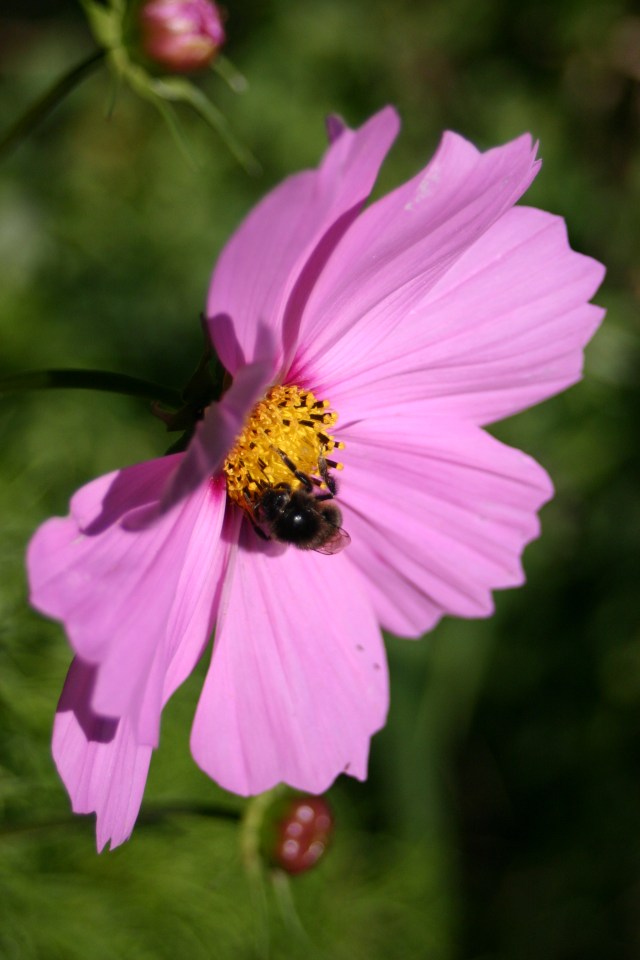
Cosmos looking good at Old School Garden
To Walter Degrasse
Dear Walter,
Sorry for the delay in this month’s letter. Having been away for a couple of weeks, I find myself playing ‘catch up’ in the garden and in many other respects too! The past month in the garden has been a relatively quiet one. The continued dry, hot weather has had a marked impact on the state of the plants, and not having been here for a fortnight has also left its mark, though I’m blessed with some very kind, helpful neighbours who have at least kept most of the vulnerable things watered – more on that later.
It was a joy seeing you and Lise at the beginning of the month, and I’m glad you enjoyed your visit and what you saw in the garden. That new crop protection netting I was telling you about arrived just before I went on holiday and this meant I was able to get it set up over a wooden and twine frame to cover my recently – planted Purple Sprouting Broccoli and Calabrese. You remember this has a smaller mesh than the previous one I’d been using and is supposed to prevent Cabbage White butterflies getting at the brassicas? Well, it came just in time (or so I thought), as the beginning of August saw an explosion in these pretty but annoying pests that lay their eggs on the undersides of Brassica leaves leaving a legacy of a host of hungry caterpillars that destroy your best Brassica efforts!
As we departed on holiday (I’ll be doing a few posts about the various gardens we visited whilst in Devon and Cornwall), the Agapanthus was coming into flower and I had hopes that my Tithonia (‘Mexican Hat flower’) and Cleome (‘Violet Queen’) were finally putting on flower buds. The late Spring seems to have delayed their development somewhat.
What it is to have good neighbours! Our next door neighbours Rob and Wendy were happy to water the containers and greenhouse etc. whilst we were away, though they were themselves due to go on holiday a couple of days before our return, so I was a little concerned that things might just wilt before I could get to them. I had no need to worry, for on my return – in fact the very evening I went round and started watering things – I stumbled across our next to next door neighbour, Norman, who had just finished watering the containers in the Courtyard! He had apparently been tasked by Wendy to carry on with the watering in their absence! I thanked him for this kindness and remarked on my pleasant surprise at the healthy look of most of the plants.
On closer inspection, and looking beyond the containers, greenhouse, cold frame etc., I discovered that the pests had been at play while we had been away! Moles had decided the time was right to dig up various spots in the lawn (their activity might have been prompted by one day of heavy rain) and when I inspected the brassicas I found not very much left of the Cauliflowers, Calabrese and Broccoll previously mentioned! In fact the caterpillars had been busy and stripped every last leaf! The Red Cabbages looked reasonably OK, though even here there was clear evidence of caterpillars starting to munch their way through the tightly drawn heads. So a quick harvest of those was in order (and the 4 heads i salvaged are being cut up and cooked for storage as I write). So, i can only guess that the little varmints (in egg form) had somehow been deposited on the plants before my new ‘butterfly proof’ netting was in place! Oh well, it’ll be different next year… I might just try one last sowing of Sprouting Broccoli and Calabrese, to get us some home-grown greenery in the winter months. We’ve also been harvesting courgettes (some interesting ‘patty pan’ ones included), and the tomatoes and cucumbers as well as autumn raspberries and blackberries are looking great. The apple and plum harvest to come is also looking very promising and I’ve even found a first pear on one of the ‘super column’ fruit trees I planted a year or two ago. This year looks like a good one for fruit, as everyone is saying.

Mole hills on the Old School Garden lawn

Stripped Broccoli

The courgette that got away..

Red cabbage just about survived..
The flower garden is hanging in there. The Tithonia and Cleome have fulfilled their promise and are adding some bright colour (along with cosmos, Achillea, Phlox, Helianthus, etc.) to the late summer borders, once again complemented by the burnished stems and seed heads of the various grasses that intermingle in the main borders. I’m especially pleased with the mix of Verbena bonariensis and Nicotiana that underscores the view to St. Peter’s church. The Nicotiana’s perfume of vanilla is wonderful too.
This slideshow requires JavaScript.
Having had the late ‘bank holiday’ my mind definitely turns to autumn and so the coming month will be very much about managing a mix of harvesting (especially fruit), dead – heading and coaxing the last flowers as well as gradually clearing up those plants that have finsihed flowering and whose foliage won’t add anything to the winter garden in terms of structure or wildlife value.
Further afield I popped into Gressenhall Farm and Workhouse Museum (where you know I’m a garden volunteer). The gardens here seem to be surviving the hot dry weather pretty well. However, the sweet peas and container plants are obviously struggling with lack of water (though I was told that the Museum had had some pretty heavy showers at the weekend). I spent a couple of hours watering, dead heading and weeding and also helped contribute to a new film being produced for the museum website . This is going to ‘cameo’ some of the many volunteers here in order to provide some information for anyone thinking of joining the volunteer team. I had to say a few words about my time as a volunteer, how I’d helped to redesign and renovate some of the gardens and my time as a Heritage Gardening trainee last year. This all seemed to go well, but a few hours afterwards I received an email from one of the film crew saying that because the sun had glinted on my glasses, that this had somehow affected the focus of the whole sequence – hence the need for a rerun next week- at least I’ll have had practice at my lines!
Its back to school here next week, and so Deborah is gearing herself for the return to our local primary school. I will no doubt also be having some discussions with the Outdoor Learning Coordinator about the year ahead in the School Garden, Hopefully we can build on the progress we’ve made this year and ensure the children all get a chance to work, learn and enjoy the garden through the different seasons.
That’s about all the news from here at present. Hopefully you and Lise are enjoying the late summer sun, as we are. It somehow seems easier to sit and view (and snooze) in the garden at this time of year, occasionally harvesting some produce, pulling up the odd weed or cutting the lawn, rather than the more frantic, continuous activity needed to cope with the surge in growth that is spring and early summer – an altogether more relaxing time!
Old School Gardener
Other posts in this series:
Dear Walter…. letter from Old School Garden 22nd July 2013
Dear Walter…. letter from Old School Garden 21st June 2013
Dear Walter….letter from Old School Garden, 20th May 2013
Dear Walter….letter from Old School Garden, 18th April May 2013
Dear Walter….letter from Old School Garden, 11th March 2013
Dear Walter… letter from Old School Garden: 15th February 2013
If you’ve enjoyed reading this post and others on this blog, why not comment and join others by signing up for automatic updates via email (see side bar, above right ) or through an RSS feed (see top of page)?


 Freshwater wetlands are considered to be one of the most important natural resources. They provide food, fuel, store and filter water, buffer against flooding and, store carbon. Wetlands are also important sites of recreation, allowing people to get in touch with nature. They also preserve important archaeological records such as organic materials and paleo-environmental deposits.






 Old School Garden