

Category: School and childrens’ Gardening

Have you ever created a miniature garden? If not, here is a fun activity you can do with your children over the summer holidays. When I did this project with the grade three class, the teachers said that this was the most fun the children had all year. Creating miniature gardens lets the children use their imaginations. So what is a miniature garden? It is generally one that uses dwarf or miniature plants and replicates a scale model of our own gardens. Miniature gardens can be created in the ground or in containers and can be kept both inside and outside. It just depends on personal taste. This is a good project to teach children about scale.

The photo above is one of my first miniature gardens. I try to create my gardens using found items and thrift shop treasures. You can buy miniature garden kits as well.

This year…
View original post 878 more words
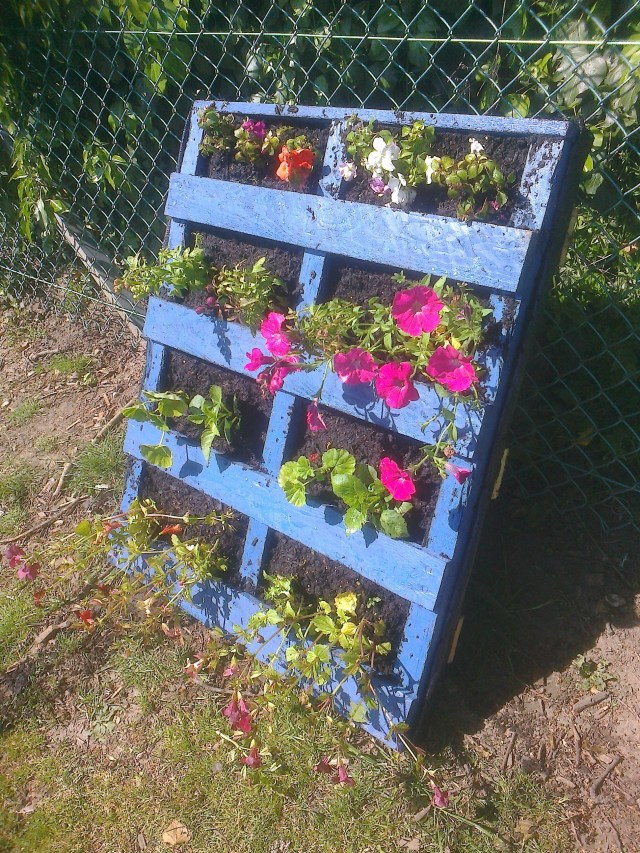
One of the finished planters standing alongside the Playground
My examples of using pallets and other old timber for garden projects seem to have been very popular (see links below). I’m experimenting myself with some ideas, including vertical pallet planters, made with a group of children (aged 7-10)at my local Primary school as part of a Gardening Club there. This has been great fun and a good learning experience for me as well as the children! We used pallets I was given by a builder at the Museum where I volunteer – they were relatively small pallets used for stacking bricks, so were a manageable size for the children.
I followed the guide produced by Garden Designer Mike Rendell (you can access a pdf of this here). It was fairly straightforward and with some help, the children managed to do most of the tasks needed to achieve some pretty flowering planters which now adorn the edge of their playground.
What we did:
1. Sawed off the ends of the slats so that there were solid timber sides to the planter – the children coped with this with a bit of help now and again (it didn’t help that my saws weren’t that sharp!).
2. Removed every other slat to provide space for planting – this proved to be difficult, especially for the children, as it involved a lot of strength and using claw hammers and the like.
3. Nailing two of the spare slats, one to the top, the other to the bottom of the planter – the children enjoyed using hammers and nails (it was helpful being able to use the nails and pre set holes already in the removed slats).
4. Painting the planters – we chose a rich blue paint suitable for outdoor furniture and the children enjoyed painting, though some of the younger ones had to be encouraged to ensure every bit of wood was properly covered!
5. Stapling some spare landscaping fabric to the back of the planter. I’d pre cut the size needed (allowing for a double layer joined in the middle and overlapping it around the sides and top of the planter). The children found it very difficult using the staple gun, which was designed for bigger hands, so I had to do this for them, whilst they held the fabric in place.
6. After this the children nailed the remaining spare slats to the back of the planter to provide reinforcement. Again, with a bit of basic ‘hammer tuiton’ the children managed this pretty well, though we did use some spare nails where some of the old ones got bent in the process.
7. The children then filled and compacted the compost into the planters, starting at the bottom and planting up as they went. We used about 40 litres of peat free compost per planter, a little loose, but with compaction and wetting seemed to hold together reasonably well. The children tired a bit towards the end, so I made sure the compost was properly compacted and roots covered. Once tidied up, the planters were thoroughly watere. Incidentally the plants were kindly donated by a local nursery woman who had held a plant sale at the school a few weeks before. We have a mix of Petunias, Antirrhinums, Dahlias, Geraniums and Impatiens- quite a mix and it will be interesting to see how some of the larger varieties fare in this vertical world!
8. I had fixed some cup hooks to the top and rear of each planter so that they can eventually be hooked into the fence to avoid them falling over, though for now the planters are at an angle to allow the compost and plants to become firmer.

Sawing off the ends and removing some slats


Painting, fixing landscape fabric to back and reinforcing slats up


Putting in the compost and plants
Having just seen a TV programme about the ‘Pallet Garden’ competition at the ‘Gardening Scotland’ show, I might try to introduce some sort of competition next year within the school (or maybe even between local schools?) …watch this space!
Other articles on pallets and other recycled wood in the garden:
Pallets Plus – more examples of recycled wood in the garden
Pallet Power
Pallet Power- the sequel
Raised beds on the cheap
Old School Gardener
If you’ve enjoyed reading this post and others on this blog, why not comment and join others by signing up for automatic updates via email (see side bar, above right ) or through an RSS feed (see top of page)?

Decorated Compost Bin Competition
Winners Announced!!

 Guest post by Zoë Slade.
On Friday 5 July 2013 schools all over the country will be learning outside for Empty Classroom Day.
Empty Classroom Day is a day to celebrate all the learning that takes place outside the classroom and to encourage even more outdoor learning. The day was created by schools and organisations at London Sustainable Schools Forum and the idea is simple: One class, outdoors, for one lesson on one day.
Last year, despite the rain, over one hundred schools took part with activities ranging from planting wildflowers, bug hunting and pond-dipping to inspiring class visits to the great outdoors. The first Empty Classroom Day was a success showing that learning outside can be fun, memorable and healthy. This year lots of schools have signed up to say that one class will be learning outside for one lesson on Friday 5 July, some schools are doing even…
View original post 252 more words


I’ve just returned from a session of the ‘Gardening Club’ at my local primary school – 7 children of varying ages. What a little preparation and enthusiastic kids can achieve! We:
- Painted up the pallet planters we’re making for a floral display at the school (we’re planting up hanging baskets next week for sale at the Summer Fair on 19th May) – more on this project in due course…
- Set up a wormery outside the school kitchen – I bought some worms from a local angling shop and with the day’s fruit peel and other kitchen waste on a bed of leaf mould we set the little critters to work and talked with the School cook about how to keep the process going…
- Sowed some Squash and Lavender seeds one of the children had brought in – they’re already excited at how tall their sowings of trailing Nasturtiums have grown in two weeks…
- Had a brief run down on the composting process in the wormery and set them a challenge of finding out some ‘compost facts’ for next week, as well as discussing who’ll be available to help me sell the hanging baskets, make paper pots with children visitors and advise people on food growing and composting at the Summer Fair…
Phew – need a little sleep….
Old School Gardener
Should gardening be taught in schools?

A CBBC Newsround report which is about the proposed UK school curriculum changes next year. These currently propose that gardening is taught in schools – your views are being sought!
Old School Gardener
Do you garden with children or work at a school? This is a fun project to do with children. I am always looking for a rainy day project and since I love gardening, this is perfect. Last year we made memory ladybug rocks with the students in a grade one class. This year I hope to do it with my grade three school garden class.
To start, you have to collect some flat rocks. You can either collect them from around the garden or buy them at your local garden center. If you need a lot for a class project , it may be easier to see if the local garden center will donate them.

I painted my rock with two coats of red acrylic paint and let it dry. I love the shape of this rock, its perfect for a ladybug.

Okay, honesty here, I am not the best…
View original post 241 more words
Today I am preparing for a school garden class with a grade three class. We will be exploring the senses and how they work. Since there are a total of 28 children in the class we always break into smaller groups. Since there are five senses, we will have groups of six to seven children per group. We will move from one group to another spending about 5-6 minutes at each sense.

I converted name tags and replaced the names with the five senses, hearing, touch, sight, smell and touch. Each group leader will wear a tag so the children know which group to move to.

Of course, the favourite sense for the children is when they get to taste food from the garden. Today I will cut some chives, mint, sorrel, arugula,rhubarb, kale and lettuce and have it on hand all freshly washed so that each child can try…
View original post 253 more words





 Old School Garden