Category: Portuguese Gardens

We’ve been to Lisbon, Portugal quite a few times, but only on our most recent trip did we discover a beautful little restaurant/club/social centre/cultural hub close to the restaurant quarter- Casa do Alentejo.
While the outside of the former Palacio Alverca is unspectacular, its true beauty lies inside: moorish design including beautiful tiles and a huge patio. It was created 85 years ago, as a meeting place for people from Portugal’s historical province Alentejo (além Tejo means beyond the Tagus) and to cultivate its unique culture. At that time many people from this region left home in search for a better life in Lisbon.
The palace dates from the last quarter of the 17th C., but its current appearance is a result of considerable alterations carried out in 1918. Nowadays it’s the headquarters of the association of the Alentejo people. Many activities take place here: on Saturdays there are ‘Alentejo afternoons’ (tardes Alentejanas), with choral groups. On Sundays, dancing begins at 3;30 pm. Mostly elderly people come here to socialize. There’s also a library and a handicraft shop of typical products of the Alentejo region.
The dining rooms are picturesque, with open fireplaces and decorated with beautiful tiles (azulejos). The azulejo is a form of Portuguese painted, tin-glazed, ceramic tilework (Azulejo comes from the Arabic word az-zulayj, meaning polished stone).
Old School Gardener
Our 2014 September visit to Portugal featured some interesting new places, including three wonderful gardens. The first I’m featuring was a visit to the home of wealthy ex pat Brits when it was established over a century ago. Monserrate sits in the mountains north-west of Lisbon in the regal suburb of Sintra.
The website which covers many of the Sintra garden gems describes Monserrate gardens and its palace as:
‘..one of the most beautiful architectural and landscape Romantic creations in Portugal… unique representatives of 19th century eclecticism.The Palace combines gothic and Indian influences as well as Moorish suggestions together with exotic and plant motifs which are harmoniously extended to the exterior. The gardens have received species from all corners of the world, which were planted according to their geographical origin. The front lawn of the Palace provides a well-deserved rest, while discovering one of the richest Portuguese botanical gardens.’
It was built in 1858 for Sir Francis Cook, an English baronet who had amassed a fortune as a trader and textile baron and was created Visconde de Monserrate by King Luis. Cook turned to an English architect, James Knowles jr. for the house design. He took inspiration from the many countries Cook had dealings with and also the flamboyantly oriental Royal Pavilion in Brighton, England, built for the Prince Regent, later Goeorge IV over 50 years earlier. I loved the round tower and proportions of the palac, the use of reflected light under the wide eaves with subtle creamy and terracotta hues to create a lovely warm glow. The rich decoration is a generally successful blending of eastern, moorish and gothic revival styles. Here are some pics of the house….
Cook hired William Nevil as Botanical expert and landscaper. The project was completed within 5 years and was Cook’s summer residence. The entire estate was put up for sale in the 1920s by Cook’s great-grandson, and after many years of neglect was purchased by the state in 1949. Since then it has been open to the public as a national monument.
The English influence emanates throughout the gardens which have a romantic feel, especially as you wind your way along rough paths through shaded glades with waterfalls, pockets of sunlight and mock ruins, and eventually up to the rather more manicured lawn (the first laid in Portugal) that stretches away from the house down to the grounds. These also include specialist and exotic gardens with non-native plants from Cook’s personal collection. Here are some pics of the gardens and grounds…
The Monserrate Palace is the smallest of Sintra’s three palaces but it is by far the most decorative – and beautiful- and certainly captivated me, as did the winding and varied gardens – especially the Mexican Garden, some pics of which follow…
It has taken 20 years to restore the gardens and the result was recognised in 2013 when they were voted the winner of the European Garden Awards in the category for “Historical parks”. In 1995 the park was recognised by the UNESCO as a World Heritage Site as a part of several palaces and parks in Sintra. The citation for its latest award says:
‘Light and shadow, exotic and rare plants, winding paths and breath-taking views, but even new garden sections, such as the rose garden that was opened in the year 2011 by the Prince of Wales, make a visit to Monserrate, in spite of the many other wonderful parks in Portugal, a unique, fascinating and therefore “prize worthy” event.’
Old School Gardener
So, this is it, the final stop on our final day in Portugal (well, at least this visit). The Quinta da Regaleira is one a group of grand palaces with grand gardens and estates in the mountain top resort of Sintra, a few miles from Lisbon, and famous as the retreat of the royals and the rich.
It consists of a romantic palace and chapel, and a luxurious park featuring lakes, grottoes, wells, benches, fountains, and a vast array of exquisite constructions. The palace is also known as “Palace of Monteiro the Millionaire”, from the nickname of its first owner, Antonio Augusto Carvalho Monteiro. The estate has had many owners through time, but in 1892 it was purchased by Carvalho Monteiro who then set about creating a place where he could gather symbols that would reflect his interests and ideologies. With the assistance of the Italian architect Luigi Manini, he installed in the 4-hectare estate a range of enigmatic buildings, believed to hide symbols related to Alchemy, Masonry, the Knights Templar and the Rosicrucians. The architecture is an eclectic mix of styles, constructed in the first few years of the 1900’s and completed in 1910.
After a number of other owners, and a period in which it fell into disrepair, the estate was bought by Sintra Council in 1997. Extensive restoration was undertaken, and the palace and surroundings were opened to the public one year later.
Most of the estate consists of a dense woodland park crossed by many roads and footpaths. The woods are neatly arranged in the lower parts of the estate, but left wild and disorganized in the upper parts, reflecting Carvalho Monteiro’s belief in primitivism. Decorative, symbolic and leisure structures are dotted aorund the park and there is also a mysterious system of tunnels, which have multiple accesses including via grottoes, Chapel, Waterfall Lake, and “Leda’s Cave” beneath the Regaleira Tower. Their symbolism has been interpreted as a trip between darkness and light, death and resurrection.
The “Initiation Well” or “Initiatic Well” (sometimes referred to as the “Inverted Tower”) is a 27 metre staircase that leads straight down underground and connects with other tunnels via underground walkways.Water is a frequent element with two artificial lakes and several fountains and the Aquarium, built as if it were naturally embedded in a rock.
I loved the playfulness of the park and children of course love its quirky touches, secret passages and tall towers. Quite a place and a fitting end to our latest Portuguese trip.
Source: Wikipedia
Old School Gardener
It was our last full day in Portugal and having visited two grand Baroque gardens in Caxias and Oleiras we stopped off in stylish Cascais for lunch. It was also a chance to take a look at a very different garden, one very much more domestic in size and with a more informal air.
Casa da Pergola (‘The Pergola House’) is a mediterranean – style mansion or Manor House, near the centre of Cascais. I viewed the charming and well kept front garden from outside the locked entrance gates, not having the time (or courage) to ask if I might be let in to look around. Still, I could see enough to be impressed.
The hotel website shows pictures of elegant white marble floors and staircases, beautifully decorated bedrooms with “bas relief” stucco ceilings. The house has been owned by the same family for over a century and its beautiful facade, adorned with hand painted tiles, has been the delight of both amateur and professional photographers. Here’s my take on it!
Further Information: Pergola House website
Old School Gardener
Thanks for reading this, my 1000th post on Old School Garden. I’ll do a fuller review of my blogging experience on my first anniversary on 17th December. But for now I hope that you enjoy my review of an interesting garden in Portugal.
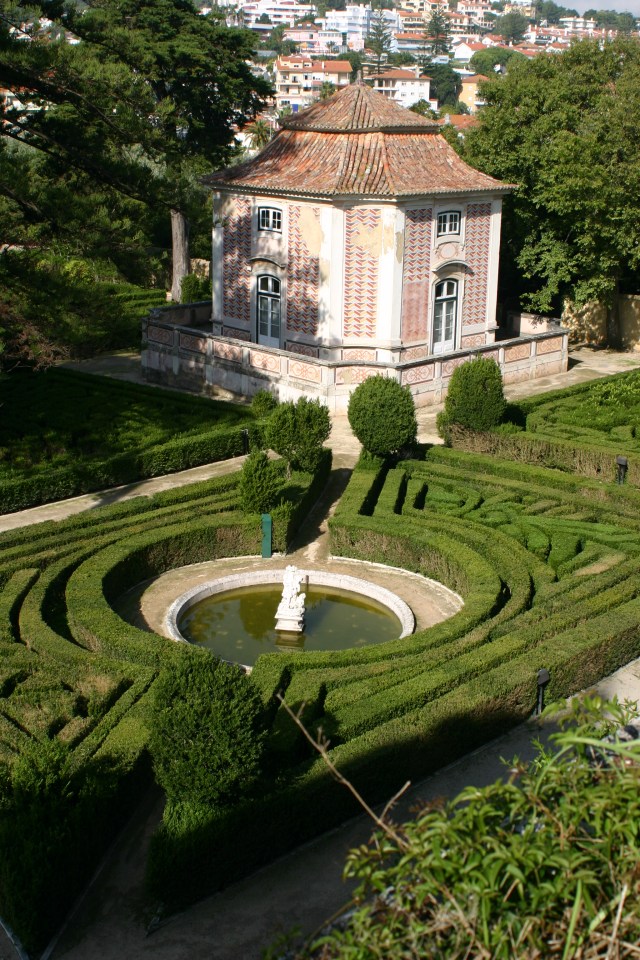
A little off the beaten track in one of Lisbon’s northern suburbs (Lumiar), sit the Gardens of Monteiro Mor (this translates as ‘the High Huntsman of the Royal House’ refering to one of the former grand residents).They come with not one, but two bonuses – small, but fascinating museums, one focusing on Portuguese Theatre and the other Costume.
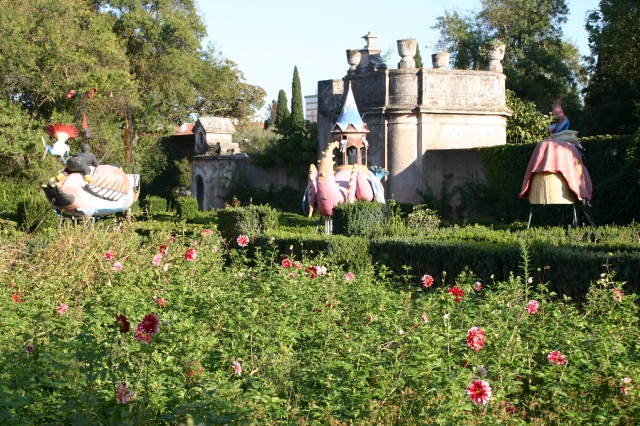
The surrounding gardens are a very engaging mix of formal, botanical display and wilder woodland walks – all very pleasant on a warm autumn day. And there are a number of curious sculptures to see en route too, along meandering paths and steps which take you to a variety of water features and through glades of mixed, mature trees and shrubs.
Interestingly, a communal food growing area seems to have been created on the edge of the parkland, and we also were lucky enough to see a wide range of flowers on display when we visited.
The museums, housed in two former grand houses a few paces from each other, are very well laid out. The Theatre Museum comes stocked with a huge array of printed and pictorial material along with theatre models, sculpture and theatrical props (including some lovely puppets and larger costume displays).
No need for much in the way of interpretation here as the visual richness speaks for itself!
The Costume Museum is an altogether more restrained affair, with displays of clothes and accessories from different periods set off wonderfully in the elegantly decorated rooms of the former palace. Varied lighting levels and effects and a nicely uncluttered feel all contributed to a beautiful wander though time.
This became especially interesting when we reached the 1960’s and more recent displays, which brought back some long-lost memories!
This was a visit well worth the subway ride from central Lisbon, the ‘one for all’ ticket being very good value.
Old School Gardener
After a stroll through Estrela Gardens in Lisbon we found our way to somewhere new to us – the English Cemetery just over the road. What a discovery- a quiet, green and fascinating space where a wide range of graves and monuments records the long association of the English with Portugal. The website of the Anglican Church in Lisbon describes it’s past:
‘Part of the Treaty of 1654 negotiated between Cromwell and King João IV of Portugal stipulated that English subjects living in Portugal should have a plot allotted to them “fit for the burial of their dead” in the Lisbon area. Due to opposition from the Inquisition, nothing was done about this until the early eighteenth century and it was only in 1717 that Consul Poyntz was able to report back to London that he had leased a suitable plot near the City “for the burial of our dead”. It became known as St. George’s Cemetery. From those early beginnings until the present day non- Roman Catholic British Nationals have had a traditional privilege of burial at St. George’s; practising Roman Catholics are now also admitted.
It is an historic site for many reasons and an interesting one too. Probably the most famous British person buried there is the novelist Henry Fielding; he came to Lisbon to try and recover from health problems but actually died on 8th October 1754. No-one knows exactly where he was buried, but a monument to him in the form of a raised tomb was erected by public subscription in 1830. Later on in the Peninsular War Portuguese soldiers acting under orders from Marshal Beresford forced open the door in order to inter the remains of Brigadier General Coleman; legend has it that many other British soldiers were buried there during this period but have no marked graves. From the twentieth century there are rows of Commonwealth War Graves, commemorating servicemen who happened to die in the Lisbon area during World War II. These are but three examples, a wander round confirms that the remains of many interesting people from all walks of life and different nationalities have been interred at St. George’s for almost three hundred years.
In the second half of the nineteenth century many trees and shrubs were planted in the cemetery, some of which survive to this day. It makes it a peaceful, verdant spot, a walled oasis covering several acres in the middle of Portugal’s busy capital.’
Here is my record of our visit in late October 2013.

This last ‘garden’ from our recent trip to Portugal, is a bit of a cheat. The main attraction is the gothic splendour of the monastery and associated cathedral, but there are some wonderful outdoor spaces too, so I think its worth sharing.
Our recent visit to Portugal included a longer trip 1 hour north from Lisbon to a fascinating park (it is too big to be called a garden)- in fact it is billed as the biggest oriental park in Europe, stretching to around 35 hectares.


Our October visit to Portugal concluded with a day packed with garden visits to the west of Lisbon and in the regal suburb of Sintra to the north- home to many a splendid palace and garden.