
Category: Play

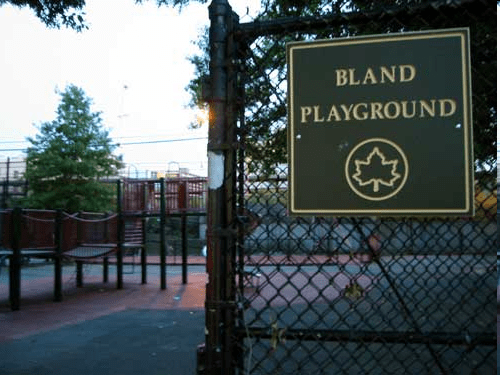
So how is your playground- bland or what….?
What do you thnk about attitudes to childrens’ play?

I wonder what my childhood would have been like had it been subjected to the curse of ‘over risk assessment’. I’ve been immersed in looking at ‘health, safety and security’ within play environments this week, because that’s where some of my learners are at in their studies at the moment. The problems of an ‘elfansafety’ culture (thanks for that sort of phraseology, Arthur!) can play themselves out in rather over-zealous risk assessment paperwork.
Whilst I do appreciate safety and children not breaking themselves, what the ‘powers that be’ seem to forget is the dynamic common sense ‘see-it-as-it-unfolds’ way of assessing if something is just too hazardous to take the risk over. What play environments’ policies seem to forget (or rather, what those who write these things seem to forget) is that children are more than capable of assessing for themselves if they can or will do something.
So, what…
View original post 993 more words

The Maze at Longleat House, England
I must admit I’m a bit of a fan of labyrinths and mazes.
As a play landscape designer I’ve tried to find ways of incorporating them in my designs as they are especially attractive to children. Usually they are one of the first design ideas to be dropped, generally on grounds of maintenance requirements. I’ve tried to suggest simple materials like grasses to mark out a pattern, rather like the one in the Cambridge Botanic Garden, but again they do take some looking after. The best I’ve managed is a wooden stepping stone and daffodil spiral. One day I’ll find a client with the imagination and deep(ish) pockets to give a bigger one a real go.
Labyrinths and mazes – what’s the difference between them?
Well, the answer is ‘it rather depends…’. There is one school of thought that sees labyrinths as different to mazes and another that sees labyrinths as one type of maze. Labyrinths have just one route– so there’s no danger of getting lost – whereas mazes are rather more cunning in that they have dead ends, twists and turns which are set out to puzzle and confuse. Sir Walter Scott’s ‘O, what a tangled web we weave, when first we practise to deceive!’ comes to mind.
Labyrinths (remember the single route or ‘unicursal’ one) are found in many cultures, some as old as 3,500 years. They all have an entrance or mouth, one route to follow and a central destination, sometimes marked with some sort of stone/statue/ feature. A further detail is how many concentric circuits or paths they contain and they can vary from the small to the huge – several hundred feet across. They have traditionally been seen as spiritually symbolic, meditative paths as well as just entertaining and can be found in many religious buildings such as Chartres and Ely cathedrals.

The Labyrinth pattern in Chartres Cathedral
Humankind has been fascinated by patterns in the land for millennia and some of the earliest were forms of spiral (some multiple spirals). These later developed into the sorts of maze-like patterns we’re more familiar with, including the Cretan maze (or labyrinth as its usually called!). Of course the famous one was that in classical mythology where Theseus found his way to the centre and killed the Minotaur to ensure he freed his fellow Athenians. He used a length of thread to trace his way in and so find his way out. Which rather suggests that this ‘labyrinth‘ was in fact a more complicated maze as it would have been easy to retrace his steps in a one-route labyrinth! This all goes to support the case that the words labyrinth and maze are interchangeable, and certainly common usage suggests this- e.g the turf ‘mazes’ in some English gardens are in fact labyrinths (i.e. one routers).
A-maz-ing Gardens
Mazes as multi – choice routes really developed in gardens out of the parterre and knot gardens which used lines of plants (usually Box) to create patterns within which other plants, gravel, grass or sometimes coloured powders created a contrast in colour and level. You can wander around these hedges in some gardens and it isn’t difficult to imagine how (either deliberately or perhaps through lack of maintenance!) these hedges grew taller. This both made it difficult to grow anything successfully within them and also added a touch of mystery to the experience of walking round the garden. A book by Daniel Loris – ‘Le Thresor des Parterres de l’univers‘ – written in 1629, seems to capture the developing fashion for such mazes (though most of it is concerned with the traditional parterre).

Hampton Court Maze, England
Britain’s oldest surviving hedge maze is at Hampton Court – created by George London and Henry Wise in 1690 and also thought to be the oldest hedge maze in the world in continuous use. Originally planted with Hornbeam and having two trees at the centre the hedging is now Yew, the hedging used in many traditional hedge mazes.

Labyrinth of Horta, Barcelona
The Labyrinth Park of Horta in Barcelona, Spain, was created around 1794 as part of a neoclassical ‘makeover’ of the garden by its Marquis owner. In recent years the garden and maze have been restored and I have had the good fortune to almost stumble across it.

A simple bulb labyrinth at Cornell University, USA
Today there are many different types of maze to be found in gardens, parks and estates around the world, some using hedges or walls (for your truly ‘puzzling maze’), others using turf, other grasses, low-growing plants or materials to mark out the (usually labyrinthine) route. In Britain temporary ‘Maize mazes’ created in agricultural fields have become a popular summer visitor attraction.
There is something magical about these labyrinth and maze ‘puzzles on the land’ and I hope that one day I can create one in a park or garden…maybe you have scope for one in your garden?
Sources and further information:
Quizzicals (thanks to Les Palmer for these):
answers to the last two-
- Has had too much already – Sycamore
- A country full of automobiles – Carnation
and a couple of gardening ditties…
‘Big in Japonica’
‘You picked a fine time to leave me lucerne’
Old School Gardener
If you’ve enjoyed reading this post and others on this blog, why not comment and also join some other people and sign up for automatic updates via email (see side bar, above right ) or through an RSS feed (see top of page)?

Simple natural elements can make a garden special for younger children
Surveys show how playing in parks or their own garden come out tops for children when asked what their favourite activities are. And an expert warns that children are no longer ‘free range’.
Providing simple play pleasures won’t cost parents an arm and a leg either! Thinking about how to make your garden child-play friendly and then spending a little money on creating the right space will repay dividends over many years.
Start with the idea that the garden for children (and for adults too for that matter) should be a multi-sensory space, with:
- different surfaces and textures to touch – stones/ gravel/ bark/ brick and plants with interesting leaves such as Stachys byzantina (‘Lambs’ Ears’),
- varied smells – from different flowers and leaves,
- tastes – growing and picking your own strawberries or fresh vegetables,
- sounds – wind through grasses, chimes, water dripping into a child-proof pool
- sights– break up the garden into different zones with their own character.

A children’s food garden
Then talk about the ways you might create this in your garden with your children, focusing on the sorts of play activities they would like…and work up your ideas using these…
Seven tips for garden play:
- Natural resources– treat the outdoors differently to the indoors- its special, so create spaces and provide playthings which children can’t get inside; e.g a tree house or a tree for climbing if you have one big enough, a pit or pile of sand, or if you’re feeling very brave- a mudpool…
- Growing children– give children a separate, personal garden where they can ‘grow their own’ food…
- Futureproof- think ahead and provide things which will engage children for several years or which can be easily adapted as they grow older – convert a sand pit to a growing area, a swing frame into a hammock frame…
- Small and simple– a few odd bits and pieces of wood, boxes, bricks, cloth, plastic pipe etc. can fuel children’s imaginations and creative play, though purchased play equipment does have a place too, if you have the space and cash…
- Doubling up– make the most of space – think about garden structures which can play a role in the ‘adult garden’ as well as providing something for children; e.g wooden arches that can support a swing, sand pits concealed below trap doors in wooden decked terraces, a climbing frame that’s one side of a pergola, varied path surfaces with some in-built pattern (you can even get some with fossils imprinted on them)…
- Move the earth– don’t be afraid of creating (even small) hills and hollows in your otherwise flat garden (unless you have these already of course)- children love running up and down slopes and use these for all sorts of creative games. If you like, add in a few rocks and logs (fixed down) for them to clamber over…
- Get social– encourage your children to play with other children – invite their friends round and take them to friend’s gardens, play areas and other places where there’s a good chance of meeting other children…
Even if your garden is small, you can use your imagination and create a unique and special place for your children.






 Old School Garden