Category: Pests and diseases


dying dahlias 4This week’s question concerns some rather sad looking Dahlias (see picture), and comes from Jen Reteaj of Loughton, Essex. The plants are flowering, but the leaves have yellowed and then turned brown. It appears that some other nearby plants are also affected. Jen says:

‘It’s got quite serious as you can see from the pictures. I have sprayed, fed and watered them but still they die! Is it a virus?’

Dahlias can be prone to a number of diseases (and that’s what this is, I think). The pictures you’ve sent suggest that the stems are still green and looking healthy, so I’d rule out over – watering and consequently rot setting in. As you say you’ve been watering and feeding them so we can also probably rule out mineral deficiency of some sort. The browning of the leaves (if it’s occurred from the bottom and moved up the plant) sounds like a disease, probably fungal. The recent hot, and sometimes humid weather we’ve had is perfect for such problems. The only safe remedy is to remove the affected leaves for burning or disposal (not to compost). If there are some uninfected leaves left you might try to save the plant by watering only in the morning, so leaving the leaves dry into the night time. If the disease has spread throughout the plant (and your pictures suggest it has), I’d remove everything (including the tuberous roots and stems) and dispose as above.

The Dahlia was named after Anders Dahl (a swedish botanist), born on 17th March, 1751

For the future you might like to be aware of some common Dahlia disease and pest problems:

Ringspot- large, yellow circles appear on the leaves. This viral disease is transmitted by insects called thrips. it infects the dahlia’s roots and spreads throughout the plant. Gradually the rings on the leaves grow larger and brown spots may develop in the middle of each ring. It is not usually possible to treat the sick plant.

Dahlia Mosaic- this is another root-based viral disease. It gets its name from the alternating light and dark green patches that appear on leaves. These appear because the virus causes an imbalance in the plant’s chlorophyll. Yellow leaf spots and veining are also symptoms. The infection is usually spread by aphids and once infected it is usually very difficult to treat, so once gain you need to remove the plant and burn it.

Powdery Mildew – grey, fuzzy leaves that fall off is the symptom of powdery mildew. This is a fungal disease that infects dahlias when it is very humid, but it may also strike in dry weather. It is also more common in plants that are planted close together (restricting airflow). The disease can be treated with wettable sulphur once a week.

Insects- thrips are small flying insects that can destroy dahlia flowers by sucking out their juice as well as brining Ringspot. They can be controlled by placing sticky traps around the plant and spraying the plant with insecticidal soap (this also works well on controlling aphids). Leaf borers can also be a problem for dahlias. These tiny worms burrow into the stem and this kills the plant. The problem can be dealt with through applying a bacteria called Bacillus thuringiensis when watering – this kills the borers, but is safe for the plant.

‘The Dahlia you brought to our isle

Your praises forever shall speak

‘Mid gardens as sweet as your smile

And colour as bright as your cheek.’

            Lord Holland (1773–1840)


Further information:

Dahlia diseases

Dahlia Care

Old School Gardener

If you’ve enjoyed reading this post and others on this blog, why not comment and join others by signing up for automatic updates via email (see side bar, above right ) or through an RSS feed (see top of page)?

Image

Water Lily Beetle- image from Donsgarden.com

Today’s GQT comes from Adele Inwood from the lsle of Wight:

‘I have a new pool in my garden and I want to know how to deal with the main pests and diseases of pool plants please.’

Adele, the worst pest of pool plants is the Water Lily beetle- it’s larvae are like small slugs, dark on top and pale underneath. They feed on the leaves of water lilies.

The small brown beetles hibernate in the hollow stems of other aquatic plants, which should therefore be cut down in the autumn and burnt. You can control the larvae by laying a double thickness of newspaper over all the foliage from the first appearance of the pest (indicated by holes chewed through the foliage). If this is done in the evening and the papers removed in the morning, and the process is repeated at weekly intervals for at least four weeks, you should find that the beetle larvae will have been eaten by other water life.

Remove the worst damaged leaves. This method of control is also good for the reddish-black aphids which can seriously damage the leaves. Hosing off the aphids and beetles is also effective – but be careful not to add too much new water to the pool.

You might also see a thick green scum appearing on the surface of the pool. If the pool hasn’t been filled for a matter of only a few days or weeks, remove the worst of the scum with a fine mesh net. The scum – really an algae – appears after you change the water, before it settles down again. The presence of foliage on the surface will help to speed up the process by preventing light from getting to all of the water, stopping the formation of the algal ‘bloom’. So perhaps look at trying to cover more of your water surface with plants – about a third coverage is a good target.

Pond algae can be reduced by increasing leaf cover on the water surface

Pond algae can be reduced by increasing leaf cover on the water surface

Further information:

Water Lily Pests

Old School Gardener

If you’ve enjoyed reading this post and others on this blog, why not comment and join others by signing up for automatic updates via email (see side bar, above right ) or through an RSS feed (see top of page)?


Grey mould on strawberries

Grey mould on strawberries

Do you spray your strawberries against fungal infections?

An innovative development at the East Malling research centre in Kent may make this a thing of the past, At least if you keep bees that is. Scientists have designed a dispenser to fit into bee hives that the bees move through on their way out of the hive to forage for nectar. As they do so, they pick up a tiny amount of biofungicide, Gliocladium catenulatum ( a fungus which suppresses the growth of grey mould). The sunbstance sticks to their legs and bodies and as they move among the strawberry plants a small amount is deposited on each bloom, preventing grey mould being carried onto developing fruit. And tests have shown that the bees’ control was just as good as when the crops were sprayed – and there was the bonus that fungicide residue on the fruit was reduced. Sounds like a brilliant development that will probably benefit commercial strawberry production, but maybe a kit will also be produced for the serious home strawberry grower- bee keeper!

This ‘bioweapon’ isn’t the only one being reported at present. It seems that the invasive Harlequin Ladybird (Harmonia axyridis) is also armed with its own ‘bioweapon’ which is helping them to out compete native ladybirds.

Harmonia axyridis, the Harlequin Ladybird

Harmonia axyridis, the Harlequin Ladybird

German scientists have found  that the Harlequins carry a fungal parasite in their blood that they can tolerate, but which is fatal to other types of ladybird. There’s some uncertainty about how the natives become infected,, but it seems likely that their habit of eating other ladybirds’ offspring may be to blame. Seven native types of ladybird in the UK have declined in numbers by up to 44 per cent since the arrival of the Harlequin in 2004. Originally introduced from China as a way to control aphids, the Harlequins do not so far seem to have affected the numbers of Seven Spot ladybirds.

Another, more positive finding from the research is that the fungal parasite carried by the Harlequins seems to kill the bacterium responsible for tuberculosis and the malaria parasite, so there may be the possibility of developing medicines that can help to cure these important human illnesses.

Source: ‘The Garden’- RHS Journal August 2013

Old School Gardener

If you’ve enjoyed reading this post and others on this blog, why not comment and join others by signing up for automatic updates via email (see side bar, above right ) or through an RSS feed (see top of page)?

PicPost: Varmint Free

http://ww38.tucsongardener.com/Year09/varmintraisedbeds.htm

SONY DSCNettles are one of the most widespread and well-known plants in Britain. You might think of them as weeds or nasty things to avoid with bare legs, but they do have some uses in the garden (as well as for making paper, dyeing cloth and eating)!

The two types – the perennial or stinging nettle and the smaller annual nettle- grow everywhere and their main benefits in the garden are:

  • For attracting beneficial insects the perennial nettle supports some 107 different species, including hoverflies, lacewings, parasitic wasps and ladybirds- all great for natural pest control.

  • In the compost heap freshly cut nettles, especially young, soft growth, make an excellent compost activator, as they provide a good source of nitrogen for the bacteria that start the decomposition process.

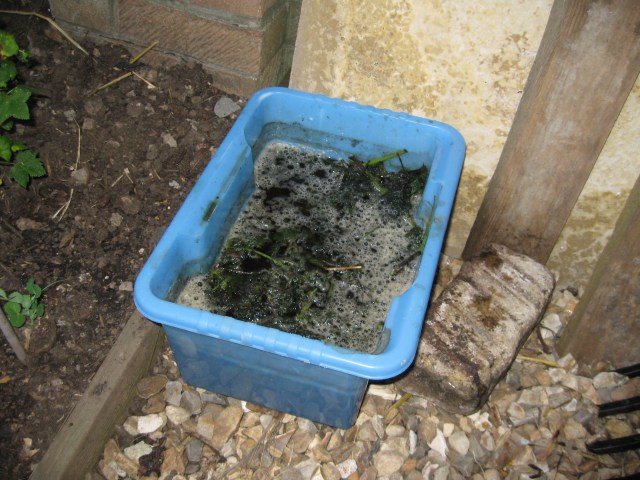
  • Liquid plant food research in Sweden has shown that liquid made from nettles gathered in the spring has high mineral content and so if you have access to plenty of nettles at that time of year, you can harvest them and dry for use later in the season to make nettle plant feed. To do this soak 1 kilo of nettles in 10 litres of water for about 2 weeks stirring occasionally. It won’t smell too good, but it’s worth the pong! You then strain the liquid off and use it diluted 1 part nettle juice to 10 parts water. The Nettle remains can be added to the compost heap but won’t act as an activator.

Making Nettle Plant Food- image from Tracey the transitoner

Making Nettle Plant Food- image from Tracey the transitioner

The roots of the perennial nettle form a dense mat from which they regrow each year- I have lots on the edges of the wood next to Old School Garden and they are constantly trying to invade! If you want to use the foliage and still keep them growing, cut them back only twice a year- if you want to be rid of them cut them back 3 or 4 times a year, even so it will probably take a couple of years to clear them entirely!

Source: Garden Organic Master Composter Factsheet 6

Further information:

Nettles- Royal Horticultural Society

Perennial Nettle- Garden Organic

Annual Nettle Garden Organic

Top ten uses for Nettles- Daily Telegraph

Heal the burn

Old School Gardener

If you’ve enjoyed reading this post and others on this blog, why not comment and join others by signing up for automatic updates via email (see side bar, above right ) or through an RSS feed (see top of page)?

'Friend or foe?'

‘Friend or foe?’

‘Prevention is better than cure’ applies to many situations in  life and controlling the pests and diseases in your garden is one of them.

As part of the ‘Master Composter’ project providing advice to families and groups about using green waste to make compost and enrich their soil, I’ve recently been sent a useful factsheet about organic pest and disease control. And pest control – specifically pigeons and blackbirds – is presently keeping me well exercised in the garden! More positively, I don’t seem to have had much of a problem with either slugs and snails, aphids or caterpillars – so far. A harsh winter and dry spell may be part of the answer. Anyway, I thought I’d share the basics of this factsheet with you (plus a few thoughts of my own).

Here are 7 tips for effective action to prevent your crops and plants being trashed by those not – so – welcome forces of nature!

1. Healthy soil

Too much fertiliser and your plants will be soft and sappy – providing a lovely lunch for pests and encouraging you to spray to deal with them. Not good practice. Better to feed your soil with a ‘wholefood’ diet of garden compost and leaf mould rather than those ‘fast food’ fertilisers designed to feed the plant and not the soil.

2. Resistant plants

Choose varieties of plant that can withstand the attack of pests and disease; e.g. blight resistant potatoes such as ‘Remarka’ and Sarpo’ and root aphid resistant lettuces like ‘Milan’.

Leaf mould - a great way to improve your soil

Leaf mould – a great way to improve your soil

3. Rotate your crops

Focusing on the veggy garden, crop rotation is an essential technique to build soil fertility and controlling the build up of pests and diseases.  Divide your veg into at least four groups (those in the same or similar families and having similar feeding habits) that stay together each year, but move onto another part of the garden  every spring.

4. Barriers and scarers

Keeping pests out of your crops and off your choice plants is probably the most effective way of reducing if not preventing damage. There is a range of different barriers and scarers suited to different types of crop or plant:

  • Fine mesh netting  – works well for carrot root fly and pea moth as well as pretty well most pests that attack cabbages (flea beetles, cabbage white butterfly, leaf weevils, birds and white fly).
  • Other Netting – useful for preventing birds eating/ damaging fruit and vegetables, but remember it should be tightly drawn to the ground to avoid any gaps – my own experience is that pigeons and blackbirds are past masters at finding the smallest of holes and working their way in! Netting can also prevent cabbage white butterflies from laying their eggs on Brassicas, but the gauge of the net needs to be fine enough to stop them. Also, having used hard plastic mesh netting for a while, I’d suggest investing in those made of softer, string -like material (nylon?), as this will drape more easily over crops.
  • Cabbage collars  – a collar of carpet underlay around the neck of  a young cabbage will prevent cabbage root fly from laying its eggs at the base of the cabbage.
  • Bottle cloches – made out of plastic bottles (tops and bottoms cut off) and placed over newly planted vegetables will prevent them being eaten by slugs or anything else that takes a fancy to them.
  • Small gauge chicken wire – always useful, this can be placed over newly sown peas to stop them being eaten by mice while germinating or being scratched up by cats. Wrapped around flowering bulbs, it can prevent them being dug up by squirrels.
  • Bird scarers – a ‘humming line’ (sometimes called buzzwire) criss – crossed over veg and which vibrates in the slightest of breezes will help scare off birds. You can come up with any number of other devices that use the wind to create noises or flashes of light and colour that will put off the birds, but move them around, as birds get used to things being in the same place and will eventually ignore them. I’ve just bought (for the princely sum of £2.50) a colourful windmill that I’ve stuck atop a cane and put over a spot where pigeons come to pinch my raspberries – we’ll see how effective that is! Another method is to tie up old CDs/DVDs to lines between canes to let them flash and move in the breeze. I’ve also seen some pretty realistic models of Owls and other birds of prey and a host of other devices that you can set up to ward off other birds – I’m not sure if they are effective, though.
A beer trap will entice slugs

A beer trap will entice slugs

5. Traps

Beers traps for slugs do work. Codling and Plum moth traps hung from apple trees and other ‘sticky’ traps can also be effective, using  a pheromone stuck to a sticky base which attracts male insects and gets them stuck in the glue. Greasebands painted around the trunks of apple trees in autumn will prevent the wingless female winter moth from climbing up the tree to mate. Sticky glue is also useful for glasshouse staging if you have a problem with ants. Sticky yellow bits of card hung up in greenhouses can help reduce the white fly population.

6. Beneficial bugs

These are your best friends when it comes to controlling pests in your garden. Planting simple annuals among the veg (e.g. Marigolds, Californian poppies), will attract  a wealth of beneficial insects  like ladybirds and hoverflies which will gobble up your aphids. I’ve put some marigolds alongside my tomatoes in the greenhouse for this reason and also planted Nasturtiums which can attract cabbage white butterflies as a diversion away from my Brassicas.You can also plant a few native shrubs and herbaceous perennials (e.g. hazel and hardy geraniums), create a pond, leave a small pile of logs in the corner of the garden or create a ‘bug hotel’  and feed the birds throughout the winter. There are other ‘biological controls’  that you can buy to deal w ith specific problems- little packets of some of the bugs for use in the greenhouse as well as nematodes that can attack some of the more troublesome pests.  Any or all of these will keep enough wildlife in your garden to eat literally thousands of pests and their eggs!

'Bishybarnabee' - or a ladybird- will eat loads of aphids at one sitting

‘Bishybarnabee’ – or a ladybird- will eat loads of aphids at one sitting

7. Keep it clean

Think ‘clean cut’. If you’re removing a dead or diseased branch from a tree (e.g one with coral spot), make sure you cut into healthy wood and always wash your tools in boiling water or wipe them with surgical spirit afterwards. Scrub out pots and give your greenhouse a good scrub every winter to get rid of over wintering pests. Maximise air circulation by correct pruning of plants and leaving  just a little more space between plants will help control fungal diseases, though his needs to be balanced of course against closer planting to keep weeds under control! Controlling powdery mildew in Roses is something that benefits from greater air circulation, for instance. Finally, and most importantly, be vigilant and check your plants regularly so that any pests and diseases don’t get a foothold. For example, start checking the centre of any Gooseberry bushes in April for Sawfly eggs and larvae. Also be wary of accepting gifts of onion and cabbage plants, as they may well carry onion white rot or clubroot respectively!

So, not a spray in sight – rather planning, forethought, observation and simple control measures can help you beat those garden pests and diseases!

Source: Master Composter Manual Factsheet 4, Jojo Norris, Garden Organic 2013

Old School Gardener

If you’ve enjoyed reading this post and others on this blog, why not comment and join others by signing up for automatic updates via email (see side bar, above right ) or through an RSS feed (see top of page)?
Brigid Jackson's avatararistonorganic

ESSENTIAL OIL NATURAL PEST REPELLENTS
Insect Essential Oil
Ants – peppermint, garlic, citronella
Aphids – peppermint, cedarwood, hyssop
Black Fly – lavender, tagetes
Caterpillars – peppermint
Fleas – lemongrass, citronella, lavender
Flies – lavender, citronella, peppermint, basil
Gnats – citronella, patchouli
Lice – peppermint, cedarwood
Mosquitoes – lavender, citronella, lemongrass
Slugs – garlic, cedar wood, pine
Snails – cedarwood, pine, garlic, hyssop
Ticks – thyme, citronella, sage
Weevils – sandalwood, citronella, sage

OLYMPUS DIGITAL CAMERA

GOOD COMPANIONS
Vegetable Essential Oil
Asparagus basil
Green beans lavender, basil
Beetroot marjoram
Broccoli basil, thyme
Cabbage peppermint, sage, thyme
Cauliflower thyme
Celery geranium
Cucumber sage
Leeks hyssop
Lettuce tagetes
Onions chamomile
Peas geranium
Potatoes basil, sage
Tomatoes basil

View original post

Aphids forecast to fly considerably later this year

‘…Dr Susannah Bolton, HGCA Head of Research and KT, said, “Average temperatures in January and February can be used to forecast the first aphid flights. As this winter was colder than the long-term average throughout the country it means that aphid flights are expected to occur much later this year.”

In the southern half of the country, as average temperatures were between 1oC and 2oC below normal, the first aphid flights are expected to be two to four weeks later than average.

In the northern half of the country, as average temperatures were less than 1oC below normal, the first aphid flights are expected to be up to two weeks later than average….’

Latest news from the Home Grown Cereals Board (UK)

Finding Nature

Nature Connectedness Research Blog by Prof. Miles Richardson

Norfolk Green Care Network

Connecting People with Nature

Discover WordPress

A daily selection of the best content published on WordPress, collected for you by humans who love to read.

Susan Rushton

Celebrating gardens, photography and a creative life

Unlocking Landscapes

Writing, photography and more by Daniel Greenwood

Alphabet Ravine

Lydia Rae Bush Poetry

TIME GENTS

Australian Pub Project, Established 2013

Vanha Talo Suomi

The Journey from Finnish Rintamamiestalo to Arboretum & Gardens

Marigolds and Gin

Because even in chaos, there’s always gin and a good story …

Bits & Tidbits

RANDOM BITS & MORE TIDBITS

Rambling in the Garden

.....and nurturing my soul

The Interpretation Game

Cultural Heritage and the Digital Economy

pbmGarden

Sense of place, purpose, rejuvenation and joy

SISSINGHURST GARDEN

Notes from the Gardeners...

Deep Green Permaculture

Connecting People to Nature, Empowering People to Live Sustainably

BloominBootiful

A girl and her garden :)