Category: Historic landscapes


WP_20150512_14_16_43_ProAnother trip out and another chance to visit some interesting and inspiring gardens last week. We travelled to see friends in Sussex and our lunch time stop was Knole near Sevenoaks, Kent, a large estate still owned by the Sackville family (of Vita fame) and part run by the National Trust. We were very lucky because we tipped up on a Tuesday, when the private Sackville gardens are open to the public, and we availed ourselves of a very engaging guided tour…

Beginning in the classical orangery, the tour wound its way around a fascinating garden, with some highlights to savour; the longest Wisteria on a wall outside China; the longest ‘Green Alley’ circumnavigating the walls of the garden; a champion fastigiate Oak tree and some wonderful azaleas with eye popping colour.

This slideshow requires JavaScript.

The house- a splendid mix of architectural styles- is undergoing some major alterations, but the grounds and gardens are breathtaking. Wikipedia describes the estate:

‘a 1,000-acre (4.0 km2) park, within which the house is situated. Knole is one of England’s largest houses, the National Trust attribute a possibility of its having at some point been a calendar house which had 365 rooms, 52 staircases, 12 entrances and 7 courtyards. Its grade I listing reflects its mix of Elizabethan to late Stuart structures, particularly in the case of the central façade and state rooms. The surrounding deer park has also survived with little having changed in the 400 years since 1600 although its formerly dense woodland has not fully recovered from the loss of over 70% of its trees in the Great Storm of 1987….

As a walled garden, Knole’s is very large, at 26 acres (11 ha) (30 including the ‘footprint’ of the house) and as such is large enough to have the very unusual — and essentially medieval feature of a smaller walled garden inside itself (Hortus Conclusus). It contains many other features from earlier ages which have been wiped away in most country-house gardens: like the house, various landscapers have been employed to elaborate the design of its large gardens with distinctive features. These features include clair-voies, a patte d’oie, two avenues, and bosquet hedges.

WP_20150512_14_46_18_Pro Further information: National Trust website

Old School Gardener

Stoke Poges Memorial Gardens

Stoke Poges Memorial Gardens


WP_20150505_15_12_46_ProOur second visit whilst travelling to the Lake District last week, was to Biddulph Grange, in Staffordshire.
Restored over the last 30 years by the National Trust, this is a delightful series of gardens designed to house James Bateman’s (the original owner) extensive plant collection from around the world. This is achieved in a series of gardens within a strong overall design structure, featuring some amusing and beautiful touches typical of the Victorian age.

This slideshow requires JavaScript.

The gardens are a delight and I was fortunate to see the highlight (‘China’) last; a fitting climax as you wander round this fascinating window on one man’s passion for plants, superbly restored by the Trust. Wikipedia describes the devopment of the gardens:

Biddulph Grange was developed by James Bateman (1811–1897), the accomplished horticulturist and landowner; he inherited money from his father, who had become rich from coal and steel businesses. He moved to Biddulph Grange around 1840, from nearby Knypersley Hall. He created the gardens with the aid of his friend and painter of seascapes Edward William Cooke. The gardens were meant to display specimens from Bateman’s extensive and wide-ranging collection of plants….

Bateman was president of the North Staffordshire Field Society, and served on the Royal Horticultural Society‘s Plant Exploration Committee…. He especially loved Rhododendrons and Azaleas. Bateman was “a collector and scholar on orchids,” …

His gardens are a rare survival of the interim period between the Capability Brown landscape garden and the High Victorian style. The gardens are compartmentalised and divided into themes: Egypt, China, etc.

In 1861 Bateman and his sons, who had used up their savings, gave up the house and gardens, and Bateman moved to Kensington in London. Robert Heath bought Biddulph Grange in 1871. After the house burnt down in 1896, architect Thomas Bower rebuilt it.

The post-1896 house served as a children’s hospital from 1923 until the 1960s; known first as the “North Staffordshire Cripples’ Hospital” and later as the “Biddulph Grange Orthopaedic Hospital” (though it took patients with non-orthopaedic conditions as well…. The 15 acre (61,000 m²) garden became badly run-down and neglected during this period, and the deeply dug-out terraced area near the house around Dahlia Walk was filled in level to make a big lawn for patients to be wheeled out on in summertime. The Bateman property was (and still is) divided: the hospital got the house and its gardens, and the uncultivated remainder of Biddulph Grange’s land became the Biddulph Grange Country Park…’

WP_20150505_15_04_33_Pro


Further information: National Trust website

Old School Gardener

WP_20150505_13_09_00_Pro

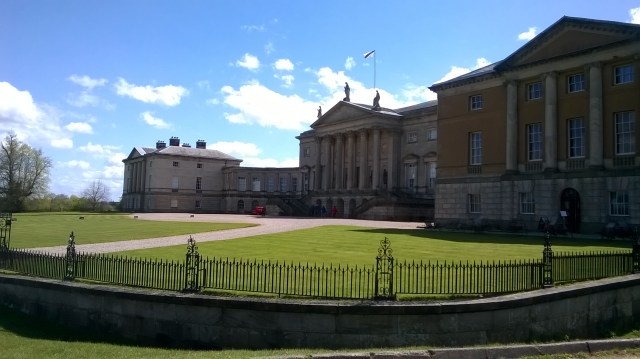
On a trip north last week, we managed to pack in three very interesting National Trust properties to and from our destination in the Lake District. The first was Kedleston Hall, the 18th century pile of the Curzons, an old Norman family who became prominent Tories in later times and built this magnificent home as a power statement to rival that developed by their Derbyshire Whig rivals, the Cavendish family, at Chatsworth.

WP_20150505_11_56_22_ProWe thought the front of the house reminiscent of Norfolk’s Holkham Hall, and indeed in the very helpful introductory talk we learned it had been designed by the same architects in Palladian style. However, the similarities started to dilute once we were inside, as the then Lord Curzon decided to follow the emerging design fashion of Neo Classical, so the house is an interesting- and successful – blend of the two styles.

The gardens- really more of a bold, sweeping landscape plus some slightly more human scale ‘pleasure grounds’- fit the classical style of the house and it was a lovely experience strolling around these before we had our lunch. Wikipedia describes the gardens and grounds:

‘The gardens and grounds, as they appear today, are largely the concept of Robert Adam. Adam was asked by Nathaniel Curzon in 1758 to “take in hand the deer park and pleasure grounds”. The landscape gardener William Emes had begun work at Kedleston in 1756, and he continued in Curzon’s employ until 1760; however, it was Adam who was the guiding influence. It was during this period that the former gardens designed by Charles Bridgeman were swept away in favour of a more natural-looking landscape. Bridgeman’s canals and geometric ponds were metamorphosed into serpentine lakes.

 Adam designed numerous temples and follies, many of which were never built. Those that were include the North lodge (which takes the form of a triumphal arch), the entrance lodges in the village, a bridge, cascade and the Fishing Room. The Fishing Room is one of the most noticeable of the park’s buildings. In the neoclassical style it is sited on the edge of the upper lake and contains a cold bath and boat house below. Some of Adam’s unexecuted design for follies in the park rivalled in grandeur the house itself. A “View Tower” designed in 1760 – 84 feet high and 50 feet wide on five floors, surmounted by a saucer dome flanked by the smaller domes of flanking towers — would have been a small neoclassical palace itself. Adam planned to transform even mundane utilitarian buildings into architectural wonders. A design for a pheasant house (a platform to provide a vantage point for the game shooting) became a domed temple, the roofs of its classical porticos providing the necessary platforms; this plan too was never completed. Amongst the statuary in the grounds is a Medici lion sculpture carved by Joseph Wilton on a pedestal designed by Samuel Wyatt, from around 1760-1770.

In the 1770s George Richardson designed the hexagonal summerhouse, and in 1800 the orangery. The Long Walk was laid out in 1760 and planted with flowering shrubs and ornamental trees. In 1763 it was reported that Lord Scarsdale had given his gardener a seed from rare and scarce Italian shrub, the “Rodo Dendrone” (sic).

The gardens and grounds today, over two hundred years later, remain mostly unaltered. Parts of the estate are designated as a Site of Special Scientific Interest, primarily because of the “rich and diverse deadwood invertebrate fauna” inhabiting its ancient trees.’


WP_20150505_11_57_53_Pro

Further information: National Trust website

Old School Gardener

'The Pimple' on the edge of Dartmoor, Tavistock, Devon- one of my favourite places...

‘The Pimple’ on the edge of Dartmoor, Tavistock, Devon- one of my favourite places…

As promised, here is a selection of pictures from a three day trip to the Czech capital last week.

This slideshow requires JavaScript.


Thaxted: Sunlit Gem

Lonely Planet?

Lonely Planet?

A few pictures from a recent visit to this beautiful Essex town.

Old School Gardener


Sutton Hoo?

sutton hoo via national trust‘An Anglo-Saxon king and his treasured possessions were unearthed here. Sutton Hoo is a hauntingly beautiful estate with far-reaching views, where you can explore ancient burial mounds, and see replica treasure as well as original finds. A reconstruction of the king’s burial chamber adds some adventure to the story. Inspired? Read on here ‘

Via The National Trust

It’s been a while since I featured some interesting architectural detailing, but I was blown away by what I saw ‘over my head’ in Bruges, so feast your eyes…(I’ve thrown in a few other shots of this wonderful town).

This slideshow requires JavaScript.

 Old School Gardener

WP_20141124_12_22_31_ProOn our recent trip to Bruges, Belgium we did a lot of walking and the weather was kind, with some bright, sunny, crisp mornings to explore the beautiful medieval town centre. One wonderful discovery was the Beguinage (Begijnhof). Wikipedia tells us more…

‘The word béguinage is a French term that refers to a semi-monastic community of women called Beguines, religious women who sought to serve God without retiring from the world, as well as to the architectural complex that housed such a community. The word has been absorbed into English, where it is typically written without an accent. There are two types of beguinages: small, informal, and often poor communities that emerged across Europe from the twelfth century on, and the Court Beguinages (begijnhof (Dutch)), a much larger and more stable type of community that emerged only in the region of the Low Countries in the first decades of the thirteenth century.

While a small beguinage usually constituted just one house where women lived together, a Low Countries Court Beguinage typically comprised one or more courtyards surrounded by houses, and also included a church, an infirmary complex, and a number of communal houses or ‘convents’. From the twelfth century through the eighteenth, every city and large town in the Low Countries had at least one Court Beguinage (they shut down, one by one, in the nineteenth and twentieth centuries). They were encircled by walls and separated from the town proper by several gates which were closed at night. During the day the Beguines could come and go as they pleased. Beguines came from a wide range of social classes, though truly poor women were only admitted if they had a wealthy benefactor who pledged to provide for their needs.

Our understanding of women’s motivations for joining the Beguinages has changed dramatically in recent decades. The development of these communities is clearly linked to a preponderance of women in urban centers in the Middle Ages, but while earlier scholars like the Belgian historian Henri Pirenne believed that this “surplus” of women was caused by men dying in war, that theory has been debunked. Since the groundbreaking work of John Hajnal, who demonstrated that, for much of Europe, marriage occurred later in life and at a lower frequency than had previously been believed, historians have established that single women moved to the newly developed cities because those cities offered them work opportunities. Walter Simons has shown how the smaller beguinages as well as the Court Beguinages answered those women’s social and economic needs, in addition to offering them a religious life coupled with personal independence, which was a difficult thing to have for a woman.’

The Beguinage residences here in Bruges are clustered around a green space which was full of mature Lime Trees- they cast beautiful shadows in the low sun..

It was about a year ago that we visited Amsterdam and discovered another Beguinage there. See Young Women and the gutters of Amsterdam

Old School Gardener

Finding Nature

Nature Connectedness Research Blog by Prof. Miles Richardson

Norfolk Green Care Network

Connecting People with Nature

Discover WordPress

A daily selection of the best content published on WordPress, collected for you by humans who love to read.

Susan Rushton

Celebrating gardens, photography and a creative life

Unlocking Landscapes

Writing, photography and more by Daniel Greenwood

Alphabet Ravine

Lydia Rae Bush Poetry

TIME GENTS

Australian Pub Project, Established 2013

Vanha Talo Suomi

The Journey from Finnish Rintamamiestalo to Arboretum & Gardens

Marigolds and Gin

Because even in chaos, there’s always gin and a good story …

Bits & Tidbits

RANDOM BITS & MORE TIDBITS

Rambling in the Garden

.....and nurturing my soul

The Interpretation Game

Cultural Heritage and the Digital Economy

pbmGarden

Sense of place, purpose, rejuvenation and joy

SISSINGHURST GARDEN

Notes from the Gardeners...

Deep Green Permaculture

Connecting People to Nature, Empowering People to Live Sustainably

BloominBootiful

A girl and her garden :)