Category: Historic landscapes


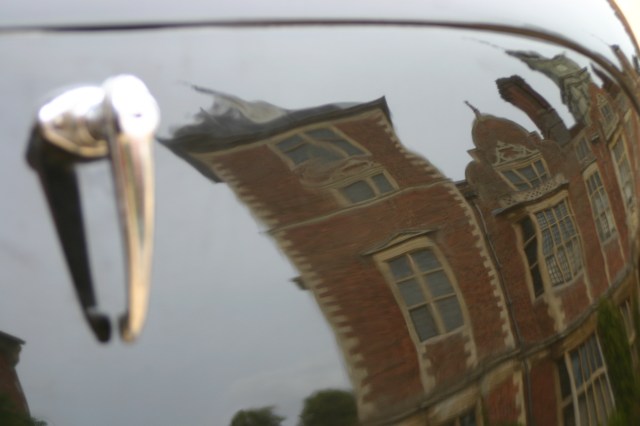
IMG_7088I frequently visit this wonderful Jacobean Mansion and more particularly it’s gardens and parkland. After all it is just 7 miles from home. A  walk around the park after a Christmas Day ‘brunch’ has become something of a family institution, often complete with festive headwear!

I try to visit the gardens at different times of the year as they offer something for every season, and back in September I was keen to experience the late summer colour festival of its herbaceous and other plantings. At this time of year it’s mix of formal and informal styles is most evident.

Coincidentally, there was a splendid event going on to celebrate the role of the Hall in the Second World War, including people dressed in military uniforms and plenty of vehicles and ‘kit’ from the time. This is my photo record of my most recent visit along with a very good summary of the gardens’ history and features from Wikipedia:

‘A house and garden existed at Blickling before the estate was purchased by the Boleyn family in the 1450s, but no records survive to give an indication of their appearance. After Sir Henry Hobart acquired the estate in 1616, he remodelled the gardens to include ponds, wilderness and a parterre. A garden mount– an artificial hill in Blickling’s flat landscape, was made to provide views of the new garden. With the accession of Sir John Hobart (later the 1st Earl of Buckingham) in 1698 the garden was expanded to add a new wilderness and the temple was constructed.

In the latter half of the 18th century John Hobart, 2nd Earl of Buckingham, embarked on works that would radically change the appearance of the gardens. All traces of formality were removed, and naturally arranged clumps of trees were planted to create a landscape garden. By the 1780s an orangery had been built to overwinter tender citrus trees. Following the 2nd Earl’s death in 1793, his youngest daughter Caroline, Lady Suffield, employed landscape gardener Humphry Repton and his son John Adey Repton to advise on garden matters. John Adey Repton would go on to provide designs for many garden features.


The estate was inherited by nine-year-old William Schomberg Robert Kerr, 8th Marquess of Lothian in 1840. He later re-introduced the formality and colour schemes of the parterre. After his death at the age of 38, responsibility for the gardens rested with Lady Lothian and her head gardener Mr Lyon. Philip Henry Kerr, 11th Marquis of Lothian, inherited the estate in 1930. After disparaging comments in a publication of Country Life, Lothian engaged socialite gardener Norah Lindsay to remodel the gardens. In the parterre she replaced the jumble of minuscule flower beds with four large square beds planted with a mixture of herbaceous plants in graduated and harmonious colours. Other improvements included removal of a line of conifers in the Temple walk, which were replaced with plantings of azaleas.

The garden today

The garden at Blickling covers 55 acres (22 ha) and contains formal and informal gardens, Grade II listed buildings and structures, woodland, specimen trees, Victorian garden ornaments, topiary, the kitchen garden .. and 18th century yew hedges.

The lawns which frame the main approach to the hall are bounded by yew hedges which were first recorded by William Freeman of Hamels in 1745. Surrounding the hall on three sides is the dry Moat. The plantings in the moist, sheltered conditions of the moat were considerably revised by Lindsay who introduced hosta, species of hydrangea, buddleja and rosemary.

To the rear of the hall is the noted Parterre garden which is located on the east lawn. Originally created as a Victorian sunken garden it was remodelled by Lindsay in the early 1930s. Set around an 18th-century listed stone fountain, she divided the garden into four large, colourful herbaceous beds surrounded by L shaped borders stocked with roses and catmint with an acorn shaped yew marking each corner.


In the terraces above the parterre there are plantings of peony, seasonal beds and the Double Borders created in 2006, contain a wide variety of perennials, shrubs and grasses with colours ranging from hot to cool. Close by, are the White and Black Borders which were established in 2009, together with a collection of eleagnus.

The western side of the garden features the lawned Acre which is fringed by a spreading oriental plane tree. Outdoor sports such as croquet are played here in the summer months. Further highlights are a collection of magnolia underplanted with autumn cyclamen, the shell fountain and the kitchen garden. To the north of the parterre is the Wilderness garden which is bisected by radial grassed avenues flanked with turkey oak, lime and beech trees and naturalised bulbs. The wilderness hides a Secret Garden with a summerhouse, scented plants and a central sundial.

Nearby is the listed 18th century orangery which houses a collection of citrus trees. Adjacent, to the building is the steep sided Dell which is home to many woodland plants including a selection of hellebore and foxglove. In 2009, an area of woodland was cleared close to the orangery to create a new garden. Stocked with a wide range of woodland plants including camellia and varieties of mahonia. Opened in 2010, it will be known as the Orangery Garden.

The Grade II listed Temple is approached by the Temple walk which is lined with azalea planted by Lindsay in her original 1930s design. Scattered throughout the garden are many garden ornaments including thirty pieces supplied to Lady Lothian in 1877 by Austin & Seeley of Euston Road, London.

Future projects include the creation of a philadelphus and rose garden. Both of which will be located in the Wilderness and open to the public in the near future .’ (Note – these have now been established and are open to the public- see pics below).

Further information:

National Trust Website

Wikipedia

Old School Gardener

PicPost: Rice weather we're having...

Old School Gardener

IMG_8062

The second garden visit on our last day in Portugal took us a little further towards the mouth of the River Tagus, but still within the town of Oeiras. The Gardens of the Palace of the Marquis of Pombal convey an even more prosperous feel and are altogether larger – almost a ‘landscape’ scale. It is easy to imagine these high baroque walks, lawns, borders and water features as the scene of some serious 18th century showing off, flirting and general fun. 

The 1st Marquis of Pombal

The Town Council now occupies the former palace. The Marquis of Pombal, one of Portugal’s most famous leaders, was rewarded with the palace, the title (and the title Count of Oeiras) for his service as first minister to the Portuguese King Dom Jose I in the mid- late 18th century. The surrounding gardens are typical of Portuguese landscape art, inspired by eighteenth century European designs but holding to the tradition of the Portuguese stately house. They are richly decorated with marble busts and statues, low walls and marble staircases along with many murals composed from azulejos (glazed tiles).

Here too is the Poets’ Waterfall, with excellent busts of the four epic poets (Tasso, Homer, Virgil and Camoes) looking out over the gardens and carved in marble by Machado de Castro. At the fountain’s centre lounges the figure of a ‘river god’ modelled on the one that existed at the Belvedere Gardens, in the Vatican, Rome. As in the garden we visited earlier at Caxias, the fountain is a fantastic structure made out of pitted stone which conveys a truly antique feel. There are also splendid views of the surrounding gardens from the stairs that wrap around the sides of the construction.

The gardens form one part of a wider estate which is planned to a rigourous geometry and divides recreation spaces, great gardens and surrounding farms, all reflecting the style of the well-to-do families of the age.  The gardens saw cultural events such as theatre, ballet and musical performances, a tradition kept up to the modern day (Roxy Music performed here in 2010!).  Here are some pictures of the formal gardens lying to the side of the Poets’ Fountain, with empty pools resting near to the remains of a ‘bousquet’ (a sort of woodland in miniature) and the wonderful (empty) pools and fountains of a large water garden with some beautiful glazed tiles that must look really vibrant when wet.

Related article:

Portuguese Gardens: Baroque Splendour at Caxias, Portugal

Old School Gardener

shinealightproject's avatarShine A Light

By Dayna Woolbright

The Georgian period spans 123 years, 1714-1837, and marks the period when England was ruled by the Hanoverian Kings, George I, George II, George III, George IV, William IV.The Georgian period saw much change; in politics, industry and literature. In social terms it saw the gap between rich and poor widen and the emergence of the libertarian ‘middle class.’ This era helped shape Britain as we know it today and there are far too many important historical events to consolidate into one blog, for this reason I will concentrate on the social history and the developments that can be represented through objects in the Norfolk Museums and Archaeology service’s collection.

Architecture

The Georgian period saw the emergence of imperial based wealth through the import/export of various goods which were sold around the world. This created a new larger, wealthy middle class who liked to illustrate their wealth…

View original post 2,766 more words

IMG_7828 After a stroll through Estrela Gardens in Lisbon we found  our way to somewhere new to us – the English Cemetery just over the road. What a discovery- a quiet, green and fascinating space where a wide range of graves and monuments records the long association of the English with Portugal. The website of the Anglican Church in Lisbon describes it’s past:

‘Part of the Treaty of 1654 negotiated between Cromwell and King João IV of Portugal stipulated that English subjects living in Portugal should have a plot allotted to them “fit for the burial of their dead” in the Lisbon area. Due to opposition from the Inquisition, nothing was done about this until the early eighteenth century and it was only in 1717 that Consul Poyntz was able to report back to London that he had leased a suitable plot near the City “for the burial of our dead”. It became known as St. George’s Cemetery. From those early beginnings until the present day non- Roman Catholic British Nationals have had a traditional privilege of burial at St. George’s; practising Roman Catholics are now also admitted.  

It is an historic site for many reasons and an interesting one too. Probably the most famous British person buried there is the novelist Henry Fielding; he came to Lisbon to try and recover from health problems but actually died on 8th October 1754. No-one knows exactly where he was buried, but a monument to him in the form of a raised tomb was erected by public subscription in 1830. Later on in the Peninsular War Portuguese soldiers acting under orders from Marshal Beresford forced open the door in order to inter the remains of Brigadier General Coleman; legend has it that many other British soldiers were buried there during this period but have no marked graves. From the twentieth century there are rows of Commonwealth War Graves, commemorating servicemen who happened to die in the Lisbon area during World War II. These are but three examples, a wander round confirms that the remains of many interesting people from all walks of life and different nationalities have been interred at St. George’s for almost three hundred years.

In the second half of the nineteenth century many trees and shrubs were planted in the cemetery, some of which survive to this day. It makes it a peaceful, verdant spot, a walled oasis covering several acres in the middle of Portugal’s busy capital.’

Here is my record of our visit in late October 2013.


Old School Gardener

IMG_7805

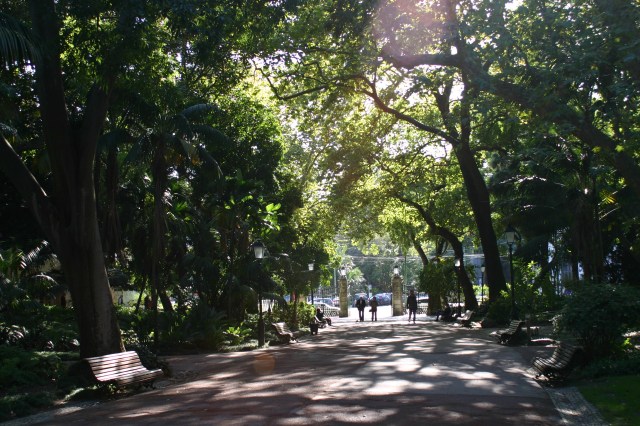
I wrote an earlier article about the ‘Star Garden’ (Jardim da Estrela) in Lisbon, singing its praises as a wonderful example of a classic public park/ gardens and how it has maintained an important role in the life of the capital. On a recent trip I managed to weave in an early Autumn visit, something I haven’t done before.

It was even better than in the Spring – luxuriant foliage was everywhere, people were out and about enjoying the space and the low autumn sunshine provided some wonderful lighting effects. I was particularly taken this time with the little ‘public library’ housed in a picturesque kiosk in the centre of the gardens. Obviously popular with a set of older men, who here, as in other parts of the gardens, were reading or playing cards- one suspects that they are regulars.

This seems to be a wonderful amenity and an idea that’s worth a try in UK parks and gardens! (or are there some examples already out there that I’m not aware of?)

I also mentioned in my previous article the various statues in the gardens and how these were placed here after the formation of the Portuguese Republic in the early 20th century. I made a point in this visit to seek some more of them out, as I had not noticed them before, hiding, as they seem to be, under trees or in mature shrubbery.

My visit felt rather like meeting up with an old friend, someone I hadn’t seen for some time. I was able to easily recollect their more important physical features and personaility traits, but was also drawn to some new features or angles on them. My ‘new look’ at Estrela was repaid not only with the uncovering  of more statues, but also with some superb scenes of dappled sunlight (including the dramatic back lighting of large exotic leaves), superb ‘Dragon’ and other trees, a fantastic decorative ceiling on the bandstand roof, lively play area, late summer blooms of Hibiscus and unusual tree conservation measures (filling in a hole in a trunk with brickwork!)

I wonder what the place must be like high summer when various events inlcuding live Jazz add yet another dimension to this magical place? Another visit beckons…..

Related article: Portuguese Gardens: Estrela Garden, Lisbon

Old School Gardener

I couldn’t resist sharing some pictures I took on my recent trip to Amsterdam. Wandering the roads and taking a canal boat ride offered many opportunities to capture the beauty of this City’s distinctive architecture, canals and other features – especially in the low autumn sunshine that accompanied us. First the canals….

Next the cycles….

Finally, those ‘Coffee Shops’ that aren’t really that at all. Not to be confused with cafés, they have been a part of Amsterdam since the 1970s, when the Dutch government made a clear distinction in the law between ‘hard’ and ‘soft’ drugs. Coffee shops have always existed in a legal grey area. They are allowed to operate with a set, non-transferable licence (shown by the display of an official, green and white sticker in the window). There are about 200 in Amsterdam, and most have a ‘menu’ of soft drugs for sale, but they are not allowed to sell alcohol! Then there are the fully legal ‘Smart Shops’, which sell herbal i.e. smart drugs, named because they are supposed to stimulate the mind and improve memory. They also sell magic mushrooms. In recent years there has been an explosion of smart shops in Amsterdam, many shops are selling mushrooms, vitamins, weed seeds, grown kits, pipes and various souvenirs and arts.

Oh, and a bonus of a few odd pictures around and inside the Rijksmuseum- guess what the crowd are looking at?……………….. Rembrandt’s masterpiece ‘The Nightwatch’.

Old School Gardener

WP_20131109_031

Sorry to disappoint if you think this is going to be about the famous ‘red light district’ of Amsterdam. It’s not. I’m just back from a weekend celebration with my wife, Deborah who had an ‘important birthday’ on Saturday.

It was a great visit, the highlight meeting up with 10 friends and relations in a cosy but wonderful restaurant complete with birthday cake and fireworks! I wasn’t expecting either the time or opportunity to take some serious photographs while there, but I was pleasantly surprised, so I’ll share a few of the better ones (taken on my phone camera) over the next week or two.

Saturday morning in the city was sunny so we managed a delightful wander through the canal – ringed old city and came across a wonderful little oasis called the ‘Begijnhof’. ‘Beguines’ were pious single catholic women who wanted to do good works, like nuns, but did not want to live in a convent and therefore had not taken all of the nun’s vows. Here’s what Wikipedia has to say:

‘The Begijnhof is the only inner court in Amsterdam which was founded during the Middle Ages, and therefore lies within the Singel — the innermost canal of Amsterdam’s circular canal system. The Begijnhof is at medieval street level, which means a meter below the rest of the old city center.

It is unclear when exactly the Begijnhof (Beguines’ court) was founded. In 1346, the beguines still lived in a house (a document of that time mentioned one beghynhuys). A courtyard was only first mentioned in 1389, probably after the religious status of the city rose due to the Amsterdam Eucharistic Miracle of 1345.

Originally the Begijnhof was entirely encircled by water …. The back facades were therefore water-locked….The Begijnhof differs from the usual Amsterdam patricians’ court in that this old people’s home was not founded by private persons. It bore closer resemblance to a convent, although the beguines enjoyed greater freedom than nuns in a convent. While beguines took a vow of chastity, and while they considered themselves obliged to attend Holy Mass every day and pray various official prayers, they were free to leave the court at any time in order to get married….

The most famous beguine in the Begijnhof’s history is sister Cornelia Arens, who died on 14 October 1654…. Rather than be laid to rest in the Chapel, which she considered “desecrated” by Presbyterians, she chose to be buried in the gutter of the court. Legend has it that contrary to her wish, she was in fact buried in the Chapel, but her coffin was found in the adjoining gutter the following day. This happened two more times, until she was at last laid to rest in the gutter. Another version of the legend is that her soul found no peace and roamed the court at night until she was buried in the gutter…..

On 23 May 1971, the last beguine died at the age of 84. “Sister Antonia” ……………… She was buried in the Sisters’ Grave in the St. Barbara’s Roman Catholic Cemetery in Amsterdam on 26 May of the same year…

Until its renovation in 1979, the court had 140 dwellings — some 110 of them consisting of a single room, and about 25 comprising two. The occupants likewise numbered 140. The renovations enlarged the houses to two or three rooms. Since that time, the number of female inhabitants has been an unvaried 105.’

Here is my take on the Begijnhof, where a combination of small domestic gardens, splendid architecture and a unifying lozenge – shaped green created a real Autumn Jewel on our visit to this beautiful city.

Old School Gardener

Finding Nature

Nature Connectedness Research Blog by Prof. Miles Richardson
Norfolk Green Care Network

Connecting People with Nature

Discover WordPress

A daily selection of the best content published on WordPress, collected for you by humans who love to read.

Susan Rushton

Celebrating gardens, photography and a creative life

Unlocking Landscapes

Writing, photography and more by Daniel Greenwood

Alphabet Ravine

Lydia Rae Bush Poetry

TIME GENTS

Australian Pub Project, Established 2013

Vanha Talo Suomi

The Journey from Finnish Rintamamiestalo to Arboretum & Gardens

Marigolds and Gin

Because even in chaos, there’s always gin and a good story …

Bits & Tidbits

RANDOM BITS & MORE TIDBITS

Rambling in the Garden

.....and nurturing my soul

The Interpretation Game

Cultural Heritage and the Digital Economy

pbmGarden

Sense of place, purpose, rejuvenation and joy

SISSINGHURST GARDEN

Notes from the Gardeners...

Deep Green Permaculture

Connecting People to Nature, Empowering People to Live Sustainably

BloominBootiful

A girl and her garden :)