Category: Heritage Gardens & gardening


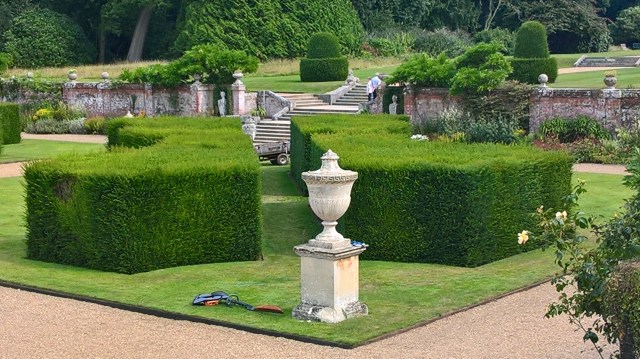
wp_20161013_15_48_01_proThis week it was a concerted effort to cut back and tidy up the hedge that runs along the ‘ha ha’ on the northern boundary of the gardens at Blickling.

The hedges that run along the ha ha, backed by a wire fence for security, are a bit of a bone of contention. Some are pretty consistent (like the one that was cut back this week- it’s mainly Beech), but others are a real mixture of different hedge plants and hedge plants that want to grow into trees (especially Sycamore). And in some places the hedge has grown out to reduce the space between it and the fence which makes it almost impossible to get in alongside with a strimmer to keep the undergrowth down.

If I had my way I think it would be worth spending time to grub them out completely, as they perform no useful security role, but take  a lot of maintenance if they are to be kept in a reasonably tidy state. Of course they are of value to nature (as nesting sites and food sources for birds) and I must say gardeners Ed and Rob did make a nice job of cutting back the northern hedge so that it should, hopefully sprout forth with new life next spring.

wp_20161013_11_55_59_pro

After cut..looking a bit of a mess….?

Anyway, our session involved finishing off cutting back the hedge and its immediate surrounds and then ‘feeding the wolf’ that is the industrial scale shredder. By the end of the morning, having brought up all the brashings from the hedge to the path above the ha ha the shredder had finished its first pass.

After lunch we tidied up the last few cuttings and then moved on to finish off the hedge at its steepest descent from the path. An earlier attempt at cutting this area had been halted as a wasp’s nest had been discovered. Despite the wasps still being active, gardener Rob proceeded to cut the remaining hedge back…only to disturb the wasps and get attacked for his efforts! A few stings later (one on the head seemed to be especially painful), Rob paused for thought…and we gingerly tidied up as much as we could, but staying well away from the wasps, until the nest can be properly dealt with.

All told it had taken Gardeners Ed, Rob, Rebecca and Jane plus half a dozen volunteers virtually all day to complete the job. But it does look tidy, if bare- the hedge has been drastically reduced in height and girth, and hopefully is back to a manageable size. Now will the next stage be to tackle the east and southern boundaries, or would that be a hedge too far….?!

Further Information:

Blickling Hall website

Blickling Hall Facebook page

A 360 degree tour of Blickling Hall

Old School Gardener

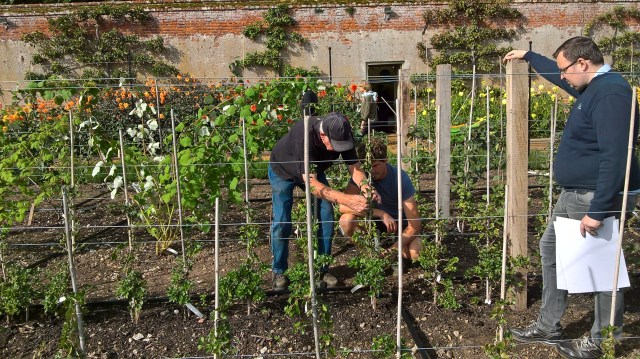
wp_20160929_13_42_00_proBack to Thursday at Blickling this week. An interesting, if not particularly tiring day helping to erect the new fruit cage that I thought might have been up already!

I’m not sure about why there had been a delay, but no matter, it was an enjoyable day working mainly with Project Manager Mike, Gardeners Ed and Rebecca, Norfolk Peter and a couple of guys sent over by the supplier to help.

Reminiscent of the task we had putting in the oak posts to support the raspberries, this involved lining up the posts, sinking receivers into the ground for the powder coated posts and then fixing the cross rails, making sure all were vertical and level as we went. We finished off with some corner braces to fix the outer posts rigid. The cage had been specially made to fit the irregular shape of the fruit bed, so I spent some time sorting out the different lengths of cross rail and placing them ready to be fitted.

Underway...

Underway…

After lunch I took a different route back to the Walled Garden; the sun was out and people were enjoying a late summer day by the lake…

Back to cage fighting! After a few moments of cursing at posts that wouldn’t stand straight or rails that weren’t level, with the aid of a sizeable rubber mallet and spirit level, we were able to ensure the structure looked neat and tidy. There was also a good standard of ‘garden banter’ on offer!

..near the end..of our tethers?!

..near the end..of our tethers?!

By the time I had to leave the bulk of the cage was up, leaving just one side to be put in. I think Mike is going to put the side netting on, but in case of heavy snow this winter, is leaving the roof off until the spring. I also had a spare ten minutes so I weeded the large piles of compost waiting to be put on the ground as mulch.

I also had the chance to speak with Mike about one or two matters I raised in last week’s post. First, I was right about the new compost bins- they are designed as ‘hot bins’ so don’t need any extra aeration. Mike tells me the temperature in the middle is already up in the 70’s fahrenheit! Second, he does plan to put in some green manure on the pumpkin beds, but it looks like its getting a bit late to sow any but a variety of grazing rye, so we shall see. I noticed that the beds had already been dug over following my clear up last week.

Ready for rye...

Ready for rye…

Today was the beginning of ‘sign up’ for the series of winter talks put on for volunteers here- a great idea. I’ve signed up to hear Mike talk further about the Walled Garden and also Assistant Head Gardener Steve, who is sharing his many year’s memories of working at Blickling….that should be ‘interesting’…

Further Information:

Blickling Hall website

Blickling Hall Facebook page

A 360 degree tour of Blickling Hall

Old School Gardener

wp_20160921_12_28_07_proI went in to Blickling on Wednesday this week and worked with Peter and Maurice clearing away the piles of pumpkin and squash greenery left behind after the previous day’s volunteers had harvested a fantastic array of squashes and pumpkins.
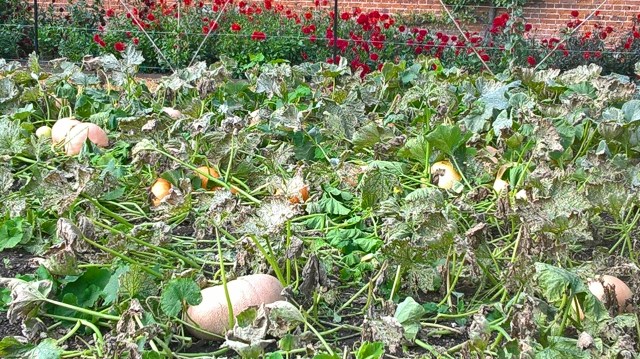
Some of the squash beds awaiting harvesting and clearing

Some of the squash beds awaiting harvesting and clearing

I was excited to see another wooden structure in the far corner of the Walled Garden- three new compost bins with removable, slatted fronts and panelled lids. These will be a great addition to the garden and reduce the need to transport piles of compost from the main dumping ground on the other side of the gardens.

The new compost bins

The new compost bins

I was initially puzzled to see no gaps in the sides fo these new bins as I thought they would be necessary to allow some air to get into the bins. However, on reflection, I think the theory might be that the amount of material, and with regular turning, these bins will be ‘hot’ bins creating usable compost within a matter of a few months. Mike, the Project Manager wasn’t around to clarify this, so that’ll be a question for next week’s session. As we were finishing off the clearing up, a couple of young children and their parents wheeled a couple of mini barrowfuls of material over to help us!

wp_20160921_11_23_58_proIn the remaining hour before lunch we hoed and stone picked around the soft fruit bushes, where, Assistant Head Gardener, Steve, told us that new fruit cages were to be erected the following day. I look forward to seeing these in place next week.

After lunch Maurice and I hoed across the pumpkin and squash beds to tidy them up. I think Mike plans to sow some green manures in these over winter. I hope so, as I’d be interested to see how this would look and what it would do to protect and add to the nutrients in the soil.

The Dahlias are continuing to put on a good show, and I noticed that the cyclamen were in full bloom just outside the Walled Garden.

We had plenty of visitors in the Walled Garden, and many stopped to chat and ask questions, as well as praising everyone’s efforts. One chap asked me what the difference is between a gourd and a squash…hmm after a quick thought I offered the view that they are different types of the same sort of plant, the gourd possibly being more of a climbing variety…As it turns out I wasn’t quite right, as this very helpful advice from the site Missouri Botanical Garden explains:

‘Pumpkins, squash and gourds are members of the enormously diverse Cucurbitaceae family, which contains more than 100 genera and over 700 species.  They have been providing mankind with food and utilitarian objects since before recorded history.  Various members of the genus Cucurbita are known as squash or gourds.

Names differ throughout the world, but in the United States, any round, orange squash used for pies or jack-o-lanterns is likely to be called a pumpkin.  But the term “pumpkin” really has no botanical meaning, as they are actually all squash.  Squash are divided into two categories: tender or summer squash, and hard-skinned or winter squash.  Examples of summer squash include zucchini, pattypan, straightneck, crookneck and other types.  Winter squash include small to medium hard-skinned squash such as the acorn, small hubbard, miniature pumpkin and spaghetti types, as well as the large hard-skinned types, including banana, butternuts, cheese pumpkins, cushaws, and large hubbards, among others.

Botanists use distinctive characteristics of leaves, seeds and fruit stalks to classify the different species.  The origins of these species are lost in time, but all are assumed to have originated in the Western Hemisphere, principally South and Central America and Mexico.  Variety selection for the many distinct shapes, sizes and colors has occurred in all cultures worldwide….

Gourds are defined as hard-shelled durable fruit grown principally for ornament, utensils and general interest….

Hardshell gourds remain green throughout the growing season, but dry to a brownish-tan when fully cured.  They have traditionally been utilized as bottles and containers for liquid and dry materials, as well as food, medicine, musical instruments, artistic media and many other uses.

Like the squash, cultivar selections in various shapes and sizes have continued from prehistoric times to the modern era.’

wp_20160921_12_28_39_proFurther Information:

Blickling Hall website

Blickling Hall Facebook page

A 360 degree tour of Blickling Hall

Old School Gardener

Looking towards the Temple at te start of a very hot day...

Looking towards the Temple at te start of a very hot day…

Only a couple of hours this week at Blickling. In some ways that was a relief as it turned out to be the hottest September day for many years (on my way to a meeting in Diss, the reading on my car’s thermometer was 31.5 degrees C!)

I arrived around 9am and signed in as usual; but no gardeners were to be found. The whole place had a peacefulness that only hinted at the boiling heat that was to follow; the lines of the main Temple Walk were gradually emerging from an early morning mist, soon to be burned off.

The diary we garden volunteers use to sign in and get our instructions said we were to be split between the Parterre (removing Bindweed with assistant Head gardener Steve) and something unspecified in the Walled Garden. As I couldn’t see anyone around the parterre I wandered over to the Walled Garden- still not a soul in sight. Hmmm… where could they all be?

I made my way in the direction of the Orangery, and Head Gardener Paul turned the corner and greeted me in his usual jolly way. He modestly told me about his own small garden and some of the wide range of plants he’s been growing , including some tropicals. We both moved on- he to his office, me to join the (small as it turned out) gardening team in the Orangery.

There Steve, Rebecca and Ed were busy hosing down, weeding and generally tweaking the inside of this lovely building, in readiness for a wedding reception to be held there the day after. I joined in and helped sweep off the pammented floor, raking gravel and, having spotted several of the potted citrus trees with black sooty mould on the leaves, went round and rubbed as much off as I could.

Ed hosing down the inside..

Ed hosing down the inside..

We finished off by shifting some of the many plants around; including rather tentatively carrying several large Agaves (with their extremely sharp and pointed leaves) into an adjoining room. By this time it was morning break (had I really done much?- I was certainly sweating). Anyway, after greeting fellow volunteers, we went off to various parts of the gardens; most it seemed to the rose garden to dig over and weed, in the comparatively cool shade of a starting- to- steam mid morning.

Samson, I think, casting a protective eye over proceedings...

Samson, I think, casting a protective eye over proceedings…

With only about an hour to spare I went over to the Walled Garden and hoed around the soft fruit bushes- once again this was a pleasant job with one of the twin-bladed Wolf hoes that Mike had recently purchased. But boy it was hot, and though the Dahlias were looking resplendent, it was not place to be for long, so I was glad to be on my way just before midday.

Dahlia 'David Howard' putting on a show with it's partners in the Walled Garden

Dahlia ‘David Howard’ putting on a show with it’s partners in the Walled Garden

Further Information:

Blickling Hall website

Blickling Hall Facebook page

A 360 degree tour of Blickling Hall

Old School Gardener

Another hot day...

Another hot day…

An interesting (if not very taxing), session at Blickling this week. In the morning I worked with Norfolk Peter and Chris ‘bashing brambles’ along the main Temple walk. Cutting them out at ground level often involved scrambling amongst the rhododendrons and then hauling the extensive stems out of the bushes. Prickly work!

I then joined the ladies in the Walled garden and did a bit of weeding around the Raised beds with their brightly coloured Zinnias. The heat was climbing…

Weeding in the Walled Garden

Weeding in the Walled Garden

After lunch Peter and I joined Gardener Ed and a team of Tree surgeons over in the Wilderness, where a couple of huge, but unsafe, trees (a Beech and Sycamore) had already been felled- I remember hearing the loud crashes earlier in the day.

Well we were there to help clear up the brashings once another sycamore (also infected with Honey fungus) was felled. It was fascinating watching one of the surgeons clamber up the tree and progressively rid it of all its side growth, to leave a tall (I estimate 80 feet) trunk, ready for the chop. Ed told me that the hand-held chain saw he used is digitally controlled, so it regulates the power it delivers in relation to the resistance it picks up in the sawing job in hand. It was impressive.

Well, did we clear up? No. Did we see the tree fall? No. Unfortunately we had to leave before the deed was done, but Ed told me later that it fell well, and that it was caught just in time as it’s inner wood was spongy and soft from the fungus….a few more lives saved!

Old School Gardener

Further Information:

Blickling Hall website

Blickling Hall Facebook page

A 360 degree tour of Blickling Hall

Old School Gardener

imagesOn Saturday a group of about a dozen volunteers set about transforming the space around my local church, St. Peter’s Church, Haveringland; from a wildlife friendly, but rather dishevelled churchyard into the first stage of creating a more ‘managed’ space.

The newly established ‘Friends of Haveringland Parish Church’ arranged the event following a visit from Norfolk Wildlife Trust who gave us some very helpful advice, and my own efforts at producing a Management Plan for the churchyard. The overall aims of this are to achieve a space which is a balance of:

  1. Accessibility to recent graves

  2. A place for reflection and calm

  3. Wildlife friendly

  4. Prevents deterioration of the church building and grounds

  5. Low maintenance

  6. Easy accessibility to the Church (and some surrounds to church?) for wheelchair users

The overall layout features:

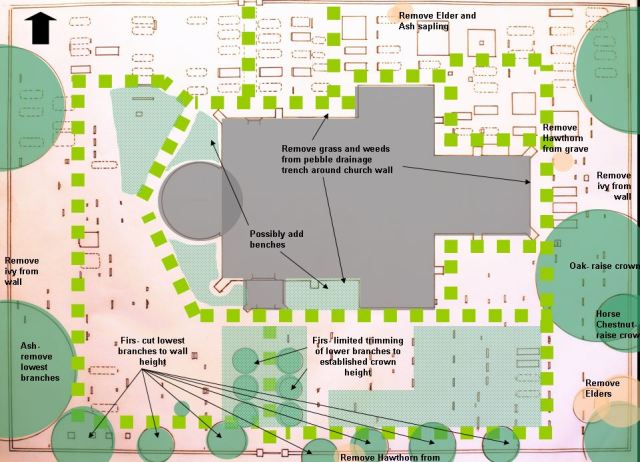
  • Blocks of ‘meadow’ (major perennial weeds dug out, strimmed annually and raked off) surrounded by regularly close mown paths.

  • Areas of regularly close mown grass around recent graves and close to the Church; possibly including seating and ‘photo opportunity’ spaces.

  • Perimeter trees (firs) pruned from ground to above churchyard wall height, and an entrance avenue maintained to it’s established crown height.

  • Other major deciduous trees pruned to raise crowns; elders and hawthorns removed.

  • Regular removal of invasive ivy, grass and weeds on perimeter walls and next to church walls (drainage trench).

A few days before the event, this is what the place looked like.

Our first ‘Groundforce Day’ focused on strimming and mowing the rough grass and then raking the cuttings off to avoid fertilising the soil (so as to encourage wildflowers to thrive and spread), removing thistles, Ragwort and sapling trees from poor locations and trimming back trees along the front wall of the churchyard to open up the churchyard to the outside and to improve views out to the surrounding fields. One of our team also made a start on weeding the pebble drainage trench surrounding the church walls- a painstaking job. Here’s a layout plan that will guide our work.

st. peters planWe made good progress until ‘rain stopped play’ around 3pm, by which time the strimming was done, most of the cuttings had been raked away, some of the ‘weed thugs’ removed and the front row of trees trimmed to provide great views in and out of the churchyard. We also planted our sign showing we are members of the Churchyard Conservation Scheme run by Norfolk Wildlife Trust and Norwich Diocese…

This slideshow requires JavaScript.

HUGE thanks to Deborah (refreshments), Gisela, Andre (and for the cakes too), Andrew, Brian, David, Fred, Les, Neil, Norman, and Richard (and Nancy for the delicious lemon drizzle cake).

…and also thanks to Peter Richardson and Dick Rowse for the loan of two special strimmers!

Here’s to Haveringland Groundforce Day #2 (date to be confirmed, but probably mid October- watch this website)! We will finish off the weeding round the church walls and tackle the ivy on the churchyard walls.

For now, the Church looks ready for the special Harvest Festival event this Sunday, 11th September when a vintage tractor run, the Aylsham Band, children’s activities, standing steam engines, refreshments (and toilet facilities), and an informal Harvest Service (hopefully outside) will be on offer- please come and visit us from 2.30-pm to 5pm (St. Peter’s is set in fields just off of the Haveringland Road, between Cawston and Felthorpe).

Old School Gardener

One block of the 'Piano Hedges'

One block of the ‘Piano Hedges’

A very hot, humid session this week at Blickling. Just as well then that Gardener Ed had something not too taxing for Aussie Pete and me to do. It involved coaxing the Yew bushes known as ‘pianos’ (due to their resemblance to grand pianos) into a bit of order.

Gardener Ed explaining his approach to 'playing the piano'...

Gardener Ed explaining his approach to ‘playing the piano’…

Ed handled the hedge clipper, while Pete and I used measuring tapes and lines to cut the turf edges that will help to guide the edges of the hedges! I his usual thorough way Ed explained how, over time, the bushes have become a bit unruly- too much ‘cutting by eye’ had resulted in a number of bumps, bulges and hollows that spoil the neat geometry. Over the past few years he has been letting some areas of the bushes grow out to the desired lines, and now they look pretty much ready to be ‘whipped into line’. It’s interesting looking at how much these bushes – and their accompanying ‘acorns’ on the parterre- have grown in the last 200 years or so. Here are some pictures taken between 80 and 100 years ago and the difference with today is quite noticeable…

Whilst the bushes will continue to grow (especially inside), the hope is that the lines now beign established can be maintained. Even so, it was interesting to see how much Pete and I had to cut back the turf edges to accommodate them- 2-3 inches in places. As I say, it was relatively easy work with lines and half moons, but even so the high humidity made it rather sapping work. Still we were rewarded with an ice cream from Ed at the end of the session.

The rest of the gardens in this area are looking grand, and I also made a quick trip over to the walled garden to see how it was looking (Project Manager Mike wasn’t around today). The other garden volunteers were busy weeding around the edges fo the parterre and Rob and Becca were raising the crown on a Lime tree near the Temple- complete with hydraulic lift. The result has certainly opened up the area and enabled some shaded shrubs and trees to benefit from more light.

Before the session I’d emailed Head Gardener Paul a layout plan and list of trees for possible inclusion in the Tree Trail project I’ve mentioned before. This is coming together nicely, with between 20 and 30 trees in the trail. Once firmed up we can start to sort out the information to go on the sign boards at each specimen, as well as leaflets, childrens’ activities etc.

This slideshow requires JavaScript.

As I may have mentioned before, the gardening team is a wonderful group of people, with many an amusing tale to tell. Ed’s contribution today concerns the ‘human sundial’ set out in the parterre (see picture below). Apparently he confronted a bemused gentleman walking around this one dull day. The man complained that the sundial wasn’t working- ‘It’s overcast’ said Ed. The man was puzzled and disappointed he couldn’t get the dial to work- ‘You should put a sign up explaining that it only works when the sun is out’, he said. Hmm, maybe a case for introducing an artificial sun on dull days?!

The 'Human Sundial'- it seems a little too complicated for some people...

The ‘Human Sundial’- it seems a little too complicated for some people…

Further Information:

Blickling Hall website

Blickling Hall Facebook page

A 360 degree tour of Blickling Hall

Old School Gardener

WP_20160530_13_41_55_ProOn our last Devon trip we spent a day at Antony House, Torpoint.  This 18th century mansion tells the story of a family caught up in the English civil war, a place which is still home to the Carew- Poles.

Before entering the house it was great to visit a small exhibition of some interesting artefacts, including one of Humphry Repton’s original ‘Red Books’, where he set out his assessment and vision of the gardens including some beautiful, if soemtimes fantastical, ‘before and after’ watercolour illustrations.

‘A house of silver grey stone, Antony is a beguiling mixture of the formal and informal. It’s believed to be one of the finest surviving Queen Anne buildings in the West Country.

View the outstanding collection of portraits, including works by Sir Joshua Reynolds and a famous painting of Charles I during his trial. There are also fine examples of period furniture, textiles and tapestries.

Breathe in the sweeping views as you explore the landscape garden, which includes a formal garden with topiary, modern sculptures and the National Collection of Daylilies.

The Woodland Garden, owned and run by the Carew Pole Garden Trust, also has outstanding rhododendrons, azaleas, magnolias and camellias.

The magic of Antony was captured by director Tim Burton, as a film location for his blockbuster, Alice in Wonderland.’

This slideshow requires JavaScript.

The gardens and grounds are exceptional. The tree collection is especially interesting and I was pleased (and inspired) by their tree trail which gives few bits of information alongside each specimen – and there are plenty of these, many at or beyond maturity. The walks around the woodland garden are peaceful, with a selection of viewing and sitting points overlooking the nearby channel, and, when we visited, a superb collection of Rhododendrons and Azaleas in flower. I also loved the pond and some playful timber seats, which contrast with some very old wooden seats in the more formal garden spaces.

This slideshow requires JavaScript.

As you may have read earlier this week, in my post about my latest session at Blickling, I’ve made progress in getting a similar tree trail project going there, so am very thankful for the detailed information Antony provided on how they put theirs together.

Further information: National Trust website

Old School Gardener

WP_20160818_10_09_52_ProI’d missed a week, but the Dahlias, which I thought had reached their best two weeks ago, were definitely in peak form in the Walled Garden at Blickling this week.

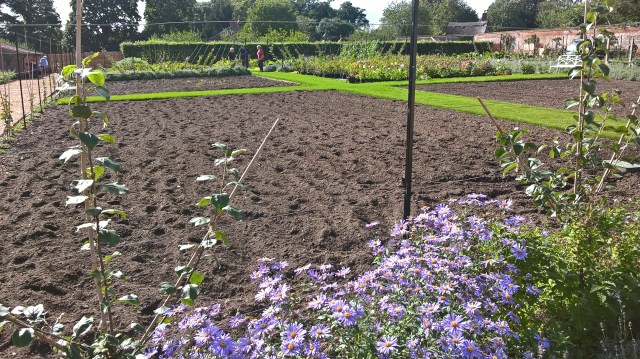
It was also pleasing to see that the posts and wires for the soft fruit were finished- but not after some further manoeuvering of our ‘difficult post’, by Project Manager, Mike! And the four new benches are also in place; they look great and offer visitors a chance to sit and enjoy the veg, fruit and flower offerings in the garden. I began work weeding around the herbs – a rather intoxicating experience as I rubbed against Thyme, Sorrel, Garlic, Fennel, Annis and so on…

After this- a mixture of hand weeding and hoeing- I went off to see Head Gardener, Paul and Assistant Head Gardener, Steve to discuss the Tree Trail Project. We are hoping to set out a series of name and information boards for around 20-30 trees within the gardens and perhaps add some ‘child friendly’ activities along the way. I suggested this after visitng Antony house in cornwall, where a similar, volunteer-led project has helped present their wonderful collection of trees.

We had an enjoyable walk around the gardens identifying the trees with a bit of special interest or stories to tell- it was difficult keeping up with the professionals whose encyclopedic knowledge of the many trees on offer was mightily impressive! Still, I think we have the makings of a great project and I’m looking forward to drawing the information together and working with Trust staff and other volunteers to finalise the information boards and leaflets etc. Something of a winter project, I think!

After a late lunch I spent an hour helping Chris and three of the lady volunteers in the corner of the walled garden clearing away the extensive weeds under and around the Mulberry Tree (which is one of those likely to make it to the Tree Trail, too). This area- previously enclosed in glass- is a wilder part of the walled garden, but after our work looked rather more in keeping with the trim borders elsewhere.

Further Information:

Blickling Hall website

Blickling Hall Facebook page

A 360 degree tour of Blickling Hall

Old School Gardener

WP_20160606_12_23_13_ProWe had a delightful trip to the west of Norfolk a month or two back; to the splendid medieval ruins of Castle Rising with its massive mounded enclosure and monumental masonry.

Equally fascinating was the village next door, where the old ‘hospital’ (almshouses) had a fantastic garden (including a large clipped box seat) and the Norman church featured some beautiful decoration.

A cricket match was underway in the adjoining field …the epitome of English country life (of old)! The sun shone, we strolled, and then took coffee in a great little cafe, where we also found a novel use for a redundant telephone box- a local lending library!

We shall definitely be back. The castle’s website says:

‘Castle Rising Castle is one of the most famous 12th Century castles in England. The stone keep, built in around 1140 AD, is amongst the finest surviving examples of its kind anywhere in the country and, together with the massive surrounding earthworks, ensures that Rising is a castle of national importance. In its time Rising has served as a hunting lodge, royal residence, and for a brief time in the 18th century even housed a mental patient.

The most famous period in its history was when it came to the mother of Edward III, Queen Isabella, following her part in the murder of her husband Edward II. The castle passed to the Howard family in 1544 and it remains in their hands today, the current owner being a descendant of William D’Albini II, the norman baron who raised the castle.’

Further information:

Castle website

English Heritage website


Finding Nature

Nature Connectedness Research Blog by Prof. Miles Richardson

Norfolk Green Care Network

Connecting People with Nature

Discover WordPress

A daily selection of the best content published on WordPress, collected for you by humans who love to read.

Susan Rushton

Celebrating gardens, photography and a creative life

Unlocking Landscapes

Writing, photography and more by Daniel Greenwood

Alphabet Ravine

Lydia Rae Bush Poetry

TIME GENTS

Australian Pub Project, Established 2013

Vanha Talo Suomi

The Journey from Finnish Rintamamiestalo to Arboretum & Gardens

Marigolds and Gin

Because even in chaos, there’s always gin and a good story …

Bits & Tidbits

RANDOM BITS & MORE TIDBITS

Rambling in the Garden

.....and nurturing my soul

The Interpretation Game

Cultural Heritage and the Digital Economy

pbmGarden

Sense of place, purpose, rejuvenation and joy

SISSINGHURST GARDEN

Notes from the Gardeners...

Deep Green Permaculture

Connecting People to Nature, Empowering People to Live Sustainably

BloominBootiful

A girl and her garden :)