Category: Heritage Gardens & gardening


PicPost: Great Garden @ Victor Hugo's house, Guernsey

Victor Hugo’s house, Guernsey

‘Victor Hugo left France in 1851 for an exile that would last 19 years. Following a short period of time in Jersey Victor Hugo came to Guernsey and was instantly captivated by the island.

During his fifteen years on the island he made a lasting impression and wrote some of his most famous works.

Victor Hugo’s home, for most of his exile in Guernsey, was Hauteville House, which remains today as it was left, allowing visitors to see his individual style of decoration.’  (Hauteville House website)

Old School Gardener

The Farmhouse Garden at Gressenhall Farm and Workhouse Museum

The Farmhouse Garden at Gressenhall Farm and Workhouse Museum

A variety of gardens awaits the visitor to Union Farm, part of the Gressenhall Farm and Workhouse Museum, Norfolk.

The main Farmhouse Garden sits alongside the Victorian farmhouse and was designed and developed around 10 years ago. It was intended to be a ‘sensory garden’ with aromatic, tactile and other plants including a ‘herb wheel’. It was also intended to demonstrate how planting could be used to control pests. This original purpose has been diluted over the years and the garden now provides a pleasant green foil to the farmhouse building. The garden is domestic in scale with a large area of grass and an irregular series of planted island borders, including raised beds edged with split poles. There are a number of shrubs, including climbing roses on the farmhouse wall, bench seats and a wooden shed in the north-eastern corner which contains garden tools.

The kitchen garden at Union Farm

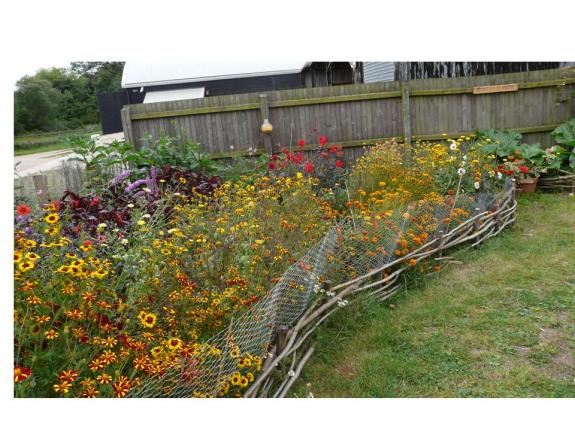
On another side of the Farmhouse a vegetable growing patch has been developed which is used to demonstrate grow your own techniques and different types of vegetables. To the front of the farmhouse sit two other gardens, one with a range of perennial herbs that would have been used in the farmhouse kitchen and another which houses a wide range of plants that were used in the traditional dyeing of cloth. This garden was slightly rearranged last year with new edges to the borders and with a length of low willow fencing to provide both a sense of enclosure and to discourage visitors from trampling in the beds.  The plants are regualrly used here in demonstrations of traditional dyeing.

One side of the Dyers' Garden

One side of the Dyers’ Garden

Developed in recent years by the volunteer dyers, some of the plants grown here include:

Alcea rosea varieties Helianthus annuus varieties
Alkanna tinctoria Hemerocallis varieties
Amaranthus caudatus Isatis tinctoria
Anthemis tinctoria Lythrum salicaria
Berberis vulgaris Mahonia aquifolium
Buddleja davidii Origanum majorana
Calendula officinalis cultivars Perilla frutescens
Carthamus tinctorius Phytolacca americana
Consolida ajacis Pyracantha angustifolia
Convallaria majalis Reseda luteola
Coreopsis tinctoria Rheum x hybridum
Dahlia varieties Rhus typhina
Datisca cannabina Rosa –climbing varieties
Foeniculum vulgare Rubia tinctorum
Forsythia Rudbeckia triloba
Galium verum Solidago
Genista tinctoria Tagetes patula cultivars

Other posts in this series:

From Grand entrance to Grand Central at Norfolk Museum

Gypsies, tramps and thieves: garden where poor once trod at Norfolk Museum

Cottage Garden recreates 1930’s at Norfolk Museum

Old Workhouse Garden a wildlife oasis at Norfolk Museum

Unique Heritage Gardens at Norfolk Museum

Old School Gardener

If you’ve enjoyed reading this post and others on this blog, why not comment and join others by signing up for automatic updates via email (see side bar, above right ) or through an RSS feed (see top of page)?

PicPost: Help - title needed for this picture- please add your ideas!

Picture taken at Mottisfont Abbey, Hampshire

sethsnap's avatarsethsnap

I recently visited the Lebanon, Ohio cemetery.  The cemetery was started in the mid 1800’s and has over 11,000 burials.  It is a peaceful place for one to rest.  The stones are situated among large trees that provide eternal shade and protection.

Visit my store.

View original post

The entrance to the workhouse as it looked in the early 1900's - the well house stands next to the person to the rear

The entrance to the workhouse as it looked in the early 1900’s – the well house stands next to the person (gardener?) to the rear

The former grand entrance of the Gressenhall Workhouse now performs a very different function. The once ornamental gardens and driveway have given way to a busy hub for this Norfolk Museum’s outdoor events.

As can be seen from the old photograph the main approach to the Workhouse was once a rather grand affair – a heart-shaped island of formal lawns and borders surrounded by a circular drive.  To the front, huge iron gates and a much smaller wooden door provided the entrances from the forbidding outer wall of the complex. The smaller door was the main pedestrian entrance to the workhouse being next to the porter’s lodge, the man who controlled the arrival and departure of Workhouse inmates. This door today still carries the solid metal knocker shaped into a clasped hand around a metal bar – a hint of the prison-like existence to come for the new inmates! They must have entered here with very mixed emotions – relief at having somewhere to get a square(ish) meal and a warm (ish) bed, mixed with guilt at not being able to fend for their families and anxiety about the harsh regime they were entering.

The 'Yew Tree border' in front of the chapel- before the Yews were reduced

The ‘Yew Tree border’ in front of the chapel- before the Yews were reduced

Towards the main building, but long since demolished, once stood a small building enclosing the Workhouse well (still visible in the old photograph) and the front of the 18th century main building once carried a magnificent Wisteria clambering up and along the warm red brickwork. This was, apparently, cut down to the ground by an over – enthusiastic work placement trainee about thirty years ago! A small rooted area remains and is being carefully trained up the walls once more, in the hope of restoring this once glorious feature. To the side the workhouse chapel is fronted by a small border which is dominated by two Yews and a cherry tree with spring bulbs and other under – planting. Recently these Yews were reduced in width in an attempt to provide a more open, sunny site for the other planting (and increase the width of the adjacent paths). The hard cut – back has improved the shape and balance of the border whilst not harming the Yews, where new growth has begun.

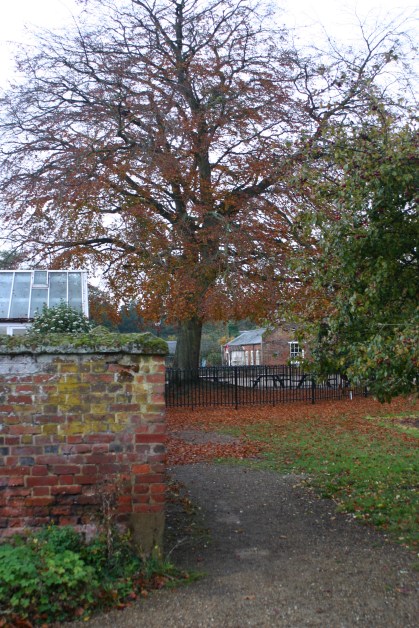
The magnificent Copper Beech Tree in autumn

The magnificent Copper Beech Tree in autumn

To the right of the main approach sits a majestic old Copper Beech tree (which gave its name to the Old People’s Home that succeeded the workhouse after the 2nd World war – ‘Beech House’). This area was originally sub divided by walls into exercise yards and a playground for the adjoining boys school, and in later years for those in the nearby infirmary (and featuring two revolving wooden tuberculosis pavilions). There is also an avenue of beech trees on the approach to the Workhouse believed to be 150 years old.

There is some evidence that the southern section of this area, adjoining the modern café was laid out as a formal ‘garden’ but the historical accuracy of this is uncertain. Today this area houses a semi – permanent marquee used for the many events now taking place at the Museum.  A large expanse of grass (useful for picnicking for the Museum’s many summer visitors) is surrounded by areas of planting including an isolated Crab Apple tree, planted in more recent years as a memorial to a former member of the Norfolk Archaeology Department (also housed on the site).

There is also a long south – facing border of mixed shrubs adjoining the walls of the former workhouse, some of which are now rather large for their position adjacent to the building. Others – such as several clumps of Boston Ivy – clamber up the walls and are vigorous enough to get under the eaves and into the roof! Recently these shrubs have been pruned to try to restore their scale and shape as well as encouraging new growth, with some success. And spring bulbs also provide splashes of colour underneath the mainly evergreen shrubs. But a perennial problem is the rabbit population which have burrows in this border and which also occasionally escape into some of the adjoining gardens to wreak havoc!

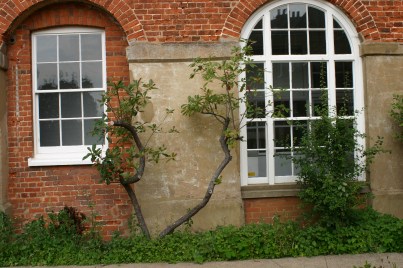
Shrubs in front of the southern wall of the old Workhouse- showing the arcading that was once open

Shrubs in front of the southern wall of the old Workhouse- showing the arcading that was once open

The walls here still show the evidence of the (once open) arcading that sheltered individual ‘cottages’ for families living in the workhouse. This was before its daily routine became harsher in the mid 19th century, when inmates were divided by sex and age and so families were split up.

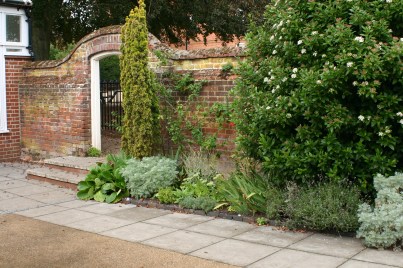
One of the borders in the Cafe Garden

One of the borders in the Cafe Garden

Today’s cafe building was once a  fever or isolation ward commonly known as the ‘itch ward’. More recently this was the Museum’s Education Centre, for which a garden was laid out by volunteers in the 1980’s. This was further remodelled into the current space, presumably upon creation of the café and now houses a  delightful, smaller courtyard garden of mixed borders with picnic tables.

Today's courtyard on an event day at the Museum

Today’s courtyard on an event day at the Museum

Today, the large entrance courtyard and its adjoining spaces provide a great setting for the main workhouse buildings and perform an important role as a thoroughfare for the Museum’s visitors as they explore the surrounding gardens and on event days when tents, stalls and other temporary exhibits spring up into a hub of activity.

Other posts in this series:

Gypsies, tramps and thieves: garden where once poor trod at Norfolk Museum

Cottage garden recreates 1930’s at Norfolk Museum

Old Workhouse Garden a wildlife oasis at Norfolk Museum

Unique heritage gardens at Norfolk museum

Old School Gardener

If you’ve enjoyed reading this post and others on this blog, why not comment and join others by signing up for automatic updates via email (see side bar, above right ) or through an RSS feed (see top of page)?

greenbenchramblings's avatargreenbenchramblings

Felley Priory Gardens are described in promotional literature as “a tranquil garden” and as  “one of Nottinghamshire’s best kept secrets” but how can this be true when it is just half a mile from the M1 motorway? There is only one way to find out the answer to such mysteries visit and see for ourselves. Such a visit should be a delight as the gardens are reputed to contain many rare and unusual plants.

DSC_0008

So did our recent foray to Felley present us with answers to the queries above?

DSC_0011

Just minutes from the heavy traffic of the motorway in quiet farmland we find a narrow drive leading to a roughly surfaced, virtually empty car park. As usual coffee was our first requirement, so off to the “Farmhouse Tea Room” which was remarkably busy.

When we entered the garden we were the only visitors and a gardener opened up the garden…

View original post 165 more words

gressenhallfw's avatarGressenhall Farm and Workhouse

I arrived at Gressenhall knowing very little about farming. I was vaguely interested in history and I knew I wanted to have a smallholding when I was older. However the industrious commercial farms had no attraction to me. When the opportunity arose to come to Gressenhall I jumped at the chance and from the first day that I saw the advert I dreamt of getting the job and the things that I would learn on the farm.

Ploughing with Trojan and Bowler with Ransomes Plough

Since I have been here I have really enjoyed working the horses and learning about Victorian agriculture and the agricultural revolution. Aside from this I have been attending college one day per week in order to achieve my level 2 NVQ in mixed agriculture. This has given me a sound footing in agricultural knowledge that I can apply here on the farm as well as in future work. Before I came to Gressenhall…

View original post 332 more words

Pena PalaceThe Pena National Palace (Palácio Nacional da Pena) is a Romanticist palace in Sintra, Portugal. The palace stands on the top of a hill above the town of Sintra, and on a clear day it can be easily seen from Lisbon. It is a national monument and constitutes one of the major expressions of 19th century Romanticism in the world. The palace is a UNESCO World Heritage Site and one of the ‘Seven Wonders of Portugal’.

Pena Palace Park is a vast forested area completely surrounding the Pena Palace, spreading for over 200 hectares of uneven terrain. The park was created at the same time as the palace by King Ferdinand II, who was assisted in the task by the Baron von Eschwege and the Baron von Kessler. The exotic taste of the Romanticism was applied to the park as it was to the palace. The king ordered trees from diverse, distant lands to be planted there. Those included North American Sequoia, Lawson’s cypress, Magnolia, and Western Red Cedar, Chinese Ginkgo, Japanese Cryptomeria  and a wide variety of ferns and tree ferns from Australia and New Zealand, concentrated in the Queen’s Fern Garden (Feteira da Rainha). The park has a labyrinthine system of paths and narrow roads, connecting the palace to the many points of interest throughout the park, as well as to its two gated exits.

Source: Wikipedia

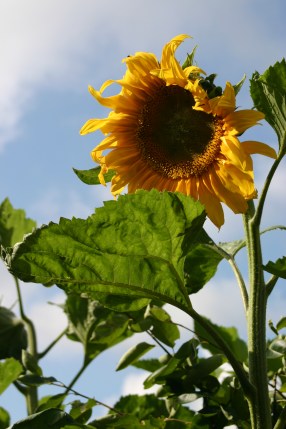
Sunflowers were planted by a local playgroup at the May opening of the garden - with the wet summer they grew to over 2.5 metres tall!

Sunflowers were planted by a local playgroup at the May opening of the garden – with the wet summer they grew to over 2.5 metres tall!

A renovated garden is moving towards maturity in what were once exercise yards for tramps and unmarried mothers at Gressenhall Farm and Workhouse Museum, Norfolk.

The garden occupies what were once two exercise/work yards for inmates of the Victorian Workhouse. The footings of what was once the dividing wall between these two yards can still be seen, emerging as the lawn above is worn away.  In Victorian times these yards joined two blocks of accommodation:

  • for so-called  ‘casuals’ or tramps who used to travel between workhouses earning ‘a night’s board for 2 days hard labour’ – possibly crushing stones for use in road building
  • for unmarried mothers nursing their babies – they wore distinctive uniforms to mark them out from the other workhouse inmates.
The refurbished 'Education Garden'

The refurbished ‘Education Garden’

These buildings today provide the Museum’s Learning Centre and space for occasional groups and events. Until last year the garden area between the two buildings was kept maintained as grass and a range of mixed borders which is an important picnic/ rest spot as well as being used by school and pre school groups for art and learning activities. In 2012 funding from the Friends of the Museum as well as the Museum itself and donations from a range of local businesses were secured to refurbish and redesign it. A number of design issues were tackled, including:

  • Providing further paved terrace space with new picnic tables and some renovated paving
  • Introducing a number of planting containers to add interest to the paved terraces
  • Realigning paths to follow ‘desire lines’ and make access easier
  • Deepening borders to provide more visual interest and unified planting
  • Creating a new ‘curiosity corner’ to provide a space designed for under 5’s which contains a range of features to encourage children to explore.
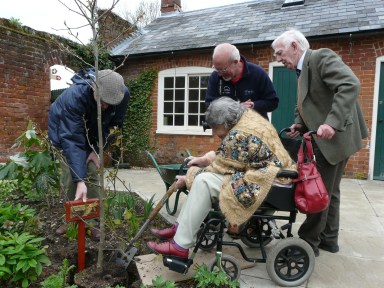
Mary and Derek Manning plant a tree to mark the opening of the garden

Mary and Derek Manning plant a tree to mark the opening of the garden

The newly renovated garden was formally opened on 6th May 2012, and two of the original gardening volunteers, Mary and Derek Manning, planted a ‘Paper Handkerchief Tree‘ to mark the occasion. Local children also played their part and cut ribbons to open ‘Curiosity Corner’.

One of the new residents of the Garden!

One of the new residents of the Garden!

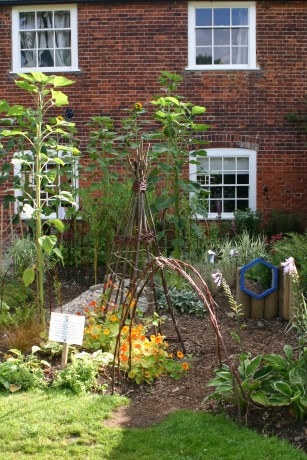
The Curiosity Corner proved to be very popular in its first season last year and included some giant sunflowers planted by a local play group as well as a turf seat; a willow tunnel and arches; hazel wigwam; mirror; ‘fossil slab’; various ‘animals’  hidden away in the planting and a range of different path surfaces and planting. There is also a half barrel filled with stones,water and pond plants, so that youngsters can ‘get up close’ to this watery habitat.

 'Curiosity Corner'

‘Curiosity Corner’

The coming year will see the garden mature further and hopefully there will be sunny days so that visitors can really enjoy this lovely picnic area at its best.

New planters with sweet peas on conical obelisks

New planters with sweet peas on conical obelisks

Quizzicals:

Two more cryptic clues to the names of plants, fruit or veg…

  • The scourge of female chickens
  • Cheap goods in a pile of dung

Old School Gardener

If you’ve enjoyed reading this post and others on this blog, why not comment and also join some other people and sign up for automatic updates via email (see side bar, above right ) or through an RSS feed (see top of page)?

Roses are one of the splendours of the gardens

Roses are one of the splendours of the gardens

The Peckovers – a quaker banking family – left behind them a secret gem of a house and garden in Wisbech, Cambridgeshire. This is one ‘banker’s bonus’ that can be shared by everyone.

Peckover House is said to be one of the finest Georgian town houses in the country. It stands proudly fronting the River Nene in this Fenland market town of 20,000 people. Originally built in 1722, the house was initially rented by the Peckovers in 1794, and purchased soon after. Jonathan Peckover had a grocery business and then moved into banking, setting up the first bank in Wisbech in partnership with the Gurney family- who later founded Barclays Bank. Peckover established a good reputation – it was said that during times of financial crisis the Peckover Bank was safer than the Bank of England!

Peckover House was initially called Bank House, reflecting the role of the house and it’s newly built banking wing. The property remained in the family for over 150 years, eventually passing over to the National Trust from its last owner, Alexandrina Peckover, in 1948.

The gardens – of around 2 acres – extend to the rear of the house and grew over the years as the family purchased ground from adjacent landowners. They also included a much larger estate extending to 48 acres, much of which today is used as playing fields and has some character-ful old trees. The Peckovers were also  keen collectors, and introduced a number of foreign plants into the garden. The gardens today maintain the basic layout from Victorian times –  including the old walls that used to mark the boundaries of adjacent properties.

The rear of the hous with the Croquet lawn in front- surrounded by some glorious trees such as the Tulip Tree (Liriodendron tulipifera)

The rear of the house with the Croquet lawn in front- surrounded by some glorious trees such as the Tulip Tree (Liriodendron tulipifera)

Step out into the garden and you feel as though you are back in Victorian times, as you move from one delightful space to another.

Once needing a team of 17 gardeners, todays gardening team of three is headed up by Allison Napier. She finds it difficult to single out her favourite part of the garden –  ‘It depends on the time of year’, she says. ‘In late winter and early spring the Wilderness Walk is full of the colours and scents from bulbs, Hellebores, Winter Honeysuckle, Christmas Box and an impressive Cornus mas. There is also the  fantastic trunk of an old Ginkgo which stands out and this with surrounding evergreens, deciduous shrubs and trees creates a strong framework.’

‘In spring the Orangery is a riot of colour and fragrance from the various bulbs and other spring plants all arranged in terracotta pots on the staging and if the flowering of the Wisteria on the front of the house coincides with the wall flowers in the various formal beds at their peak, then that is a wonderful spot.’
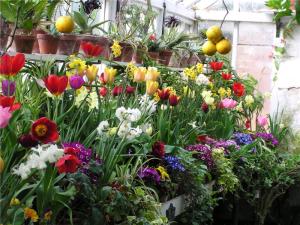
Inside the orangery- a heady mix of seasonal colour and fragrance

Inside the Orangery- a heady mix of seasonal colour and fragrance

And what about the summer The various rose gardens come into their own. There are over 60 species of rose here, many lovingly pruned and tied in every year over several metal pergolas and against walls. The area christened ‘Alexandrina’s Rose Garden‘ is a particular focal point.

But the show isn’t over yet. In late summer and autumn a ‘Red Border’ provides an array of warm colours and varied textures which are set off brilliantly against a golden privet hedge. This and an Autumn Border provide a glorious conclusion to the year. Jenny Windsor, one of the gardening team, loves these herbaceous borders and especially the contrast that they offer to other, more formal areas of the garden. ‘I love nothing more than to ‘have a play’ in the borders,’ she says –  ‘weeding, dead heading, tying in etc.’

Herbaceous borders

Herbaceous borders surrounding the Orchard Lawn with a fine old Quince tree

Many first-time visitors are surprised at the size and variety of plants in the garden. And, not surprisingly, they also commend the high standards of care maintained by the team.

Very few chemicals are used in the gardens and Allison finds that biological controls are effective in the glasshouses. As she says,

‘The healthy populations of beneficial insects, frogs and birds in the garden are testament to the ‘greener gardening’ policies we like to follow.’

The orangery (left) has rotten timbers and is due for a major renovation this year

The orangery (left) has rotten timbers and is due for a major renovation this year

The gardening team is well supported by local volunteers and a small number of trainees who come to gain practical horticultural experience (as I know, because I had the pleasure of being one last year!). Allison also thinks it important to encourage future generations of potential gardeners, so the team actively seeks school visits and has a Garden Club with students from the local grammar school.
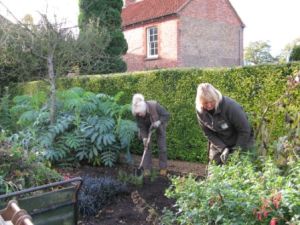
Gardeners Jenny and Janet digging over and mulching the 'Red Border'

Gardeners Jenny and Janet digging over and mulching the ‘Red Border’

What of the future? Well,the forthcoming restoration of the Orangery – with its 300 year old orange trees – is a major project due to get under way this year. Allison plans to complete work on the Conservation Plan for the garden this year, but it will be a major challenge working out the priorities and policies for the future, especially as the climate appears to be entering a very unpredictable phase affecting decisions about the range of plants to be used.

Still, the team seem to be a pretty content bunch, even though on occasions paperwork and ‘office stuff’ may get in the way of being outside and doing what they love. As Allison says, even the laborious turning of the compost heaps can sometimes be rewarding:

  ‘.. it gives you a good workout and you can find a surprising  number of lost hand tools!’

Gardener in charge Allison Napier- normally not sitting on the compost, but turnning it!

Gardener in charge Allison Napier- normally not sitting on the compost, but turning it!

Acknowledgement: thanks to Allison, Jenny and Janet, the Peckover Gardening Team for their contributions.

Quizzicals:

answers to the two on the post ‘Lock down- pros and cons of garden ties’

  • Hello Miss Black – Hyacinth
  • A punch up in the water – hydrophyte

Old School Gardener

If you’ve enjoyed reading this post and others on this blog, why not comment and also join some other people and sign up for automatic updates via email (see side bar, above right ) or through an RSS feed (see top of page)?


Finding Nature

Nature Connectedness Research Blog by Prof. Miles Richardson

Norfolk Green Care Network

Connecting People with Nature

Discover WordPress

A daily selection of the best content published on WordPress, collected for you by humans who love to read.

Susan Rushton

Celebrating gardens, photography and a creative life

Unlocking Landscapes

Writing, photography and more by Daniel Greenwood

Alphabet Ravine

Lydia Rae Bush Poetry

TIME GENTS

Australian Pub Project, Established 2013

Vanha Talo Suomi

The Journey from Finnish Rintamamiestalo to Arboretum & Gardens

Marigolds and Gin

Because even in chaos, there’s always gin and a good story …

Bits & Tidbits

RANDOM BITS & MORE TIDBITS

Rambling in the Garden

.....and nurturing my soul

The Interpretation Game

Cultural Heritage and the Digital Economy

pbmGarden

Sense of place, purpose, rejuvenation and joy

SISSINGHURST GARDEN

Notes from the Gardeners...

Deep Green Permaculture

Connecting People to Nature, Empowering People to Live Sustainably

BloominBootiful

A girl and her garden :)