Category: Heritage Gardens & gardening


Tamara Jare's avatarMy Botanical Garden

wpid-2013-03-13-17.34.53.jpg

Our dinner today  was an educative event, kids were teaching parents and grandparents about bitcoin, an interesting phenomena of the internet era. Things went pretty bad for us, older ones, it almost looked like we were complete idiots not understanding basic new concepts of virtual world. I said almost, for then I’ve remembered tulip mania.Some concepts were known already far ago, it would be shame to forget them, just in case…….which of course does not mean I do not believe in bitcoin…or tulips!

At the peak of tulip mania, in February 1637, some single tulip bulbs sold for more than 10 times the annual income of a skilled craftsman. It is generally considered the first recorded speculative bubble (or economic bubble),[3] although some researchers have noted that theKipper- und Wipperzeit episode in 1619–22, a Europe-wide chain of debasement of the metal content of coins to fund warfare…

View original post 72 more words

Paco de Sao Cipriano

Paco de Sao Cipriano

The latest meeting of the Norfolk Gardens Trust focused on historic Portuguese Gardens. Postponed from earlier in the year due to bad weather, the talk – which took place at Norwich’s John Innes Centre – was again delayed, this time due to travel problems!

I can say that it was well worth the wait. In a lively talk, gardening writer Helena Attlee explored a ‘cocktail’ of influences that have formed the typical historic portuguese garden. A fusion of historical, cultural and climatic factors has come together over the centuries, with the latest fashions and ideas in garden design being reinterpreted in the unique setting that is Portugal.

The country straddles the atlantic coast of Iberia and so its climate ranges from the warm and moist in the north to the near Mediterranean in the south, with the rocky outcrop of Sintra (just north of Lisbon) providing a microclimate that is particularly prone to damp air deposited from atlantic fronts. These climatic variations have clearly influenced the design and planting of gardens in the country, but arguably of greater impact has been the country’s historical development.

The Romans invaded in around 200 B.C. and stayed for around 500 years. Not surprisingly the gardens from this time show the features you’d expect of a roman garden – enclosed by a colonnade with a central water pool as the focus and with grand mosaics. Though even here, it seems that particularly Portuguese touches are evident – for example the curved niches and planting islands found in the pool of a reconstructed example of a roman garden at The House of Water Jets, in Conimbra.
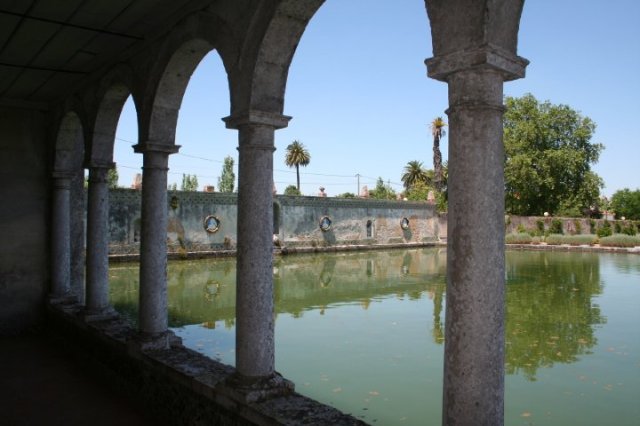
Quinta da Bacalhoa - the Water tank

Quinta da Bacalhoa – the Water tank

Possibly the greatest influence on garden design came from the invasions of arabs and other peoples from north africa – the so-called ‘Moors’. Arriving in the 8th century and remaining for about 400 years they brought with them the traditions of brimming water tanks, high walls to enclose the garden and capture the exotic scents of citrus fruit as well as decorated ceramic tiles – otherwise known as ‘azulejos’ in Portuguese. These citrus trees – bitter oranges and lemons – were introduced from the Himalayas, and it was some centuries later that sweet oranges were introduced into Europe – possibly by the italians (from india), or possibly by the Portuguese (from China).  Interestingly, up until the 20th century sweet oranges were known across europe as ‘Portugals’.

Azulejos at Quinta dos Azulejos!

Azulejos at  Quinta dos Azulejos!

Azulejos began as geometric or botanical designs and used a technique which trapped the coloured glazes in ridged areas on the surface of the tiles – the so-called ‘aresta‘ technique. They were used extensively to cover walls of gardens and buildings. The moorish aesthetic is also evident in the later patterning of box parterres which are more complex than the patterns seen in the grand gardens of France, Italy or Holland.

Even though moorish rule of Portugal ended in the 12th century, many of the skilled craftsmen stayed on and continued to influence garden and house design in the following centuries. However it was not until the growth of Portuguese economic power in the 16th century (based on its exploration and discovery of new lands and leading to the founding of the valuable spice trade) that grand Portuguese gardens started to flourish. Design ideas also travelled from the far east and were absorbed into the Portuguese style of the time – this was when complex parterres, citrus groves and water tanks came into their own, alongside further developments in azulejos. Initially imported from southern Spain by King Manuel I,  the tiles now moved away from repeat patterns of geometrical or botanical themes to assemblies of individual tiles into grand tableaux of  mythical and amusing scenes. The arrival of a new technique – Maiolica’– meant that glazes, and so pictures, could be painted directly onto the tile surface.

Complex parterres at Quinta da Bacalhoa, a superb example of an early renaissance Poprtuguese garden

Complex parterres at Quinta da Bacalhoa, a superb example of an early renaissance Poprtuguese garden. The area beyond was originally an orange grove

Following a period of rule from Spain, Portugal again found its independence in the early 17th century and this heralded a new period of rich garden making, with Delft blue tiles becoming fashionable (the Delft factory had a production line just for Portugal) and the creation of cartoon-like scenes (known as singerie) featuring monkeys and cats mimicking humans in scenes such as going to the barbers and taking piano lessons!

During the 18th century new colonial ventures in Brazil resulted in discoveries of gold and diamonds which fuelled another period of wealth, which once more found expression in the country’s gardens and houses. This second ‘golden age’ put Portugal at the forefront of europe’s economic powers, such that King Juan V was the richest monarch in the continent and could afford to order a solid gold bath for his mistress (who happened to be a nun)!

The dramatic well stairway at the Quinta da Regaleira, typical of the design work of Mannini

The dramatic well stairway at the Quinta da Regaleira, typical of the design work of Manini

This period saw influences from the Italian baroque make their mark in Portuguese gardens. Architects and designers such as Nasoni and Manini added a new flamboyance to the gardens of the wealthy and the latter in particular brought an opera set designer’s skills to create magical spaces where the rich could entertain. Further developments in azulejos also occurred during this period, with new, brighter colours and styles arriving influenced by the French Rococo. Some of these were to provide amusing Trompe d’oeil (visual tricks). The tiled canal at the palace of Queluz is perhaps the zenith of the azulejo. Here, candlelit tableaux lined the walls of the waterway, along which royalty and aristocrats glided by in their gondolas on warm summer evenings.

Azulejos lining the canal at Palacio de Queluz

Azulejos lining the canal at Palacio de Queluz

The Lisbon earthquake of 1755 (and ensuing fires and tsunami) wrecked huge areas of the city and its surroundings and so few great houses and gardens of the time inn tht area remained intact. A period of austerity followed during which the country’s Prime Minister, the Marquess of Pombal, removed many of the privileges of the rich aristocracy. Many of the gardens that remained fell into disrepair and few new ones of any note were created.

'Camellia Architecture' at Casa do Campo

‘Camellia Architecture’ at Casa do Campo

During the 19th century a new fashion for Camellia growing was born, centred on Porto and the north of the country where the moist warm climate favoured them. There is much evidence of the splendour of these gardens still in existence today, the Camellia bushes being trained into architectural shapes and even into ‘outside rooms’ which remained in flower between November and March when little else in the garden was of interest. During this time the discovery of new plants in far away places had its impact in Portugal as elsewhere and exotic specimens from Brazil and other countries were imported to some important gardens, including by British emigres involved in the Port trade. Further romantic – style houses and gardens were created, such as Montserrate and the National Palace of Pena at Sintra.

Parque de Serralves

Parque de Serralves

Perhaps not surprisingly, the talk concluded with a single example of a 20th century grand garden (Parque de Serralves), a rather ‘minimalist’ affair  featuring simple clipped box topiary and no other colours but that of the pinkish terracotta of walls and paths and the sky blue tiles lining rills and pools. Another garden (Casa da Pergola in Cascais, near Lisbon), originally created in the 19th century with a house that was renovated in the 1920’s gives a rather more modest ‘cottage style’ example of some of Portugal’s more modern gardens.

Casa da Pergola, Cascais

Casa da Pergola, Cascais

From my own knowledge, the 20th and 21st centuries have seen investment in public gardens and parks, which in their own ways are as important as the grand palace gardens of the earlier periods. I’ll be posting some information on some of my favourites over the coming weeks.

So, how to sum up Portuguese heritage gardens?

Well, as you can see they have absorbed and interpreted fashions, styles and ideas from other cultures and with the particular climatic, social and cultural conditions in the country have made them something uniquely Portuguese. Apart from ‘oranges and azulejos’ the other characteristic features seem to be:

  • Terraces

  • Trough or cavity walls filled with plants

  • Water tanks

  • Topiary, especially complex parterres

As far as planting is concerned, this tends to follow the local climatic conditions so features roses, succulents, palms and colourful annuals , especially in the hotter centre/south, whereas ferns, exotics and of course Camellias are common in the warm, moist north and around Sintra.

A public garden in Braga, northern Portugal.

The Garden of Santa Barbara, a public garden in Braga, northern Portugal

Sources and other information:

‘The Gardens of Portugal’ by Helena Attlee (published by Francis Lincoln, 2008)

Gardenvisit- Portuguese gardens

Article by Helena Attlee

Sheila Sim photography gallery of Portuguese gardens

Old School Gardener

If you’ve enjoyed reading this post and others on this blog, why not comment and join others by signing up for automatic updates via email (see side bar, above right ) or through an RSS feed (see top of page)?

alnwick poison garden sign There are many plants that can cause you harm, particularly from the sap or if they are eaten. At Alnwick Gardens, Northumberland a Poison Garden contains quite a few of these – and several had to have their own special licence from the Home Office to be on show! Many plants have medicinal qualities of course (and some otherwise poisonous ones are used in medicines- Foxgloves and Yew, for example). But there is a fascination with the dangerous ones. As the creator of the Poison Garden, the Duchess of Northumberland, says:

‘I wondered why so many gardens around the world focused on the healing power of plants rather than their ability to kill… I felt that most children I knew would be more interested in hearing how a plant killed, how long it would take you to die if you ate it and how gruesome and painful the death might be.’

alnwick poison garden

Pretty but poisonous- part of the Poison Garden at Alnwick Gardens

The garden contains over 100 plants with varying degrees of deadliness. It’s difficult to tell if a plant is harmful from it’s look, as some are beautiful while others look pretty harmless. Many of the plants grown in the Poison Garden are easily recognised as common to the back garden; Foxgloves, Belladonna, Poppies, Laburnum and varieties of Aquilegia for example.

And the nasty things they can do to you are many and varied. Eczema is a chronic inflammation of the skin and causes itchiness. Sometimes this is caused because the victim has an allergy to a particular plant substance. However, serious poisoning from plants in the UK is relatively rare and many plants can be grown safely provided they are treated with respect (and usually wearing gloves).

Foxglove

Foxglove

Younger children under the age of six who are able to walk have an increased risk of poisoning, because they often put things in their mouth without realising they are harmful. Also, as their bodies are smaller they are more vulnerable to the harmful effects of certain substances.

Poisonous plants cause far less harm than might be expected. In ‘Accidental poisoning deaths in British children 1958-77’ (British Medical Journal), Neil C Fraser reports a total of 598 poisoning deaths of children under 10 years of age.

In the period covered only three deaths were attributed to plants.

Even this low number is overstated – one death was due to eating fungi and in another of the three cases eating the poisonous plant was doubted as the cause of death. In the one confirmed plant death Hemlock was the plant responsible.

The report makes it clear that medication, household cleaning materials and cosmetics pose a much higher risk than poison plants.

But illness, injury or irritation can of course be more frequent unless care is taken. The following is a list of some common ornamental plants that are either poisonous and/or a skin/ eye irritant, so remember they should not be eaten and cover your skin for protection if handling them:

Acalypha – Aconitum – Actaea – Aglaonema – Alstroemeria – Anthurium – Arum – Asparagus – Calla palustris – Capsicum annum –  Chelidonium majus –  Chrysanthemum – Colocasia esculenta – Datura – Drancunculus – Euphorbia – Fremontodendron – Helleborus – Heracleum mantegazzianum – Iris – Laburnum – Narcissus – Phytolacca – Primula obconcica – Solanum pseudocapsicum – Spathphyllum –  Tulipa –  Zantedeschia

aconitum

Aconitum (‘Monkshood’)

cuckoopint arum

Arum (‘Cuckoopint’)

Bearded Iris Raspberry Blush

Iris

lily of the valley

Lily of the Valley

More examples of poisonous plants can be found on the Royal Horticultural Society’s and other websites listed below. If you think you or someone else has eaten part of a harmful plant, seek medical advice from a hospital Accident and Emergency Department immediately, taking a sample of the plant with you. Do not try to make the person sick. Likewise if a pet has consumed something you suspect is poisonous seek veterinary advice as soon as possible.

Sources and further information:

‘Poisonous plants to be wary of‘- Martyn Davey, Eastern Daily Press, March 16th 2013

Alnwick Poison Garden website

Wikipedia- List of poisonous plants

The Poison Garden website- lots of useful information

Botanical.com- index of poisonous plants

Livescience- 10 most common poisonous plants

Realgardeners- list of poisonous plants with images

NHS- plant dangers in the garden and countryside

RHS- potentially harmful garden plants

Garden Safety- pretty but poisonous plants

RHS Wisley– to seek information about plant poisons (tel. 0845 260 8000- 10am-12.30pm and 1.30pm – 4pm)

Kew gardens – plant poisons information (tel. 020 8332 5792 9am-5pm) General, non urgent inquiries about poisonous pants can be emailed to ceb-enq@kew.org

Old School Gardener

If you’ve enjoyed reading this post and others on this blog, why not comment and join others by signing up for automatic updates via email (see side bar, above right ) or through an RSS feed (see top of page)?

The Scottish Country Garden's avatarThe Scottish Country Garden

Well, the blizzards continue here at the Scottish Country Garden. The snow that arrived on Tuesday morning is still here, and the high winds tonight are blowing it and some new stuff off the fields across the roads in flowing icing sugar waves.  Overnight and tomorrow, more is due. The Garden continues in its state of suspended animation for another week, when perhaps there will be signs of spring.  So, rather than show you yet more pictures of snowscapes, I thought it might be appropriate to talk about…ice houses! A few weeks ago, the family visited Dalkeith Palace (see Going Gothic). Hidden in the grounds is an ice house.Built in the late 18th Century, it stored ice and kept foods refrigerated for the Palace. It is 15 metres (50 ft) wide and 10m (33 ft) deep and situated on a north facing slope, dug into the hillside, where the sunlight won’t reach…

View original post 217 more words

gressenhallfw's avatarGressenhall Farm and Workhouse

 Over the winter months, the volunteers and the Skills for the Future Library and Archive trainee have been keeping warm by re-organising the newly decorated library at Gressenhall Farm and Workhouse Museum.

The library was originally started in 1976 as a resource to help staff identify objects and object histories donated to the Museum of Rural Life and the library now has a dedicated space in which researchers can have access to these resources.

Library

Some of the items available include:

  • Farm documents including diaries, horse remedy notebooks, stud books, invoices from Norfolk farms; books, journals and magazines relating to farming and livestock


  •  Manuals for engines and farm machinery, Government publications and posters concerning agriculture, health, war and education, retail and agricultural show catalogues


  • Photographs, objects, books and printed documents relating to Agricultural Unions and George Edwards


  • Educational books and objects used in Norfolk schools, class photographs and…

View original post 205 more words

PicPost: Great Garden @ Abbotsbury

Early History
Established in 1765 by the first Countess of Ilchester as a kitchen garden for her nearby castle. Developed since then into a magnificent 20 acre garden filled with rare and exotic plants from all over the world. Many of these plants were first introductions to this country, discovered by the plant hunting descendants of the Countess.

The Garden Today
After the great storm of 1990, a major restoration project has been underway. many new exotic and unusual flowers have been introduced to this fabulous Dorset Garden.

The Garden is a mixture of formal and informal flowers, world famous for it’s Camellia groves and magnolias. Noted in Dorset for its Rhododendron and Hydrangea collections and the charming Victorian Garden’

Source : Abbotsbury website

Old School Gardener

PicPost: Great Garden @ Tintinhull

‘Delightful formal garden

The garden, complete with working kitchen garden and orchard, lies in the charming village of Tintinhull, Somerset. Glittering pools, secluded lawns, colourful borders and clipped hedges provide the perfect spot to relax and unwind away from the hustle and bustle…

“My garden is, I think and hope, a happy one.”

Phyllis Reiss and her husband Captain Reiss bought Tintinhull in 1933 and here they created a most harmonious and carefully thought-out small garden.

There are six courtyards within the garden, each with very different characters.’

Source: National Trust website

gressenhallfw's avatarGressenhall Farm and Workhouse

As a Heritage Gardening Trainee under the Skills For The Future programme, you have to be prepared for all kinds of weather, and having previously worked as a coppicer in ancient woodlands, I have experienced some pretty harsh conditions in my time. That said this winter has been pretty darn cold! It’s been like the winters I’ve heard so much about from those of a more ‘advanced’ age.

Working one day a week at the National Trust’s Peckover House in Wisbech, I’ve experienced some very chilly early morning drives along the A47 – not my favourite road at the best of times! It’s often been dark and cold, but when you’re greeted by the sight of Peckover’s garden under a fresh blanket of snow or still in the grip of an overnight frost, it somehow seems worth it. Sometimes the cold means you simply can’t do a lot gardening-wise, but…

View original post 347 more words

Picpost: Great Garden @ Lindisfarne Castle

‘Romantic 16th-century castle with spectacular views

Location has always been the main attraction for the owners and occupiers of Lindisfarne Castle.

From a former fort to the holiday home of a wealthy Edwardian bachelor seeking a quiet retreat from London, the idyllic location of the Castle has intrigued and inspired for centuries.

The renovation by Arts and Crafts architect Edwin Lutyens both hides and emphasises the old fort, all the while overlooking Gertrude Jekyll’s enchanting walled garden and the unexpected grandeur of the Lime Kilns, an imposing and striking reminder of Lindisfarne’s industrial past.

Before visiting please check the tide timetable to see safe crossing times for the Holy Island causeway and the latest opening times for the Castle.’

Source : National Trust website

PicPost: Great Garden @ Harlow Carr

‘Harlow Carr is a garden dominated by water, stone and woodland and is very much part of the surrounding Yorkshire landscape.

We seek to push the boundaries of design and planting styles, creating displays that are beautiful but sometimes provocative. Careful gardening techniques, reflecting our respect for the environment, ensures that wildlife will flourish in the garden.’ (RHS website)

Finding Nature

Nature Connectedness Research Blog by Prof. Miles Richardson

Norfolk Green Care Network

Connecting People with Nature

Discover WordPress

A daily selection of the best content published on WordPress, collected for you by humans who love to read.

Susan Rushton

Celebrating gardens, photography and a creative life

Unlocking Landscapes

Writing, photography and more by Daniel Greenwood

Alphabet Ravine

Lydia Rae Bush Poetry

TIME GENTS

Australian Pub Project, Established 2013

Vanha Talo Suomi

The Journey from Finnish Rintamamiestalo to Arboretum & Gardens

Marigolds and Gin

Because even in chaos, there’s always gin and a good story …

Bits & Tidbits

RANDOM BITS & MORE TIDBITS

Rambling in the Garden

.....and nurturing my soul

The Interpretation Game

Cultural Heritage and the Digital Economy

pbmGarden

Sense of place, purpose, rejuvenation and joy

SISSINGHURST GARDEN

Notes from the Gardeners...

Deep Green Permaculture

Connecting People to Nature, Empowering People to Live Sustainably

BloominBootiful

A girl and her garden :)