Category: Heritage Gardens & gardening


IMG_5527We had a very enjoyable walk around one of our local ‘haunts’ on Sunday – Sheringham Park, in north Norfolk. I think we can honestly say that we’ve visited this beautiful landscape in all weathers – I recall the children sledging down some of the steep slopes in the snow and also the time we took some visiting friends there in the pouring rain!  Fortunately the sun was shining and there wasn’t a cloud in the sky on this latest visit.

The Park surrounds Sheringham Hall (privately occupied), but Sheringham Park is in the care of the National Trust and is open for visitors. The Park was designed by the famous Landscape Gardener, Humphry Repton, who presented his proposals in July 1812 in the form of one of his ‘Red Books’ – he showed ‘before and after’ fold – out images to illustrate the differences his design proposals would make. He described Sheringham as his ‘favourite child in Norfolk’ and he is buried in Aylsham Church, about 15 miles to the south. At the time he was in his later years and his star was on the wane, but this Park is described by some as his most successful landscape design. Abbot and Charlotte Upcher bought the Estate in 1811, and successive generations of the Upcher family did much to develop it, as well as the Hall and the park, and also built a school.

The landscape has been moulded to make the most of the natural hills and vales (formed by glacial gravels). Many of the trees are now of a very mature age and there is some evidence of felling or ‘natural topple over’ as they near the end of their normal lifespans. The Trust has done much new planting and maintains the ‘wilderness’ feel of some areas, along with mature woodland with glades and pools, surrounding heathlands (with interesting views towards the restored North Norfolk Railway, the coast and North Sea), plus all the elements of the romantic landscape around the House and its setting.

The woodlands also contain a large variety of rhododendrons and azaleas. In the early 20th century Henry Morris Upcher obtained rhododendron seeds of various types from plantsman ‘Chinese’ Wilson. Many other species of tree and shrub are represented in the park, including fifteen kinds of magnolia, maples, acers,styrax, Eucryphia, Davidia involucrata and a fine example of the ‘Snowdrop Tree’,  Halesia. Several outlook towers and viewpoints provide good views over the park and of the nearby coast and surrounding countryside. Recently a new ‘Bower Garden’ has been created which provides a wonderful den building area, enclosed seating area and widllife pond which had many tadpoles, pond skaters and the like on our visit.

If you visit you’ll also have the benefit of an interesting exhibition about Repton and the development of the estate, a number of marked walks plus all the usual National Trust attractions – I particularly enjoyed some Stem Ginger Ice Cream!

Old School Gardener

If you’ve enjoyed reading this post and others on this blog, why not comment and also join some other people and sign up for automatic updates via email (see side bar, above right ) or through an RSS feed (see top of page)?

The afternoon sun in late winter falls across one of the gardens at Buckland Abbey

The afternoon sun in late winter falls across the Elisabethan Garden at Buckland Abbey

‘700-year-old home of Elizabethan seafarers Drake and Grenville

In the 13th century, Buckland Abbey was home to the Cistercian monks who built the abbey and the incredible Great Barn and farmed the then vast estate.

The Abbey, now a house with a combination of furnished rooms and interactive museum galleries, tells the story of how two seafaring adventurers – Sir Richard Grenville and Sir Francis Drake – changed the shape of the house and the fate of the country….

Our Abbey garden is mainly a 1950s design. The main border includes hydrangeas, camellias, eucryphias, azaleas, rhododendrons and our two magnificent magnolia trees: a delavayi species and a grandiflora.

The monks cultivated the walled kitchen garden behind our Cider House and it’s still as prolific as ever. Meander through the espaliered fruit trees and vegetables and admire the Abbey towering above.

Our beloved herb garden next to the Great Barn has had a tough time. It was once home to 50 different culinary and medicinal herbs but box blight wiped it out. We’re currently refurbishing it.

In 2001 we purchased the Cider House, which was turned into a private residence in the 1940s. This acquisition has brought the monastic estate back together and has allowed us to invite the public to visit the beautiful gardens, passionately created by former owners Michael and Sarah Stone. It includes mixed planted borders, roses and a large amount of trees and shrubs

We created our Elizabethan garden in 2001. It shows you what the garden may have been like when Sir Richard Grenville and Sir Francis Drake lived in the Abbey. There’s a wild flowery mead, cultivated hedges, changing flower displays and even a hidden garden just perfect for contemplating your next voyage, just like Drake.’

Source and further information:

The gardens at Buckland Abbey, Devon – National Trust web site

Old School Gardener

This beautiful tropical garden is  located next to the Palace of Belém (the Portuguese Presidential residence).  The 15 acre garden is a charming, yet often overlooked spot that has maintained a number of ponds, towering palm trees, and many hundreds of species of tropical plants that it had when it was created in the early 1900’s.  The Tropical Botanical Gardens (Jardim-Museu Agrícola Tropical) are also known as ‘Jardim do Ultramar’ (‘Garden of the Colonies beyond the Sea’) or ‘Jardim das Colónias’ (‘Garden of the Colonies’) as most of the plants come from old Portuguese colonies.

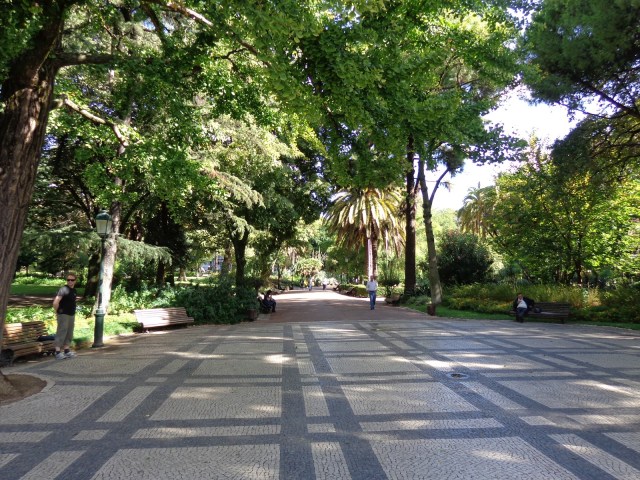
The entrance is an avenue created by huge California Fan palms and Mexican Fan palms, and on each side you can see several ‘living fossils’ – species that have not suffered any mutations for millions of years. On the left, Ginkgos, Dawn Redwood and Monkey-puzzle trees go back to the age of the dinosaurs. Close to the lake you can see Sago palms, native from Japan, and sacred figs from south east Asia, also known as the Buda tree. There is an oriental garden that shows off the Chinese Hibiscus.

Created in 1906 by royal decree (King D. Carlos I), and located in the grounds of a former zoo, it was opened in 1912, the presence of natural water influencing the choice of location. It sits on the slopes overlooking the River Tagus in Belem, one of the most interesting of Lisbon’s districts. It is one of three botanical gardens in the Lisbon area, the others being the Ajuda Botanical Gardens (also in Belem) and the Botanical Gardens near the Science Museum in central Lisbon.

The garden has rare tropical and subtropical trees and plants (many of them endangered species) from all over the world, such as Dragon Trees from the Canary and Madeira Islands and Brazilian Coral Trees. Most of them are labeled, so a visit here can also be a learning experience. It is a tranquil place regularly visited by leading international scientists and botanists. Its scientific work continues today and in its grounds you will find a seed bank, greenhouses, in-vitro culture laboratory and a xylarium (wood collection).

A highlight is the Macau Garden complete with mini pagoda, where bamboo rustles and a cool stream trickles. Young children love to clamber over the gnarled roots of a Banyan tree and spot the waddling ducks and geese.

It is a joy to amble along its palm – lined avenues and discover the grottos and ponds, the oriental garden and the topiary accompanied by the friendly birds. A welcome, peaceful, shady retreat on a sweltering summer’s day!

Other articles about Portuguese gardens:

Portuguese Gardens: Estrela Gardens, Lisbon

Oranges and Azulejos: Portuguese Heritage Gardens

Sources and further information:

Go Lisbon

aportugalattraction

Old School Gardener

If you’ve enjoyed reading this post and others on this blog, why not comment and join others by signing up for automatic updates via email (see side bar, above right ) or through an RSS feed (see top of page)?

PicPost: Knotted

The ‘Education Garden’ at Gressenhall Farm and Workhouse Museum, Norfolk, was in need of a ‘refresh’. As part of my one year Heritage Garden Traineeship I came up with a new design, having consulted staff and volunteers. The agreed design was carried out in 2012 by me and other volunteers at the Museum. It features some minor adjustments to the former planting areas, terraces and grass and also includes an area designed for pre – school children, known as ‘Curiosity Corner’.

‘Curiosity Corner’ is deliberately child – sized, with a winding bark and pebble path and deep borders that sometimes rise above and fall below the path. There are living structures – a willow tunnel and two entrance arches. A ‘pebble mountain’ and a series of wooden features are complemented by a low level mirror, as well as a number of metal and wooden birds, insects, butterfly and a cat, windmills and other ‘oddities’ such as a ‘fossil slab’ set in grass and a wall mask of a ‘small friendly giant’- the idea is to provide unusual things for the the children to spot and stimulate their imaginations.

The planting is varied and includes species with interesting leaves (e.g. Stachys byzantina or ‘Lambs Ears’, ferns and grasses) and last year children planted Sunflowers which grew to an enormous height! There is also a turf seat and a half barrel water feature (complete with metal frog). The garden has now seen a full season of ‘wear and tear’ and has stood up reasonably well – it seems to have been a popular addition to the Museum. However, some adjustments are needed to prevent children accessing the inner path from the terrace, strengthening the enclosed feel of the space and replacing the turf seat which has not really withstood the wear – it has turned into a mound for running up and down rather than sitting on! These changes will be carried out soon.

Old School Gardener

If you’ve enjoyed reading this post and others on this blog, why not comment and join others by signing up for automatic updates via email (see side bar, above right ) or through an RSS feed (see top of page)?

Aly B's avatarAly Baumgartner

The history of science is full of interesting characters, and Carl Linnaeus certainly fits the bill. Known as the father of modern taxonomy, he was born in Sweden on May 23rd, 1707. He was only the second generation of the name Linnaeus. In fact, when his father enrolled in school he was required to take a family name (instead of using the patronymic name Ingemarsson) and he chose Linnaeus after a giant linden tree that grew on his family homestead. With a name like that, Carl seemed to be destined for biological greatness.

Linnaeus showed an interest in botany from a very young age. His father, an amateur botanist, encouraged his son’s enthusiasm. When he enrolled at the Lund University in 1727, he knew that botany was a very serious subject. He registered under the name ‘Carolus Linnæus’, the latinized form of his name. He later would use this form…

View original post 688 more words

deltagardener's avatarThat Bloomin' Garden

Last week as part of the demonstrations at the Milner garden Party, I happened to visit the Kwantlen Polytechnic University Seed Library. Now I know what you are thinking, seed library, whats that?  Good question! The seed library opened to keep heritage seed varieties alive and to build interest in locally sourced sustainably grown food.

So how does someone use the seed library? There is no charge. The seed library asks that you return to the library with some saved seed from your own garden to make up for what you have taken. They want their seed library to keep on growing and supply gardeners for years to come.

What is a seed library?

I think this such a great idea. Just look at this file bursting with flower seeds. Think about it, when you buy package of something like onions seeds, do you use them all? Often there are almost 800-1000 seeds per package and…

View original post 187 more words

The Saffron Crocus (Crocus sativus)

The Saffron Crocus (Crocus sativus)

You will recall that our day out had begun promisingly at Anglesey Abbey in Cambridgeshire. After lunch we drove off (car roof remaining closed in view of the low cloud and short journey) to the town of Saffron Walden in north Essex. More specifically it is the chief town of the District of Uttlesford– I always think this sounds like somewhere you might find in ‘The Shire’ of Hobbit fame!

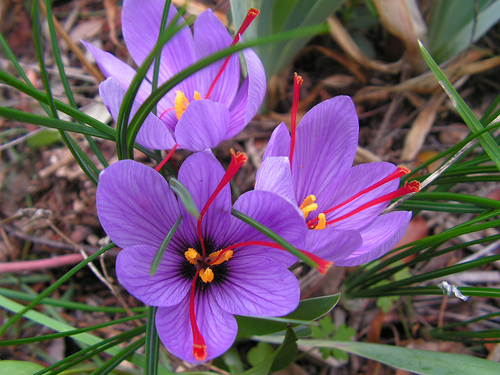
We’d been here a long time ago and then only driving through so didn’t really have a chance to explore it thoroughly. Here’s a link to Wikipedia’s entry on the town if you’re interested in its history. In brief it’s of ancient standing, there having been a settlement here long before the Roman occupation of Britain 2 thousand years ago. Of particular interest is the derivation of the town’s name. In the medieval period the primary trade in Saffron Walden was in wool, but in the 16th and 17th centuries the Saffron Crocus (Crocus sativa) was grown in the area. Each saffron crocus grows to 20–30 cm and bears up to four flowers, each with three vivid crimson stigma. Together with the styles, or stalks that connect the stigmas to their host plant, the dried stigmas were used originally in medicines, as a condiment, a perfume, an aphrodisiac, and as an expensive yellow dye. This industry gave its name to the town and what used to be Chipping Walden became Saffron Walden. The town itself retains many old buildings, interesting spaces and features, as you’ll see in the gallery at the end of this article.

We began our visit in a fascinating garden – Bridge End Garden. This is actually a series of seven interlinked gardens laid out by the Gibson family (eminent bankers and brewers) in the nineteenth century. They are Grade II* listed (so protected), close to the town centre and church and are open to the public each day free of charge. Careful restoration has replicated gardening techniques and designs typical of the Victorian era and has brought the garden back to its full splendour.

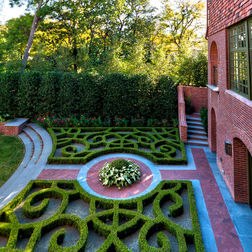
Though there are signs around stating that it is ‘not a playground’ and ‘ball games are not allowed’, I can see it can be difficult to prevent its use for play by the town’s children, some of which might get a bit over exuberant at times…. While we were there I was delighted to see a group of teenage boys playing ‘It’ around the different spaces and the hedge maze was also an obvious draw for local kids. These features in an original 17th or 18th century setting must surely have been used in a similar, playful way – if not by children then by adults! The Dutch Garden with its complex parterre of box bushes also looks so like a ‘mini maze’ (in fact hedge mazes developed out of the complex parterres in France, Holland and elsewhere across Europe), so it wasn’t suprising to see another sign, perhaps rather desperately, announcing that it isn’t a maze!

The gardens are maintained by a team of paid staff (of the Town Council, which also maintains a number of other public gardens) and volunteers, and are in a very good condition. A long winding path flanked by well – kept mixed borders leads you past the formal Rose Garden with views to the parish church beyond (apparently the tallest church in Essex) to the walled garden with its fence and wall – trained fruit trees and two glasshouses with miniature orchard and citrus fruit trees, respectively, in pots that look as though they are brought outside in warmer weather.

All around are little curiosities to intrigue –  statues of mock-snarling (or is it smiling) beasts, other classical statuary, some fine, mature trees such as a Cedar of Lebanon, a small summer house with a display of some curiosities from the garden (such as old gardener’s notes) and another gazebo called ‘Poets’ Corner’. The ‘Wilderness’, as it’s name suggests, was an area of more naturalistic planting (now with a developing Yew tunnel) and from the viewing platform at one end you can get a wonderful view of the Dutch Garden, with its swirling pattern of box hedging laid out to a design by Gertrude Jekyll, who visited the garden in the early 20th century.

Having seen a hedge maze, we went in search of one that is much older – and made of turf. At one edge of the town’s Common sits this wonderful example of a classical labyrinth (see my post on mazes and labyrinths for more information), of uncertain age, but several centuries at least as it was recut in the 17th century. This splendid feature is certainly a challenge to concentration and determination, being 1 kilometer long if you walk the full length of the winding brick path between the shallow turf mounding! Labyrinths are ancient features, adopted by Christianity as a way of encouraging meditation along the symbolic ‘journey of life’.

From here we passed by some of the medieval charm of central Saffron Walden, with their ‘pargetted’ walls (a technique that creates geometric patterns and pictures on the external render) and Market Square, and found a nice little Tea shop for our afternoon break. Unfortunately the west country ‘Saffron Cake’ appears not to be a local delicacy here, despite the town’s association with the spice! Instead portions of Strawberry Cheesecake and Millionaire’s Shortbread had to suffice! We finished our visit by looking round an old – estabslished Antique shop and the parish church of St. Mary- a superb example of a grand parish church built on wool – wealth (and latterly saffron – wealth). It has glorious glass, high painted wooden roof and stonework. Just as we were leaving this delightful town,  the rain began to fall – great timing!

Further information:

Plantax 5: Crocus- spicy herald of Spring

Saffron Walden Town Council website

Bridge End Garden- Uttlesford District Council website

Visit Saffron Walden website

Old School Gardener

If you’ve enjoyed reading this post and others on this blog, why not comment and join others by signing up for automatic updates via email (see side bar, above right ) or through an RSS feed (see top of page)?

The sun looked as though it might break through the low cloud, so we (that’s my wife Deborah and me), put the top down on the car and hoped (we’ve come not to expect any particular weather here in Norfolk, UK). Alas, the temperature hovered around 7 C all day, but it didn’t spoil our outing to Cambridgeshire and north Essex. Just over an hour’s drive away lies Anglesey Abbey, former home of Lord Fairhaven and now a National Trust – run house and garden.

I’ve featured the garden already on this blog under a ‘Picpost’ but didn’t really do it justice. So you can see a few more pics of it in the gallery below. We had a pleasant stroll along the Winter Garden walk with its fiery colours and varied textures, though it was noticeable how many evergreens showed evidence of ‘leaf scorch’ by the recent cold easterly winds – the Garrya elliptica was looking especially sorry for itself. At the end of this walk sits the old Lode Water Mill, where flour is still ground and sold to visitors – fortunately we arrived and ascended the steep wooden staircases just before a coach load of german youngsters (several of the boys must have been 6’6″ plus).

Winding our way along the old mill stream we found the House (as the name suggests some of the older parts were once an Abbey) and donning our paper over – shoes to protect floors and carpets, we meandered around this house full of eclectic decor and collections of this and that – including many things ‘rescued’ from other ancestral homes by Lord Fairhaven during the early 20th century. He certainly had a love of Windsor Castle as there is one and a bit large gallery rooms full of different paintings of the place from a number of centurires and angles. I was particularly impressed with the display of some of Lord Fairhaven’s clothes and especially his shoes which looked as new (and some would probably be back in fashion today). He had so many pairs, for different occasions, that they were hardly ever worn – so much for the idea that it’s just women who hoard footwear!

To be honest, this probably wasn’t the best time to visit Anglesey Abbey for the gardens – the display of Snowdrops is famous but was well over, and the late spring has resulted in only a few bulbs being out, most notably the wonderful purply- blue of Scylla in the woodland end of the Winter Walk as well as some Daffodils. The Dahlia beds of course were looking bare and the Roses will not be out for a good couple of months yet (assuming they catch up). Still, there is a lot of interest here, including the more formal landscape garden with its evergreen hedges and statuary and some lovely areas of woodland. We concluded part one of our day with a wholesome lunch of jacket potatoes and salad in the well-appointed restaurant on site. The sun had not broken through, but we didn’t mind – Saffron Walden and the promise of afternoon tea (and Saffron cakes?) beckoned…. return to read part 2 of our special day tomorrow!

Old School Gardener

If you’ve enjoyed reading this post and others on this blog, why not comment and join others by signing up for automatic updates via email (see side bar, above right ) or through an RSS feed (see top of page)?

Entrance to the Estrela gardenFollowing my article about Portuguese Heritage Gardens, I thought I’d turn my attention to a few of my favourite public gardens in that country. I’m beginning with one of my real favourites, one I love to return to when I’m in Lisbon (not that that’s very often!).

It’s the Estrela Garden (the Jardim da Estrela or Garden of the Star) which has a wonderful blend of exotic, artful, friendly charm with an atmosphere from the best of classic 19th century neighbourhood parks and gardens. It’s no surprise, then , that it remains as one of the most popular gardens in Lisbon. The orignal layout – 19th century romantic landscape style – features plenty of exotic plants and a central pond.
It is known officially as the Jardim Guerra Junqueiro (Junqueiro was a famous poet and politician who was a key figure in the downfall of the Portuguese monarchy and the establishment of the Portuguese Republic in 1910). In the 1840s the governor of Lisbon saw the need for a public garden in the densely populated city, and thanks to a donation by a wealthy baron, the governor was able to acquire the area  (5 acres) opposite the Estrela Basilica. Work on building the garden started in 1842 but due to the outbreak of war and financial difficulties, it didn’t open to the public for another ten years.

The gardens are laid out in a landscaped style with plenty of exotic trees, cacti, flower beds and a pond with fountains. The garden is especially popular with locals who come here during weekends to socialize, stroll along the paths, have a drink at the café, or play cards at one of the permanent tables among the trees.

The garden was designed by gardeners Bonard and João Francisco and it originally featured several romantic structures such as a gazebo and a Chinese pavilion. These structures are no longer there, but there are plenty of sculptures and a 19th century wrought iron bandstand, originally located at the site of the City’s main boulevard, Avenida da Liberdade. It was moved here in 1936.

After the creation of the Portuguese republic, several statues were installed in the park, the most expressive of which is of a farmer (sculptor Costa Mota,1913).  There is another of a female nude known as ‘O Despertar’ (sculptor Simões de Almeida).The most famous statue in the park is probably that of the Guardadora de Patos (keeper of the ducks) – a limestone replica of the marble original from 1914, it shows the protagonist of a popular fairy tale. Other statues include a dog spouting water from its mouth and 3 other busts depicting poets and an actor. More recent additions include a children’s playground and a pond-side cafe. The garden hosts the annual  Out Jazz festival – on Sunday afternoons during this time (usually May), Jardim Estrela will be alive with music and people enjoying the Sunday evening jazz in the open air auditorium.

Beyond the park is the English Cemetery, founded in 1717 and originally shared with the Dutch community. Novelist Henry Fielding, author of Tom Jones, died during a visit to Lisbon and is buried here.

Here are some images to let you get the feel of the place.

Source: A View on Cities

Old School Gardener

If you’ve enjoyed reading this post and others on this blog, why not comment and join others by signing up for automatic updates via email (see side bar, above right ) or through an RSS feed (see top of page)?

Finding Nature

Nature Connectedness Research Blog by Prof. Miles Richardson

Norfolk Green Care Network

Connecting People with Nature

Discover WordPress

A daily selection of the best content published on WordPress, collected for you by humans who love to read.

Susan Rushton

Celebrating gardens, photography and a creative life

Unlocking Landscapes

Writing, photography and more by Daniel Greenwood

Alphabet Ravine

Lydia Rae Bush Poetry

TIME GENTS

Australian Pub Project, Established 2013

Vanha Talo Suomi

The Journey from Finnish Rintamamiestalo to Arboretum & Gardens

Marigolds and Gin

Because even in chaos, there’s always gin and a good story …

Bits & Tidbits

RANDOM BITS & MORE TIDBITS

Rambling in the Garden

.....and nurturing my soul

The Interpretation Game

Cultural Heritage and the Digital Economy

pbmGarden

Sense of place, purpose, rejuvenation and joy

SISSINGHURST GARDEN

Notes from the Gardeners...

Deep Green Permaculture

Connecting People to Nature, Empowering People to Live Sustainably

BloominBootiful

A girl and her garden :)