Category: Heritage Gardens & gardening


PicPost: Baroque Brassicas

Cabbage beds at Villandry, France

Old School Gardener

IMG_8203

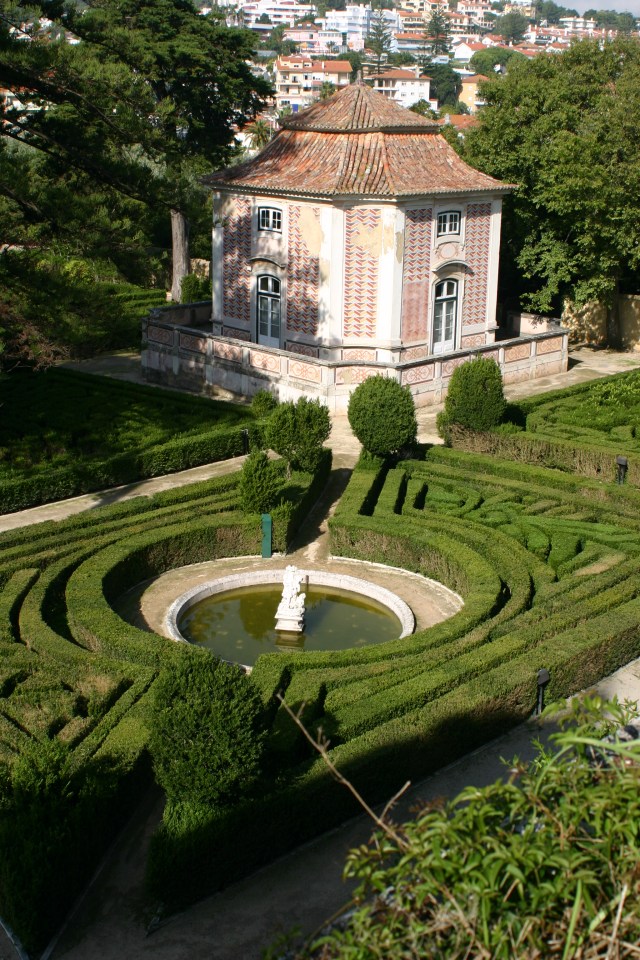
So, this is it, the final stop on our final day in Portugal (well, at least this visit). The Quinta da Regaleira is one a group of grand palaces with grand gardens and estates in the mountain top resort of Sintra, a few miles from Lisbon, and famous as the retreat of the royals and the rich.

It consists of a romantic palace and chapel, and a luxurious park featuring lakes, grottoes, wells, benches, fountains, and a vast array of exquisite constructions. The palace is also known as “Palace of Monteiro the Millionaire”, from the nickname of its first owner, Antonio Augusto Carvalho Monteiro. The estate has had many owners through time, but in 1892 it was purchased by Carvalho Monteiro who then set about creating a place where he could gather symbols that would reflect his interests and ideologies. With the assistance of the Italian architect Luigi Manini, he installed in the 4-hectare estate a range of enigmatic buildings, believed to hide symbols related to Alchemy, Masonry, the Knights Templar and the Rosicrucians. The architecture is an eclectic mix of styles, constructed in the first few years of the 1900’s and completed in 1910.

After a number of other owners, and a period in which it fell into disrepair, the estate was bought by Sintra Council in 1997. Extensive restoration was undertaken, and the palace and surroundings were opened to the public one year later.

Most of the estate consists of a dense woodland park crossed by many roads and footpaths. The woods are neatly arranged in the lower parts of the estate, but left wild and disorganized in the upper parts, reflecting Carvalho Monteiro’s belief in primitivism. Decorative, symbolic and leisure structures are dotted aorund the park and there is also a mysterious system of tunnels, which have multiple accesses including via grottoes, Chapel, Waterfall Lake, and “Leda’s Cave” beneath the Regaleira Tower. Their symbolism has been interpreted as a trip between darkness and light, death and resurrection.

The “Initiation Well” or “Initiatic Well” (sometimes referred to as the “Inverted Tower”) is a 27 metre staircase that leads straight down underground and connects with other tunnels via underground walkways.Water is a frequent element with two artificial lakes and several fountains and the Aquarium, built as if it were naturally embedded in a rock.

I loved the playfulness of the park and children of course love its quirky touches, secret passages and tall towers. Quite a place and a fitting end to our latest Portuguese trip.

Source: Wikipedia

Old School Gardener

IMG_7088I frequently visit this wonderful Jacobean Mansion and more particularly it’s gardens and parkland. After all it is just 7 miles from home. A  walk around the park after a Christmas Day ‘brunch’ has become something of a family institution, often complete with festive headwear!

I try to visit the gardens at different times of the year as they offer something for every season, and back in September I was keen to experience the late summer colour festival of its herbaceous and other plantings. At this time of year it’s mix of formal and informal styles is most evident.

Coincidentally, there was a splendid event going on to celebrate the role of the Hall in the Second World War, including people dressed in military uniforms and plenty of vehicles and ‘kit’ from the time. This is my photo record of my most recent visit along with a very good summary of the gardens’ history and features from Wikipedia:

‘A house and garden existed at Blickling before the estate was purchased by the Boleyn family in the 1450s, but no records survive to give an indication of their appearance. After Sir Henry Hobart acquired the estate in 1616, he remodelled the gardens to include ponds, wilderness and a parterre. A garden mount– an artificial hill in Blickling’s flat landscape, was made to provide views of the new garden. With the accession of Sir John Hobart (later the 1st Earl of Buckingham) in 1698 the garden was expanded to add a new wilderness and the temple was constructed.

In the latter half of the 18th century John Hobart, 2nd Earl of Buckingham, embarked on works that would radically change the appearance of the gardens. All traces of formality were removed, and naturally arranged clumps of trees were planted to create a landscape garden. By the 1780s an orangery had been built to overwinter tender citrus trees. Following the 2nd Earl’s death in 1793, his youngest daughter Caroline, Lady Suffield, employed landscape gardener Humphry Repton and his son John Adey Repton to advise on garden matters. John Adey Repton would go on to provide designs for many garden features.


The estate was inherited by nine-year-old William Schomberg Robert Kerr, 8th Marquess of Lothian in 1840. He later re-introduced the formality and colour schemes of the parterre. After his death at the age of 38, responsibility for the gardens rested with Lady Lothian and her head gardener Mr Lyon. Philip Henry Kerr, 11th Marquis of Lothian, inherited the estate in 1930. After disparaging comments in a publication of Country Life, Lothian engaged socialite gardener Norah Lindsay to remodel the gardens. In the parterre she replaced the jumble of minuscule flower beds with four large square beds planted with a mixture of herbaceous plants in graduated and harmonious colours. Other improvements included removal of a line of conifers in the Temple walk, which were replaced with plantings of azaleas.

The garden today

The garden at Blickling covers 55 acres (22 ha) and contains formal and informal gardens, Grade II listed buildings and structures, woodland, specimen trees, Victorian garden ornaments, topiary, the kitchen garden .. and 18th century yew hedges.

The lawns which frame the main approach to the hall are bounded by yew hedges which were first recorded by William Freeman of Hamels in 1745. Surrounding the hall on three sides is the dry Moat. The plantings in the moist, sheltered conditions of the moat were considerably revised by Lindsay who introduced hosta, species of hydrangea, buddleja and rosemary.

To the rear of the hall is the noted Parterre garden which is located on the east lawn. Originally created as a Victorian sunken garden it was remodelled by Lindsay in the early 1930s. Set around an 18th-century listed stone fountain, she divided the garden into four large, colourful herbaceous beds surrounded by L shaped borders stocked with roses and catmint with an acorn shaped yew marking each corner.


In the terraces above the parterre there are plantings of peony, seasonal beds and the Double Borders created in 2006, contain a wide variety of perennials, shrubs and grasses with colours ranging from hot to cool. Close by, are the White and Black Borders which were established in 2009, together with a collection of eleagnus.

The western side of the garden features the lawned Acre which is fringed by a spreading oriental plane tree. Outdoor sports such as croquet are played here in the summer months. Further highlights are a collection of magnolia underplanted with autumn cyclamen, the shell fountain and the kitchen garden. To the north of the parterre is the Wilderness garden which is bisected by radial grassed avenues flanked with turkey oak, lime and beech trees and naturalised bulbs. The wilderness hides a Secret Garden with a summerhouse, scented plants and a central sundial.

Nearby is the listed 18th century orangery which houses a collection of citrus trees. Adjacent, to the building is the steep sided Dell which is home to many woodland plants including a selection of hellebore and foxglove. In 2009, an area of woodland was cleared close to the orangery to create a new garden. Stocked with a wide range of woodland plants including camellia and varieties of mahonia. Opened in 2010, it will be known as the Orangery Garden.

The Grade II listed Temple is approached by the Temple walk which is lined with azalea planted by Lindsay in her original 1930s design. Scattered throughout the garden are many garden ornaments including thirty pieces supplied to Lady Lothian in 1877 by Austin & Seeley of Euston Road, London.

Future projects include the creation of a philadelphus and rose garden. Both of which will be located in the Wilderness and open to the public in the near future .’ (Note – these have now been established and are open to the public- see pics below).

Further information:

National Trust Website

Wikipedia

Old School Gardener

IMG_8145

It was our last full day in Portugal and having visited two grand Baroque gardens in Caxias and Oleiras we stopped off in stylish Cascais for lunch. It was also a chance to take a look at a very different garden, one very much more domestic in size and with a more informal air.

Casa da Pergola (‘The Pergola House’)  is a mediterranean – style mansion or Manor House, near the centre of Cascais. I viewed the charming and well kept front garden from outside the locked entrance gates, not having the time (or courage) to ask if I might be let in to look around. Still, I could see enough to be impressed.

The hotel website shows pictures of elegant white marble floors and staircases, beautifully decorated bedrooms with “bas relief” stucco ceilings. The house has been owned by the same family for over a century and its beautiful facade, adorned with hand painted tiles, has been the delight of both amateur and professional photographers. Here’s my take on it!

Further Information: Pergola House website

Old School Gardener


IMG_8062

The second garden visit on our last day in Portugal took us a little further towards the mouth of the River Tagus, but still within the town of Oeiras. The Gardens of the Palace of the Marquis of Pombal convey an even more prosperous feel and are altogether larger – almost a ‘landscape’ scale. It is easy to imagine these high baroque walks, lawns, borders and water features as the scene of some serious 18th century showing off, flirting and general fun. 

The 1st Marquis of Pombal

The Town Council now occupies the former palace. The Marquis of Pombal, one of Portugal’s most famous leaders, was rewarded with the palace, the title (and the title Count of Oeiras) for his service as first minister to the Portuguese King Dom Jose I in the mid- late 18th century. The surrounding gardens are typical of Portuguese landscape art, inspired by eighteenth century European designs but holding to the tradition of the Portuguese stately house. They are richly decorated with marble busts and statues, low walls and marble staircases along with many murals composed from azulejos (glazed tiles).

Here too is the Poets’ Waterfall, with excellent busts of the four epic poets (Tasso, Homer, Virgil and Camoes) looking out over the gardens and carved in marble by Machado de Castro. At the fountain’s centre lounges the figure of a ‘river god’ modelled on the one that existed at the Belvedere Gardens, in the Vatican, Rome. As in the garden we visited earlier at Caxias, the fountain is a fantastic structure made out of pitted stone which conveys a truly antique feel. There are also splendid views of the surrounding gardens from the stairs that wrap around the sides of the construction.

The gardens form one part of a wider estate which is planned to a rigourous geometry and divides recreation spaces, great gardens and surrounding farms, all reflecting the style of the well-to-do families of the age.  The gardens saw cultural events such as theatre, ballet and musical performances, a tradition kept up to the modern day (Roxy Music performed here in 2010!).  Here are some pictures of the formal gardens lying to the side of the Poets’ Fountain, with empty pools resting near to the remains of a ‘bousquet’ (a sort of woodland in miniature) and the wonderful (empty) pools and fountains of a large water garden with some beautiful glazed tiles that must look really vibrant when wet.

Related article:

Portuguese Gardens: Baroque Splendour at Caxias, Portugal

Old School Gardener

IMG_8032Our October visit to Portugal concluded with a day packed with garden visits to the west of Lisbon and in the regal suburb of Sintra to the north- home to many a splendid palace and garden.

We began at a restored baroque garden in the riverside  town of  Caxias. The Quinta Real de Caxias is located quite close to the train station (direct services to and from Lisbon). It was a leisure residence of Queen D. Maria I, as well as the home of King Luís for a few weeks, before he moved to the Ajuda Palace (which we’d visited a few days before).

Inspired by the gardens at the Palace of Versailles, the formal parterres- woven in intricate patterns – are interspersed with various water features, statuary and tall Brazilian pine trees.

The waterfall, ornamented with terracotta statues (of the Machado de Castro school), is the centre piece. Set out at the end of the principal avenue the fountain itself (made out of weather – beaten limestone), is flanked by two wings of tiered terracing, accessed by staircases at either end – the perfect spot form which to view the patterns of the box parterres.

Awarded a European Prize for the Recovery of Historical Gardens, the local Council has done a superb job in restoring much of the baroque splendour of this ‘off the beaten track’ haven. I could have spent hours here ‘chilling out’ – and it would have been even more alluring if the water features had been in operation. Maybe that’s something for the next phase of restoration?

Old School Gardener

IMG_7228There’s been a brewery and garden here since 1795. Perched on the north bank (or ‘brink’) of the River Nene in Wisbech, Cambridgeshire, Elgood’s Brewery remained virtually unaltered until the Second World War.

The established Victorian garden was ripped up and as much land as possible devoted to growing food for the war effort. After being turned over to grass for many years, 1993 saw the discovery of some old photographs of the original garden and it was decided to both restore some of the old spaces and features and to create new areas.

The structure of the garden today owes much to the framework of superb specimen trees which survived over the centuries; Ginkgo, Cedrus, Liriodendron and Salix to name but a few. These were mainly provided by members of Wisbech’s famous banking family, the Peckovers, who themselves established a grand Victorian garden a few paces down river at what is now called Peckover House.

Some important features such as the maze (of Thuja and Laurel and featuring old brewery and garden objects as focal points), walled garden, Japanese garden, rockery, water features, glasshouses and herb garden have been recreated. These are complemented by a modern grass and bamboo garden with contemporary water features. And there are typical Victorian ‘swags’ (ropes) over which climbing roses clamber as well as arbours featuring two varieties of hop (‘Fuggles’ and ‘Challenger’) – both of which feature in Elgood’s beers.

The modern additions have added to what is a typically eclectic mix of curiosities and attractive garden features. Well worth a visit, and can be combined for a full day’s outing with nearby Peckover House and the Georgian town of Wisbech.

Hops- ornamental and useful for brewing too!

Further information:

‘Banker’s Bonus- secret garden gem 

Oranges in the Fens

Elgood’s website

Old School Gardener

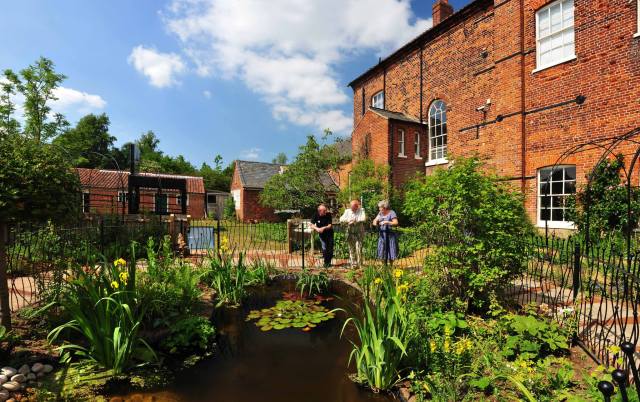
gressenhall wildlife gardenHere’s a video featuring some of the gardening volunteers (including yours truly) and the gardens at Gressenhall Farm and Workhouse Museum, Norfolk. The next couple of months will be quiet in the gardens, but we’re recruiting now for anyone who can spare some time and expertise (basic gardening skills plus) to help maintain and evelop this wonderful resource!

Leave a comment or contact me on nbold@btinternet.com

Old School Gardener

IMG_7887

Thanks for reading this, my 1000th post on Old School Garden. I’ll do a fuller review of my blogging experience on my first anniversary on 17th December. But for now I hope that you enjoy my review of an interesting garden in Portugal.

A little off the beaten track in one of Lisbon’s northern suburbs (Lumiar), sit the Gardens of Monteiro Mor (this translates as ‘the High Huntsman of the Royal House’ refering to one of the former grand residents).They come with not one, but two bonuses – small, but fascinating museums, one focusing on Portuguese Theatre and the other Costume.

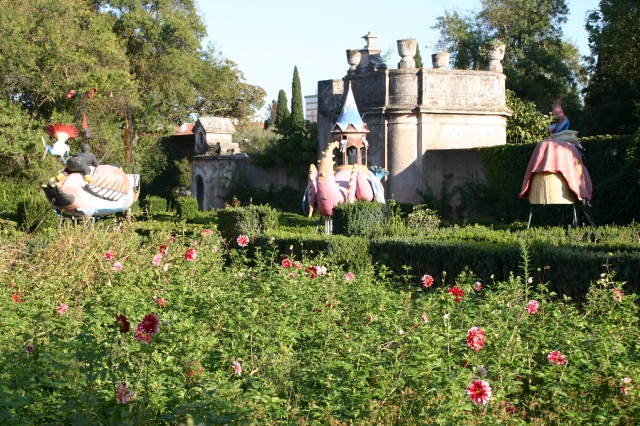
The surrounding gardens are a very engaging mix of formal, botanical display and wilder woodland walks – all very pleasant on a warm autumn day. And there are a number of curious sculptures to see en route too, along meandering paths and steps which take you to a variety of water features and through glades of mixed, mature trees and shrubs.

Interestingly, a communal food growing area seems to have been created on the edge of the parkland, and we also were lucky enough to see a wide range of flowers on display when we visited.

The museums, housed in two former grand houses a few paces from each other, are very well laid out. The Theatre Museum comes stocked with a huge array of printed and pictorial material along with theatre models, sculpture and theatrical props (including some lovely puppets and larger costume displays).

No need for much in the way of interpretation here as the visual richness speaks for itself!

The Costume Museum is an altogether more restrained affair, with displays of clothes and accessories from different periods set off wonderfully in the elegantly decorated rooms of the former palace. Varied lighting levels and effects and a nicely uncluttered feel all contributed to a beautiful wander though time.

This became especially interesting when we reached the 1960’s and more recent displays, which brought back some long-lost memories!

This was a visit well worth the subway ride from central Lisbon, the ‘one for all’ ticket being very good value.

Old School Gardener

shinealightproject's avatarShine A Light

By Dayna Woolbright

The Georgian period spans 123 years, 1714-1837, and marks the period when England was ruled by the Hanoverian Kings, George I, George II, George III, George IV, William IV.The Georgian period saw much change; in politics, industry and literature. In social terms it saw the gap between rich and poor widen and the emergence of the libertarian ‘middle class.’ This era helped shape Britain as we know it today and there are far too many important historical events to consolidate into one blog, for this reason I will concentrate on the social history and the developments that can be represented through objects in the Norfolk Museums and Archaeology service’s collection.

Architecture

The Georgian period saw the emergence of imperial based wealth through the import/export of various goods which were sold around the world. This created a new larger, wealthy middle class who liked to illustrate their wealth…

View original post 2,766 more words

Finding Nature

Nature Connectedness Research Blog by Prof. Miles Richardson

Norfolk Green Care Network

Connecting People with Nature

Discover WordPress

A daily selection of the best content published on WordPress, collected for you by humans who love to read.

Susan Rushton

Celebrating gardens, photography and a creative life

Unlocking Landscapes

Writing, photography and more by Daniel Greenwood

Alphabet Ravine

Lydia Rae Bush Poetry

TIME GENTS

Australian Pub Project, Established 2013

Vanha Talo Suomi

The Journey from Finnish Rintamamiestalo to Arboretum & Gardens

Marigolds and Gin

Because even in chaos, there’s always gin and a good story …

Bits & Tidbits

RANDOM BITS & MORE TIDBITS

Rambling in the Garden

.....and nurturing my soul

The Interpretation Game

Cultural Heritage and the Digital Economy

pbmGarden

Sense of place, purpose, rejuvenation and joy

SISSINGHURST GARDEN

Notes from the Gardeners...

Deep Green Permaculture

Connecting People to Nature, Empowering People to Live Sustainably

BloominBootiful

A girl and her garden :)