Category: Grow your own food


Keeping the bees happy is one aspect of planting a wildlife garden

Keeping the bees happy is one aspect of planting a wildlife garden

The latest round of RHS Garden Shows winds it’s way around the country – Hampton Court is next up and opens 0n 8th July. I’ve been to this show twice before and I reckon that most if not all of the show gardens (and this is probably true of the other shows too), tend towards what you might call the ‘middle ground’ of design (perhaps considered a ‘safe bet’?) What I mean is that they usually combine that tried and tested formula of ‘formal structure, informal planting’ – what you might call the classic Arts and Crafts/ English Country House style.

Don’t get me wrong, this is a style I love myself and is what I’m trying to create here at the Old School Garden. But every now and then its refreshing to see something at one of the ‘design extremes’- the sort of creation that pushes you into thinking again about structural features or particular planting choices and combinations in your own garden, or even more fundamentally, what you expect your garden to do.

At this year’s Hampton Court Show one garden looks set to do this and at the same time get across some important messages about the potential food value of gardens- and in particular the wide range of good quality food that nature puts on the menu.  ‘The Jordans Wildlife Garden’ has been created to reflect a long-term commitment from Jordans to the British countryside. With a colourful variety of features from edible wild flowers, trees and hedges to oats, fruit and nuts – all of which can be foraged from the countryside – the garden provides a natural ‘larder’ to share as a shelter for birds, bees and butterflies. Its unveiling celebrates the belief that great tasting food comes from working closely with nature, as well as aiming to inspire gardeners everywhere to support British wildlife.
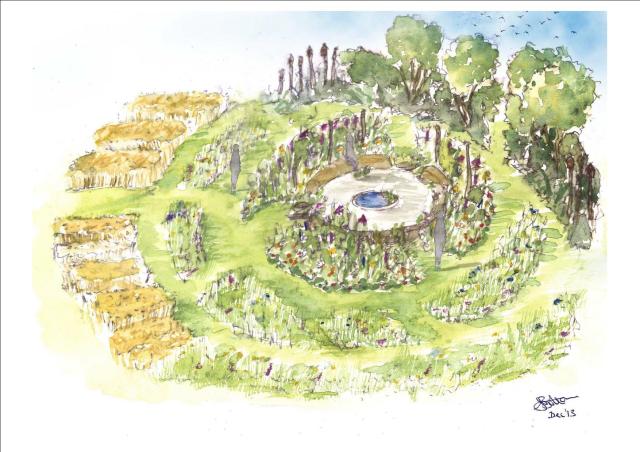
The Jordans Wildlife Garden Design

The Jordans Wildlife Garden Design

This Garden is set to showcase the importance of sustainability and protecting the British countryside to RHS visitors from across the country. Oat fields, inspired by Jordans’ farms, outline the sides of the garden, moving through to mown paths of species rich meadow, which curve through the space. Swathes of meadow alongside the paths give a close connection to nature. The garden is surrounded by a cut log wall and grassy banks, which form a wildlife friendly edge to the garden and a habitat for wildlife. A nut terrace that provides an edible treat for both people and wildlife surrounds the elegant, reflective pool in the centre of the garden. There are also sculpted straw benches, created by willow sculptor Spencer Jenkins, that provide a place to rest and enjoy the relaxing atmosphere. Mixed native hedgerow and fruit and nut trees will surround one side of the garden, providing more edible treats for people and animals.

The Garden features have been designed to support local wildlife, including thatched insect hotels, birdhouses and feeding stations. These were all custom crafted for the Garden and add a unique beauty to the space. Design elements such as cut wood stepping-stones, created by chainsaw artist Ella Fielding, will provide further material for animals to make their homes in, whilst the meadow flowers themselves house a beehive – a core feature of any wildlife garden.

All the sustainable elements of the Garden also represent a commitment by Jordans to The Prince’s Countryside Fund, which works to support the people that take care of our countryside and ensures a sustainable future for British farmers and rural communities. And it just shows the ease with which these elements can be brought into compact garden spaces, whilst still supporting local wildlife.

Selina Botham, a passionate wildlife and garden enthusiast, designed the Garden. She has won numerous awards for her beautiful and considered approach to gardening, from Gold Medal to Best In Show for her first ever garden at the RHS Hampton Court Palace Flower Show. And as part of its British countryside celebrations this July, Jordans has enlisted the taste expertise of Great British Bake Off winner, Edd Kimber, to create a series of foraged food recipes inspired by The Jordans Wildlife Garden.

Selina Botham
Selina Botham

Long-term supporters of wildlife habitats and increased biodiversity, Jordans’ cereal farmers devote at least 10% of their farmed areas to supporting wildlife. These sustainable practices are at the centre of the company’s ethos and their pioneering work in this area helps to create a more diverse countryside by encouraging up to five times more wildlife in agricultural spaces.

As a daily consumer of their fruity Muesli, it’s nice to know that they promote sustainable farming practices!

Links for further information:

Jordans Cereals and the Wildlife Garden

Up to date coverage of the Jordan’s Wildlife Garden at the RHS Hampton Court Flower Show – on Facebook and Twitter

Old School Gardener

quackers

Do you have any amusing tomatoes?

Old School Gardener

PicPost: Organic Dreamscape

Old School Gardener

IMG_7453

‘If well managed, nothing is more beautiful than the kitchen garden: the earliest blossoms come there: we shall in vain seek for flowering shrubs in March, and early April, to equal the peaches, nectarines, apricots, and plums; late in April, we shall find nothing to equal the pear and the cherry; and, in May, the dwarf, or espalier, apple trees, are just so many immense garlands of carnations. The walks are unshaded: they are not greasy or covered with moss, in the spring of the year, like those in the shrubberies: to watch the progress of crops is by no means unentertaining to any rational creature; and the kitchen- garden gives you all this long before the ornamental part of the garden affords you anything worth looking at.’

William Cobbett: The English Gardener 1829

Old School Gardener

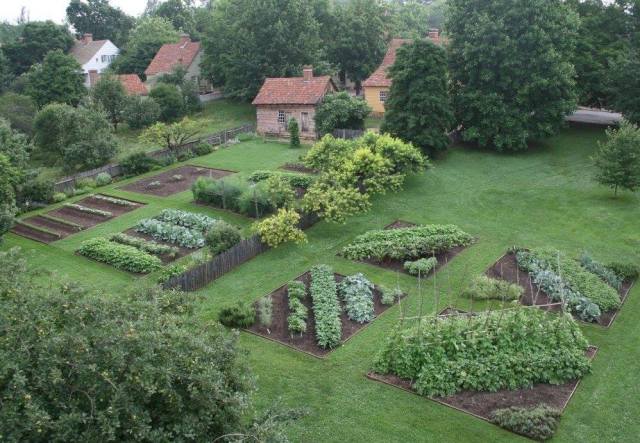
old salem museums and gardens via p.allen smith


‘Diagonal Veg’ at Old Salem Museums and Gardens via P. Allen Smith

Old School Gardener

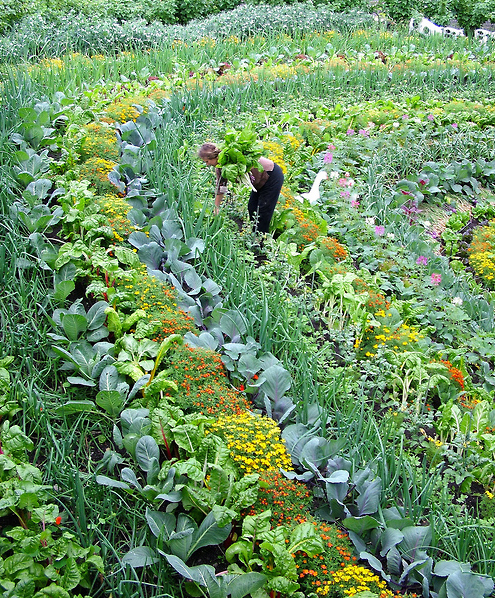
Planting Patterns #13

Growing food in style- picking veg at the Eden Project, Cornwall

Old School Gardener

Gardening-Boots2Two new rounds of my courses on Garden Design and Grow Your Own Food for Beginners start soon, and I’m also offering a new, one day course on Wildlife Gardening. I ran the last Garden Design course earlier this year and had great feedback on it (I even had a thank you present from the students!). All the courses feature a lot of group discussion and some practical tasks as well as useful tips and tricks to help particpants apply what they learn to their own plots.

The Garden Design course takes students through a customised design process, prompting a fresh look at participants’ own gardens, giving them the opportunity to develop their own ideas in a systematic way and benefitting from ideas generated in the whole group. I support participants to draw up their own scale plan design for their garden and supply plenty of useful background information and links to helpful web sources as well as the opportunity to borrow from my own garden book library. The course can also feature a visit to a well known garden to look at design ideas in practice.

The ‘GYO’ course is aimed at food-growing beginners or novices and gets off to a flying start with making paper pots and sowing broad bean seeds. It also prompts students to look at what they want to eat/grow and how they might do this most effectively in their own plots – this can include growing in containers for those with little or no garden.The course includes a visit to Old School Garden to look at my own approach to food growing, and covers topics like soils and soil improvement, growing under glass, encouraging beneficial wildlife into your garden and how to effectively control pests and diseases.

Narrow beds in the Kitchen Garden at Old School GardenNarrow beds in the Kitchen Garden at Old School Garden

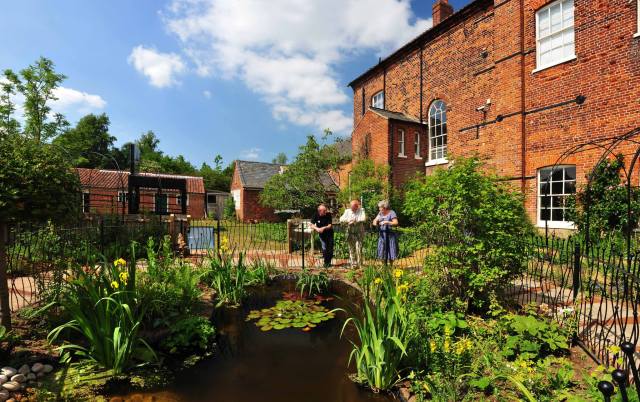
The one day Wildlife Gardening course, taking place at Gressenhall Farm and Workhouse Museum, makes use of the Wildlife Garden at the Museum and includes some practical work to help develop the wildlife -friendly features there as well as helping participants to focus on their own gardens and gardening practices. The aim is for them to develop  their own action plans for the future.

The Wild life Garden at Gressenhall Farm and Museum

The Wild life Garden at Gressenhall Farm and Museum

The courses are fast filling up but there are some places still available if you’re quick!

They are running as follows:

Garden Design–  6 Monday evenings, 7pm-9pm at Reepham High School & College, commencing on 12th May.

Grow Your Own Food for Beginners – 6 Wednesday evenings, 7pm-9pm at Reepham High School and College, commencing 14th May.

Get more details and how to enrol at www.reephamlearningcommunity.co.uk

Wildlife Gardening- Sunday 18th May, 10am-4pm at Gressenhall Farm and Workhouse Museum, near Dereham.

For more information on this and other short courses at the Museum see www.museums.norfolk.gov.uk

Old School Gardener

Planting Patterns #1

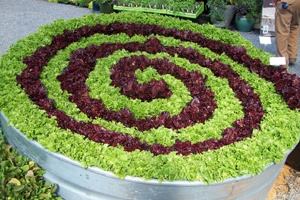
A Lettuce swirl

Old School Gardener

come

Vertical gardening and planting seems to be taking off. If it isn’t home-made planters for herbs and the like then its mega green walls in public places. Here are a few of the latest examples I’ve come across.

Old School Gardener

The finished 'Woodblockx' planter- soon to be home to an alpine collection

The finished ‘WoodblocX’ planter- soon to be home to an alpine collection

You may recall that two wooden planters in the courtyard here at Old School Garden, recently ‘bit the dust’. Not using pressure treated timber when I made these a few years ago was certainly a mistake. I was wondering what to do to replace them and a few weeks ago was approached by a Scottish company called WoodblocX to do a trial of their products- they make a range of raised planters, beds and ground support systems using an interlinking set of wooden bricks (or ‘blocX’).

Having looked at their comprehensive website, I decided to go for a raised planter (1350mm long by 450mm wide and 450mm high), and I’m hoping to use this both to replace the old planters and create a new feature – an alpine bed. This should be at the right height to be viewed from the nearby metal table and chairs in the courtyard and if suitably finished off will tie in nicely to the predominantly black and terracotta colouring of the many other planters and pots in this sheltered, sun trap setting.

Well, the planter was successfully delivered within a few days of ordering. Last week (having given the courtyard surfacing its yearly clean), I set about constructing it.

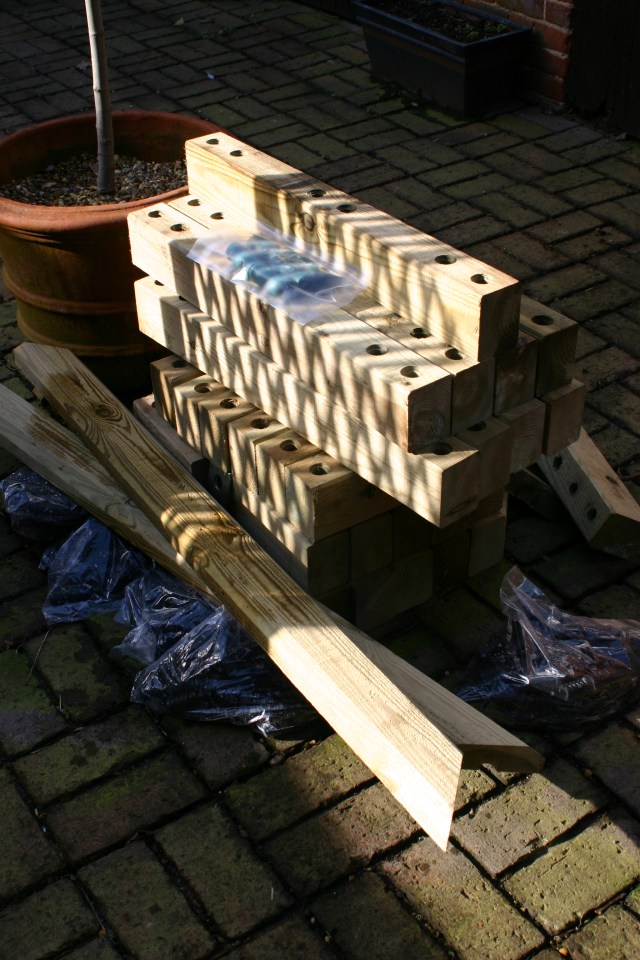
In with the new- my new 'Woodblockx' planter awaiting construction
In with the new- my new ‘Woodblockx’ planter awaiting construction

There was a pack of various leaflets and other material supplied with the pallet-load of parts and having checked these off against the list supplied, I wound myself through this material. Though comprehensive, the fact that there were bits of advice and information spread across more than one document initially threw me and I didn’t find any instructions specifically about how my planter should be built or look.

So I spent a few minutes working back from the diagram on the company website to see how each layer of the planter should be built up. I also began knocking in the various plastic dowels and wedges (which join each layer of ‘blocX’ together) to what I hoped was the correct configuration. Then I discovered that these didn’t match up to the next layer’s holes, as the next layer of blocX has to be laid like a brick course with no joints overlapping each other, so not all of the holes correlate. Still no problem, as I guessed that a couple of spare blocX had been sent and, as I discovered later, it is easy to just saw off the tops af any dowels that are in the wrong place! (there was also a good supply of plastic dowels sent so I could afford to waste a couple).

I decided to take another look at the literature I’d been sent and then – to my embarrassment – discovered a set of instruction diagrams for my planter showing which sized blocX should go where and which holes should have the dowels in! Though I hadn’t worked out the layout to exactly match that shown in these diagrams, I thought mine would work too, so I pressed on with the second and subsequent layers. Hammering in the dowels and then pushing home the next layer of blocX on top was very satisfying and I proceeded layer upon layer, to see my planter taking solid form before my eyes!

Using a rubber mallet, and green plastic tubing to hammer home the black plastic dowels was a doddle

After the fourth and final layer of blocX then came the simple, but attractive capping, which really finished of the planter very tidily. This is knocked onto another set of dowels as well as four metal corner brackets which help the planter to hold its shape. The whole construction time- allowing for my careless beginning– took around an hour, was simple and good fun, giving ‘instant results’.

These planters can be used in open ground (they come with two long metal spikes which help anchor it into the ground), but in my situation, sat on clay paviours, the weight of the planter (especially once full of earth) will be sufficient to hold it in place. As advised by the Company I could have also fixed it in place with some angle brackets. I will add an inner lining of landscaping fabric to help protect the wood (though it is all pressure treated) and to avoid soil seeping out from underneath.

Though the rough-planed finish of the WoodblocX is attractive enough from a distance, I think I may sand it down a little and apply either some black wood stain or similar treatment to tie it into the rest of the courtyard planters. I’ll do a further article to show the finished item, planted up.

This slideshow requires JavaScript.

So, what do I think of WoodblocX?

The planter is very solid and I think will last a long time- especially with the extra treatment I’m planning to give it. The solid construction does not look out of place in the ornamental setting of my courtyard and would also look smart in a more ‘kitchen garden’ context too. I should imagine that the construction system using the plastic dowels would be very effective in a ground retaining role too. The modular nature of the system opens up all sorts of design possibilities if you’re considering a multi/split level garden.

As someone who’s a bit of a DIYer (especially using reclaimed timber), I guess that I could have created a similar sort of planter for a fraction of the cost (the planter that I have would cost just under £200, including delivery). I doubt whether it would look as attractive or be as solid and long lasting though. So, if you’re after a smart look and solid construction, your time is limited or your skill level relatively low, WoodblocX offers an ideal ‘self assembly’ solution to your planter/walling needs. I have a friend who’s considering the system for edging a patio that’s surrounded by sloping ground, and I can imagine him setting this up relatively easily and so avoiding the need to engage a tradesman to install a (probably) more expensive brick or similar retaining wall. The company also offers telephone advice and support during your ‘build’ in case of queries (I didn’t take advantage of this).

So, all in all, I’m pleased with the result and enjoyed the construction process, though perhaps a ‘less is more’ approach to the literature the Company sends out would make the construction a little less daunting at the start. If you’d like to find out more, click on the link on the right hand side to go to the WoodblocX website.

Old School Gardener

Finding Nature

Nature Connectedness Research Blog by Prof. Miles Richardson

Norfolk Green Care Network

Connecting People with Nature

Discover WordPress

A daily selection of the best content published on WordPress, collected for you by humans who love to read.

Susan Rushton

Celebrating gardens, photography and a creative life

Unlocking Landscapes

Writing, photography and more by Daniel Greenwood

Alphabet Ravine

Lydia Rae Bush Poetry

TIME GENTS

Australian Pub Project, Established 2013

Vanha Talo Suomi

The Journey from Finnish Rintamamiestalo to Arboretum & Gardens

Marigolds and Gin

Because even in chaos, there’s always gin and a good story …

Bits & Tidbits

RANDOM BITS & MORE TIDBITS

Rambling in the Garden

.....and nurturing my soul

The Interpretation Game

Cultural Heritage and the Digital Economy

pbmGarden

Sense of place, purpose, rejuvenation and joy

SISSINGHURST GARDEN

Notes from the Gardeners...

Deep Green Permaculture

Connecting People to Nature, Empowering People to Live Sustainably

BloominBootiful

A girl and her garden :)