Category: Great Gardens


PicPost: Great Garden @ The Old Vicarage

The Old Vicarage – East Ruston, Norfolk

“Throughout the garden you will see many rare and unusual plants growing…. Our garden lies 1½ miles from the North Sea in an exposed prairie landscape containing large arable fields. Many of the wildlife habitats have long been swept away and we have endeavoured throughout the garden to replace these by the planting of mixed hedgerows, banks, wildflower areas and ponds.

The soil here is of excellent quality, a light sandy loam with a neutral pH. Due to the maritime influence the garden suffers little in the way of serious frost damage and we have planted large shelter belts of Pinus radiata, the Monterey Pine, Alnus cordata, the Italian alder and many Eucalyptus. This enhances the garden’s unique microclimate which enables us to grow such a huge range of plants.”

Source : Old Vicarage website

Old School Gardener

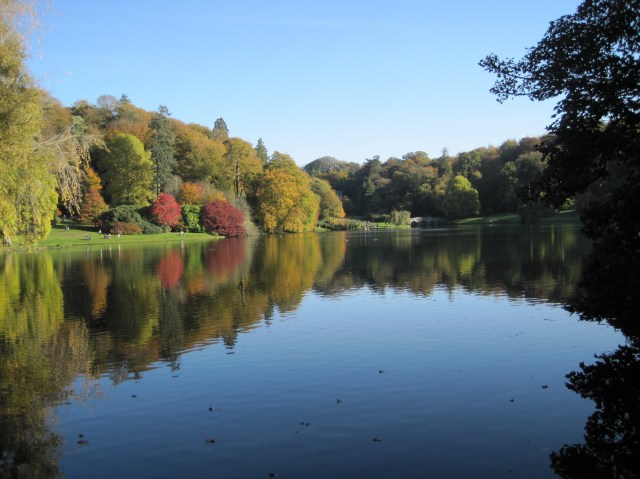
 “The Genius of the Place

The gardens at Stourhead, Wiltshire were designed by Henry Hoare II and laid out between 1741 and 1780 in a classical 18th-century design set around a large lake, achieved by damming a small stream. The inspiration behind their creation were the painters Claud Lorrain, Poussin, and, in particular, Gaspar Dughet, who painted Utopian-type views of Italian landscapes. It is similar in style to the landscape gardens at Stowe.

Included in the garden are a number of temples inspired by scenes of the Grand Tour of Europe. On one hill overlooking the gardens there stands an obelisk and King Alfred’s Tower, a 50-metre-tall, brick folly designed by Henry Flitcroft in 1772; on another hill the temple of Apollo  provides a vantage point to survey the magnificent rhododendrons, water, cascades and temples..

The lake is artificially created. Following a path around the lake is meant to evoke a journey similar to that of Aeneas’s descent in to the underworld…..The plantings in the garden were arranged in a manner that would evoke different moods, drawing visitors through realms of thought. According to Henry Hoare, ‘The greens should be ranged together in large masses as the shades are in painting: to contrast the dark masses with the light ones, and to relieve each dark mass itself with little sprinklings of lighter greens here and there.’”

Source: Wikipedia

Old School Gardener

Roses are one of the splendours of the gardens

Roses are one of the splendours of the gardens

The Peckovers – a quaker banking family – left behind them a secret gem of a house and garden in Wisbech, Cambridgeshire. This is one ‘banker’s bonus’ that can be shared by everyone.

Peckover House is said to be one of the finest Georgian town houses in the country. It stands proudly fronting the River Nene in this Fenland market town of 20,000 people. Originally built in 1722, the house was initially rented by the Peckovers in 1794, and purchased soon after. Jonathan Peckover had a grocery business and then moved into banking, setting up the first bank in Wisbech in partnership with the Gurney family- who later founded Barclays Bank. Peckover established a good reputation – it was said that during times of financial crisis the Peckover Bank was safer than the Bank of England!

Peckover House was initially called Bank House, reflecting the role of the house and it’s newly built banking wing. The property remained in the family for over 150 years, eventually passing over to the National Trust from its last owner, Alexandrina Peckover, in 1948.

The gardens – of around 2 acres – extend to the rear of the house and grew over the years as the family purchased ground from adjacent landowners. They also included a much larger estate extending to 48 acres, much of which today is used as playing fields and has some character-ful old trees. The Peckovers were also  keen collectors, and introduced a number of foreign plants into the garden. The gardens today maintain the basic layout from Victorian times –  including the old walls that used to mark the boundaries of adjacent properties.

The rear of the hous with the Croquet lawn in front- surrounded by some glorious trees such as the Tulip Tree (Liriodendron tulipifera)

The rear of the house with the Croquet lawn in front- surrounded by some glorious trees such as the Tulip Tree (Liriodendron tulipifera)

Step out into the garden and you feel as though you are back in Victorian times, as you move from one delightful space to another.

Once needing a team of 17 gardeners, todays gardening team of three is headed up by Allison Napier. She finds it difficult to single out her favourite part of the garden –  ‘It depends on the time of year’, she says. ‘In late winter and early spring the Wilderness Walk is full of the colours and scents from bulbs, Hellebores, Winter Honeysuckle, Christmas Box and an impressive Cornus mas. There is also the  fantastic trunk of an old Ginkgo which stands out and this with surrounding evergreens, deciduous shrubs and trees creates a strong framework.’

‘In spring the Orangery is a riot of colour and fragrance from the various bulbs and other spring plants all arranged in terracotta pots on the staging and if the flowering of the Wisteria on the front of the house coincides with the wall flowers in the various formal beds at their peak, then that is a wonderful spot.’
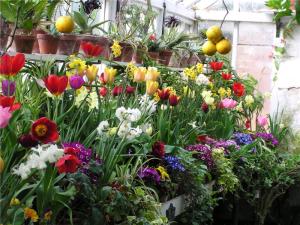
Inside the orangery- a heady mix of seasonal colour and fragrance

Inside the Orangery- a heady mix of seasonal colour and fragrance

And what about the summer The various rose gardens come into their own. There are over 60 species of rose here, many lovingly pruned and tied in every year over several metal pergolas and against walls. The area christened ‘Alexandrina’s Rose Garden‘ is a particular focal point.

But the show isn’t over yet. In late summer and autumn a ‘Red Border’ provides an array of warm colours and varied textures which are set off brilliantly against a golden privet hedge. This and an Autumn Border provide a glorious conclusion to the year. Jenny Windsor, one of the gardening team, loves these herbaceous borders and especially the contrast that they offer to other, more formal areas of the garden. ‘I love nothing more than to ‘have a play’ in the borders,’ she says –  ‘weeding, dead heading, tying in etc.’

Herbaceous borders

Herbaceous borders surrounding the Orchard Lawn with a fine old Quince tree

Many first-time visitors are surprised at the size and variety of plants in the garden. And, not surprisingly, they also commend the high standards of care maintained by the team.

Very few chemicals are used in the gardens and Allison finds that biological controls are effective in the glasshouses. As she says,

‘The healthy populations of beneficial insects, frogs and birds in the garden are testament to the ‘greener gardening’ policies we like to follow.’

The orangery (left) has rotten timbers and is due for a major renovation this year

The orangery (left) has rotten timbers and is due for a major renovation this year

The gardening team is well supported by local volunteers and a small number of trainees who come to gain practical horticultural experience (as I know, because I had the pleasure of being one last year!). Allison also thinks it important to encourage future generations of potential gardeners, so the team actively seeks school visits and has a Garden Club with students from the local grammar school.
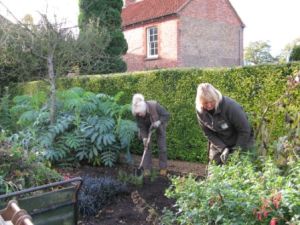
Gardeners Jenny and Janet digging over and mulching the 'Red Border'

Gardeners Jenny and Janet digging over and mulching the ‘Red Border’

What of the future? Well,the forthcoming restoration of the Orangery – with its 300 year old orange trees – is a major project due to get under way this year. Allison plans to complete work on the Conservation Plan for the garden this year, but it will be a major challenge working out the priorities and policies for the future, especially as the climate appears to be entering a very unpredictable phase affecting decisions about the range of plants to be used.

Still, the team seem to be a pretty content bunch, even though on occasions paperwork and ‘office stuff’ may get in the way of being outside and doing what they love. As Allison says, even the laborious turning of the compost heaps can sometimes be rewarding:

  ‘.. it gives you a good workout and you can find a surprising  number of lost hand tools!’

Gardener in charge Allison Napier- normally not sitting on the compost, but turnning it!

Gardener in charge Allison Napier- normally not sitting on the compost, but turning it!

Acknowledgement: thanks to Allison, Jenny and Janet, the Peckover Gardening Team for their contributions.

Quizzicals:

answers to the two on the post ‘Lock down- pros and cons of garden ties’

  • Hello Miss Black – Hyacinth
  • A punch up in the water – hydrophyte

Old School Gardener

If you’ve enjoyed reading this post and others on this blog, why not comment and also join some other people and sign up for automatic updates via email (see side bar, above right ) or through an RSS feed (see top of page)?


PicPost: Great Garden @ Wrest Park

‘After decades behind virtually closed doors, its treasures overgrown and largely unknown, English Heritage is reviving one of Britain’s largest and most important ‘secret gardens’ – Wrest Park in Bedfordshire.

This is a wonderful 90-acre historic landscape and French-style mansion which will take its rightful place amongst the country’s great garden attractions – and give locals and visitors to Bedfordshire a superb new day out.

Stroll in the recently restored Italian and Rose Gardens. Enjoy miles of reinstated historic pathways as you discover the garden buildings, pavilion and statues. Find out more about the garden and the people that shaped it, in our new exhibitions in the house and garden buildings.’

Source: Wrest Park website

Old School Gardener

PicPost: Great Garden @ The Garden House

‘The Garden House is the elegant former home of the vicars of Buckland Monachorum..(near Tavistock, Devon)…

The present building dates from the early 19th century and now accommodates the tearooms and conference centre. The history of this 8-acre garden is closely entwined with that of Buckland Abbey and the local church. In 1305 the Bishop instructed the Abbot to build a house for the parish priest and this site was chosen. At the dissolution of the monasteries, the abbot became the vicar of Buckland Monachorum and by the early 1700s, the vicarage consisted of a substantial 3-storey dwelling. The remains of this building, a tower with spiral staircase and a thatched barn, formerly the kitchen, are now the romantic ruins in the Walled Garden.

A modern vicarage was built in the 1920s and The Garden House was sold as a private dwelling. The house came onto the market again just after the Second World War and was purchased and given its present name by Lionel Fortescue, a retiring master at Eton, and his wife Katharine. Lionel was the son of a Newlyn school painter and had a good eye for colour as well as being an exacting plantsman. Lionel and Katharine immediately set about renovating and developing their garden whilst running a thriving market garden business, providing stock plants for growers in the Tamar Valley, and managing a herd of Jersey dairy cattle.

Over nearly 40 years, the Fortescues created a garden viewed as one of the finest in Britain. By 1961, they had established the Fortescue Garden Trust, an independent registered charity to which they bequeathed the house and garden to ensure the survival of this beautiful place for future generations. After their deaths in the early 1980s, ownership passed to the charity which to this day maintains the Fortescue’s lovely legacy.

The second phase of development took place under Keith Wiley who was appointed by Lionel and spent 25 years as Head Gardener. Keith took the 6 acres of paddocks to the far side of the road into cultivation from 1990, creating a series of gardens that take their inspiration from the natural world. Keith left in 2003 to concentrate on writing and creating his own nursery, Wildside Plants.

Matt Bishop is the present Head Gardener and he is particularly well-known for his expertise on snowdrops and bulbs. Matt’s brief is to care for and respect the legacies of his predecessors whilst ensuring, just as they did, that The Garden House remains a crucible of new ideas and new plants, at the cutting edge of horticultural excellence and innovation. He has undertaken a major refurbishment of the original Fortescue garden as well as ongoing maintenance in other areas to ensure a long opening season of glorious colour and variety. This has been an excellent opportunity to introduce many new plants whilst continuing Lionel’s principle of using only the best forms and cultivars avaialble.

Matt has two horticultural students under training here and a small team of dedicated staff and volunteers who care for the garden.’

Source: The Garden House website

Old School Gardener

Great Garden @ Gulbenkian Museum, Lisbon

‘Whenever I want to escape the hustle and bustle of Lisbon, and don’t want to travel far, I retreat to the gardens of the Calouste Gulbenkian Museum.

Covering roughly 17 acres, this beautifully landscaped garden contains a wide variety of well-established tropical as well as indigenous plants and trees that shelter subtly-appointed benches and seats. In the last few months a network of new, flat, winding paths has been opened through the garden.

There are picnic tables situated next to a lake where you can sit on bright winter days and soak up the sun, or watch the ducks with their fleets of ducklings enjoying the water in spring. At the weekends the gardens come alive with the sound of kids playing in the sunshine.

In the summer months, it is nice to disappear into this garden down one of the maze-like paths that snake through the shrubbery and to feel as if you are the only person in the world, surrounded only by birds scurrying around in the undergrowth or flitting in the trees. Somehow, the vast tree canopies manage to dull the sound of Lisbon traffic to the point you forget it is there and will also shelter you from the heat of the day.

The garden contains an open-air amphitheater where, during the summer, a programme of films or music events takes place in the evenings.

Whether on a hot, sultry summer evening or a bright, sunny winter day this garden is the perfect place to be and feel completely relaxed.’

Katy Pugh

Old School Gardener

Mother and child

On the outskirts of Harlow, Essex there is a garden full of beauty, peace and tranquillity – The Gibberd Garden. It is a wonderful place to stroll and be inspired. Every turn reveals another aspect or a work of art, for this garden was created by Sir Frederick Gibberd, the planner of Harlow New Town, who designed the garden and filled the grounds with sculptures, ceramic pots and architectural salvage from 1972 till his death in 1984.

The garden has many aspects – formal lawns, flower beds, a brookside walk with a waterfall, a wild garden with a tangle of paths where children love to hide, a gazebo with a formal pond, an island fort to defend with a drawbridge onto it, an arboretum of young trees, and, at the end of a fascinating and memorable tour, a tearoom with mouth-watering cakes, ice creams and refreshments.

Old School Gardener

hanging gardens

Anyone know where this is?

PicPost: Great Garden @ Great Dixter

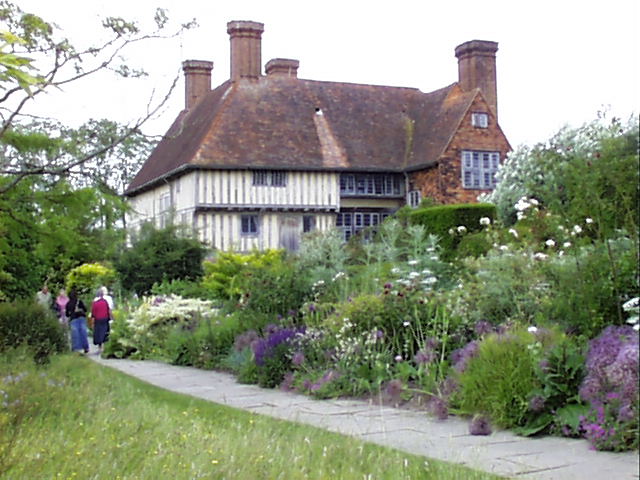
Great Dixter, East Sussex was the family home of gardener and gardening writer Christopher Lloyd – it was the focus of his energy and enthusiasm and fuelled over 40 years of books and articles. Now under the stewardship of Fergus Garrett and the Great Dixter Charitable Trust, Great Dixter is a historic house, a garden, a centre of education, and a place of pilgrimage for horticulturists from across the world.

The Master's Garden as it looked in the 1970's

The Master’s Garden as it looked in the 1970’s- evidence of food growing when ‘Beech House’ old people’s home occupied the buildings.

In the second of a series about the gardens at Gressenhall Farm and Workhouse Museum, Norfolk, I explain how the former Workhouse Master’s garden has been turned into a wildlife oasis.

During the 19th and early 20th centuries the Master of the workhouse looked down on the walled garden from his family accommodation. There is no evidence of what it looked like or what was grown here then, but during more modern times, when the Workhouse became an Old People’s home, it seems that the area was used to grow food (see photograph).

Today the area is used mainly as a wildlife garden and was the subject of a major overhaul a couple of years ago with financial support from the Big Lottery and Friends of the Museum (totalling £13,000) as well as donations from local nurseries and others. Originally created in the mid 1980’s the Wildlife Garden has been the subject of several awards, but as time passed, with fewer volunteers  able to maintain it, the garden was less attractive and the thugs of the plant world rather took over. The pond liner was punctured and the plastic safety cover and overgrown water plants were throttling what life did exist!

The Wildlife Garden before it's recent makeover

The Wildlife Garden before it’s recent makeover

All in all the garden was looking very sad!

After a review it was decided to improve access to the garden by:

  • widening one entrance and adding another and a new path
  • renovating and re-laying the existing circular path with new infill material between the slabs
  • relocating and enlarging the pond to make it a central feature of the garden
  • strengthening the different types of habitat for wildlife
  • providing some seating and a wheelchair bay
  • improving interpretation for visitors so that they can appreciate what is in the garden and why.
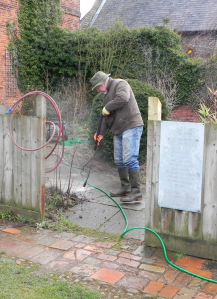
Cleaning the slabs that were later re-used

Cleaning the slabs that were later re-used

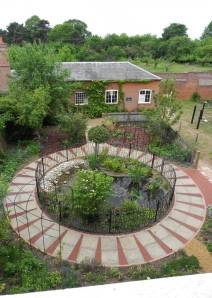
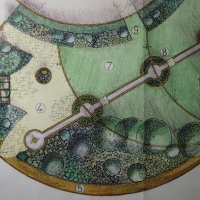
There is now a central pond (with shelved edges, a pebble beach and shallow water to act as portals for insects), and surrounding bog areas. Other habitats  are ranged on each side – a hot and dry gravel garden on the south facing side, a darker and damper shade garden towards the north-facing side. There are some other wildlife friendly features here such as bug hotels and bat and bird boxes which were originally installed in the 1980’s. There is a new attractive interpretation board encouraging visitors to look out for different types of wildlife, including the resident Newts (named either Nigel or Nigella- no one has got close enough to tell their gender!). I find it amazing how quickly amphibians, insects etc. have been attracted to the pond and surrounding areas, so that today a wide range of wildlife can be seen (if you’re patient and quiet).

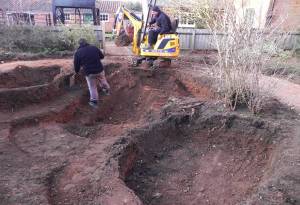
Excavating the new pond

Excavating the new pond

The new garden under construction

The new garden under construction

The new Wildlife Garden

The new Wildlife Garden

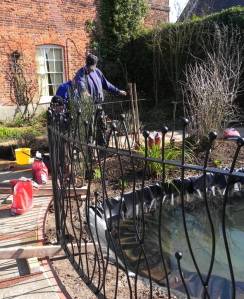
I designed and managed the project and with other volunteers put in the new plants and did some of the other renovation work. The main contractor for the new pond, borders and paths was Ian Chatten Ltd. and Kontorted Iron created the wonderful ‘organic’ fence around the pond, together with metal pergolas and an arbour– all in black wrought iron to link with other items in the Museum including the nearby old cattle- weighing machine, originally from Fakenham Market. The Gardening Team’s tool store and sheds are also ranged along one side. The arbour has taken advantage of an old ‘Rambling Rector’ rose growing in the corner of the garden – this has been pruned and tied around the frame of the arbour and provides both a wonderful sight and a romantic spot from where to view the garden in summer.

There’s also a  ‘Really Useful Patch’  of flowers, herbs and shrubs. Until very recently households had to be self-sufficient in flavourings, medicines, insecticides, cleaning products and so on. The plants in this garden were all used in the past by the housewife to keep her family healthy. The only other criterion for this area was that it was to cost nothing so all the plants have been grown from cuttings or division, or have been donated or ‘recycled’.

Installing the new wrought iron fence

Installing the new wrought iron fence

The new Wildlife Garden from the new entrance

The new Wildlife Garden from the new entrance

The coming season promises to see the planting and features mature further and hopefully the ‘critters’ will enjoy it too!

Quizzicals (courtesy of Les Palmer):

two more cryptic clues to the names of plants, fruit or veg…
  • The noise of a bird imitating a cat
  • How Australians describe English rock  

Old School Gardener (with thanks to Christine Walters for some of the photographs)

If you’ve enjoyed reading this post and others on this blog, why not comment and also join some other people and sign up for automatic updates via email (see side bar, above right ) or through an RSS feed (see top of page)?
Finding Nature

Nature Connectedness Research Blog by Prof. Miles Richardson

Norfolk Green Care Network

Connecting People with Nature

Discover WordPress

A daily selection of the best content published on WordPress, collected for you by humans who love to read.

Susan Rushton

Celebrating gardens, photography and a creative life

Unlocking Landscapes

Writing, photography and more by Daniel Greenwood

Alphabet Ravine

Lydia Rae Bush Poetry

TIME GENTS

Australian Pub Project, Established 2013

Vanha Talo Suomi

The Journey from Finnish Rintamamiestalo to Arboretum & Gardens

Marigolds and Gin

Because even in chaos, there’s always gin and a good story …

Bits & Tidbits

RANDOM BITS & MORE TIDBITS

Rambling in the Garden

.....and nurturing my soul

The Interpretation Game

Cultural Heritage and the Digital Economy

pbmGarden

Sense of place, purpose, rejuvenation and joy

SISSINGHURST GARDEN

Notes from the Gardeners...

Deep Green Permaculture

Connecting People to Nature, Empowering People to Live Sustainably

BloominBootiful

A girl and her garden :)