Category: Great Gardens


IMG_5527We had a very enjoyable walk around one of our local ‘haunts’ on Sunday – Sheringham Park, in north Norfolk. I think we can honestly say that we’ve visited this beautiful landscape in all weathers – I recall the children sledging down some of the steep slopes in the snow and also the time we took some visiting friends there in the pouring rain!  Fortunately the sun was shining and there wasn’t a cloud in the sky on this latest visit.

The Park surrounds Sheringham Hall (privately occupied), but Sheringham Park is in the care of the National Trust and is open for visitors. The Park was designed by the famous Landscape Gardener, Humphry Repton, who presented his proposals in July 1812 in the form of one of his ‘Red Books’ – he showed ‘before and after’ fold – out images to illustrate the differences his design proposals would make. He described Sheringham as his ‘favourite child in Norfolk’ and he is buried in Aylsham Church, about 15 miles to the south. At the time he was in his later years and his star was on the wane, but this Park is described by some as his most successful landscape design. Abbot and Charlotte Upcher bought the Estate in 1811, and successive generations of the Upcher family did much to develop it, as well as the Hall and the park, and also built a school.

The landscape has been moulded to make the most of the natural hills and vales (formed by glacial gravels). Many of the trees are now of a very mature age and there is some evidence of felling or ‘natural topple over’ as they near the end of their normal lifespans. The Trust has done much new planting and maintains the ‘wilderness’ feel of some areas, along with mature woodland with glades and pools, surrounding heathlands (with interesting views towards the restored North Norfolk Railway, the coast and North Sea), plus all the elements of the romantic landscape around the House and its setting.

The woodlands also contain a large variety of rhododendrons and azaleas. In the early 20th century Henry Morris Upcher obtained rhododendron seeds of various types from plantsman ‘Chinese’ Wilson. Many other species of tree and shrub are represented in the park, including fifteen kinds of magnolia, maples, acers,styrax, Eucryphia, Davidia involucrata and a fine example of the ‘Snowdrop Tree’,  Halesia. Several outlook towers and viewpoints provide good views over the park and of the nearby coast and surrounding countryside. Recently a new ‘Bower Garden’ has been created which provides a wonderful den building area, enclosed seating area and widllife pond which had many tadpoles, pond skaters and the like on our visit.

If you visit you’ll also have the benefit of an interesting exhibition about Repton and the development of the estate, a number of marked walks plus all the usual National Trust attractions – I particularly enjoyed some Stem Ginger Ice Cream!

Old School Gardener

If you’ve enjoyed reading this post and others on this blog, why not comment and also join some other people and sign up for automatic updates via email (see side bar, above right ) or through an RSS feed (see top of page)?

The afternoon sun in late winter falls across one of the gardens at Buckland Abbey

The afternoon sun in late winter falls across the Elisabethan Garden at Buckland Abbey

‘700-year-old home of Elizabethan seafarers Drake and Grenville

In the 13th century, Buckland Abbey was home to the Cistercian monks who built the abbey and the incredible Great Barn and farmed the then vast estate.

The Abbey, now a house with a combination of furnished rooms and interactive museum galleries, tells the story of how two seafaring adventurers – Sir Richard Grenville and Sir Francis Drake – changed the shape of the house and the fate of the country….

Our Abbey garden is mainly a 1950s design. The main border includes hydrangeas, camellias, eucryphias, azaleas, rhododendrons and our two magnificent magnolia trees: a delavayi species and a grandiflora.

The monks cultivated the walled kitchen garden behind our Cider House and it’s still as prolific as ever. Meander through the espaliered fruit trees and vegetables and admire the Abbey towering above.

Our beloved herb garden next to the Great Barn has had a tough time. It was once home to 50 different culinary and medicinal herbs but box blight wiped it out. We’re currently refurbishing it.

In 2001 we purchased the Cider House, which was turned into a private residence in the 1940s. This acquisition has brought the monastic estate back together and has allowed us to invite the public to visit the beautiful gardens, passionately created by former owners Michael and Sarah Stone. It includes mixed planted borders, roses and a large amount of trees and shrubs

We created our Elizabethan garden in 2001. It shows you what the garden may have been like when Sir Richard Grenville and Sir Francis Drake lived in the Abbey. There’s a wild flowery mead, cultivated hedges, changing flower displays and even a hidden garden just perfect for contemplating your next voyage, just like Drake.’

Source and further information:

The gardens at Buckland Abbey, Devon – National Trust web site

Old School Gardener

This beautiful tropical garden is  located next to the Palace of Belém (the Portuguese Presidential residence).  The 15 acre garden is a charming, yet often overlooked spot that has maintained a number of ponds, towering palm trees, and many hundreds of species of tropical plants that it had when it was created in the early 1900’s.  The Tropical Botanical Gardens (Jardim-Museu Agrícola Tropical) are also known as ‘Jardim do Ultramar’ (‘Garden of the Colonies beyond the Sea’) or ‘Jardim das Colónias’ (‘Garden of the Colonies’) as most of the plants come from old Portuguese colonies.

The entrance is an avenue created by huge California Fan palms and Mexican Fan palms, and on each side you can see several ‘living fossils’ – species that have not suffered any mutations for millions of years. On the left, Ginkgos, Dawn Redwood and Monkey-puzzle trees go back to the age of the dinosaurs. Close to the lake you can see Sago palms, native from Japan, and sacred figs from south east Asia, also known as the Buda tree. There is an oriental garden that shows off the Chinese Hibiscus.

Created in 1906 by royal decree (King D. Carlos I), and located in the grounds of a former zoo, it was opened in 1912, the presence of natural water influencing the choice of location. It sits on the slopes overlooking the River Tagus in Belem, one of the most interesting of Lisbon’s districts. It is one of three botanical gardens in the Lisbon area, the others being the Ajuda Botanical Gardens (also in Belem) and the Botanical Gardens near the Science Museum in central Lisbon.

The garden has rare tropical and subtropical trees and plants (many of them endangered species) from all over the world, such as Dragon Trees from the Canary and Madeira Islands and Brazilian Coral Trees. Most of them are labeled, so a visit here can also be a learning experience. It is a tranquil place regularly visited by leading international scientists and botanists. Its scientific work continues today and in its grounds you will find a seed bank, greenhouses, in-vitro culture laboratory and a xylarium (wood collection).

A highlight is the Macau Garden complete with mini pagoda, where bamboo rustles and a cool stream trickles. Young children love to clamber over the gnarled roots of a Banyan tree and spot the waddling ducks and geese.

It is a joy to amble along its palm – lined avenues and discover the grottos and ponds, the oriental garden and the topiary accompanied by the friendly birds. A welcome, peaceful, shady retreat on a sweltering summer’s day!

Other articles about Portuguese gardens:

Portuguese Gardens: Estrela Gardens, Lisbon

Oranges and Azulejos: Portuguese Heritage Gardens

Sources and further information:

Go Lisbon

aportugalattraction

Old School Gardener

If you’ve enjoyed reading this post and others on this blog, why not comment and join others by signing up for automatic updates via email (see side bar, above right ) or through an RSS feed (see top of page)?

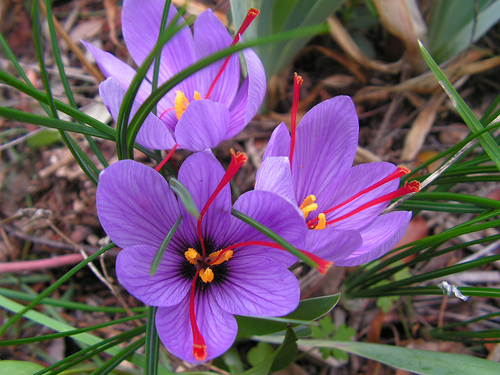
The Saffron Crocus (Crocus sativus)

The Saffron Crocus (Crocus sativus)

You will recall that our day out had begun promisingly at Anglesey Abbey in Cambridgeshire. After lunch we drove off (car roof remaining closed in view of the low cloud and short journey) to the town of Saffron Walden in north Essex. More specifically it is the chief town of the District of Uttlesford– I always think this sounds like somewhere you might find in ‘The Shire’ of Hobbit fame!

We’d been here a long time ago and then only driving through so didn’t really have a chance to explore it thoroughly. Here’s a link to Wikipedia’s entry on the town if you’re interested in its history. In brief it’s of ancient standing, there having been a settlement here long before the Roman occupation of Britain 2 thousand years ago. Of particular interest is the derivation of the town’s name. In the medieval period the primary trade in Saffron Walden was in wool, but in the 16th and 17th centuries the Saffron Crocus (Crocus sativa) was grown in the area. Each saffron crocus grows to 20–30 cm and bears up to four flowers, each with three vivid crimson stigma. Together with the styles, or stalks that connect the stigmas to their host plant, the dried stigmas were used originally in medicines, as a condiment, a perfume, an aphrodisiac, and as an expensive yellow dye. This industry gave its name to the town and what used to be Chipping Walden became Saffron Walden. The town itself retains many old buildings, interesting spaces and features, as you’ll see in the gallery at the end of this article.

We began our visit in a fascinating garden – Bridge End Garden. This is actually a series of seven interlinked gardens laid out by the Gibson family (eminent bankers and brewers) in the nineteenth century. They are Grade II* listed (so protected), close to the town centre and church and are open to the public each day free of charge. Careful restoration has replicated gardening techniques and designs typical of the Victorian era and has brought the garden back to its full splendour.

Though there are signs around stating that it is ‘not a playground’ and ‘ball games are not allowed’, I can see it can be difficult to prevent its use for play by the town’s children, some of which might get a bit over exuberant at times…. While we were there I was delighted to see a group of teenage boys playing ‘It’ around the different spaces and the hedge maze was also an obvious draw for local kids. These features in an original 17th or 18th century setting must surely have been used in a similar, playful way – if not by children then by adults! The Dutch Garden with its complex parterre of box bushes also looks so like a ‘mini maze’ (in fact hedge mazes developed out of the complex parterres in France, Holland and elsewhere across Europe), so it wasn’t suprising to see another sign, perhaps rather desperately, announcing that it isn’t a maze!

The gardens are maintained by a team of paid staff (of the Town Council, which also maintains a number of other public gardens) and volunteers, and are in a very good condition. A long winding path flanked by well – kept mixed borders leads you past the formal Rose Garden with views to the parish church beyond (apparently the tallest church in Essex) to the walled garden with its fence and wall – trained fruit trees and two glasshouses with miniature orchard and citrus fruit trees, respectively, in pots that look as though they are brought outside in warmer weather.

All around are little curiosities to intrigue –  statues of mock-snarling (or is it smiling) beasts, other classical statuary, some fine, mature trees such as a Cedar of Lebanon, a small summer house with a display of some curiosities from the garden (such as old gardener’s notes) and another gazebo called ‘Poets’ Corner’. The ‘Wilderness’, as it’s name suggests, was an area of more naturalistic planting (now with a developing Yew tunnel) and from the viewing platform at one end you can get a wonderful view of the Dutch Garden, with its swirling pattern of box hedging laid out to a design by Gertrude Jekyll, who visited the garden in the early 20th century.

Having seen a hedge maze, we went in search of one that is much older – and made of turf. At one edge of the town’s Common sits this wonderful example of a classical labyrinth (see my post on mazes and labyrinths for more information), of uncertain age, but several centuries at least as it was recut in the 17th century. This splendid feature is certainly a challenge to concentration and determination, being 1 kilometer long if you walk the full length of the winding brick path between the shallow turf mounding! Labyrinths are ancient features, adopted by Christianity as a way of encouraging meditation along the symbolic ‘journey of life’.

From here we passed by some of the medieval charm of central Saffron Walden, with their ‘pargetted’ walls (a technique that creates geometric patterns and pictures on the external render) and Market Square, and found a nice little Tea shop for our afternoon break. Unfortunately the west country ‘Saffron Cake’ appears not to be a local delicacy here, despite the town’s association with the spice! Instead portions of Strawberry Cheesecake and Millionaire’s Shortbread had to suffice! We finished our visit by looking round an old – estabslished Antique shop and the parish church of St. Mary- a superb example of a grand parish church built on wool – wealth (and latterly saffron – wealth). It has glorious glass, high painted wooden roof and stonework. Just as we were leaving this delightful town,  the rain began to fall – great timing!

Further information:

Plantax 5: Crocus- spicy herald of Spring

Saffron Walden Town Council website

Bridge End Garden- Uttlesford District Council website

Visit Saffron Walden website

Old School Gardener

If you’ve enjoyed reading this post and others on this blog, why not comment and join others by signing up for automatic updates via email (see side bar, above right ) or through an RSS feed (see top of page)?

The sun looked as though it might break through the low cloud, so we (that’s my wife Deborah and me), put the top down on the car and hoped (we’ve come not to expect any particular weather here in Norfolk, UK). Alas, the temperature hovered around 7 C all day, but it didn’t spoil our outing to Cambridgeshire and north Essex. Just over an hour’s drive away lies Anglesey Abbey, former home of Lord Fairhaven and now a National Trust – run house and garden.

I’ve featured the garden already on this blog under a ‘Picpost’ but didn’t really do it justice. So you can see a few more pics of it in the gallery below. We had a pleasant stroll along the Winter Garden walk with its fiery colours and varied textures, though it was noticeable how many evergreens showed evidence of ‘leaf scorch’ by the recent cold easterly winds – the Garrya elliptica was looking especially sorry for itself. At the end of this walk sits the old Lode Water Mill, where flour is still ground and sold to visitors – fortunately we arrived and ascended the steep wooden staircases just before a coach load of german youngsters (several of the boys must have been 6’6″ plus).

Winding our way along the old mill stream we found the House (as the name suggests some of the older parts were once an Abbey) and donning our paper over – shoes to protect floors and carpets, we meandered around this house full of eclectic decor and collections of this and that – including many things ‘rescued’ from other ancestral homes by Lord Fairhaven during the early 20th century. He certainly had a love of Windsor Castle as there is one and a bit large gallery rooms full of different paintings of the place from a number of centurires and angles. I was particularly impressed with the display of some of Lord Fairhaven’s clothes and especially his shoes which looked as new (and some would probably be back in fashion today). He had so many pairs, for different occasions, that they were hardly ever worn – so much for the idea that it’s just women who hoard footwear!

To be honest, this probably wasn’t the best time to visit Anglesey Abbey for the gardens – the display of Snowdrops is famous but was well over, and the late spring has resulted in only a few bulbs being out, most notably the wonderful purply- blue of Scylla in the woodland end of the Winter Walk as well as some Daffodils. The Dahlia beds of course were looking bare and the Roses will not be out for a good couple of months yet (assuming they catch up). Still, there is a lot of interest here, including the more formal landscape garden with its evergreen hedges and statuary and some lovely areas of woodland. We concluded part one of our day with a wholesome lunch of jacket potatoes and salad in the well-appointed restaurant on site. The sun had not broken through, but we didn’t mind – Saffron Walden and the promise of afternoon tea (and Saffron cakes?) beckoned…. return to read part 2 of our special day tomorrow!

Old School Gardener

If you’ve enjoyed reading this post and others on this blog, why not comment and join others by signing up for automatic updates via email (see side bar, above right ) or through an RSS feed (see top of page)?

PicPost: Great Garden @ Buddha Eden, Portugal

‘The Buddha Eden Garden is an area of about 35 hectares designed and conceived by Comendador José Berardo in response to the destruction of the Giant Bamyan Buddhas, sculpted in the rocks of the valley of Bamyan in central Afghanistan and which had for centuries been a cultural and spiritual reference.

Comendador Berardo was profoundly shocked by the attitude of the Taliban Government, which intentionally destroyed these unique monuments of World Heritage, considered acts of cultural barbarism which attempted to erase from memory the art of the late Gandhara period. In 2001, in response to this loss he initiated another of his dreams, the creation of an extensive oriental garden in honour of those colossal Buddhas….’

Source: Buddha Eden website

Entrance to the Estrela gardenFollowing my article about Portuguese Heritage Gardens, I thought I’d turn my attention to a few of my favourite public gardens in that country. I’m beginning with one of my real favourites, one I love to return to when I’m in Lisbon (not that that’s very often!).

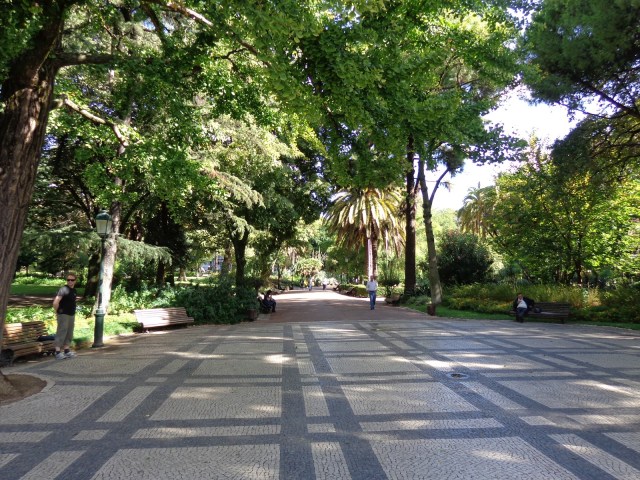
It’s the Estrela Garden (the Jardim da Estrela or Garden of the Star) which has a wonderful blend of exotic, artful, friendly charm with an atmosphere from the best of classic 19th century neighbourhood parks and gardens. It’s no surprise, then , that it remains as one of the most popular gardens in Lisbon. The orignal layout – 19th century romantic landscape style – features plenty of exotic plants and a central pond.
It is known officially as the Jardim Guerra Junqueiro (Junqueiro was a famous poet and politician who was a key figure in the downfall of the Portuguese monarchy and the establishment of the Portuguese Republic in 1910). In the 1840s the governor of Lisbon saw the need for a public garden in the densely populated city, and thanks to a donation by a wealthy baron, the governor was able to acquire the area  (5 acres) opposite the Estrela Basilica. Work on building the garden started in 1842 but due to the outbreak of war and financial difficulties, it didn’t open to the public for another ten years.

The gardens are laid out in a landscaped style with plenty of exotic trees, cacti, flower beds and a pond with fountains. The garden is especially popular with locals who come here during weekends to socialize, stroll along the paths, have a drink at the café, or play cards at one of the permanent tables among the trees.

The garden was designed by gardeners Bonard and João Francisco and it originally featured several romantic structures such as a gazebo and a Chinese pavilion. These structures are no longer there, but there are plenty of sculptures and a 19th century wrought iron bandstand, originally located at the site of the City’s main boulevard, Avenida da Liberdade. It was moved here in 1936.

After the creation of the Portuguese republic, several statues were installed in the park, the most expressive of which is of a farmer (sculptor Costa Mota,1913).  There is another of a female nude known as ‘O Despertar’ (sculptor Simões de Almeida).The most famous statue in the park is probably that of the Guardadora de Patos (keeper of the ducks) – a limestone replica of the marble original from 1914, it shows the protagonist of a popular fairy tale. Other statues include a dog spouting water from its mouth and 3 other busts depicting poets and an actor. More recent additions include a children’s playground and a pond-side cafe. The garden hosts the annual  Out Jazz festival – on Sunday afternoons during this time (usually May), Jardim Estrela will be alive with music and people enjoying the Sunday evening jazz in the open air auditorium.

Beyond the park is the English Cemetery, founded in 1717 and originally shared with the Dutch community. Novelist Henry Fielding, author of Tom Jones, died during a visit to Lisbon and is buried here.

Here are some images to let you get the feel of the place.

Source: A View on Cities

Old School Gardener

If you’ve enjoyed reading this post and others on this blog, why not comment and join others by signing up for automatic updates via email (see side bar, above right ) or through an RSS feed (see top of page)?

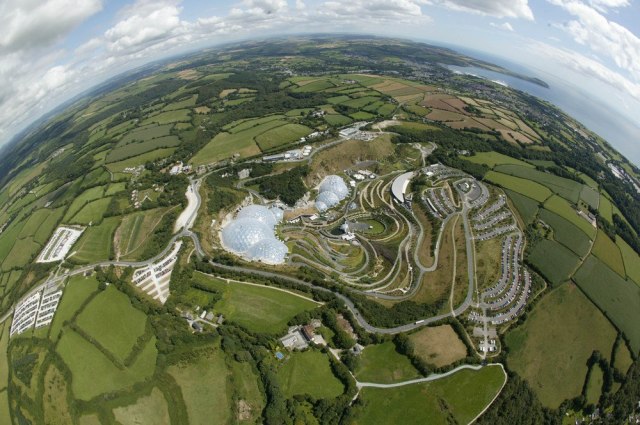
PicPost: Great Garden @ The Eden Project

‘The Eden Project does much more than offer a memorable day out in Cornwall. Eden is also a charity and social enterprise.

As well as creating stunning gardens and laying on fantastic arts and music events, much of our energy goes into:

  • running transformational social and environmental projects on our doorstep and around the world

  • creating unforgettable learning experiences for students

  • doing valuable research into plants and conservation

  • making sure we run our operations in the greenest possible way…’

Source: Eden project website

Picpost: Great Garden @ Alnwick Castle

‘The Alnwick Garden is being created by Jacques and Peter Wirtz, celebrated international garden designers from Belgium.

In design terms it is fair to say that The Alnwick Garden pushes the boundaries, and this is due in no small part to the Duchess of Northumberland herself, who has always believed that almost anything is possible if you get the right people involved. Her original concept was to produce a garden design framework and then to bring in the specialists, the experts, the best in their field, to ensure that each individual garden and concept was cutting edge in terms of both design and technology.

The Garden is a place where the imagination can run wild and the element of surprise is everything. This is created not just by the imaginative design of The Garden as a whole, but the attention to detail which is apparent in every aspect of it and of the many features it contains.Water is the lifeblood of this garden….’

Source: Anwick Garden website

Paco de Sao Cipriano

Paco de Sao Cipriano

The latest meeting of the Norfolk Gardens Trust focused on historic Portuguese Gardens. Postponed from earlier in the year due to bad weather, the talk – which took place at Norwich’s John Innes Centre – was again delayed, this time due to travel problems!

I can say that it was well worth the wait. In a lively talk, gardening writer Helena Attlee explored a ‘cocktail’ of influences that have formed the typical historic portuguese garden. A fusion of historical, cultural and climatic factors has come together over the centuries, with the latest fashions and ideas in garden design being reinterpreted in the unique setting that is Portugal.

The country straddles the atlantic coast of Iberia and so its climate ranges from the warm and moist in the north to the near Mediterranean in the south, with the rocky outcrop of Sintra (just north of Lisbon) providing a microclimate that is particularly prone to damp air deposited from atlantic fronts. These climatic variations have clearly influenced the design and planting of gardens in the country, but arguably of greater impact has been the country’s historical development.

The Romans invaded in around 200 B.C. and stayed for around 500 years. Not surprisingly the gardens from this time show the features you’d expect of a roman garden – enclosed by a colonnade with a central water pool as the focus and with grand mosaics. Though even here, it seems that particularly Portuguese touches are evident – for example the curved niches and planting islands found in the pool of a reconstructed example of a roman garden at The House of Water Jets, in Conimbra.
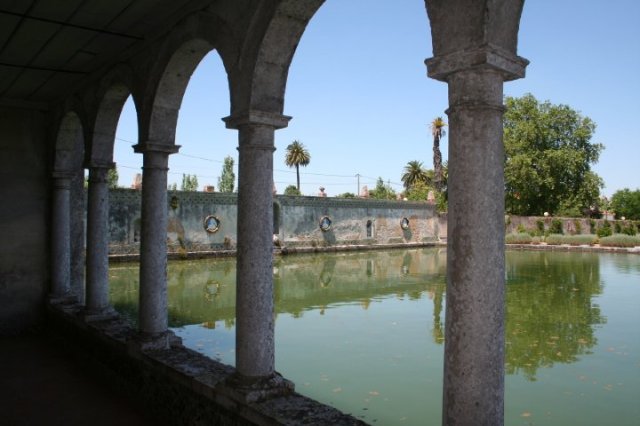
Quinta da Bacalhoa - the Water tank

Quinta da Bacalhoa – the Water tank

Possibly the greatest influence on garden design came from the invasions of arabs and other peoples from north africa – the so-called ‘Moors’. Arriving in the 8th century and remaining for about 400 years they brought with them the traditions of brimming water tanks, high walls to enclose the garden and capture the exotic scents of citrus fruit as well as decorated ceramic tiles – otherwise known as ‘azulejos’ in Portuguese. These citrus trees – bitter oranges and lemons – were introduced from the Himalayas, and it was some centuries later that sweet oranges were introduced into Europe – possibly by the italians (from india), or possibly by the Portuguese (from China).  Interestingly, up until the 20th century sweet oranges were known across europe as ‘Portugals’.

Azulejos at Quinta dos Azulejos!

Azulejos at  Quinta dos Azulejos!

Azulejos began as geometric or botanical designs and used a technique which trapped the coloured glazes in ridged areas on the surface of the tiles – the so-called ‘aresta‘ technique. They were used extensively to cover walls of gardens and buildings. The moorish aesthetic is also evident in the later patterning of box parterres which are more complex than the patterns seen in the grand gardens of France, Italy or Holland.

Even though moorish rule of Portugal ended in the 12th century, many of the skilled craftsmen stayed on and continued to influence garden and house design in the following centuries. However it was not until the growth of Portuguese economic power in the 16th century (based on its exploration and discovery of new lands and leading to the founding of the valuable spice trade) that grand Portuguese gardens started to flourish. Design ideas also travelled from the far east and were absorbed into the Portuguese style of the time – this was when complex parterres, citrus groves and water tanks came into their own, alongside further developments in azulejos. Initially imported from southern Spain by King Manuel I,  the tiles now moved away from repeat patterns of geometrical or botanical themes to assemblies of individual tiles into grand tableaux of  mythical and amusing scenes. The arrival of a new technique – Maiolica’– meant that glazes, and so pictures, could be painted directly onto the tile surface.

Complex parterres at Quinta da Bacalhoa, a superb example of an early renaissance Poprtuguese garden

Complex parterres at Quinta da Bacalhoa, a superb example of an early renaissance Poprtuguese garden. The area beyond was originally an orange grove

Following a period of rule from Spain, Portugal again found its independence in the early 17th century and this heralded a new period of rich garden making, with Delft blue tiles becoming fashionable (the Delft factory had a production line just for Portugal) and the creation of cartoon-like scenes (known as singerie) featuring monkeys and cats mimicking humans in scenes such as going to the barbers and taking piano lessons!

During the 18th century new colonial ventures in Brazil resulted in discoveries of gold and diamonds which fuelled another period of wealth, which once more found expression in the country’s gardens and houses. This second ‘golden age’ put Portugal at the forefront of europe’s economic powers, such that King Juan V was the richest monarch in the continent and could afford to order a solid gold bath for his mistress (who happened to be a nun)!

The dramatic well stairway at the Quinta da Regaleira, typical of the design work of Mannini

The dramatic well stairway at the Quinta da Regaleira, typical of the design work of Manini

This period saw influences from the Italian baroque make their mark in Portuguese gardens. Architects and designers such as Nasoni and Manini added a new flamboyance to the gardens of the wealthy and the latter in particular brought an opera set designer’s skills to create magical spaces where the rich could entertain. Further developments in azulejos also occurred during this period, with new, brighter colours and styles arriving influenced by the French Rococo. Some of these were to provide amusing Trompe d’oeil (visual tricks). The tiled canal at the palace of Queluz is perhaps the zenith of the azulejo. Here, candlelit tableaux lined the walls of the waterway, along which royalty and aristocrats glided by in their gondolas on warm summer evenings.
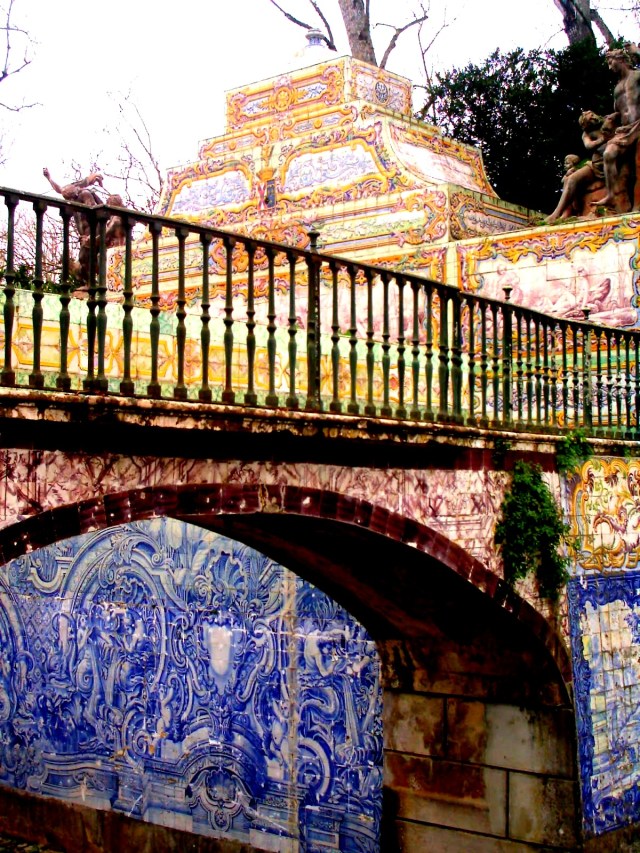
Azulejos lining the canal at Palacio de Queluz

Azulejos lining the canal at Palacio de Queluz

The Lisbon earthquake of 1755 (and ensuing fires and tsunami) wrecked huge areas of the city and its surroundings and so few great houses and gardens of the time inn tht area remained intact. A period of austerity followed during which the country’s Prime Minister, the Marquess of Pombal, removed many of the privileges of the rich aristocracy. Many of the gardens that remained fell into disrepair and few new ones of any note were created.

'Camellia Architecture' at Casa do Campo

‘Camellia Architecture’ at Casa do Campo

During the 19th century a new fashion for Camellia growing was born, centred on Porto and the north of the country where the moist warm climate favoured them. There is much evidence of the splendour of these gardens still in existence today, the Camellia bushes being trained into architectural shapes and even into ‘outside rooms’ which remained in flower between November and March when little else in the garden was of interest. During this time the discovery of new plants in far away places had its impact in Portugal as elsewhere and exotic specimens from Brazil and other countries were imported to some important gardens, including by British emigres involved in the Port trade. Further romantic – style houses and gardens were created, such as Montserrate and the National Palace of Pena at Sintra.

Parque de Serralves

Parque de Serralves

Perhaps not surprisingly, the talk concluded with a single example of a 20th century grand garden (Parque de Serralves), a rather ‘minimalist’ affair  featuring simple clipped box topiary and no other colours but that of the pinkish terracotta of walls and paths and the sky blue tiles lining rills and pools. Another garden (Casa da Pergola in Cascais, near Lisbon), originally created in the 19th century with a house that was renovated in the 1920’s gives a rather more modest ‘cottage style’ example of some of Portugal’s more modern gardens.

Casa da Pergola, Cascais

Casa da Pergola, Cascais

From my own knowledge, the 20th and 21st centuries have seen investment in public gardens and parks, which in their own ways are as important as the grand palace gardens of the earlier periods. I’ll be posting some information on some of my favourites over the coming weeks.

So, how to sum up Portuguese heritage gardens?

Well, as you can see they have absorbed and interpreted fashions, styles and ideas from other cultures and with the particular climatic, social and cultural conditions in the country have made them something uniquely Portuguese. Apart from ‘oranges and azulejos’ the other characteristic features seem to be:

  • Terraces

  • Trough or cavity walls filled with plants

  • Water tanks

  • Topiary, especially complex parterres

As far as planting is concerned, this tends to follow the local climatic conditions so features roses, succulents, palms and colourful annuals , especially in the hotter centre/south, whereas ferns, exotics and of course Camellias are common in the warm, moist north and around Sintra.

A public garden in Braga, northern Portugal.

The Garden of Santa Barbara, a public garden in Braga, northern Portugal

Sources and other information:

‘The Gardens of Portugal’ by Helena Attlee (published by Francis Lincoln, 2008)

Gardenvisit- Portuguese gardens

Article by Helena Attlee

Sheila Sim photography gallery of Portuguese gardens

Old School Gardener

If you’ve enjoyed reading this post and others on this blog, why not comment and join others by signing up for automatic updates via email (see side bar, above right ) or through an RSS feed (see top of page)?

Finding Nature

Nature Connectedness Research Blog by Prof. Miles Richardson

Norfolk Green Care Network

Connecting People with Nature

Discover WordPress

A daily selection of the best content published on WordPress, collected for you by humans who love to read.

Susan Rushton

Celebrating gardens, photography and a creative life

Unlocking Landscapes

Writing, photography and more by Daniel Greenwood

Alphabet Ravine

Lydia Rae Bush Poetry

TIME GENTS

Australian Pub Project, Established 2013

Vanha Talo Suomi

The Journey from Finnish Rintamamiestalo to Arboretum & Gardens

Marigolds and Gin

Because even in chaos, there’s always gin and a good story …

Bits & Tidbits

RANDOM BITS & MORE TIDBITS

Rambling in the Garden

.....and nurturing my soul

The Interpretation Game

Cultural Heritage and the Digital Economy

pbmGarden

Sense of place, purpose, rejuvenation and joy

SISSINGHURST GARDEN

Notes from the Gardeners...

Deep Green Permaculture

Connecting People to Nature, Empowering People to Live Sustainably

BloominBootiful

A girl and her garden :)