Category: GQT: your gardening queries answered


Amaryllis (Hippeastrum) 'Candy Floss'

Amaryllis (Hippeastrum) ‘Candy Floss’

This week’s question comes from a recent blog follower, Elena who lives in Bergamo, Italy:

“Yesterday I bought three big Amaryllis bulbs, any tips?! There was a Dutch flower stand in my city and I couldn’t resist!”

Elena, I can do no better than show this useful video of the way to pot these wonderful bulbs. After you’ve completed the potting up, place the pot in a warm, dark place and watch for signs of new leaves. Once these are showing, then place the pot in a bright, sunny, frost-free place indoors – a windowsill would do fine. Planted about now you should have some glorious colour at Christmas!

amaryllis christmasWhilst on the subject of keeping things frost-free over winter, there is one golden rule when trying to protect tender plants over the coldest months: don’t over water.

When temperatures are low, the great enemy of plants is dampness, as rot may set in. During very cold spells it is usually best to withhold water entirely. Plants that are dormant or resting should in any case be watered very rarely, perhaps just enough to prevent complete drying out. Plants with fleshy roots, and bulbs, corms, tubers, rhizomes and other storage organs must be kept quite dry and frost-free or they will rot. They should be stored in containers of clean, dry sand or gritty compost. If stored in a greenhouse, the atmosphere must also be kept on the dry side, and should be ventilated when the general temperature allows. If you have an extra cold spell and you can’t keep the air temperature up, you can protect your plants to some extent against frost damage by covering them with horticultural fleece, dry newspaper or ‘bubble wrap’ plastic anchored with stones.

dahlia tubers

Dahlia tubers are best lifted, cleaned off, dried and then stored in sand or gritty compost before significant frost

Old School Gardener

If you’ve enjoyed reading this post and others on this blog, why not comment and join others by signing up for automatic updates via email (see side bar, above right ) or through an RSS feed (see top of page)?

Pest or Pal?

Pest or Pal?

This week’s question is on an issue that I’m in two minds about. Lorne Bowles from Teddington asks:

‘On damp days in Autumn (and Spring) my grass becomes covered with earthworm casts. I’d like to get rid of them somehow. What do you recommend?’

There are many species of earth worms but only 3 of them make casts. Worm casts are a sign that you have a fairly active soil with good aeration and humus content. Earth worms are useful for mixing and aerating soil, but those which cast can create a muddy and uneven surface on grass and can also encourage weeds, as their casts make excellent seed beds!

Charles Darwin spent a lifetime studying worms, and estimated that up to 40 tons of worm casts per acre can be added to the soil (representing between 45 and 170 worms per square metre!). These casts are invariably richer, finer and less acidic than the surrounding soil, and contain around 50 per cent more calcium, nitrogen, phosphorus, potassium and bacteria.

Earthworm activity is encouraged if cuttings are left on the turf. Worms also pull fallen leaves and plant debris into their burrows and, in doing so, they add organic material to the soil, improving its structure as well as its fertility. For borders and beds, if you are short of compost, a mulch of leaves, preferably chopped up, will not only add structure to the soil, but will also dramatically increase the worm population and therefore the health and fertility of your soil. The use of alkaline or organic fertilisers and dressings can also encourage Worms in lawns. Monty Don tells an amusing anecdote about a grass tennis court which demonstrates worms’ love of alkaline soil:

‘A grass tennis court had been laid on acidic soil and marked out with chalk. Over the years, the calcium in the chalk neutralised the acid soil beneath it, making extremely narrow strips that attracted earthworms. Long after the chalk had been washed away, ‘runways’ made by moles attracted by their favourite food – earthworms – followed the line of them, without realising that they were mirroring exactly the original chalk lines of the court!’

This raises the topic of moles in lawns. A real issue for me here at Old School Garden, despite me trying to persuade the ‘little burrowers’ to take themselves next door. If you have moles, as the tennis court story indicates, this is a sure sign that you have worms in your lawn.

worm casts on lawn

Worm casts on a lawn

So what can you do?

Well one approach (but not one I’d recommend myself) is to try to deter the worms from casting using a fungicide. The law does not permit long life residual chemical build up in the soil, so gone are the days when formulations like Chlordane could be used to wipe out the worms (and possibly some gardeners too). However, Carbendazim is a chemical which is primarily used to deal with fungal diseases such as Fusarium but which also appears to interrupt the feeding of worms near the surface, by making the organic matter in which they feed unpalatable. Deeper feeding, non casting worms are apparently unaffected and continue to benefit the soil structure as normal.

Applying the chemical, which has a non hazardous classification, is said to be most beneficial in Spring and Autumn and must be carried out when the soil is already wet as it needs help in dispersing through the soil. However, be aware that whilst Carbendazim is approved for use in the UK and some other countries, some organisations argue that it is a dangerous substance.  Other options exist such as adding sulphur to the lawn, so reducing its alkalinity, and therefore reducing the attractiveness of it to worms. Manufacturer’s of this type of solution claim that this does not harm the worms or the soil.

However, I’d be a little wary of this, and other chemically – based solutions and try a more organic approach.

This does mean, however, that you’ll need to adopt a more relaxed attitude to worm casts (and mole hills, though it pains me to say so…). Worm activity, on the whole, is extremely beneficial to your lawn, so the best way to deal with the casts is to wait for them to dry and then brush them into the surface, spreading evenly with a Besom or similar broom. In doing so, you are adding to your lawn some fine compost and helping to improve its future appearance. There are also a few other things you can try to reduce the problem of casts:

  • Avoid leaving leaves on the lawn surface during the autumn and winter because this warm blanket of organic matter is an ideal ‘restaurant’ for the worms.

  • Do not allow a build up of thatch as again this decaying matter is digested by the worm which leads to casting deposits – so scarify your grass in the autumn and possibly also the spring.

  • Keep the grass at a reasonable height.

  • Avoid unnecessary watering as this attracts more worms. In dry weather the worms will move deeper, and by aerating regularly and ensuring good drainage, you will discourage activity.

If, like me you have a mole problem, I think the only safe, direct (but from experience, not necessarily successful) solution is to trap them, which might involve the services of a mole catcher unless you fancy a go yourself! I’ve found that other ‘solutions’ like noise/ vibration emitting devices seem only to have a temporary effect, if that!

Mole hills on the Old School Garden lawn

Mole hills on the Old School Garden lawn

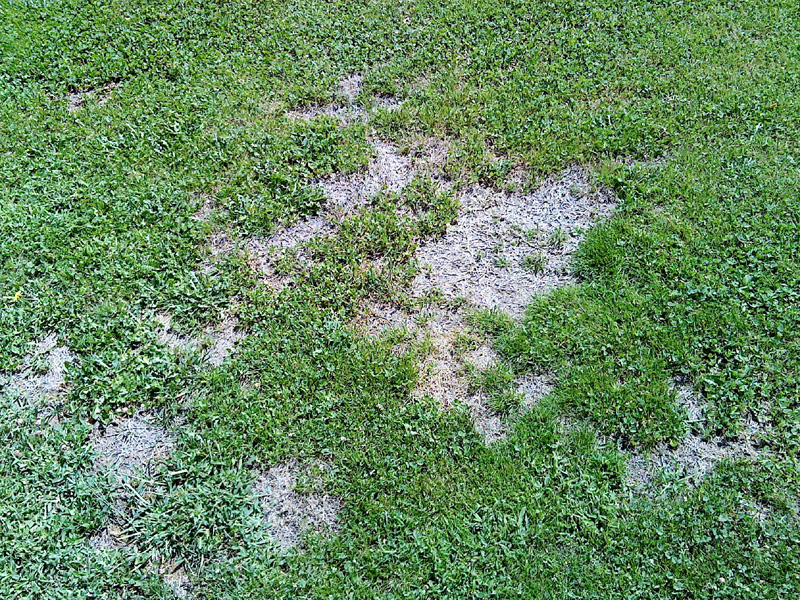
More generally, lawns are not attacked by pests, though you may at some point see the effects of the ‘Leather Jacket’ (the larva of the Crane Fly or ‘Daddy Long Legs’) and Chafer grub.

These can cause damage to the roots and stems of grass resulting in poor, stunted growth and bare patches. When a pest problem like this is suspected, the turf should be examined thoroughly to find the culprit. Pests are often found first in stressed areas, such as the edges of lawns or in shady or wet areas. They are not usually distributed evenly so it is advisable to look for spots that have discoloured, stunted or distorted turf. Insects tend to proceed outward from a central point; therefore they are generally most active on the outside edge. In both cases a lawn insecticide could be applied to kill the grubs/larvae….

Chafer Grub damage to grass

Chafer Grub damage to grass

However, an alternative, organic solution is to wait for heavy rain (or thoroughly watering any yellow patches in the lawn yourself). Then cover the affected areas with black plastic sacks and leave overnight. The Leather Jackets and grubs will come to the surface and can be collected in the morning and disposed of – or left to natural predators such as spiders and garden birds (especially Starlings). You could also use the biological control Steinernema feltiae, which should be applied while the ground is still moist and warm in late Autumn.

Old School Gardener

If you’ve enjoyed reading this post and others on this blog, why not comment and join others by signing up for automatic updates via email (see side bar, above right ) or through an RSS feed (see top of page)?

A rose trained along a rope 'swag' between posts provides a permeable divider in the garden

A rose trained along a rope ‘swag’ between posts provides a permeable divider in the garden

Regular readers may recall that I recently mentioned my plans to run a second Garden Design course at Reepham, here in Norfolk. I’m pleased to say that this has now begun and I’m looking forward to working with the 8 enthusiastic participants over the next few weeks to come up with designs and ideas for their gardens.

Coincidentally, I was also contacted recently by one of the students on the first course, Angela, who lives in a village nearby. She updated me on what she’s done in her garden since the course and was trying to arrange a meeting with her fellow students to share progress and ideas. She also asked for some advice. As this raised an interesting issue, I thought I’d share it with you as this week’s ‘GQT’. Her question is:

‘We took out a hedge last year between our vegetable garden and the lawn.  Most of the hedge area plus a bit of lawn is now a border, and we’d like to put in some sort of screen where the hedge was.  We don’t want a solid screen and were thinking of espalier fruit trees.  However, we do not need any more fruit trees and I think something of winter interest would be better.  Thoughts so far include Pyracantha or maybe Cotoneaster.  Do you think Pyracantha would work?’

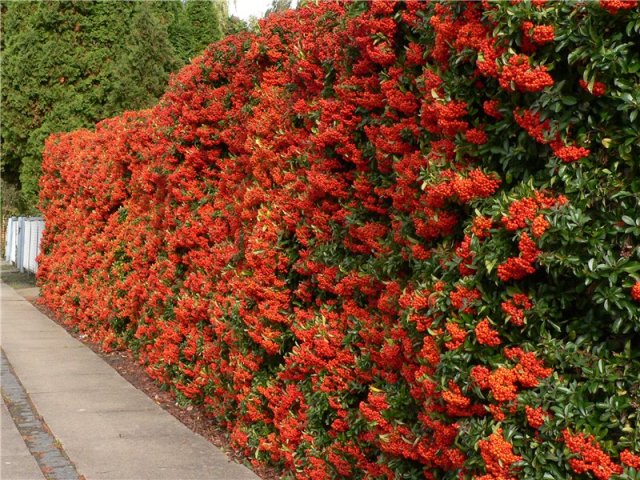
A Pyracantha hedge

A Pyracantha hedge

Well Angela, Pyracantha makes a lovely informal hedge, with spring flowers and autumn berries as well as evergreen foliage (see the picture above).

However the ones suitable for hedging can grow to 2 – 3 metres high (and can also be quite wide), so unless you keep it cut back it will provide a pretty dense and high screen, perhaps not what you were looking for? The Cotoneasters suitable for a hedge (e.g C. lacteus) have similar range of interest to Pyracantha and are also pretty dense and tall, unless kept in trim. But doing this rather defeats the object of an ‘informal’ hedge, unless you keep trimming to a minimal tidy up of loose ends!

If a more permeable screen is what you’re after, you could go for a backdrop of grasses that would add a lovely golden colour to a border at this time of year.

If they are in a sheltered spot they will stand tall and provide some winter interest (cut them to ground level in the spring); an example is Calamagrostis x acutiflora ‘Karl Foerster’. You could of course mix these along the line of the old hedge with evergreen shrubs (themselves with a variety of interest through the seasons). This would once again define the back of the border in an informal way, leaving ‘peep holes’ through the grasses into the garden beyond.

If you’re looking for something to provide a strong linear backdrop to your border but still give views through to the next garden, another idea might be to go for some sort of post and rail/rope structure (the latter is known as a ‘swag’- see the picture at the top of the article), or even a series of wide – opening trellis panels.

This then gives you the option of climbers to train up and along the wood/rope, but gives you views/glimpses through to what lies beyond. You could go for a mixture of climbers to give you a range of seasonal interest. Clematis of different varieties will give you flowers throughout the year, including winter flowers (e.g C. cirrhosa and its cultivars have winter flowers in creamy/ freckled shades and evergreen leaves). And some varieites give you other sorts of Autumn/winter interest. For example C. tangutica and it’s cultivars have some lovely ‘hairy’ seed heads that last into winter. Rambling/ climbing roses would also provide summer/early autumn flowers, followed by hips on some varieties. However, some of the Clematis (e.g cirrhosa) can get quite bushy so will need to be kept in check if you want to have views through – and the roses will also need pruning. Another option is to train a Pyracantha along a post and rail barrier to give you that ‘espalier’ effect you mentioned (see picture below).

Pyracantha coccinea trained along post and rails

Pyracantha coccinea trained along post and rails

Alternatively try one of the above options, but additionally introduce some winter interest directly into your border – e.g colourful stems from the various Cornus (Dogwoods), or foliage, flower and fragrance from any number of shrubs; e.g Daphne, Winter Jasmine, Eleagnus, Euonymus, various Viburnums etc.

Further information:

Hedge selector

10 AGM variegated evergreen shrubs- RHS

Hedge planting- RHS

All about Pyracantha

Related article:

GQT: Climbers as clothing… and as heighteners and dividers

Old School Gardener

If you’ve enjoyed reading this post and others on this blog, why not comment and join others by signing up for automatic updates via email (see side bar, above right ) or through an RSS feed (see top of page)?
Soil that you can make pots from is a challenge...

Soil that you can make pots from is a challenge…

Having ‘good’ soil is one of the most important elements in successful gardening, though some plants are well adapted to and actually prefer ‘poor’ soils. A good soil is especially important for growing food crops. The terminology and approaches to creating and keeping good soil can be confusing, as this week’s questioner illustrates:

‘My garden seems to have a very heavy clay soil. i want to know what to do to make it easier to work with and I’ve heard the terms like structure, texture and tilth – can you explain what these terms mean and advise me on what to do to improve my soil?’

So writes Lise B. Lowe from Hereford. Well Lise, a good way of summarising the different terms is:

Texture = the mix of different types of soil particle

Structure = the spaces between these particles

Tilth = the quality of the structure

The basic types of soil texture

The basic types of soil texture

Texture

Garden soils contain particles of varying size. Clay particles are minute and tend to clog together (which is why your clay soil is so heavy and difficult to work). At the other end of the scale, gravel consists of very large particles; this type of soil drains very easily and so is known as a ‘hungry’ soil. Between these two extremes will be found comparatively small soil particles, known as silt, and larger particles of sand. The majority of soils consist of mixtures of the different sizded particles. The proportions of large, medium and small particles in a given soil determine its texture.

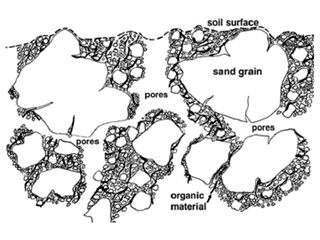
The components of soil structure

The components of soil structure

Structure

A soil has good structure if it contains a balanced range of particle sizes that provide air pockets of a size to accommodate the right amount of air and moisture for healthy plant growth; it drains well; and contains adequate humus (decayed organic material like leaves and stems which will not decay any further) and other organic material.

Tilth

When soil has been forked and raked and its clods have been broken down to a fine, workable structure it is said to have a good tilth. This quality is particularly important when small seeds are being sown, because it enables them to make good contact with the available soil moisture. Too fine a texture does not make a good tilth because such a soil’s surface will ‘cake’ (develop a hard surface or ‘pan’) in the first shower of rain. So working the soil (and adding different materials to it like organic matter, gravel , sand) produces different tilths, some suitable for seed sowing, others for establishing and growing on different plants etc.

With your heavy clay soil the best approach is to add lots  (and lots) of organic material such as compost, humus, manure so as open up the structure of the soil, making cultivation much easier. Autumn is an ideal time to do this, as once you’ve dug over the soil and incorporated organic matter, the winter weather should help to further break down the larger clumps of soil, making it easier to cultivate in the spring. Regularly adding organic matter before you sow/plant and as a a mulch during the growing season will continue to help improve the structure of the soil and add nutrients too.

Adding compost or other organic material to the soil by digging in or as a mulch is a must...

Adding compost or other organic material to the soil by digging in or as a mulch is a must…

If, on the other hand, your soil, like mine, is on the sandy side, adding organic matter can help with moisture retention and add much-needed nutrients to an otherwise poor soil. I tend to add lower nutrient material such as leaf mould in the Autumn and richer material like compost and manure in the Spring so that the nutrients these contain have less time to wash away and are readily available when plants need them most, as they burst into life. However, if your soil is really in need of improvement then add any organic matter in the Autumn and give it time to break down and blend with the soil. Of course the alternative approach, where possible, is to plant things that are suited to your soil, even if it’s on the ‘poor’ side!

However, you’re probably on to a winner by adding organic material, whatever your soil!

Different soil types

Different soil types

Further information:

Checking your soil condition

Soil structure and formation

The genesis of soil structure

Feed your soil not your plants

Old School Gardener

If you’ve enjoyed reading this post and others on this blog, why not comment and join others by signing up for automatic updates via email (see side bar, above right ) or through an RSS feed (see top of page)?

tin pot of daffodilsIt’s the time to begin planting many bulbs for flowering next spring. Narcissus, Crocus, Tulips and many more are now available in the shops and online. This week’s topical question comes from Justine Potts who lives in Bath:

“I live in the middle of town and have no garden to speak of. Can I grow bulbs in grow – bags?”

Bulbs are ‘ready – packaged’ plants that are very adaptable and so they can be used in many different ways. Growing  them in grow – bags is perfectly feasible. And just as you can have a double/treble layer of bulbs in a pot to give a longer floral effect, so you can do the same in grow-bags and other containers (though you migth be limited by the depth of the container). Among the Narcissi the old double yellow ‘Van Sion’ is early, cheerful and showy; ‘Armada’ is large, gold and scarlet; ‘Royal Orange’ is large, white and orange. among the tulips the Darwin hybrids in reds, yellows, oranges and white are very impressive.

Layering different types of bulb in a pot for long spring flowering

Layering different types of bulb in a pot for long spring flowering

As with grow bags if you grow bulbs in pots and similar containers it is important to have good drainage. So long as surplus water can soak away, bulbs should grow well in them. If you have raised containers on pedestals the plants might be blown about, so you should choose those that can put up with the wind, However even lilies are a possibility here; sturdy-stemmed types that can be tried include ‘Enchantment’ (orange flowers), L. regale (white), L. ‘Destiny’ (yellow). Daffodils in early spring and tulips a little later will give colour for weeks; in particular a double layer of daffodil bulbs planted in the autumn will give you plenty of colour. There are many suitable varieties:

  • ‘Tete a Tete’

  • ‘February Gold’

  • ‘Foresight’

  • ‘Armada’

  • ‘Rembrandt’

  • ‘Thalia’

Tulips could include:

  • ‘Red Riding Hood’

  • ‘Giuseppe Verdi’

  • ‘Toronto’

  • ‘Red Emperor’, and

  • early flowering doubles ”Electra’ and ‘Peachblossom’

Before you plant up bulbs in bowls think about what you will do with them afterwards. If you want to put them out in the garden it’s best to grow them in John Innes potting compost as this provides some nutrients that will feed the bulb and so increase their strength. If, however you discard the bulbs at the end of the flowering season you can grow them in bulb fibre which doesn’t contain these nutrients and will be cheaper. If you have your own supply of well – rotted leaf mould that would be just as good as bulb fibre – and even cheaper!

Hyacinths in pots

Hyacinths in pots

Further information:

Container gardening on Pinterest

Container growing with bulbs

Old School Gardener

If you’ve enjoyed reading this post and others on this blog, why not comment and join others by signing up for automatic updates via email (see side bar, above right ) or through an RSS feed (see top of page)?

dying dahlias 4This week’s question concerns some rather sad looking Dahlias (see picture), and comes from Jen Reteaj of Loughton, Essex. The plants are flowering, but the leaves have yellowed and then turned brown. It appears that some other nearby plants are also affected. Jen says:

‘It’s got quite serious as you can see from the pictures. I have sprayed, fed and watered them but still they die! Is it a virus?’

Dahlias can be prone to a number of diseases (and that’s what this is, I think). The pictures you’ve sent suggest that the stems are still green and looking healthy, so I’d rule out over – watering and consequently rot setting in. As you say you’ve been watering and feeding them so we can also probably rule out mineral deficiency of some sort. The browning of the leaves (if it’s occurred from the bottom and moved up the plant) sounds like a disease, probably fungal. The recent hot, and sometimes humid weather we’ve had is perfect for such problems. The only safe remedy is to remove the affected leaves for burning or disposal (not to compost). If there are some uninfected leaves left you might try to save the plant by watering only in the morning, so leaving the leaves dry into the night time. If the disease has spread throughout the plant (and your pictures suggest it has), I’d remove everything (including the tuberous roots and stems) and dispose as above.

The Dahlia was named after Anders Dahl (a swedish botanist), born on 17th March, 1751

For the future you might like to be aware of some common Dahlia disease and pest problems:

Ringspot- large, yellow circles appear on the leaves. This viral disease is transmitted by insects called thrips. it infects the dahlia’s roots and spreads throughout the plant. Gradually the rings on the leaves grow larger and brown spots may develop in the middle of each ring. It is not usually possible to treat the sick plant.

Dahlia Mosaic- this is another root-based viral disease. It gets its name from the alternating light and dark green patches that appear on leaves. These appear because the virus causes an imbalance in the plant’s chlorophyll. Yellow leaf spots and veining are also symptoms. The infection is usually spread by aphids and once infected it is usually very difficult to treat, so once gain you need to remove the plant and burn it.

Powdery Mildew – grey, fuzzy leaves that fall off is the symptom of powdery mildew. This is a fungal disease that infects dahlias when it is very humid, but it may also strike in dry weather. It is also more common in plants that are planted close together (restricting airflow). The disease can be treated with wettable sulphur once a week.

Insects- thrips are small flying insects that can destroy dahlia flowers by sucking out their juice as well as brining Ringspot. They can be controlled by placing sticky traps around the plant and spraying the plant with insecticidal soap (this also works well on controlling aphids). Leaf borers can also be a problem for dahlias. These tiny worms burrow into the stem and this kills the plant. The problem can be dealt with through applying a bacteria called Bacillus thuringiensis when watering – this kills the borers, but is safe for the plant.

‘The Dahlia you brought to our isle

Your praises forever shall speak

‘Mid gardens as sweet as your smile

And colour as bright as your cheek.’

            Lord Holland (1773–1840)


Further information:

Dahlia diseases

Dahlia Care

Old School Gardener

If you’ve enjoyed reading this post and others on this blog, why not comment and join others by signing up for automatic updates via email (see side bar, above right ) or through an RSS feed (see top of page)?

Image

Water Lily Beetle- image from Donsgarden.com

Today’s GQT comes from Adele Inwood from the lsle of Wight:

‘I have a new pool in my garden and I want to know how to deal with the main pests and diseases of pool plants please.’

Adele, the worst pest of pool plants is the Water Lily beetle- it’s larvae are like small slugs, dark on top and pale underneath. They feed on the leaves of water lilies.

The small brown beetles hibernate in the hollow stems of other aquatic plants, which should therefore be cut down in the autumn and burnt. You can control the larvae by laying a double thickness of newspaper over all the foliage from the first appearance of the pest (indicated by holes chewed through the foliage). If this is done in the evening and the papers removed in the morning, and the process is repeated at weekly intervals for at least four weeks, you should find that the beetle larvae will have been eaten by other water life.

Remove the worst damaged leaves. This method of control is also good for the reddish-black aphids which can seriously damage the leaves. Hosing off the aphids and beetles is also effective – but be careful not to add too much new water to the pool.

You might also see a thick green scum appearing on the surface of the pool. If the pool hasn’t been filled for a matter of only a few days or weeks, remove the worst of the scum with a fine mesh net. The scum – really an algae – appears after you change the water, before it settles down again. The presence of foliage on the surface will help to speed up the process by preventing light from getting to all of the water, stopping the formation of the algal ‘bloom’. So perhaps look at trying to cover more of your water surface with plants – about a third coverage is a good target.

Pond algae can be reduced by increasing leaf cover on the water surface

Pond algae can be reduced by increasing leaf cover on the water surface

Further information:

Water Lily Pests

Old School Gardener

If you’ve enjoyed reading this post and others on this blog, why not comment and join others by signing up for automatic updates via email (see side bar, above right ) or through an RSS feed (see top of page)?
purple_heather_pot

Topiarised Heather in a container

This week’s question is from Ivor Smallplot in Suffolk:

‘I have a small courtyard garden and wish to grow some shrubs in pots. What are the best varieties for this purpose, please?’

Heathers do well in pots, Ivor – even if your soil is rather limey (alkaline), you can provide an acid soil in the containers and so grow the summer flowering varieties. All the Hebes (shrubby Veronicas) are happy in pots, as are the less vigorous Berberis – but mind the thorns!

For winter colour plant the evergreen Euonymus, especially the delightfully variegated ones such as ‘Emerald Gaiety’, ‘Aureopictus’ and ‘Silver Queen’. New Zealand Flax (Phormium tenax) is also a good looker with its long, narrow leaves in many colours, as are Yuccas, with their rosettes of long needle-pointed leaves.

Further afield in the garden, you might want to grow shrubs that are especially attractive to bees. If so try flowering currants (Ribes) and goat willow (Salix caprea) for early flowering. Later in the year there are many shrubs to choose from including the ever popular ‘Butterfly Bush’ (Buddleja davidii), Californian Lilac (Ceanothus), Firethorn (Pyracantha), Lilac (Syringa), Gorse (Ulex) and Daisy Bush (Olearia).

Ceanothus jepsonii

Ceanothus jepsonii

Old School Gardener

If you’ve enjoyed reading this post and others on this blog, why not comment and join others by signing up for automatic updates via email (see side bar, above right ) or through an RSS feed (see top of page)?

Tomatoes-on-the-bushA timely question from gardener, D. Light of Little Blight about tomatoes this week:

‘When should I ‘stop’ my tomatoes?’

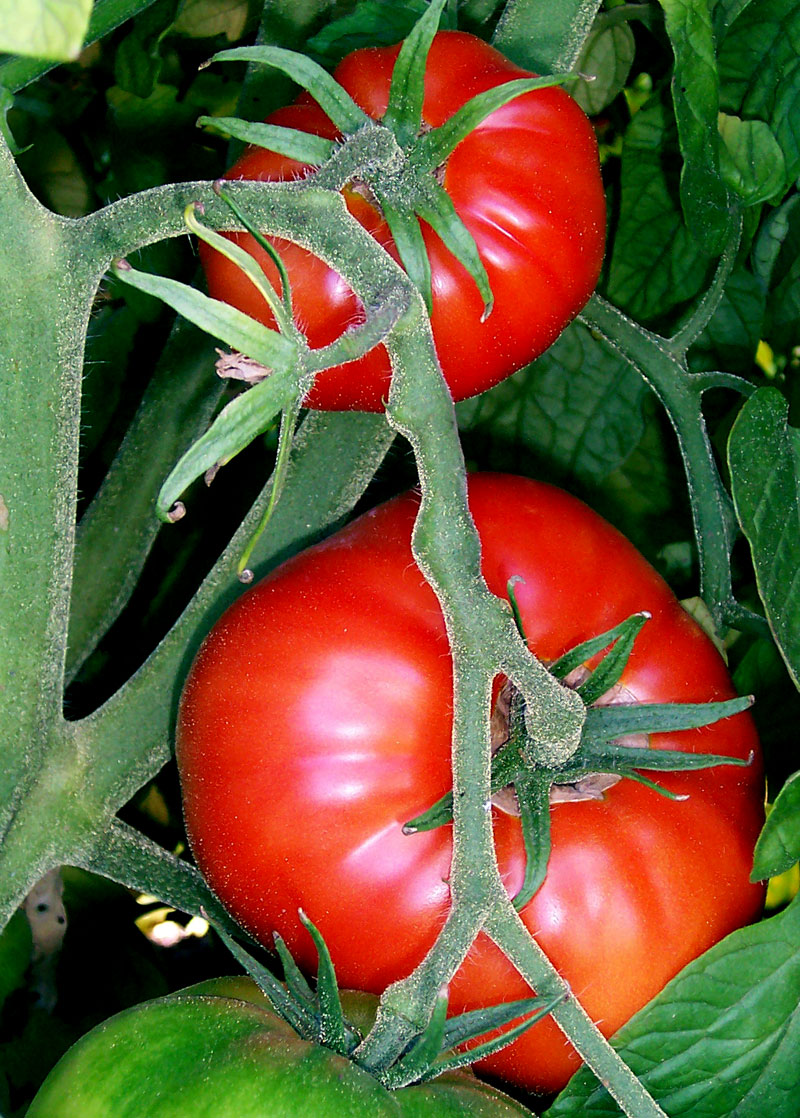
‘Stopping’ tomatoes refers to the nipping out of the growing point about two leaves above the top flower truss. This concentrates the plants energies into maturing the remaining trusses of fruit before the cold weather comes.

  • Outdoor tomatoes are usually stopped after three trusses in the north of the UK, and about four or five in the south. This probably means about now (early August) or possibly slightly earlier.
  • Indoor tomatoes are stopped after seven or eight trusses– or if they are growing well, you can leave them until there’s no more room in the greenhouse!

It’s also worth remembering to continue to nip out the side shoots that grow between the angle of the leaves and main stem (only on those grown as cordons/climbers and not necessary on bush tomatoes). And as trusses of fruit start to mature from the bottom up, progressively cut off some of the foliage to allow light and air in around the fruit to help ripening and reduce the chances of disease.


Well, that’s ‘stopping’. At this time of year it’s also possible to restart the growth of spring and early summer cabbages.

When you cut the cabbage head, leave the stalk in the ground and cut a shallow cross about 6mm deep on the top of it. Provided the ground is fertile and there’s plenty of moisture, several buds will appear below the cut and develop into cabbage heads by late summer. As many as six new cabbage heads may be produced, crammed tightly together on the old stalk!

Old School Gardener

If you’ve enjoyed reading this post and others on this blog, why not comment and join others by signing up for automatic updates via email (see side bar, above right ) or through an RSS feed (see top of page)?

Griselina littoralis- a good seaside hedge

Griselina littoralis- a good seaside hedge

I’ve had a few queries about hedges recently and this one, from Robert Galbraith is my choice for this week’s GQT:

‘We live in a bungalow near the seashore in Sussex, where the soil is rather sandy. Could you suggest some suitable hedging plants to give our garden a bit of privacy, please?’

There is quite a wide choice of suitable plants Robert. You could go for Grisselina littoralis which has thick yellowish – green leaves forming a dense, solid hedge if formally clipped and will grow in most soils. Escallonia ‘Langleyensis’, with red flowers in June – July is often grown in seaside locations and has glossy evergreen foliage. Other varieties are E. macrantha with deep red flowers in June – September and E. ‘Slieve Donard’ with large pink flowers in June- August.

Sea Buckthorn (Hippophae rhamnoides) has silvery grey foliage and orange berries (if both male and female forms are grown). Tamarisk pentandra has feathery flowers in August whilst the form T. tetranda is May – flowering.

Euonymus japonicus, with evergreen shiny leaves is also available in variegated forms which can withstand close clipping as does the shrubby honeysuckle Lonicera nitida with small golden – green leaves.

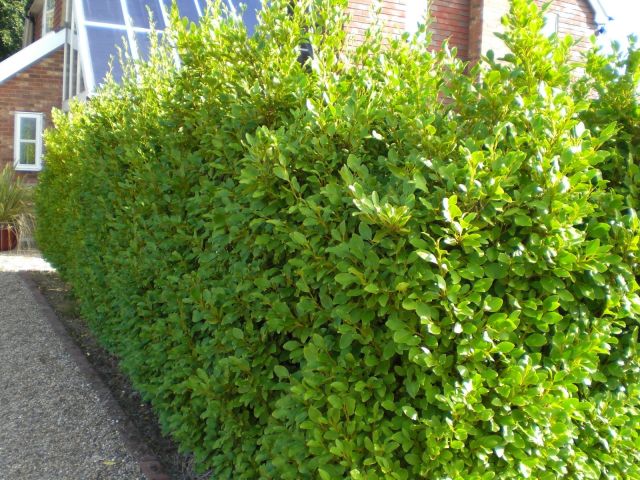
More generally, and not necessarily suitable for a seaside home, the best ornamental evergeen hedges for formal training and clipping are Yew and Holly. Box is also suitable, but is very slow growing and expensive so is best kept as low hedging (up to about 1 metre tall) or feature, perhaps topiarised, bushes. Hedges of Cypress and Cherry Laurel are also good for an evergreen barrier and Privet, provided it is trained correctly from planting, will supply a satisfactory semi-evergreen barrier.

Cherry Laurel

Cherry Laurel

Old School Gardener

If you’ve enjoyed reading this post and others on this blog, why not comment and join others by signing up for automatic updates via email (see side bar, above right ) or through an RSS feed (see top of page)?

Finding Nature

Nature Connectedness Research Blog by Prof. Miles Richardson

Norfolk Green Care Network

Connecting People with Nature

Discover WordPress

A daily selection of the best content published on WordPress, collected for you by humans who love to read.

Susan Rushton

Celebrating gardens, photography and a creative life

Unlocking Landscapes

Writing, photography and more by Daniel Greenwood

Alphabet Ravine

Lydia Rae Bush Poetry

TIME GENTS

Australian Pub Project, Established 2013

Vanha Talo Suomi

The Journey from Finnish Rintamamiestalo to Arboretum & Gardens

Marigolds and Gin

Because even in chaos, there’s always gin and a good story …

Bits & Tidbits

RANDOM BITS & MORE TIDBITS

Rambling in the Garden

.....and nurturing my soul

The Interpretation Game

Cultural Heritage and the Digital Economy

pbmGarden

Sense of place, purpose, rejuvenation and joy

SISSINGHURST GARDEN

Notes from the Gardeners...

Deep Green Permaculture

Connecting People to Nature, Empowering People to Live Sustainably

BloominBootiful

A girl and her garden :)