 To Walter Degrasse
Dear Walter,
Well, a busy month this one, and I’m pleased to say that one or two big projects have moved on a pace.
Though I’ve made some inroads into digging over the borders and getting seedlings going, these two things are suffering somewhat as I spent most of the available time (dodging windy, cold and wet weather), making progress in the pond garden and to an extent preparing the ground for my new shed (you might recall that I have a supply of old floorboards that I’m planning to use for this and acquired some cedar shingles for the roof).

The new area for an extended shed- and an attempt to keep nettles at bay!
I’m pleased to say that after many sessions of earth removing (I must have shifted ten tons or more), I finally got the underlay and liner installed and some of the major features on their way; stepping-stones, a waterfall and rockery (made out of flints given to me by my neighbour and some old valley tiles) as well as a sitting terrace with a four pole and rope swag along which I plan to train a couple fo yellow roses and some purple clematis.
I’m just at the point of finishing off the surround and path on one side and then putting in some gravel and stones to create a couple of shallow beach areas, before planting it up. I’ve got hold of a good supply of plants from a local nursery as well as things people have given me, some existing plants I want to move as well as some form seed, so it’s getting to that exciting part of ‘clothing’ the garden structure! I’ve also created a small bog garden at one end so that I can grow marginals/wet loving plants there as well as on some shelves I’ve created round the edge of the pond. I’m also looking forward to getting my waterfall going- I’ve bought a solar-powered pump to supply the water.
The mound I’m creating to overlook the fields and church has grown considerably with the rest of the pond spoil, so this should be quite a feature once its settled. I’ve made up the new bench we were given by Deborah’s mum and put this in the kitchen garden, so the bench that’s currently there will be transferred to the mound. ~And i’m well on with restoring the other, old rustic bench we were also given by Deborah’s mum- painted cherry red with dark brown wooden seating and back. It should make a great focal point in the pond garden. I’ve also re used the three or four Cotoneaster bushes I eventually dug up from in front of the house (the area where we hope to have the paint stripped back)
This was some feat of brute strength in the ned, but I’m pleased it’s now fully cleared, and I can give some thought to what to put in here after the works have een completed.
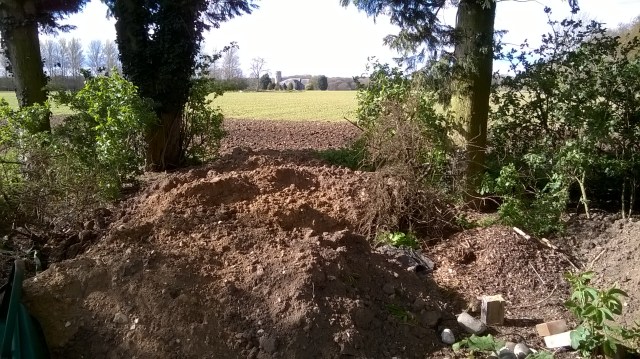
The mound grows!
Elsewhere in the garden there are plenty of tulips and other spring flowers on display, but I keep seeing the weeds in the main borders and know its unlikely I’ll get to them anytime soon; the pond needs finishing off and next week we are off to the Isle of Skye and Glasgow for about ten days. I’ll try to send some blog posts and pictures while I’m there, as I’m sure there’ll be plenty of horticultural and nature interest (as well as the Talisker Distillery of course!).
In the kitchen garden, things are fairly well organised and up to speed; I have planted my first and second early potatoes, some celery and leeks. I have some seedling Calabrese plants in the greenhouse and we continue to enjoy last years’ planting of purple sprouting broccoli as well as the first very sweet pickings from the forced Rhubarb!

Tomatoes and others under way in the greenhouse…

Strawberries coming on…

potatoes in….

first rhubarb pickings..what’s left!

Raspberries tied in and mulched
A couple of days ago a neighbour made me a very generous gift of a shredder/chipper and home-made collection box. though unused for a while I understand it does work, so I’ll perhaps get it fully serviced before I use it. It will make shredding material for the compost heap and paths etc. a whole lot easier and will mean I don’t have to light quite as many bonfires.

The new shredder…where to store it?

A couple of flowerpots short of a full house- these will display a range of pelargoniums in the courtyard

Hostas putting on new, beautifully fresh foliage

and the bug hotel put in place- i need to secure the contents!
So, this month, old friend , it feel’s like I’m getting somewhere, notwithstanding that lingering guilt at letting the borders get out of hand.. for now.
I hope that you and Lise are well and enjoying the spring- such as it is so far!
Old School Gardener

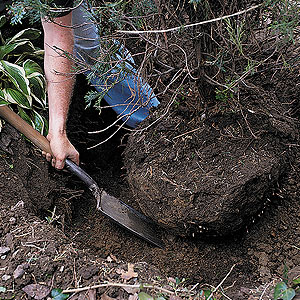 Deciduous shrubs should be moved while dormant, and evergreens in September/ October, or March/April. Dig a small trench around the shrub so that you can get your spade underneath, and lift out a good-sized root ball. To compensate for the damage to the roots, prune back the top growth of deciduous shrubs by 25 per cent to reduce trasnpiration from the leaves. Evergreens should not be cut back, but they will benefit from protection form cold, drying winds. Spray with an antitranspirant spray, sold as Christmas tree spray.
 Plant Close
 ‘There is great healing power in digging. This is so much the case that one is tempted to wonder if any actual electrical power comes up to one from the earth. Perhaps the benefit is merely from the rhythmic movements of the body. At any rate, however sulking and rebellious one may be at the start, sesitiveness creeps up the fork into hands and body and legs. Finally the brain surrenders and one is again at peace with the garden.’
 Save time removing old, browning conifers by transforming them into a new garden feature by pruning.




 Growing climbers against boundaries or internal screens adds interest to a hard or unattractive surface, and is the best use of space in a small garden. choosing the right plant for then right site is the key to minimising work; in particular, you will need to consider the plant’s eventual size, and its preferred aspect.


 When choosing a tree for a garden, take care; a large tree in a small garden will lead to problems in years to come. It will dominate the garden and put it in shade. So, unless you have a large garden, avoid large ornamentals, such as Cedars, the Tulip Tree (Liriodendron tulipifera) or Prunus ‘Kanzan’, and woodland trees, such as Oak, Beech and Horse Chestnut.


 If a plant lacks certain nutrients, it will look unhealthy- with pale of yellowing leaves, stunted growth or withering stems. In general, sick-looking plants are suffering from more than one nutrient deficiency. However, it can be difficult to identify which deficiencies a plant is suffering from, because there are so many different types and symptoms can vary from plant to plant.




 Old School Garden