Category: Gardening techniques


redcurrantsIt’s the time of year to harvest red currants around here and this week’s question comes from Frew T. Bunn of Oldham:

‘Our red currant bushes always lose their leaf colour in July or August, but the ribs of the leaves always stay green – are they suffering from some sort of disease?’

By the summer months red currant bushes are starting to lose their lustre, but the fact that the leaf ribs of yours remain green suggests a shortage of Magnesium, one of the ‘trace elements’ of importance to plant health. Commercial ‘Epsom Salts’ applied in the spring at around 65 grammes per square metre should improve matters, so try this next year.

My blackcurrants look like they'll give a good crop again this year

My blackcurrants look like they’ll give a good crop again this year

On the subject of currants, my black currants are dripping off the three bushes I have here in Old School Garden, and the family of blackbirds nesting in the courtyard is relieving us of some – literally pecking them through the netting of my too – small fruit cage!

Have you ever thought of growing white currants?

They are apparently not difficult to grow and seem to have returned to favour in recent years. Like red currants (and black currants) they fruit on old wood. ‘White Versailles’ is a popular and reliable early variety, the first white currant to crop. It produces a heavy crop of large, shiny, soft pale yellow/white berries in long heavy trusses during mid-late summer. The fruit is deliciously sweet, not as acidic as red currant, so is great for eating fresh or using for a wide range of culinary purposes. White Versailles has a vigorous, upright bushy growth habit with attractive arching canes and serrated three lobed pale green leaves. It is a very reliable cropper year after year, is self fertile so you only have to grow one bush if you want to – eventual height and spread: 1.5m (5ft).

I’m thinking that I might reorganise my bush fruit cage and substitute one of the three blackcurrant bushes with a white currant, just to get a bit more variety and perhaps less of a storage problem, with the glut of black currants we’ve had in the last couple of years!
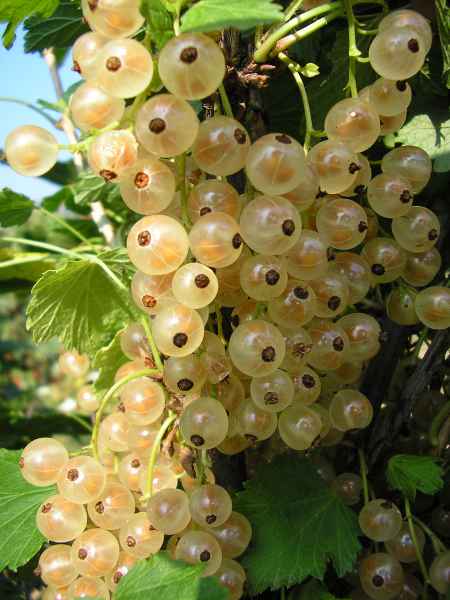
'White Versailles' - I thinki I'll try to get hold of one of these to replace one of the blackcurrant bushes

‘White Versailles’

Old School Gardener

If you’ve enjoyed reading this post and others on this blog, why not comment and join others by signing up for automatic updates via email (see side bar, above right ) or through an RSS feed (see top of page)?

Keep the bird bath topped up in hot weather

Keep the bird bath topped up in hot weather

Well, yesterday was St. Swithin’s day and folk lore decrees that the weather on that day sets the pattern for the next 40, so we can ‘look forward’ to days in the mid to upper 20’s Celsius (and warm nights too):

‘St. Swithin’s day if thou dost rain
For forty days it will remain
St. Swithin’s day if thou be fair
For forty days ’twill rain nae mair.’

dost = does
thou = you
nae mair = no more.

And the forecasters seem to be saying this hot weather is likely to continue for the next couple  of weeks at least. So how can we care for the fragile eco systems that are our gardens? It’s all about moisture- using it wisely, keeping it in place in the plants and making sure wildlife has enough to survive. Here are 7 tips that might help:

1. Apply a mulch around plants that are most sensitive to water loss – grass clippings are ideal as they are light reflective (though you might well not have many that are usable in a heat wave- see tip 5 below). Straw is another option.

grass_mulching_tomatoes tiny farm blog

Grass mulching tomatoes from  tiny farm blog

2. Water your garden early morning or late evening (ideally from your own saved rainfall or ‘grey water’ forom the house) – morning is best as the plants need most of their water during the day time when they are growing. Leave a bucket or watering can full of water inside the greenhouse to help keep up humidity and so reduce the rate at which plants lose water through transpiration.

3. Get creative about shading your tenderest plants and crops – use shade netting, cloth, or fleece and maybe even think about using picnic awnings, table parasols and even tent poles with bedsheets!

movable awning

Movable awnings can bea useful shade for tender plants

4. If you need to plant out seedlings try to plant them alongside taller neighbours to help provide some protection, or even better hold off transplanting until the weather is more suitable – you can better care for seedlings in a container if you remember to water and shade them (and pot them into bigger pots if need be).

5. If you haven’t already stopped mowing your lawn then do so and leave at least 5 – 8cms of growth to help conserve moisture.

6. Avoid adding fertiliser to your ground as plants don’t need it in the heat as their growth rate slows.

7. Look after the wildlife – top up ponds, bird baths and drinking bowls for hedgehogs etc. and put out some food for these critters too, as it will be harder for them to find natural food like worms which bury themselves deeper into the ground.

Here’s hoping you and your garden survive the heat – how long before we Brits are hankering after a ‘traditonal’ Summer!

Old School Gardener

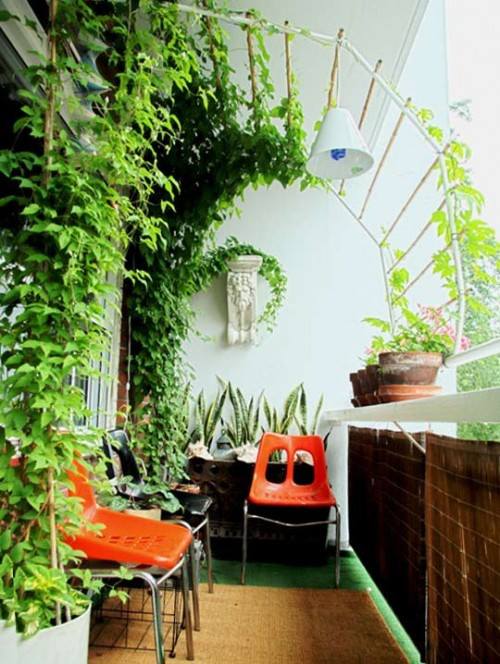
PicPost: Balcony

PicPost: Terracing your sloping ground

from Growveg

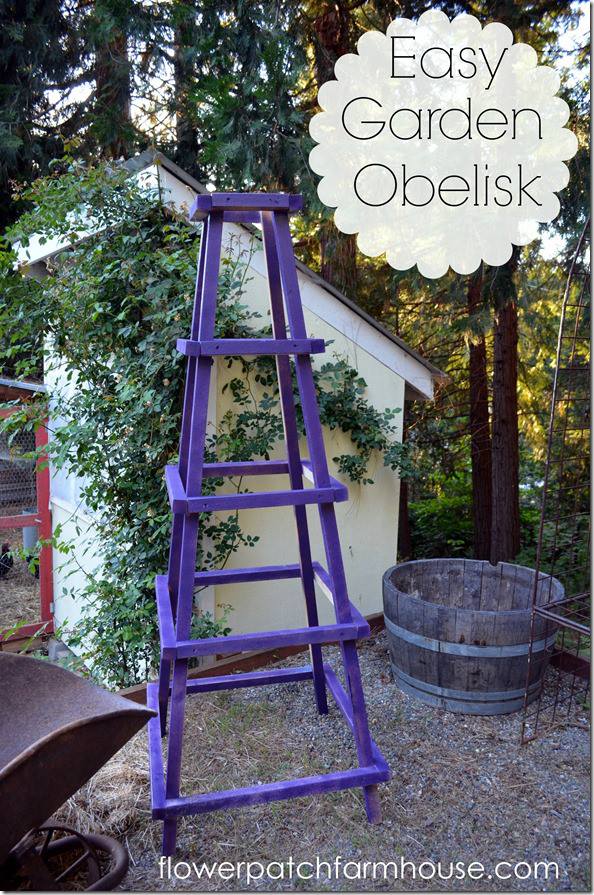
PicPost: Build yourself an obelisk

‘A great photographic step-by-step guide to building an obelisk. What will you grow up it once it’s built?’

via Growveg

http://www.flowerpatchfarmhouse.com/easy-garden-obelisk/

PicPost: Cushion floor

These are really made out of concrete!

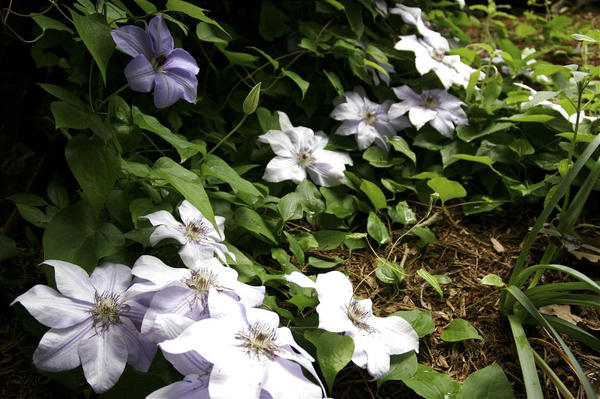
clematis ground coverAn interesting question this week, from a Trevor Arzan of Nether Wallop:

‘Some of the stems on my Clematis have fallen down and are growing along the ground, where they seem to be doing quite well. Can this or any other climber be used as ground cover?’

Clematis make very good ground cover plants as do the yellow-veined honeysuckle (Lonicera japonica ‘Aureo -reticulata’) and the climbing hydrangea (Hydrangea petiolaris). Many roses, especially ramblers, can also be used in this way.

So turn what you might use as climbers into creepers!

And climbers are also useful for covering ugly tree stumps. The less vigourous ivies are ideal for this job. Choose one of the varieties of common ivy (Hedera helix) with prettily marked leaves, such as ‘Glacier’ in grey and white, ‘Buttercup’ with young leaves entirely yellow, or ‘Adam’ with white-margined green leaves. I’ve used this approach ona tallish Cherry Tree stump in Old School Garden and the ivies can even look attractive climbing up living tree trunks. And I’ve also used ivy as ground cover with mixed results- if ground elder is present it’s a devil to get this out without completely destroying the ivy, still Ivy is pretty tough and will re-establish.

It’s also worth trying ‘Dutchman’s Pipe’ (Aristolochia macrophylla), with enormous leaves and yellow and purple pipe-shaped flowers. Schizophragma hydrangeoides, with it hydrangea-like  flowers in creamy white, does very well on old stumps and is self clinging.

ivy cherry tree

Ivy growing up from ground cover to girdle the trunk of a cherry tree in Old School Garden

Old School Gardener

If you’ve enjoyed reading this post and others on this blog, why not comment and join others by signing up for automatic updates via email (see side bar, above right ) or through an RSS feed (see top of page)?


deltagardener's avatarThat Bloomin' Garden

Have I ever told you how much stuff we have? Both hubby and I are collectors of stuff for the garden but you know how it is, we have good intentions but not always enough time. Well, three homes later and now we are finally using some found items. I bought two old gates for $5 each years ago and thought I was getting a horrible deal. That is until I went to a vintage sale and saw a gate sell for $70, cough, cough. Yes, you have that right. Funky old junk is in and the rustier the better.

rusty gate


So I went out in our secret junk area and dragged out one gate. I leaned it against my vegetable garden and there was a new trellis. Hubby saw that I had propped it up with bricks so he knew that wasn’t safe. He fashioned some clamps and screwed…

View original post 219 more words

Water management- Peruvian style

‘Great article discussing how Peru’s ancient cultures manipulated their water supplies in ingenious ways in order to survive in each of their many microclimates’ via Growveg

Pallet sizes – a handy guide for all you diy enthusiasts!

Pallet Types Pallet Size in  with Size Pallets

Finding Nature

Nature Connectedness Research Blog by Prof. Miles Richardson

Norfolk Green Care Network

Connecting People with Nature

Discover WordPress

A daily selection of the best content published on WordPress, collected for you by humans who love to read.

Susan Rushton

Celebrating gardens, photography and a creative life

Unlocking Landscapes

Writing, photography and more by Daniel Greenwood

Alphabet Ravine

Lydia Rae Bush Poetry

TIME GENTS

Australian Pub Project, Established 2013

Vanha Talo Suomi

The Journey from Finnish Rintamamiestalo to Arboretum & Gardens

Marigolds and Gin

Because even in chaos, there’s always gin and a good story …

Bits & Tidbits

RANDOM BITS & MORE TIDBITS

Rambling in the Garden

.....and nurturing my soul

The Interpretation Game

Cultural Heritage and the Digital Economy

pbmGarden

Sense of place, purpose, rejuvenation and joy

SISSINGHURST GARDEN

Notes from the Gardeners...

Deep Green Permaculture

Connecting People to Nature, Empowering People to Live Sustainably

BloominBootiful

A girl and her garden :)