Category: Gardening techniques


Here we go again…this time some garden ideas for using pallets and other recycled items to create planting spaces (plus a couple of potting benches and some very effective – looking fencing)…

Old School Gardener

If you’ve enjoyed reading this post and others on this blog, why not comment and join others by signing up for automatic updates via email (see side bar, above right ) or through an RSS feed (see top of page)?
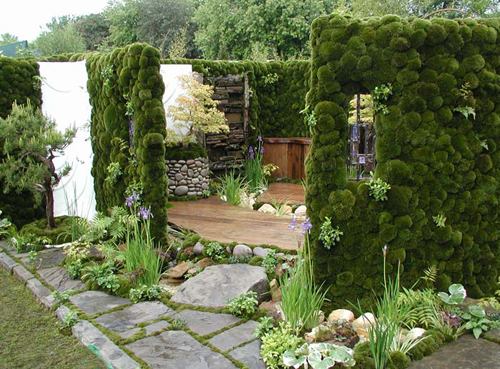
PicPost: Moss Pit

Old School Gardener

Grasses and autumn leaves are looking good in Old School Garden

Grasses and autumn leaves are looking good in Old School Garden

28th October 2013

To Walter Degrasse

Dear Walter,

I hope you and Lise are well. I guess you’ve been experiencing the warm autumn like us over the last few weeks? This has done wonders for prolonging the flowers and colour in Old School Garden and the combination of these with the golden glow of grasses in the mixed borders looks super- especially in that low October sun.

But it’s also meant that I’ve been hanging on and waiting for things to finish their show so that the ‘autumn clear up’ can truly begin (though I do like to leave some plants whose stems, seed heads or shape survive to provide eye catching winter interest). I’ve just started to get tender things inside for over wintering as well as replacing summer annual displays with something to give us winter and spring colour. The main annuals beds and containers have been cleared and planted up with a combination of spring bulbs, along with Pansies, Violas and Bellis. I’ve also cleared out the greenhouse of the remaining cucumbers and (mostly green) tomatoes, the latter are now resting in a fruit bowl along with a banana to encourage ripening! The harvest has continued with lots of delicious apples, some very good black grapes and runner beans, chard and the last of the courgettes. It’s also been a busy sowing and planting time- crops of Broad Beans, yellow and red Onions, Garlic as well as green manures have all been put in, and I’m having another go at growing Asparagus.

Scabious still looking good in the courtyard garden

Scabious still flowering in the courtyard garden

As you read this we’ll be away visiting our daughter Madeleine and our son-in-law, Diego, in Portugal. So, many other things – bringing in the dahlias, pruning the climbing roses, keeping on top of the leaves, selective cutting back of perennials and dividing and moving some – will all have to await our return. A little late perhaps, but hopefully the mild weather will continue for a couple of weeks!

I’m still helping at the local School with their ‘outdoor learning’ (specifically in the School Garden). I think virtually every child (apart from the very young), has learned about tools and tool safety and harvesting (the School cook had a lovely supply of Red Cabbage, Courgettes, Runner Beans and Carrots to weave into her daily menu). It’s been inspiring to hear their enthusiasm as they open up a runner bean pod and discover the little pink and purple jewels that can become next year’s seeds and how they love to find worms and other critters in the soil! One mum told me the other day how excited her son had been when he brought home the bean I’d let him take away!

They have also learned about the different types of seed and their dispersal, what we do in the Autumn to prepare the soil, and sow and plant certain things, as well as the importance of composting, including looking after the school wormery. The other day this half term’s efforts culminated in an open day focusing on ‘outdoor learning’. Parents linked with their children and took part in a range of activities around the school site including den building and bug hunting. I was mainly involved in fuelling the fire pit where we did some ‘campfire cooking’ (bread and marshmallows on hazel sticks), and helping with:

  • some gardening (the boys particularly like a bit of digging),

  • weather monitoring (we managed to reach 19 degrees C on a beautiful sunny day)

  • making ‘elf houses’ and furniture (and a few elves too),

  • making recycled paper pots and sowing broad beans in them.

I think this event has helped to raise awareness of the good work being done in the ‘outside classroom’ at the school and may even encourage some parents to volunteer to help out at one of the regular ‘garden gang’ days or in other ways. Here are some pictures I took to give you a flavour of what was a  fun and successful day.


The other major activity I’ve been involved with recently is teaching.

As you know from my last letter, I’ve been running a second Garden Design course at the local High School and this is now in its last couple of weeks. The eight participants, have a wide range of different garden design challenges in front of them. They are an enthusiastic group who it’s been a pleasure working with. They are now firming up their design ideas and creating scale drawings of what they want to achieve, and the final evening will focus on how to go about realising these on the ground.

I’m also pleased to say that my first ‘Grow Your Own Food’ course for beginners and novices is running locally, too. Tuesday mornings in a nearby village hall (Foulsham), sees 6 relatively new food growers coming together and both sharing experiences and exploring the ‘keys to success’ in food growing. The second week involved a visit to Old School Garden where I shared (‘warts and all’) my own experiences of food growing, some of the ideas and tips I’ve used and some of the issues confronting me – not least being the need to ‘downsize’ my food production to avoid gluts and surpluses! I shall be introducing a greater level of ornamental planting in the kitchen garden to achieve this, so reducing the productive areas by about a third.

My blog continues to grow both in terms of followers and also in the feedback and ‘conversations’ its enabling around the world. I’ve recently topped 1500 followers on all ‘social media platforms’ and since starting it back in December last year have had over 33,000 views of pages on the site. These are currently averaging about 800-1000 per month at present. Its been especially pleasing to have positive feedback from people who have enjoyed particular articles or items (recycling in the garden seems to be especially popular). Continue reading

It’s great to be in someone’s ‘top ten’ gardening blogs! Thanks Sophie 🙂

Sophie Hudson's avatarThe Forget-me-Not Cultivation Blog

I always say if you want to learn something, that can be especially tricky to ask (because usually you’re not sure what it is you’re asking), head to the internet.

Where as books can be very detailed, and in some cases terribly technical, the internet can be just the place to find simple answers that you can actually then put into practice within your own garden.

Whether it’s what shrub to prune this month, or why those leaves on your favourite plant look particularly brown you can usually find someone else has already had the same problems.

It’s the one area I find help, advice and guidance for things I’m not really sure about asking someone face to face.  It usually comes in the form of social media but something that works even better are blogs.

Today I thought I’d share with you ten blogs I refer to time and…

View original post 167 more words

Amaryllis (Hippeastrum) 'Candy Floss'

Amaryllis (Hippeastrum) ‘Candy Floss’

This week’s question comes from a recent blog follower, Elena who lives in Bergamo, Italy:

“Yesterday I bought three big Amaryllis bulbs, any tips?! There was a Dutch flower stand in my city and I couldn’t resist!”

Elena, I can do no better than show this useful video of the way to pot these wonderful bulbs. After you’ve completed the potting up, place the pot in a warm, dark place and watch for signs of new leaves. Once these are showing, then place the pot in a bright, sunny, frost-free place indoors – a windowsill would do fine. Planted about now you should have some glorious colour at Christmas!

amaryllis christmasWhilst on the subject of keeping things frost-free over winter, there is one golden rule when trying to protect tender plants over the coldest months: don’t over water.

When temperatures are low, the great enemy of plants is dampness, as rot may set in. During very cold spells it is usually best to withhold water entirely. Plants that are dormant or resting should in any case be watered very rarely, perhaps just enough to prevent complete drying out. Plants with fleshy roots, and bulbs, corms, tubers, rhizomes and other storage organs must be kept quite dry and frost-free or they will rot. They should be stored in containers of clean, dry sand or gritty compost. If stored in a greenhouse, the atmosphere must also be kept on the dry side, and should be ventilated when the general temperature allows. If you have an extra cold spell and you can’t keep the air temperature up, you can protect your plants to some extent against frost damage by covering them with horticultural fleece, dry newspaper or ‘bubble wrap’ plastic anchored with stones.

dahlia tubers

Dahlia tubers are best lifted, cleaned off, dried and then stored in sand or gritty compost before significant frost

Old School Gardener

If you’ve enjoyed reading this post and others on this blog, why not comment and join others by signing up for automatic updates via email (see side bar, above right ) or through an RSS feed (see top of page)?

rudbeckia via thegardendeliRudbeckia is a plant genus of 23 species, commonly called ‘Coneflowers’ and ‘Black-eyed-susans’. They are native to North America (‘prairie plants’) and are cultivated for their showy flower heads of yellow and orange, with a dark centre seed head, but there are also russet, bronze and mahogany tones. Mainly herbaceous perennials, some are annual or biennial.

They grow to between 0.5m and 3m tall, with simple or branched stems. The leaves are spirally arranged, and are between 5cm and 25 cm long. The flowers are daisy-like, with yellow or orange florets arranged in a prominent, cone-shaped head; “cone-shaped” because the ray florets tend to point out and down as the flower head opens.

A large number of species have been proposed within Rudbeckia, but most are now regarded as synonyms of a more restricted list. Several of these currently accepted species have a number of accepted varieties. Some of them (for example the Black-eyed Susan, R. hirta), are popular garden flowers, and prized for their long flowering times. There are many  cultivars of these species.

The name Rudbeckia was given by Linnaeus in honour of his botany teacher at Uppsala University – Professor Olof Rudbeck (1660-1740), and his father (also Professor Olaf – 1630-1702). Rudbeckia shares the common name ‘coneflower’ with other plants in the Asteraceae family – Echinacea, Dracopis and Ratibida.


Rudbeckias are not particular about soil, but do best in soil that is not too rich, with well-draining conditions. Rudbeckias love sunshine but R. laciniata and R. hirta (syn. gloriosa) will grow happily in dappled shade provided they have adequate moisture. Their blooms brighten up shadowy places wonderfully.  The flowers are daisy-like and can be single, semi double and fully double. Rudbeckias flower for a long period from late July well into autumn. Some of the varieties available include:

  • R. fulgida var. sullivantii ‘Goldsturm’ – The standard for Rudbeckia. Long blooming and virtually pest free (60cm)

  • R. hirta ‘Cherokee Sunset’ – Double and semi-double flowers in shades of yellow, orange, red, bronze and mahogany. Short lived, but re-seeds itself (60cm)

  • R. hirta ‘Indian Summer’ – Traditional daisy-like, large yellow flowers. Short lived, but re-seeds itself or grow as an annual. (1m-1.2m)

  • Rudbeckia ‘Toto Rustic’ – A dwarf Rudbeckia in autumn colors. There are also golden ‘Toto’ & pale ‘Toto Lemon’.

  • R. maxima Giant Coneflower – 12cm flowers and large leaves on an imposing plant (1.3m – 2.5m)

R. maxima (the ‘Great Coneflower’ or ‘Cabbage-leaved Coneflower’) is a favourite variety – It is an elegant plant with flowers with tall, black central cones which launch themselves upwards as its long petals droop downwards. Its foliage – unique among coneflowers – is a rosette of long paddle-shaped glaucous leaves, each with an elongated stem. Because it is late into flower it sometimes gets put at the back of a border, but it is a star performer that should be used nearer the front where its beautiful blue-grey foliage can be appreciated. Another advantage is that its flower stems are almost bare, so are easy to see through.

Rudbeckia maxima

Rudbeckia maxima

Rudbeckia work equally well as a complement to blue and purple flowers, like Russian sage and Veronica and mixed in with other jewel tones, like Sedum ‘Herbstfreude’, Purple Echinacea and Asters. Rudbeckia also make great cut flowers and even the seed heads will hold up in arrangements. Some plant combinations to try:

R. fulgida var. deamii with aster ‘Little Carlow’.

R. ‘Goldquelle’, lightened up with the airy wands of Gaura lindheimeri among it and foamy Calamintha nepetoides at its feet.

R. maxima with big-leaved plants such as bananas, hedychiums and ricinus for a late-summer ‘jungle’ effect.


Keep plants well watered the first season, to get them established. Once established, they will be quite drought resistant. A mulch of compost should be all the feeding they need. Regular deadheading of the faded flowers will keep the plants in bloom longer. You can let the last flowers of the season remain on the plants to go to seed and feed the birds, but you will also get a good deal of self-seeding. All perennial Rudbeckia can be increased by dividing clumps in spring or taking basal cuttings.


Sources and further information:

Wikipedia

Growing R. laciniata ‘Herbstonne’ – RHS

Growing R. fulgida– Daily Telegraph

Choosing and growing Rudbeckia- About.com

Rudbeckias- special perennials.com

Old School Gardener

If you’ve enjoyed reading this post and others on this blog, why not comment and join others by signing up for automatic updates via email (see side bar, above right ) or through an RSS feed (see top of page)?

PicPost: Roots Store

Pest or Pal?

Pest or Pal?

This week’s question is on an issue that I’m in two minds about. Lorne Bowles from Teddington asks:

‘On damp days in Autumn (and Spring) my grass becomes covered with earthworm casts. I’d like to get rid of them somehow. What do you recommend?’

There are many species of earth worms but only 3 of them make casts. Worm casts are a sign that you have a fairly active soil with good aeration and humus content. Earth worms are useful for mixing and aerating soil, but those which cast can create a muddy and uneven surface on grass and can also encourage weeds, as their casts make excellent seed beds!

Charles Darwin spent a lifetime studying worms, and estimated that up to 40 tons of worm casts per acre can be added to the soil (representing between 45 and 170 worms per square metre!). These casts are invariably richer, finer and less acidic than the surrounding soil, and contain around 50 per cent more calcium, nitrogen, phosphorus, potassium and bacteria.

Earthworm activity is encouraged if cuttings are left on the turf. Worms also pull fallen leaves and plant debris into their burrows and, in doing so, they add organic material to the soil, improving its structure as well as its fertility. For borders and beds, if you are short of compost, a mulch of leaves, preferably chopped up, will not only add structure to the soil, but will also dramatically increase the worm population and therefore the health and fertility of your soil. The use of alkaline or organic fertilisers and dressings can also encourage Worms in lawns. Monty Don tells an amusing anecdote about a grass tennis court which demonstrates worms’ love of alkaline soil:

‘A grass tennis court had been laid on acidic soil and marked out with chalk. Over the years, the calcium in the chalk neutralised the acid soil beneath it, making extremely narrow strips that attracted earthworms. Long after the chalk had been washed away, ‘runways’ made by moles attracted by their favourite food – earthworms – followed the line of them, without realising that they were mirroring exactly the original chalk lines of the court!’

This raises the topic of moles in lawns. A real issue for me here at Old School Garden, despite me trying to persuade the ‘little burrowers’ to take themselves next door. If you have moles, as the tennis court story indicates, this is a sure sign that you have worms in your lawn.

worm casts on lawn

Worm casts on a lawn

So what can you do?

Well one approach (but not one I’d recommend myself) is to try to deter the worms from casting using a fungicide. The law does not permit long life residual chemical build up in the soil, so gone are the days when formulations like Chlordane could be used to wipe out the worms (and possibly some gardeners too). However, Carbendazim is a chemical which is primarily used to deal with fungal diseases such as Fusarium but which also appears to interrupt the feeding of worms near the surface, by making the organic matter in which they feed unpalatable. Deeper feeding, non casting worms are apparently unaffected and continue to benefit the soil structure as normal.

Applying the chemical, which has a non hazardous classification, is said to be most beneficial in Spring and Autumn and must be carried out when the soil is already wet as it needs help in dispersing through the soil. However, be aware that whilst Carbendazim is approved for use in the UK and some other countries, some organisations argue that it is a dangerous substance.  Other options exist such as adding sulphur to the lawn, so reducing its alkalinity, and therefore reducing the attractiveness of it to worms. Manufacturer’s of this type of solution claim that this does not harm the worms or the soil.

However, I’d be a little wary of this, and other chemically – based solutions and try a more organic approach.

This does mean, however, that you’ll need to adopt a more relaxed attitude to worm casts (and mole hills, though it pains me to say so…). Worm activity, on the whole, is extremely beneficial to your lawn, so the best way to deal with the casts is to wait for them to dry and then brush them into the surface, spreading evenly with a Besom or similar broom. In doing so, you are adding to your lawn some fine compost and helping to improve its future appearance. There are also a few other things you can try to reduce the problem of casts:

  • Avoid leaving leaves on the lawn surface during the autumn and winter because this warm blanket of organic matter is an ideal ‘restaurant’ for the worms.

  • Do not allow a build up of thatch as again this decaying matter is digested by the worm which leads to casting deposits – so scarify your grass in the autumn and possibly also the spring.

  • Keep the grass at a reasonable height.

  • Avoid unnecessary watering as this attracts more worms. In dry weather the worms will move deeper, and by aerating regularly and ensuring good drainage, you will discourage activity.

If, like me you have a mole problem, I think the only safe, direct (but from experience, not necessarily successful) solution is to trap them, which might involve the services of a mole catcher unless you fancy a go yourself! I’ve found that other ‘solutions’ like noise/ vibration emitting devices seem only to have a temporary effect, if that!

Mole hills on the Old School Garden lawn

Mole hills on the Old School Garden lawn

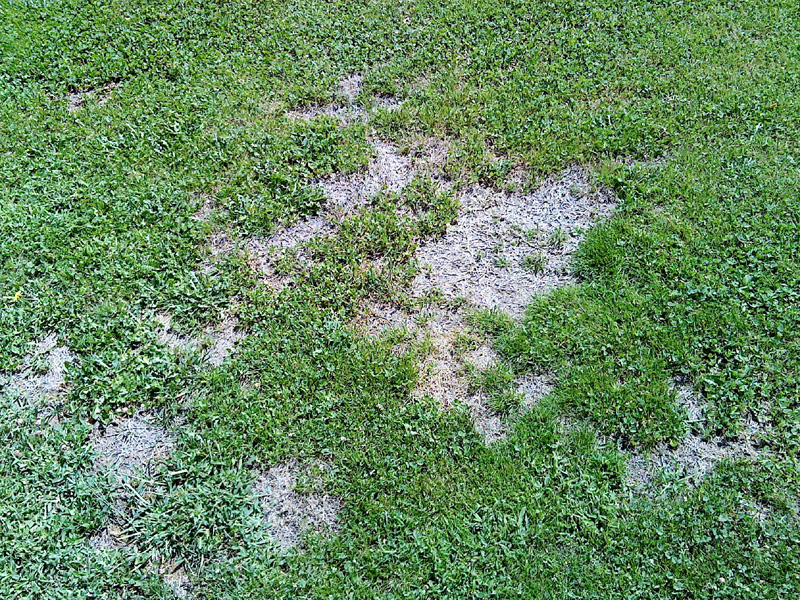
More generally, lawns are not attacked by pests, though you may at some point see the effects of the ‘Leather Jacket’ (the larva of the Crane Fly or ‘Daddy Long Legs’) and Chafer grub.

These can cause damage to the roots and stems of grass resulting in poor, stunted growth and bare patches. When a pest problem like this is suspected, the turf should be examined thoroughly to find the culprit. Pests are often found first in stressed areas, such as the edges of lawns or in shady or wet areas. They are not usually distributed evenly so it is advisable to look for spots that have discoloured, stunted or distorted turf. Insects tend to proceed outward from a central point; therefore they are generally most active on the outside edge. In both cases a lawn insecticide could be applied to kill the grubs/larvae….

Chafer Grub damage to grass

Chafer Grub damage to grass

However, an alternative, organic solution is to wait for heavy rain (or thoroughly watering any yellow patches in the lawn yourself). Then cover the affected areas with black plastic sacks and leave overnight. The Leather Jackets and grubs will come to the surface and can be collected in the morning and disposed of – or left to natural predators such as spiders and garden birds (especially Starlings). You could also use the biological control Steinernema feltiae, which should be applied while the ground is still moist and warm in late Autumn.

Old School Gardener

If you’ve enjoyed reading this post and others on this blog, why not comment and join others by signing up for automatic updates via email (see side bar, above right ) or through an RSS feed (see top of page)?

greenbenchramblings's avatargreenbenchramblings

Trench composting is an underused way to improve your soil texture and add fertility to your soil. And it has the added bonus of getting rid of those tough old stems of spent sunflowers, sweetcorn and brassicas. We spent a day trench composting the quarter of our allotment in which we shall be growing our roots next year. Many books tell us not to add manure or humus to the patch where you are planning to grow your root crops but we have found by experience that if the trenching is carried out in early autumn it works just fine. As the depth of soil on our plot is less than a border fork deep we need to keep adding to it in an attempt to build up some depth.

The job gets started as Jude, aka Mrs Greenbench or The Undergardener, takes out a 2 foot wide trench down…

View original post 356 more words

IMG_7431To Walter Degrasse

30th September 2013

Dear Walter,

September has been a month of relative quiet in Old School Garden. Summer has tipped into Autumn and the garden hasn’t needed (?wishful thinking) full throttle attention. The odd weed pulled up, flowers dead headed or staked, hedges trimmed, grass mown (less frequently and less closely). A typical September then, apart from the relatively cold spell we had earlier on which sent me to the wood shed and led to lighting of fires – albeit only once or twice. Still I resisted the temptation to switch on the central heating! Since then we seem to have had something of a mini ‘Indian summer’.

I’ve been pleasantly surprised at how some annuals I planted earlier on have at last come good – Cleome, Cosmos, Nicotiana and Tithonia in particular. A slow start, but they seem to have gone for a sprint finish so to speak! They are looking very good alongside some other late summer perennial colours – Asters, Sedums and Aconitum. And I’m pleased to say that last year’s sowings of Phalaris (‘Chinese Lanterns’) have now turned into beefier plants, just starting to show off their wonderful papery orange ‘lanterns’.

I’ve continued to harvest  various fruit and veg – Chard is now reaching maturity, Tomatoes, Lettuces and Cucumbers have done really well, and some late sowings of Carrots and Mangetout are looking promising. You may recall that I sowed three seeds of ‘Greek Squash’ sent to me by the Garden Organic Heritage Seed Library – two of these have gone on to produce four or five good-sized squashes, which are now hardening off in the autumn sunshine. Oh, and remember my caterpillar disaster with the Calabrese and Broccoli plants last month? Well, I’ve cleared the bed, and managed to get hold of some young plants of Chinese Broccoli and Spinach, so along with some of my own Red Cabbage seedlings we now have that area once more in production – hopefully they’ll all put on good growth before the onset of winter.

The first windfall apples have been falling in some strong breezes recently. We’ve been collecting some of these as well as early pickings directly from the trees, and very tasty they are too! I can see that the next couple of weeks will be consumed with apple harvesting, and that of course raises the question of where to store them! Our larder could soon be a lot fuller.

Further afield in my gardening life, I’m pleased to say that the six week Garden Design course I put on last year is once again up and running, with 8 enthusiastic students with a wide range of garden sizes and ideas that I hope to help them develop in the coming weeks. I’ve also planned a one day workshop at nearby Gressenhall Farm and Workhouse where I hope to show people how to get more from their garden through using some of the key elements of garden design. It will also be fun using the gardens at the Museum to illustrate some of these, as i designed some and help to maintain them as a volunteer. As I speak I’m hopeful, too, that the six week beginners course on ‘Growing Your Own’ at nearby Foulsham, will also be viable, but we’ll have to wait and see on that one.

I’ve also started back with my support of gardening and ‘learning outside the classroom’ at the local primary school. I’ve been encouraged by the way the school – and particularly their LOTC Coordinator, is building on the progress we made last year. Over the first half term I’m taking a series of small groups from most classes through some of the basics such as introducing different types of tool and how to use them safely; the importance of clearing and preparing the soil during the autumn; harvesting some of the produce we planted last season (there are some seriously impressive carrots that seem to have thrived on neglect!); gathering different types of seed for next year; how different plants propagate themselves and sowing broad beans, garlic and onions as well as some green manures.  The School is also carrying out an international project on composting and organic gardening to which I’m contributing. So a busy half term! It’s always great working with such enthusiastic youngsters, reawakening my own sense of wonder at nature as they dig over the soil and are delighted to discover worms, grubs and creepy crawlies!

On Saturday I went to Garden Organic’s HQ at Ryton, near Coventry, for their annual conference for Master Gardeners and Composters. Around 30 of my colleagues from Norfolk went along and were joined by over 200 other Master Gardeners and Composters from a number of other areas around the country. It was a very interesting and inspiring day. I attended some workshops on community composting, reaching ‘hard to reach’ communities and ‘love your bugs’- all about the goodies and baddies in the garden. Most inspiring was a talk by veteran naturalist Chris Baines, looking at ‘The Nature of the Future’. I’ll do a fuller article on this event later in the week, but here are a couple of pics from the ‘Naturalistic’ area of the gardens, which looked wonderful – as did the many other different gardens which demonstrate a range of gardening techniques and planting arrangements.

So, old friend, that just about brings you up to date for the last few weeks in my gardening life at Old School Garden and beyond. A mellow and measured time when its been possible to enjoy the late summer colour and reap the fruits (and veg) of my labours earlier in the year! No doubt you’re well ahead of me with your autumn garden jobs, but in case you’re not and need some ideas, I’ll be posting my regular monthly item on tasks in the garden for the new month tomorrow, so I hope that proves useful. Happy Gardening!

Old School Gardener

If you’ve enjoyed reading this post and others on this blog, why not comment and join others by signing up for automatic updates via email (see side bar, above right ) or through an RSS feed (see top of page)?

Finding Nature

Nature Connectedness Research Blog by Prof. Miles Richardson

Norfolk Green Care Network

Connecting People with Nature

Discover WordPress

A daily selection of the best content published on WordPress, collected for you by humans who love to read.

Susan Rushton

Celebrating gardens, photography and a creative life

Unlocking Landscapes

Writing, photography and more by Daniel Greenwood

Alphabet Ravine

Lydia Rae Bush Poetry

TIME GENTS

Australian Pub Project, Established 2013

Vanha Talo Suomi

The Journey from Finnish Rintamamiestalo to Arboretum & Gardens

Marigolds and Gin

Because even in chaos, there’s always gin and a good story …

Bits & Tidbits

RANDOM BITS & MORE TIDBITS

Rambling in the Garden

.....and nurturing my soul

The Interpretation Game

Cultural Heritage and the Digital Economy

pbmGarden

Sense of place, purpose, rejuvenation and joy

SISSINGHURST GARDEN

Notes from the Gardeners...

Deep Green Permaculture

Connecting People to Nature, Empowering People to Live Sustainably

BloominBootiful

A girl and her garden :)