
Category: Gardening techniques
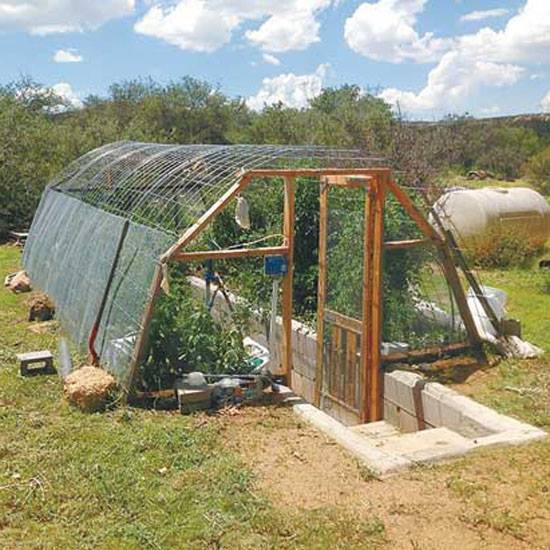 Heat Sink Greenhouse- heat is absorbed by the stone trough during the day and relased at night.
 Montreal, Canada
Old School Gardener
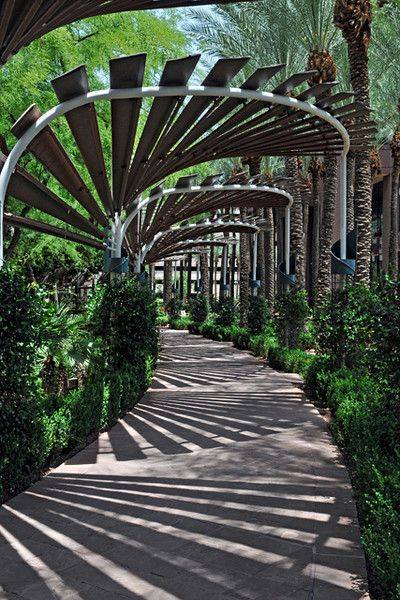 Shadow Walk, Phoenix, Arizona
Old School Gardener


Old School Garden – 30th October 2014
To Walter Degrasse
Dear Walter,
The clocks have gone back and the evenings are shortening the afternoon gardening sessions. Since I last wrote my gardening activity has stepped up a gear- well it was pretty much in 1st (or maybe even reverse) during September.
The driest September for many a year gave way to (in some parts of the UK) a very wet October. Here it has been fairly calm and though we’ve had some rain it hasn’t been the deluge experienced further north. There’s quite a range of ‘autumn colour’ in the garden right now…

Blueberries

Cornus

Cotinus

Viburnum and Physocarpus

Cercis siliquastum ‘Forest Pansy’

Chrysanthemums

Nerine bowdenii
As per normal for the gardening calendar it’s been a month of ‘managed decline’ as well as preparation for next year in Old School Garden. Plenty of leaves to gather up for leaf mould and general tidying away of spent stems and foliage that don’t offer anything by way of ornamental or wildlife value. Unfortunately this has included three large Box balls that have succumbed to Blight- they now await burning in my fire pit area. Looking in the Nurseries their replacements would be around £50 each, given their size! I don’t think I’ll bother, as it gives me a chance to use the remaining balls (3 large and six small), plus two cones a bit more creatively elsewhere in the garden – precisely where is still under debate.
The other tidying has included finally heaving out my enormous sunflowers, so that I now have a pile of what, from a distance, look like pretty thick tree trunks! I’ve also been pruning my Fremontodendron, which continues to thrive against our south-facing front wall and the Sorbaria, which I must say looks nice and neat after its haircut. I’ve also been trimming some of the native hedge between us and our neighbours and cutting out some very sorry-looking Choisya (my guess is that it has got to a size where the poor, panned soil underneath it, coupled with the dry weather, have starved it of moisture). Hopefully what remains will recover.
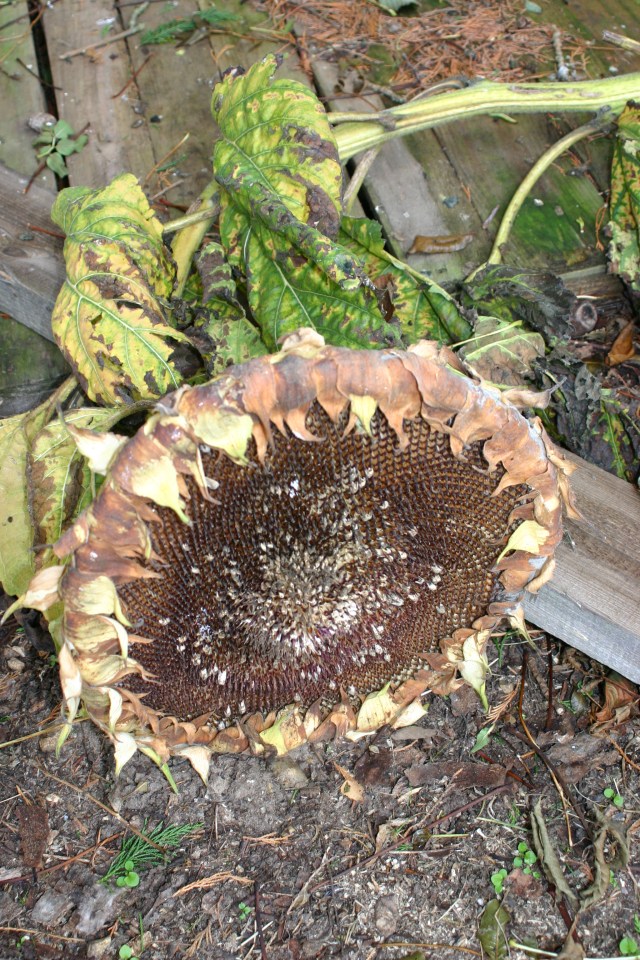
‘Tree trunk’ sunflowers awaiting their fate
Talking of neighbours, our immediate ones (with us since we moved in 27 years ago), have moved out in the last couple of days, off to a new adventure living on a canal boat! We’ve met our new neighbours, a very pleasant young couple who have been living elsewhere in Norfolk. It also turns out that our next but one neighbour has something of a pest control talent; he has waged war on the moles in his garden and so far the ‘score card’ pinned to his shed reads ‘Norman 21, Moles 0’ ! I’m sort of envious given the problems we’ve had this year. But as I write, the level of mole activity in the garden seems to have calmed a little, though the roadside verge seems as covered with hills as ever- maybe the moles are working out how to tunnel under the road and into the fields beyond- that would be a relief!
You’ll gather that I’m building up quite a supply of green and brown material which is either being composted or burned. The new bonfire pile is in a different spot, having had a big burn up a few weeks ago. This was something of an eye opener as a Tree Surveyor from the power company came running into the garden and, rather agitated, told me to put out the fire! As this was directly under the 11,000 volt power line that crosses the back of our garden, there’s apparently a risk of a ‘Carbon flashback’. This is when smoke of a particular type enables the electricity to ‘power up’ the air underneath the wires with the result that pretty much everything under it is fried! This was news to me, and having had my bonfires in this spot for many years, I wonder how close I’ve come to disaster in the past? Needless to say I’ve now resorted to using the fire pit area (away from the wires) as my bonfire site, and this has also prompted me to start thinking about what to do with the old site and its surrounds – very much a forgotten bit of the garden…more on this in future letters.

The old (unsafe) bonfire area- room for improvement
Talking of new designs I’ve been running my garden design course at the local High School again and its been great fun taking 5 more students through the design process for their own projects, which range from someone wanting to create a garden at a primary school to a couple who have been in their house (and large garden) for a few months and are wanting to adjust this to meet their needs (which include an escapist dog!). And my voluntary gardening at Gressenhall Farm and Workhouse Museum continues; yesterday I was doing a bit of ‘willow weaving’ on the tunnel I created in the ‘Curiosity Corner’ for the under 5’s. It looks a bit more tunnel- like again and also with a bit of judicious tying in, should be a bit more robust, as this area (which seems to be very popular), gets a real hammering.

Autumn fruit…Peppers

Crab apples ‘Red Sentinel’

Solanum laciniata
The last month has also been one of planting and sowing. I’ve got two varieties of onion sets in as well as some garlic and Broad Beans, and I’ve just about finished planting out Wallflowers and Sweet Williams alongside Pansies and Violas in a range of pots on the Terrace as well as in various other spots around the garden. The last few peppers are still ripening in the greenhouse so it won’t be much longer before that’s given a clean out and made ready for over wintering duties.

A good year for roses- i’ve just tied in some of the new growth on the arbour (Rosa ‘Zephirine Drouhin’)
I’ve also cleared and tidied most of the kitchen garden and given the low box edging its final trim- it must be 10 years since I grew these from cuttings and they are just about knitted together as a series of nice little hedges around the raised beds. The clearing away has also included cabbages and cauliflowers which were a disaster this year, none of them having formed any heads. I guess it must be weather related once more.

Box (h)edging tidied up in the kitchen garden
Well, I’ve just time to finish cutting the lawn (really it’s a lazy way of collecting leaves) before some friends arrive for an overnight stay. We are also on our travels again this weekend, as we visit friends in Edinburgh, so I think the waterproofs and winter clothes will definitely need to be packed as nearer normal temperatures return!
All the best to Ferdy and you; maybe we’ll meet up before Christmas?
Old School Gardener

Somewhere in Argentina?
via Sociedad Argentina de Horticultura
Old School Gardener
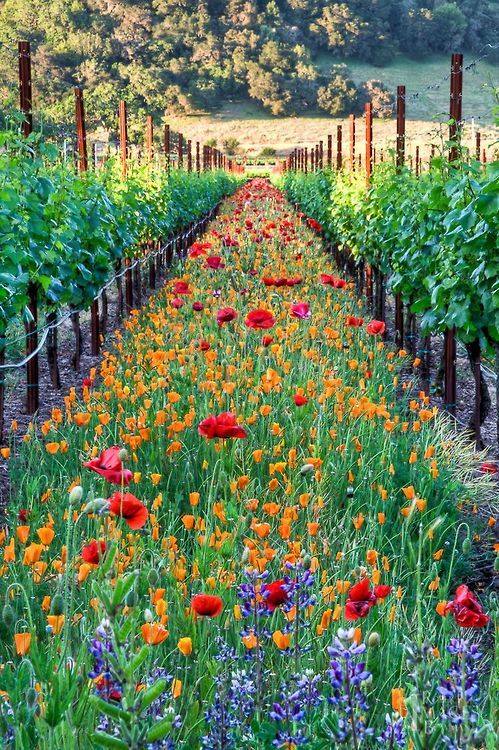
Vines at Kenwood Winery, California, with an alley of pollinating plants
Old School Gardener
I recently had a ‘tweet’ from fellow Norfolk resident, Claire in Thetford. She was wondering what the growths on these leaves were.


I must admit to being a bit puzzled at first, but some further research suggested that they are some sort of Gall, which Wikipedia describes as:
‘…abnormal outgrowths of plant tissues and can be caused by various parasites, from fungi and bacteria, to insects and mites. Plant galls are often highly organized structures and because of this the cause of the gall can often be determined without the actual agent being identified. This applies particularly to some insect and mite plant galls.’
My guess from the pictures was that these were galls possibly created by some sort of parasitic wasp (in this case on the leaves of a Lime Tree). Claire’s own research came up with a more precise description: a ‘Nail Gall’ formed by a small mite Eriophyes tiliae. These microscopic mites overwinter in the bark of lime trees and crawl on to the underside of the foliage in spring to feed. The mites secrete chemicals into the leaves causing them to produce the unusual projections into which the mites move to continue feeding during the summer. Infestations of mites and the nail galls they induce don’t appear to affect the health of the trees and there’s no way of controlling or preventing them. The galls caused by this mite are said to be yellow-green or red in colour (see picture below). It may be that the whitish nails in Claire’s picture have been be caused by another mite (Aceria lateannulatus), which affects both the small-leaved lime (Tilia cordata) and the Common Lime (Tilia x europaeus), but not the large-leaved lime (Tilia platyphyllos).
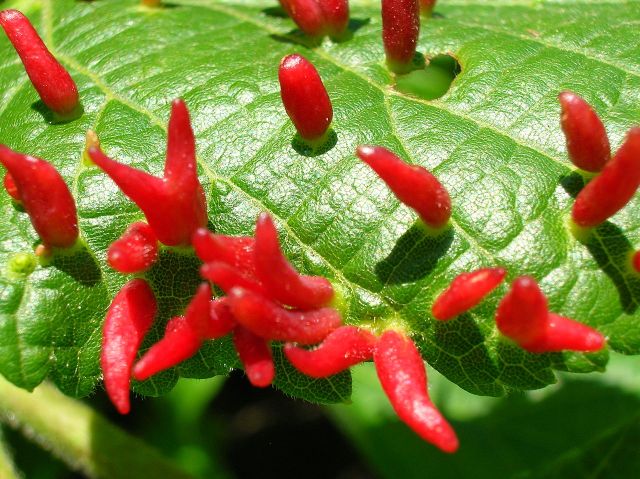
Nail Galls cauised by Eriophyes tiliae
Galls are fascinating phenomena. As Wikipedia continues, those created by insects are:
‘…highly distinctive plant structures formed by some herbivorous insects as their own microhabitats. They are plant tissue which is controlled by the insect. Galls act as both the habitat and food source for the maker of the gall. The interior of a gall can contain edible nutritious starch and other tissues. Some galls act as “physiologic sinks”, concentrating resources in the gall from the surrounding plant parts. Galls may also provide the insect with physical protection from predators.
Insect galls are usually induced by chemicals injected by the larvae or the adults of the insects into the plants, and possibly mechanical damage. After the galls are formed, the larvae develop inside until fully grown, when they leave. In order to form galls, the insects must seize the time when plant cell division occurs quickly: the growing season, usually spring in temperate climates, but which is extended in the tropics.
The meristems, where plant cell division occurs, are the usual sites of galls, though insect galls can be found on other parts of the plant, such as the leaves, stalks,branches, buds, roots and even flowers and fruits. Gall-inducing insects are usually species-specific and sometimes tissue-specific on the plants they gall.’
Galls are also caused by fungi, bacteria, viruses and nematodes. It seems that in many instances these growths do not cause any significant harm to the plants they infest, though in some cases long term harm can be caused to some species, for example by affecting their overall shape and vigour.
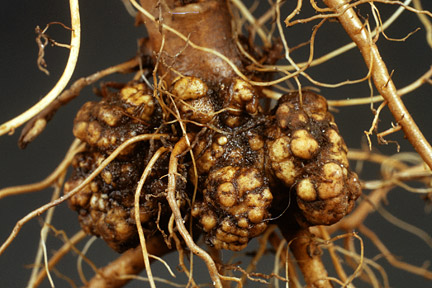
Crown Gall on apple- RHS
Crown gall affects a wide array of plants and roses are definitely one of them. It is a plant disorder caused by the bacterium Agrobacterium tumefaciens, that interferes with the plants ability to take up water and nutrients. This results in poor growth and weak plants that are easily stressed and injured- the only remedy in this case is to dig up the plant and dispose of it.
The study of plant galls is called cecidology. While these weird structures have intrigued humans for many years, there is still much that we don’t know about them.
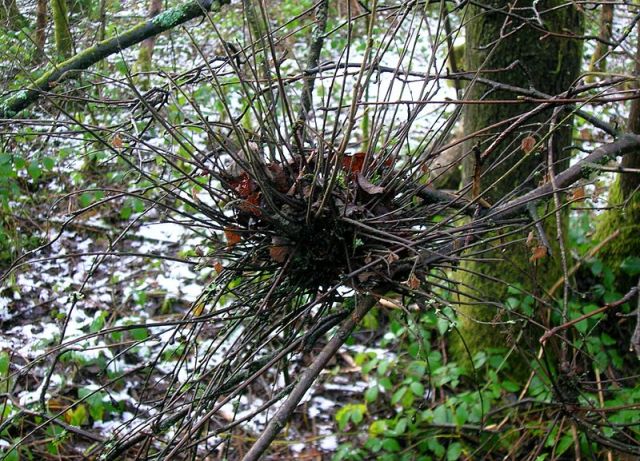
Wiches Broom Gall – picture Rosser1954
While some galls are well hidden and hard to spot, others are much more conspicuous. Have you ever looked up into a birch tree (Betula spp.) and noticed what looked like large, dense birds’ nests? In some cases these may well be nests, but very often they are actually galls called ‘witches’ brooms’. These are caused by a fungus (Taphrina betulina), which stimulates the tree to produce numerous extra shoots, resulting in a dense nest-like cluster. The fungus can then feed on the shoots. It was once believed that they were caused by witches flying over the tree!
If you spot an odd-looking growth on a dog rose (Rosa canina) it could well be a Robin’s pincushion gall, caused by a wasp (Diplolepis rosae). There was once a belief in England that these were caused by the woodland sprite, Robin Goodfellow or Puck. It is hardly surprising that people ascribed supernatural causes to some galls – they look pretty strange, and their causes aren’t exactly obvious.
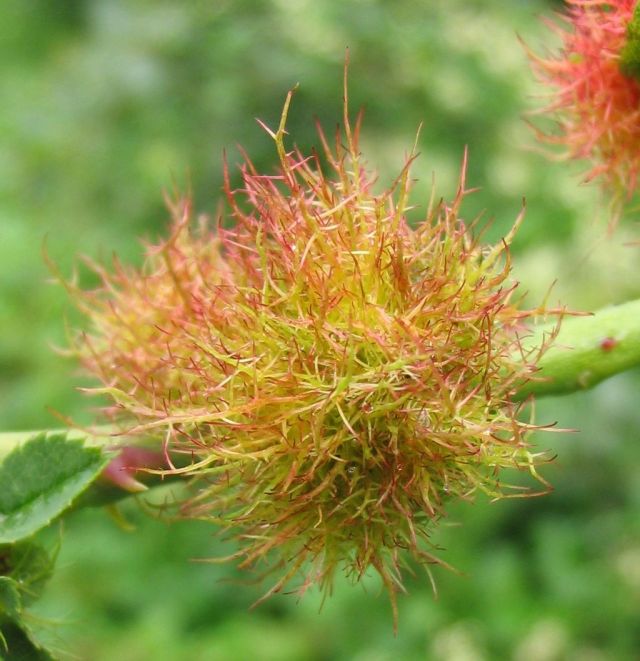
‘Robins Pincushion’ gall on a Wild rose
The real gall specialists include gall midges, gall flies and gall wasps. Perhaps one of the most familiar galls is the oak apple, caused by a tiny wasp (Biorhiza pallida).
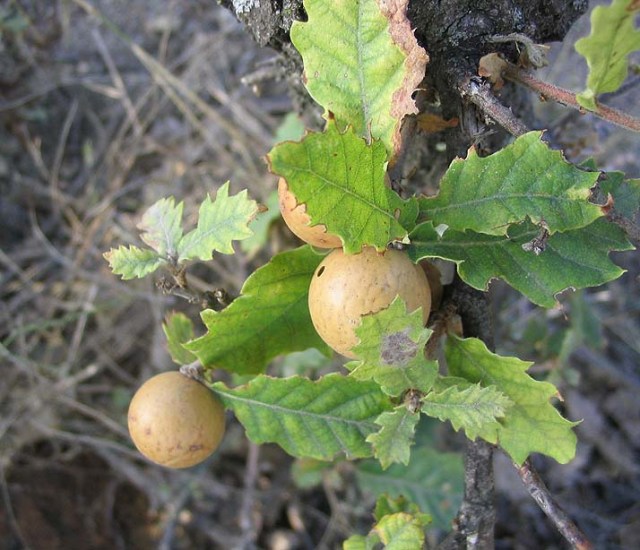
Oak apples
There are actually hundreds of species of oak gall wasps and they cause a fantastic variety of galls on oaks (Quercus spp.). A single oak tree may support many thousands of galls. Each gall wasp species creates its own unique and outlandish structure: some resemble cotton wool or marbles, pineapples or tiny UFOs!
Here’s a gallery of some of the other amazing galls to be found.
Sources and further information:
Galls- Wikipedia
Eriphyes tiliae- Wikipedia
British Plant Gall Society
Trees for Life- Galls
RHS- Crown Gall
Old School Gardener
If you’ve enjoyed reading this post and others on this blog, why not comment and join others by signing up for automatic updates via email (see side bar, above right ) or through an RSS feed (see top of page)?
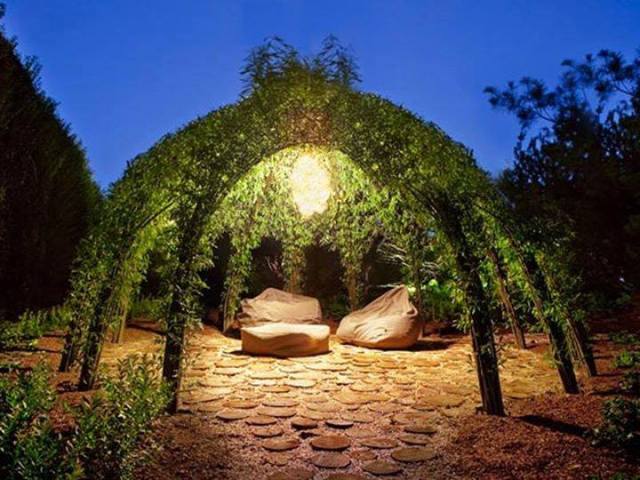
Living willow structure by Bonnie Gale




 Old School Garden