
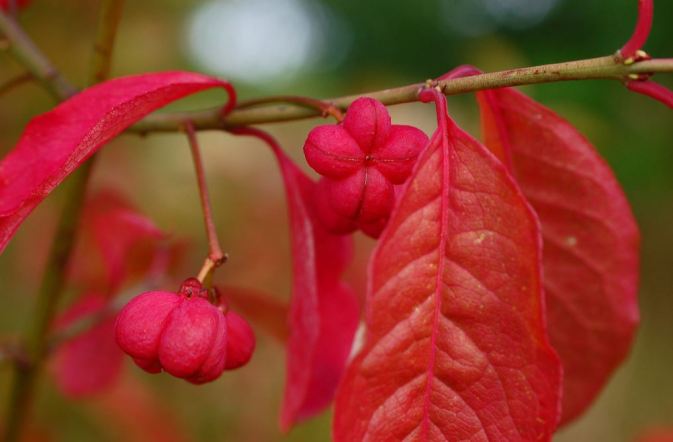
Picture by Bob Osborn
The ‘E’ in my A-Z of garden trees is a star autumn performer and can also be grown as a deciduous shrub. As I write this, my own (shrub) example of Euonymus (the alatus or ‘winged spindle’ species) here in Old School Garden has just lost all of it’s new leaves – possibly a virus or scale attack? Still, I have gathered some seeds from hedgerow examples of europaeus and the small seedlings seem to be doing well, so maybe I shall- in a few years- have a replacement or two!
Common name: ‘Spindle’, ‘European Spindle’, ‘Common Spindle’
Native areas: native to much of Europe, where it inhabits the edges of forest, hedges and gentle slopes, tending to thrive on nutrient-rich, chalky and salt-poor soils. It is a decduous shrub or small tree.
Historical notes: European spindle wood is very hard, and can be cut to a sharp point- it was used in the past for making wool spindles (used to spin the wool into thread).

First flush

Summer leaf

Flower

Unripened fruit
Features: Euonymus europaeus grows to 3–6 m (10–20 ft) tall, rarely 10 m (33 ft), with a stem up to 20 cm (8 in) in diameter. The leaves are opposite, lanceolate to elliptical, 3-8 cm long and 1-3 cm broad, with a finely serrated edge. Leaves are dark green in summer. Autumn colour ranges from yellow-green to reddish-purple, depending on environmental conditions. Flowers are produced in late spring and are insect-pollinated; they are rather inconspicuous, small, yellowish green and grow in cymes of of 3-8 together. The capsular fruit ripens in autumn, and is red to purple or pink in colour and approximately 1-1.5 cm wide (opening, when ripe, to reveal orange seed cases).
Uses: Spindle is a popular ornamental in gardens and parks due to its bright pink or purple fruits and attractive autumn colouring, in addition to its resistance to frost and wind. It has been introduced to North America where it has become an invasive species in some areas. Grown as a shrub it is useful for hedging and screens, is relatively low maintenhance and as a tree looks good in ‘Cottage’, informal and wildlife gardens.
The cultivar ‘Red Cascade’ has gained the Royal Horticultural Society’s Award of Garden Merit (AGM).This is a small arching tree (mature height 3-5 metres), and produces an abundance of rosy red fruits which open to reveal vivid orange seed cases. The foliage display in autumn is fantastic with green leaves turning to rich red by November. This variety is one of the best forms for gardens, parks and resticted spaces.

Ripe fruit clusters

Ripened fruit and seed cases

Spindle trees
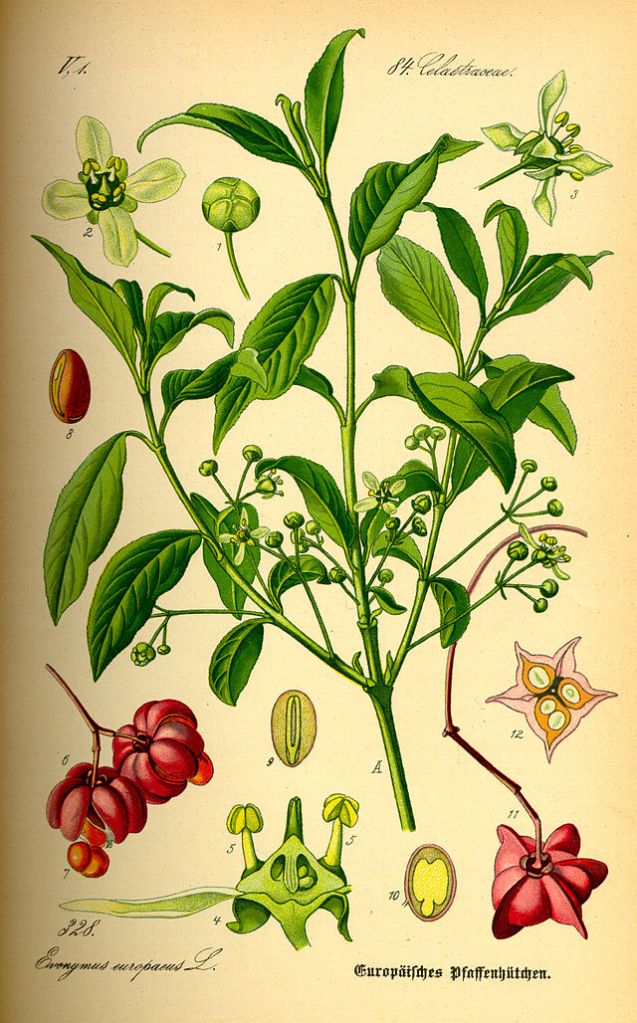 Further information:


 This is the third in my new series on garden trees. I’ve also done an


 Today’s question comes from a gardener in North Yorkshire. Ernie Uplad of Richmond has just created a new garden pond in an open, sunny spot away from trees and wants some advice about planting:








 Old School Garden