Category: Design


The Maze at Longleat House, England

The Maze at Longleat House, England

I must admit I’m a bit of a fan of labyrinths and mazes.

As a play landscape designer I’ve tried to find ways of incorporating them in my designs as they are especially attractive to children. Usually they are one of the first design ideas to be dropped, generally on grounds of maintenance requirements. I’ve tried to suggest simple materials like grasses to mark out a pattern, rather like the one in the Cambridge Botanic Garden, but again they do take some looking after. The best I’ve managed is a wooden stepping stone and daffodil spiral. One day I’ll find a client with the imagination and deep(ish) pockets to give a bigger one a real go.

Labyrinths and mazes – what’s the difference between them?

Well, the answer is  ‘it rather depends…’.  There is one school of thought that sees labyrinths as different to mazes and another that sees labyrinths as one type of maze. Labyrinths have just one route– so there’s no danger of getting lost – whereas mazes are rather more cunning in that they have dead ends, twists and turns which are set out to puzzle and confuse. Sir Walter Scott’s ‘O, what a tangled web we weave, when first we practise to deceive!’ comes to mind.

Labyrinths (remember the single route or ‘unicursal’ one) are found in many cultures, some as old as 3,500 years. They all have an entrance or mouth, one route to follow and a central destination, sometimes marked with some sort of stone/statue/ feature. A further detail is how many concentric circuits or paths they contain and they can vary from the small to the huge – several hundred feet across. They have traditionally been seen as spiritually symbolic, meditative paths as well as just entertaining and can be found in many religious buildings such as Chartres and Ely cathedrals.

The Labyrinth pattern in Chartres Cathedral

The Labyrinth pattern in Chartres Cathedral

Humankind has been fascinated by patterns in the land for millennia and some of the earliest were forms of spiral (some multiple spirals). These later developed into the sorts of maze-like patterns we’re more familiar with, including the Cretan maze (or labyrinth as its usually called!). Of course the famous one was that in classical mythology where Theseus found his way to the centre and killed the Minotaur to ensure he freed his fellow Athenians. He used a length of thread to trace his way in and so find his way out. Which rather suggests that this ‘labyrinth was in  fact a more complicated maze as it would have been easy to retrace his steps in a one-route labyrinth! This all goes to support the case that the words labyrinth and maze are interchangeable, and certainly common usage suggests this- e.g the turf ‘mazes’ in some English gardens are in fact labyrinths (i.e. one routers).

A-maz-ing Gardens

Mazes as multi – choice routes really developed in gardens out of the parterre and knot gardens which used lines of plants (usually Box) to create patterns within which other plants, gravel, grass or sometimes coloured powders created a contrast in colour and level. You can wander around these hedges in some gardens and it isn’t difficult to imagine how (either deliberately or perhaps through lack of maintenance!) these hedges grew taller. This both made it difficult to grow anything successfully within them and also added a touch of mystery to the experience of walking round the garden. A book by Daniel Loris –  ‘Le Thresor des Parterres de l’univers‘ – written in 1629, seems to capture the developing fashion for such mazes (though most of it is concerned with the traditional parterre).

Hampton Court Maze, England

Hampton Court Maze, England

Britain’s oldest surviving hedge maze is at Hampton Court – created by George London and Henry Wise in 1690 and also thought to be the oldest hedge maze in the world in continuous use. Originally planted with Hornbeam and having two trees at the centre the hedging is now Yew, the hedging used in many traditional hedge mazes.

Labyrinth of Horta, Barcelona

Labyrinth of Horta, Barcelona

The Labyrinth Park of Horta in Barcelona, Spain, was created around 1794 as part of a neoclassical ‘makeover’ of the garden by its Marquis owner. In recent years the garden and maze have been restored and I have had the good fortune to almost stumble across it.

A simple bulb labyrinth at Cornell University, USA

A simple bulb labyrinth at Cornell University, USA

Today there are many different types of maze to be found in gardens, parks and estates around the world, some using hedges or walls (for your truly ‘puzzling maze’), others using turf, other grasses, low-growing plants or materials to mark out the (usually labyrinthine) route. In Britain temporary  ‘Maize mazes’ created in agricultural fields have become a popular summer visitor attraction.

There is something magical about these labyrinth and maze ‘puzzles on the land’ and I hope that one day I can create one in a park or garden…maybe you have scope for one in your garden?

Sources and further information:

Garden Mazes

Mazes and labyrinths

Design your own maze

History

Wikipedia- labyrinths

Wikipedia- mazes

Labyrynthos- resource centre

Labyrinth.org

Maze photos

Quizzicals (thanks to Les Palmer for these):

answers to the last two-

  • Has had too much already Sycamore
  • A country full of automobiles – Carnation

and a couple of gardening ditties

Big in Japonica’

‘You picked a fine time to leave me lucerne’

Old School Gardener

If you’ve enjoyed reading this post and others on this blog, why not comment and also join some other people and sign up for automatic updates via email (see side bar, above right ) or through an RSS feed (see top of page)?

Simple natural elements can make a garden special for younger children

Simple natural elements can make a garden special for younger children

Surveys show how playing in parks or their own garden come out tops for children when asked what their favourite activities are. And an expert warns that children are no longer ‘free range’.

Providing simple play pleasures won’t cost parents an arm and a leg either! Thinking about how to make your garden child-play friendly and then spending a little money on creating the right space will repay dividends over  many years.

Start with the idea that the garden for children (and for adults too for that matter) should be a multi-sensory space, with:

  • different surfaces and textures to touch – stones/ gravel/ bark/ brick and plants with interesting leaves such as Stachys byzantina  (‘Lambs’ Ears’),
  • varied smells – from different flowers and leaves,
  • tastes – growing and picking your own strawberries or fresh vegetables,
  • sounds – wind through grasses, chimes, water dripping into a child-proof pool
  • sights– break up the garden into different zones with their own character.
A children's food garden

A children’s food garden

Then talk about the ways you might create this in your garden with your children, focusing on the sorts of play activities they would like…and work up your ideas using these…

Seven tips for garden play:

  1. Natural resources– treat the outdoors differently to the indoors- its special, so create spaces and provide playthings which children can’t get inside; e.g a tree house or a tree for climbing if you have one big enough,  a pit or pile of sand, or if you’re feeling very brave- a mudpool…
  2. Growing children– give children a separate, personal garden where they can ‘grow their own’ food…
  3. Futureproof- think ahead and provide things which will engage children for several years or which can be easily adapted as they grow older – convert a sand pit to a growing area, a swing frame into a hammock frame…
  4. Small and simple– a few odd bits and pieces of wood, boxes, bricks, cloth, plastic pipe etc. can fuel children’s imaginations and creative play, though purchased play equipment does have a place too, if you have the space and cash…
  5. Doubling up– make the most of space – think about garden structures which can play a role in the ‘adult garden’ as well as  providing something for children; e.g wooden arches that can support a swing, sand pits concealed below trap doors in wooden decked terraces, a climbing frame that’s one side of a pergola, varied path surfaces with some in-built pattern (you can even get some with fossils imprinted on them)…
  6. Move the earth– don’t be afraid of creating (even small) hills and hollows in your otherwise flat garden (unless you have these already of course)- children love running up and down slopes and use these for all sorts of creative games. If you like, add in a few rocks and logs (fixed down) for them to clamber over…
  7. Get social– encourage your children to play with other children – invite their friends round and take them to friend’s gardens, play areas and other places where there’s a good chance of meeting other children…

    Play garden using simple materials
    Play garden using simple materials

    Even if your garden is small, you can use your imagination and create a unique and special place for your children.

Further information:

Growing food with children

A children’s food garden

Garden games

Old School Gardener

ImageGarden Design Course in Norfolk

Following the successful pilot of ‘Your Garden- by Design’ last autumn, I’m pleased that Reepham Learning Community have agreed to run an extended version of this course beginning at the end of the month. 8 two-hour sessions (including one garden visit) will use a variety of methods and materials to help those who want to improve their own gardens through design.

Based at Reepham College in central Norfolk, the course is a step-by-step walk through the design process, showing how to apply this to your own garden (big or small) from basic surveying and appraisal techniques, forming ideas about what the garden is for and how it might look, to outline plans and 3-D visions of  different ideas as well as the important things needed to ensure successful delivery of attractive, practical plans.

Group review and discussion of the evolving designs will enable participants to develop a critical and creative approach to garden design and a large number of reference books will be on hand as well as links to other sources of information. Case studies and in-class exercises will help participants to develop their skills.

Green (and its many shades) is one of the most important colours in garden design (arguably it’s a more important feature than the ‘white’ in Vita Sackville-West’s garden at Sissinghurst). Gardens which feature plants with bold, contrasting foliage can be really effective and the Course will introduce colour, texture and form as three key ideas in planting design. The contribution that ‘hard’ landscaping (paths, walls, furniture and built structures) makes to successful garden design will also be covered.

Participants don’t need to have any particular skills- the course and associated support should lead to practical ideas which can be put into action. The eight sessions will cover:

  • Starting out- what do I want from my garden?IMG_4931
  • Surveying and appraising your garden and functional layouts
  • Garden Styles and Forms
  • Structure in your Garden- the third dimension
  • Planting- the fourth dimension
  • Garden visit (day time)
  • Final designs
  • Delivering your Design

Check out the link to the Reepham Learning Community for more information- I’m looking forward to meeting a new group of enthusiastic garden makers!

Quizzicals- answers to the last two:

  • Morrisey’s mother’s mother- Granny Smith
  • Someone who is out get you – Anemone

A couple of gardening ditties for you:

‘Livin’ Dill’

‘Juke Box Chive’

(note to self= must move away from herbs and spices for a while…)

Old School Gardener

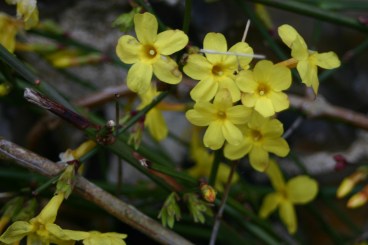
Looking good- Winter Jasmine (Jasminum nudiflorum)

Looking good in Old School Garden at present – Winter Jasmine (Jasminum nudiflorum)

 Planning your crops- to rotate or not to rotate…

Well, I guess that I’m sold on the benefits from rotation. Basically, you reduce the chances of persistent pests and diseases building up (which affect a particular plant or group of plants) and you manage the demands placed on the soil from different crops (and in the case of peas and beans actually stand to replenish, or if not that, then at least not deplete the store of Nitrogen).

Fine in theory, but it’s posed a real challenge to me in planning my crops in the kitchen garden. I’ve survived to date (just) with hasty diagrams on odd scraps of paper and scribbled ideas about what to grow where. To be quite honest, I’ve become muddled about what was previously grown in the different beds, what needs to follow what and whether I should manure, fertilise and/or add lime….sound familiar?  With just the two of us at home to cater for it’s also been a bit difficult avoiding growing either too much or too little of the right things (generally the former).

Part of the problem is that my Kitchen Garden is divided up into a number of raised beds of different sizes and aspects, so it’s a challenge fitting things into the spaces available. I also feel that it’s important to max the growing potential by putting in follow-on crops once early harvests of things like Broad Beans, onions and early potatoes have been ‘garnered in’.

Then there’s the issue of focusing on what we like to eat (sounds simple, eh?). Over recent years we’ve had mixed results:

  • some rather exotic looking French Beans which turned out a pretty yellow on the plant and then went a sort of beige when cooked- not inviting,
  • peas -they seem to involve an awful lot of trouble for not much reward
  • main crop potatoes– they take up a lot of ground and don’t taste that different from a large bag bought for a fiver…

So we’ve started to focus on the crops we like (with a bit of experimenting), things that can be expensive to buy, freezables for the winter months (Courgettes come to mind) and some particular varieties that ‘float our boat’- Mangetout for instance in preference to those whopper peas that pigeons seem to rather enjoy!

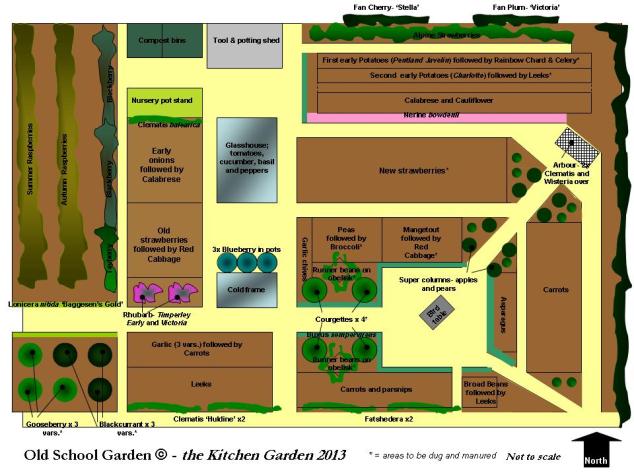
So yesterday (after pruning the apple trees), I spent a couple of hours drawing up a proper diagram of the plot, tried to think through what could go where (once I’ve taken permanent crops like fruit, Rhubarb and Asparagus out of the equation)- and also whether there’s potential for second crops in some areas, too.

I’ve tried to follow the rules on rotation (brassicas following legumes, potatoes following brassicas and onions and roots following potatoes), but I must admit it’s a bit hit and miss, taking all of the other variables into account! What’s your experience and do you have any sure- fire tips to help me?

At last, a cunning plan for food growing in 2013! (I hope)

(click on the image to enlarge and see a panorama video of the garden as it looks today at http://www.youtube.com/watch?v=rZ20lLrTLIc&feature=youtube_gdata_player)

kitchen gdn layout

P.S.  A note on manure:  if you can get some well rotted animal manure it could be good to either dig it into your beds or just lay some on top for the worms to incorporate into the soil. I’d be careful about putting it down everywhere though, as root crops like carrots and parsnips don’t like freshly manured ground (they tend to fork and not grow well in the heavier conditions that are created). However, ‘hungry’ cops like potatoes, brassicas (cabbages, calabrese, cauliflower, broccoli), courgettes, squashes and legumes (peas, beans) would all benefit from some, as would a greenhouse if you’re planning to grow tomatoes. Ideally it needs to be obtained and placed or dug in in the next few weeks in order for the weather to break it down and help to incorporate it into the soil.

Further information: Vegetable Gardening for Beginners: The Complete Guide

Quizzicals: answers to the last two…

  • Private part of a old crooner Periwinkle
  • The organ that enables you to say ‘2 plus 2 = 4’Adder’s Tongue

and just for fun two more ‘gardening ditties’:

‘Pepper’s got a brand new bag’

‘Spice Oddity’ (topical huh?- thanks Les)

Old School Gardener

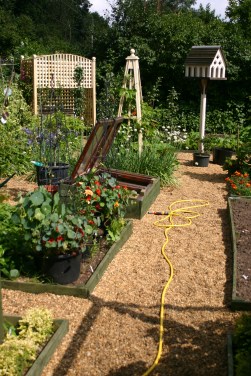
A view of the Kitchen Garden looking west- east (left to right on the diagram)

Finding Nature

Nature Connectedness Research Blog by Prof. Miles Richardson

Norfolk Green Care Network

Connecting People with Nature

Discover WordPress

A daily selection of the best content published on WordPress, collected for you by humans who love to read.

Susan Rushton

Celebrating gardens, photography and a creative life

Unlocking Landscapes

Writing, photography and more by Daniel Greenwood

Alphabet Ravine

Lydia Rae Bush Poetry

TIME GENTS

Australian Pub Project, Established 2013

Vanha Talo Suomi

The Journey from Finnish Rintamamiestalo to Arboretum & Gardens

Marigolds and Gin

Because even in chaos, there’s always gin and a good story …

Bits & Tidbits

RANDOM BITS & MORE TIDBITS

Rambling in the Garden

.....and nurturing my soul

The Interpretation Game

Cultural Heritage and the Digital Economy

pbmGarden

Sense of place, purpose, rejuvenation and joy

SISSINGHURST GARDEN

Notes from the Gardeners...

Deep Green Permaculture

Connecting People to Nature, Empowering People to Live Sustainably

BloominBootiful

A girl and her garden :)