
- The Garden- man made artifice?
‘Let us, then, begin by defining what a garden is, and what it ought to be. It is a piece of ground fenced off from cattle, and appropriated to the use and pleasure of man: it is or ought to be, cultivated and enriched by art, with such products as are not natural to this country, and consequently, it must be artificial in its treatment, and may, without impropriety, be so in its appearance; yet, there is so much of littleness in art, when compared with nature, that they cannot be well blended; it were, therefore, to be wished, that the exterior of a garden should be made to assimilate with park scenery, of the landscape of nature; the interior may then be laid out with all the variety, contrast, and even whim, that can produce pleasing objects to the eye.’
Category: A musing: odd thoughts

 A year ago today I posted my first article on Old School Garden. Thank you to all those people who have taken the trouble to read that and the more than 1000 articles or other posts I’ve made since then. And a special thanks to those who are regular followers of Old School Garden.
So what have I achieved and what has been the experience?
First the ‘metrics’ for the last year:
-
1018 posts or articles published (including re-blogs)
-
Over 40,000 ‘hits’ or ‘views’ from visitors in 129 countries with the highest dally total views being 429. The average daily views is now standing at well over 100.
-
Over 5,000 posts were shared by visitors via Facebook, Twitter and a wide range of other platforms
-
1,653 ‘followers’ alerted to new posts via Twitter, Facebook, LinkedIn and directly via email (the latter has grown in the year to 285 followers)
-
Over 900 comments, including 300 of my own in reply to others, with recycling projects and ‘Picposts’ generating most comments
-
Not surprisingly the United Kingdom, USA, Canada and Australia account for over 80% of the hits (the U.K. alone 46%)
-
Overall, the most viewed posts seem to be about recycling projects (interest in projects in the garden using pallets and other recycled materials seem to be really popular, as have posts dealing with design, gardening techniques and play)
-
21% of the views have been generated by internet searches using a wide range of search terms, and a further 10% via Twitter and 6% each via Facebook and Pinterest
I’m not sure if these figures are impressive or not – my guess is that they’re probably ‘middling’ when compared to the full range of numbers achieved by different blogs.
- Pallet furniture and other garden recycling projects seem to have been especially popular this last year
What has been my blogging experience?

I’m pleased at the overall numbers of people who have viewed the blog and that many have ‘liked’ or commented on the articles and other material I’ve shared.
I’ve been surprised at how some posts have generated enormous interest, with views ‘spiking’ on recycling posts in particular.
I’m pleased that my efforts to inform about gardening using a range of post types seem to have been well received; examples include ‘GQT’; ‘A-Z of Perennials; ‘Plantax’; monthly ‘top tips’ and various series on design topics, climate change, school gardening etc.
I guess I’m feeling that I haven’t yet ‘found my audience’ with the blog and that I seem to have generated only a small (but nonetheless very valued) community of followers who are stimulated enough to contribute to developing ideas and knowledge via comments.This may be in part due to my eagerness to produce a relatively large number of posts only a few of which have been structured and styled to generate debate.
So, I think I need to revise my blogging strategy. Perhaps I need a combination of meatier items, more of which are focused on developing ideas and seeking opinions, but retaining a mix of other types of post (but maybe reducing the frequency of these?). To ‘educate, inform and entertain’ (a la BBC) but with ‘stimulate’ perhaps added?!
What do you think? I’d love to hear from you!
Old School Gardener


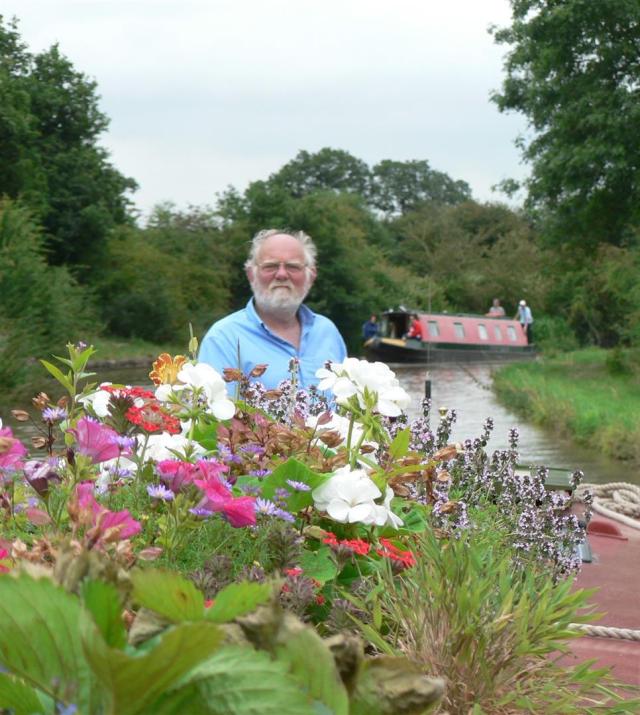
A former colleague of mine, Howard Dickenson, died recently. I hadn’t seen ‘Howie’ for many years, but another former colleague attended his funeral and paid a wonderful tribute to him which awoke some warm memories. I particularly like this picture of Howie aboard his canal boat with the beautiful flowery roof garden. Here’s to a life well spent and one that brought pleasure and amusement to many. All the best Howie.

Anything to add?


via Oakmeadow
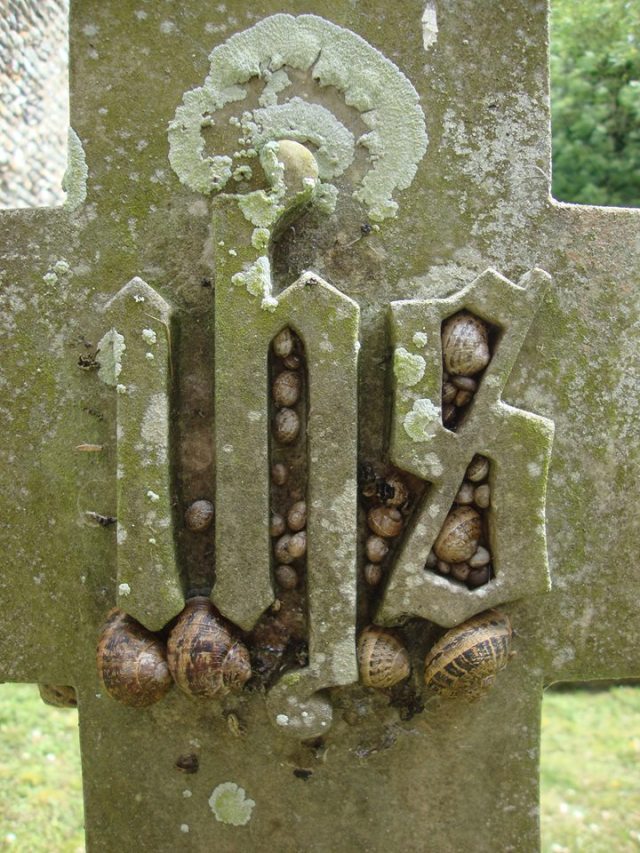
Tombstone at Weybourne, Norfolk via http://www.ournorfolk.org.uk
‘A dodman (plural “dodmen”) or a hoddyman dod is a local English vernacular word for a land snail. The word is used in some of the counties of England. This word is found in the Norfolk dialect, according to the Oxford English Dictionary. Fairfax, in his Bulk and Selvedge (1674), speaks of “a snayl or dodman.”
Hodimadod is a similar word for snail that is more commonly used in the Buckinghamshire dialect.
Alternatively (and apparently now more commonly used in the Norfolk dialect) are the closely related words Dodderman or Doddiman. In everyday folklore, these words are popularly said to be derived from the surname of a traveling cloth seller called Dudman, who supposedly had a bent back and carried a large roll of cloth on his back. The words to dodder, doddery, doddering, meaning to progress in an unsteady manner, are popularly said to have the same derivation.
A traditional Norfolk rhyme goes as follows:
“Doddiman, doddiman, put out your horn,
Here comes a thief to steal your corn.”
Source: Dictionary of Phrase and Fable, E. Cobham Brewer, 1894
The ‘inventor’ of ley lines, Alfred Watkins, thought that in the words “dodman” and the builder’s “hod” there was a survival of an ancient British term for a surveyor. Watkins felt that the name came about because the snail’s two horns resembled a surveyor’s two surveying rods. Watkins also supported this idea with an etymology from ‘doddering ‘ along and ‘dodge’ (akin, in his mind, to the series of actions a surveyor would carry out in moving his rod back and forth until it accurately lined up with another one as a backsight or foresight) and the Welsh verb ‘dodi’ meaning to lay or place. He thus decided that The Long Man of Wilmington was an image of an ancient surveyor.’
Source: Wikipedia

‘Ted’ Boldero (and friend) – my dad pictured in the 1950’s
I’m a dad. I love my children and thank them for their cards, gifts and good wishes on Father’s Day. Today, I’m also reminded that I am a son too. Though my own father died nearly 50 years ago, I think it’s to him that I owe my love of gardening.
My memories of him in our smallish terraced – house garden in London, are of a formal ‘summer bedding ‘ type of gardener and old photos confirm that he kept his patch neat and tidy if not overflowing with colour or variety. I don’t recall ‘helping’ him in the garden apart from trying to push an old manual ‘Qualcast’ mower (I have a picture of me just reaching the lower brace on the handle rather than the handles proper).
More memorable, and I think more significant in terms of its influence on my own gardening bug, was his role at the local Green Bowls club, West Essex in Leyton. He was not only a good player (he represented Essex County), but was also the voluntary green warden – basically the guy in charge of the grass and all the other bits and pieces of green areas. And there were rather a lot of these, I recall, overflowing with Dahlias and summer perennials like Phlox, Marguerite Daisies, Stocks, Hellenium and Rudbeckia.
I definitely do remember helping my dad in this, larger scale, ‘garden’. Not only did this include using a petrol motor mower (“elf ‘n’ safety” would have kittens if a ten year old did this today) and using edging shears to get a neat cut to the bowls square, but rolling it, scarifying, aerating and top-dressing too. I guess this is why I still find a good lawn (ideally with stripes) so attractive – even though in my heart of hearts I know that lawns can be environmentally unsound. And there was lots of hedge cutting (mainly Privet) with shears and planting up rows of annual flowers.
So, on Fathers’ Day, its nice to reflect on what my dad meant to me all those years ago – guidance, knowledge, encouragement and praise that shaped me as a gardener (as well as in other important ways) so many years down the track.
Thanks Dad!
Old School Gardener
If you’ve enjoyed reading this post and others on this blog, why not comment and join others by signing up for automatic updates via email (see side bar, above right ) or through an RSS feed (see top of page)?


An ancestor of mine?
‘That’s an unusual name – is it Spanish/ Italian/ French?’
If you’re also a Boldero/w/we/oe, this might be a typical response on giving your surname. That’s certainly my experience. And also my wife’s and daughters’- who, unlike me, pronounce the name with a definite latin emphasis on the ero (I prefer stressing the first syllable). Then again it’s my family name so my pronunciation is surely the one that counts? Another response – less frequent, more usually with my wife and tending to be restricted to Norfolk is:
‘Are you the people who do the walks in the Eastern Daily Press?’
My tired response is invariably ‘no’. Though on one occasion (with apologies to Charles and Joy of EDP fame), partly out of exasperation, partly from wishing to see the reaction I got, I answered ‘yes’. Gushing praise and adulation followed about how enjoyable the walks were, how useful the tips on eating out, beer etc. etc.
So what’s in a name like Boldero/w/we/oe? Well my exploration of the family tree suggests quite a lot. It seems to be a classic example of how a name comes to be spelled in several different ways (and some of them hardly resembling the main form and sound). In the less literate past, names were more often talked about but rarely written down and when they were the vagaries of accent, lower levels of literacy etc. all had an influence on what was recorded (in parish registers of births, marriages and deaths for example).

My paternal line seems to feature many agricultural labourers, living in West Norfolk. Here’s a picture of one of them in the early 20th Century, near Castle Acre, earning a penny a day for scaring birds away from crops!
You probably know about how surnames derive from different sources– some based on where someone lives, some on personal physical features, some on occupations carried out. Some allude to personal character traits and it seems that Boldero stems from a personal name which in old german means ‘bold ruler’. The Penguin Dictionary of British Surnames (John Titford. Penguin Books, 2009), suggests that it is found chiefly in East Anglia and more amusingly is synonymous with Baldrick. So a north european rather than Mediterranean homeland seems likely.
Certainly my family tree research has found strong links back to a John Baldrick (born in South Acre, Norfolk in 1735) and it is interesting to note how the form and spelling of the name has varied over the generations. The Dictionary goes on to say:
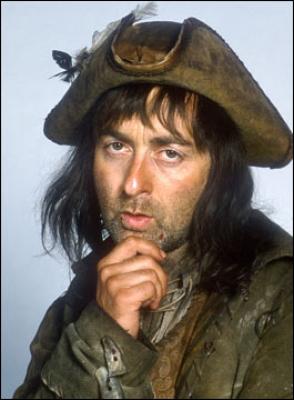
‘To those whose understanding of medieval times has been conditioned by the television series Blackadder, the name Baldrick will forever be associated with the character of that name, a former dung- shoveller played by Tony Robinson, who acted as sidekick and punch-bag to Edmund Blackadder.’
Returning to John Baldrick (or rather his son of the same name, 1767- 1821- my 4th great grand uncle, whatever that means), I came across a fascinating entry in the Longham Parish Register which underlines how confusing it must have been in olden days- when was a Baldrick not a Baldrick? so to speak-
‘I have never been able to learn the real name of John Baldrick- sometimes he has been called Balthorpe at others Balderow or Baldrow & at other times Baldrick- As Baldrick was given in the first time I had reason to register his name, I have not thought proper to change it being doubtful of his real name. St. John, Curate’
A further entry on the same page suggests that this ancestor may have been of rather dubious character:
‘John Hubbard Labourer was killed by a Blow received in fighting with John Baldrick June 29th and was buried July 1st 1794- Parish poor – duty paid to Mr Barker’

My paternal Grandfather William Kiddle Boldero- and me!
I’ve also been fascinated by some of the distinctive middle names our ancestors were given. You may well be familiar with the custom of giving a child (more often than not the first born son) a middle name that’s the mother’s maiden name. Not to create the customary ‘double barrelled’ surname but in effect forming a second christian name. Some examples from the Boldero clan are:
William Kiddle Boldero (1888-1982- my grandfather),
William Orford Boldero (1821- 1899),
Richard Orford Boldero (1849- ?),
William Balls Bolderow (1844-1904) ,
John Casey Baldrick (1792-1792),
Charles Cooper Baldrow (1844-1864),
Arthur Franklin Boldero (1904- 1984)




 Old School Garden