
 In the previous post I set out some of the ‘natural’ ingredients of designed ‘play landscapes’. What can parents do to increase the natural play opportunities for their children? Here are ten tips – why not try to use them over the half term holidays?
1. Ask yourself, how can your children have the same exciting opportunities to play naturally as you did? Remember your own childhood memories of playing in natural places: damming, running, climbing, digging, building, splashing, dreaming, chatting and watching are just some of the great natural play memories adults have.
2. Allow children the time and space to discover natural play opportunities for themselves. Natural spaces are the ultimate play environments and children instinctively seek out and discover ways in which to interact with and use nature. Children who have direct, playful experiences of nature are most likely to develop caring attitudes and behaviours in later life.
3. Find out where the nearest natural spaces are to you. Children need everyday nature. This includes free access to parks, gardens, city farms, village greens, hedgerows and rough ground within easy reach of their homes, as well as visits to woodlands, beaches and open grassland further afield.

Den building
4. Provide old clothes and outdoor gear. This will help children play naturally in all weathers. Getting muddy, wet or sweaty and coming home with snagged or grass stained clothing is just part of playing outdoors. Opportunities to play with nature, through climbing trees, exploring the world of animals, building dens or making mud pies, are fun and help children to cultivate an awareness of and respect for nature.

Most natural play areas need to be managed and sometimes benefit from man-made add ons
5. Encourage children to play out and inspire them with the magic of natural spaces. Sensitive adults can support and enthuse children by sharing the sense of wonder of the natural world and jointly uncovering its mysteries and surprises. Stories, costumes, treasure trails and quests can gently kindle the flames of children’s imaginations when playing in natural settings. Outdoor natural spaces allow children to be spontaneous and create and explore their own imaginary worlds.
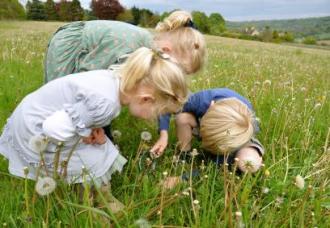
Exploring nature- picture: Emma Bradshaw
6. Help children take risks in play, like climbing trees. Children need and want to take risks through play. Playing in natural settings allows children to find ways of challenging themselves and taking risks that fit them as individuals. Be open and transparent about what is involved in natural play activities so that children playing outdoors can experience the fun and excitement of stretching and testing themselves.
7. Find your nearest adventure playground. If parents and children prefer to play with adults around, adventure playgrounds usually have some natural areas. In some areas there may be play workers or park keepers who encourage children to play in natural spaces. Ask you local council what supervised play opportunities are provided locally.

Simple pleasures- a nest created from sticks, cut grass, gravel and cotton wool..
8. Look out for opportunities for free natural supplies. Children love to move things around and rearrange their play spaces. Natural resources, like tree and hedge trimmings make great den-building materials. Good play spaces can be made by adding natural elements into children’s outdoor playgrounds, such as trees and plants, earth, rocks, logs, water and natural moveable objects.
9. Stick up for children’s right to play naturally outdoors.Children need advocates who can help them find natural places to play. Encourage children to play naturally in your area, call on your local authority to provide accessible wild spaces for children to play in, and support your local play centre to run environmental play sessions in outdoor settings. Possibly lobby for ‘play landscapes’ that include a mixture of ‘off the shelf’ play equipment and custom-built structures and natural play features.
10. Experience it yourself! The best way for adults to prepare and plan for successful natural play is to experience it! Think about natural play activities you would like today’s children doing, and then have a go for yourself.
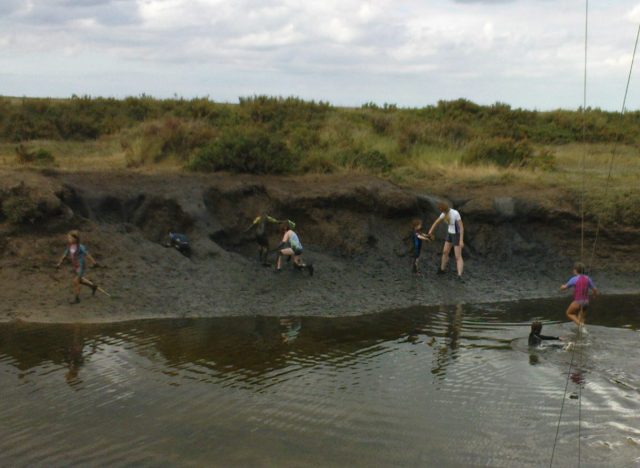
Water (and mud) play- Wells next the Sea, Norfolk
Source: after ‘Wild about Play’- Martin Maudsley
Other information:
The Forestry Commission and play
Outdoor Experiences and Healthier brains
Natural play philosophy and approach
Old School Gardener
If you’ve enjoyed reading this post and others on this blog, why not comment and also join some other people and sign up for automatic updates via email (see side bar, above right ) or through an RSS feed (see top of page)?







 Old School Garden
As a playworker it’s good to see some playwork sources being cited in other disciplines. I was reading through your list and thinking about ‘magic’ as I read. There it was at number 5. Magic is something that appeals to me: in thinking on children’s play, on environments where children play, on all of us and all our interactions in the world. I’m particularly interested in the ‘ordinary magic’ of the world, a la the magic realist writers, but also re: the liminal spaces, the between worlds, that natural spaces in particular can be. It is a very real magic, but a very earthly one, if that’s not a contradiction in terms. In the context of your article, Nigel, if parents (and others who share their lives with children in professional contexts) can be open to the possibility of ordinary magic flowing, then children’s play can be that much the richer, by proxy. Magic is in the atomic structure of the world we live in, but we don’t always see or appreciate it.
Thanks Joel- love your thoughts on magic – it points up the importance for me as a designer to be aware of the magic of places before they are subject to our manipulations as well as trign to build in possibilites into the designed space. I’m esepcially taken with the idea of designing in ambiguity – i.e. features and objects that are capable of meaning different things to different children and which are capable of being used in creative play in a myriad of ways.
This idea of ambiguity has come full circle in my life: years ago I studied architecture and remember being interested in how indoor space and outdoor space could be designed as ambiguous and overlapping; now the idea has found its way back in my work with and for play. That is, play/not play, reality/fantasy, meaning/non-meaning, etc., as well as physically and emotionally the overlaps between ‘designated playspace’ and ‘public space’, and play within public space (children are part of the public, after all, as are adults part of the playrealm!)
Thanks, yes this idea of ambiguity fuels the blurring of the edges between different places where play occurs, some ‘designated’, others very definitely not. I guess it underlines the importance of well informed, locally – grounded audits of where and what play occurs rather than relying on a survey of designated play spaces and the old ideas of hierarchical levels of open space provision (speaking as an ex planner!). Thanks for the link to Tim’s blog, which I wasn’t aware of and am now following- some meaty stuff there!
I guess it underlines the importance of well informed, locally – grounded audits of where and what play occurs rather than relying on a survey of designated play spaces and the old ideas of hierarchical levels of open space provision . . .
Or, perhaps, as I and my fellow playworkers advocate, the art of observation – simple though that sounds – but which is a keen skill to nurture.
Entirely agree- we need both a local understanding of what and where play is happening and a wider understanding of play to inform the design process.
Oddly, as I write here and now, another conversation in the stream, elsewhere, reminds me serendipitously of the need to underpin our observation with theory: informed observation. Two people stream in to me from different places in different conversations about similar thinking processes. There are small bubbles of magic in the world!