

Tag Archive: vegetables
-
 Do choose drought resistant plants
 -
Do conserve moisture by mulching in spring when the soil is moist
-
Do mulch problem problem soils- too dry, sandy or chalky- twice a year, in spring and autumn
-
Do build a deep no-dig bed if you want to grow fruit and vegetables
-
Don’t try to grow a conventional lawn. Instead, create patches of green with a herb lawn using thyme or chamomile.
Source: ‘Short Cuts to Great Gardens’- Readers Digest
Also- see this great article:
No Dig Gardening Demystified: Embracing the Magic of Natural Garden Nurturing
Old School Gardener

Volunteers tidying the kitchen garden beds at Blickling Hall
My second day as a volunteer gardener with the National Trust at Blickling Hall involved cleaning up the recently used kitchen garden, and along the way meeting some of the other garden volunteers… oh, and uncovering some plant mysteries…
You may recall that last week I helped Project Manager Mike and gardener Rebecca to make a start in preparing the ground in the main walled garden. With lots of rain since then there had been little chance of doing much more- in fact there were sections that were reminiscent of a World War I trench system, complete with mud and puddles!
‘Ooh, there’s a row of something…’
So, today we turned our attention to the long bed along the south-facing wall, an area that in recent years had been cultivated as a kitchen garden and nursery bed. There were clearly areas of bare soil, some a bit weedy, whilst other areas still had the remains of last season’s plantings, including Chard, Penstemons, Dahlias and some less obvious herbaceous perennials.

Newly turned

Foxgloves and Dahlias tidied up

Dahlias mulched and labelled
At the start it looked like I might need to weed and then use a spade to dig over the soil, but it turned out that the soil is quite workable and so a border fork proved up to the job. I was soon joined by a platoon of other garden volunteers who turned their attention to other sections of the bed; uncovering rows of planting here and there (and trying to identify and label these as we went), tidying away spent stems and foliage and generally giving the soil its first ‘breath’ of the new year.
I think the plan is to use this bed in due course as a place for demonstrating different approaches to vegetable growing, but for this year Mike is focusing on a holding operation, working around existing groups of plants that can be left and no doubt seeing what other surprises might appear along the way; for example I think I uncovered an area of Rhubarb crowns towards the end of my stint.

Part of the team, proud of the day’s work
It was a satisfying day. There’s something ‘optimistic’ about seeing a newly dug border, the dark, rich soil contrasting with the brighter colours of surrounding plants, and looking forward to creating a progressively finer tilth as the days lengthen and temperatures.

My reward at the end of the day- sunset over mid Norfolk
Further information:
Blickling Hall website
Blickling Hall Facebook page
A 360 degree tour of Blickling Hall
Old School Gardener
 I’ve mentioned recently that I’m commencing a stint as a volunteer gardener with the National Trust at Blickling Hall, a wonderful Jacobean House and estate just outside Aylsham, about 8 miles from home.
I’m particularly interested in helping with a project to regenerate a two acre walled garden that once supplied the household with an array of vegetables and fruit. Like many walled gardens of its time this was domestic food growing on a huge scale- almost like operating a mini farm.
I was reminded of this near agricultural scale of operation on my first day as the whole space has been deep ploughed (using an implement called a ‘sub soiler’ pulled behind a conventional tractor) to try to break up the compacted soil.
One of my first jobs involved marking out the main pathway structure using canes, so that plentiful supplies of farmyard manure can be tipped and spread on the growing areas and not wasted on areas which will soon be hard-surfaced. Fortunately the Project Manager, Mike Owers, had already set out some marker pegs around the periphery of the garden from which we could run lines and so get our bearings over the rough terrain. Other members of the gardening team then trailered in what seemed like a never-ending stream of manure (it was still being delivered as I left at dusk). Mike, Rebecca (one of the gardeners) and I then started the task of spreading this lovely stuff over the ground so that the worms can get to work incorporating it into the newly turned soil- a Rotatator may be used in due course to fully integrate this material.

Marking out the paths with lines and canes

Manure a plenty

The ‘field’ of a walled garden looking towards the Hall

Mike and Rebecca (and me) spreading the muck
My other main job on my first day was to work out the materials needed to restore the walled fruit support system around three walls (the fourth side of the garden is hedged). Many old espalier trained fruit bushes remain, though over the years, as the garden was not in commission, these have not been regularly pruned, so some careful renovation is called for. In some cases, the bushes may be beyond recovery, but a good basic structure exists on two out of three walls. Mike had been researching different ways of supporting these bushes and come up with a system used at another of the Trust’s properties, Scotney Castle in Kent. Here oak battens provide vertical supports for stretched wires which run along a series of vine eyes (and incorporate straining bolts at the ends of each run to ensure the wires are kept taut).

Some of the espalier fruit will need careful renovation

Two walls have a good range of espaliers; the plan is to put up new wooden battens and wires to support them anda completely new range along the west facing wall
This avoids screwing the vine eyes themselves into the ancient walls, which I must say, as you’d expect, look a little fragile in places. The battens will be placed at roughly 4 metre intervals, which more or less corresponds to the spaces between the existing bushes. I did a quick sketch diagram of each wall showing the rough placement of the battens, straining bolts etc. and finished off with some basic calculations of the materials required- interestingly my estimate on the wire (which will be in 7 rows spaced around each 5 brick courses) at 1324 metres was close to Mike’s early estimate, so hopefully the figure is more or less on target!
I’m due back at the Gardens this week and will post a brief update as this work unfolds. The next few months are promising to be especially interesting as the basic structure of the garden- paths, irrigation, greenhouses etc – are put in place and the garden is readied for its first season of growth for many years.

The main glasshouse awaiting its new wooden and glass top

The smaller glasshouse which will, for now, be retained as it is
Further information:
Blickling Hall website
Blickling Hall Facebook page
Old School Gardener
 Old School Gardener

Old School Gardener
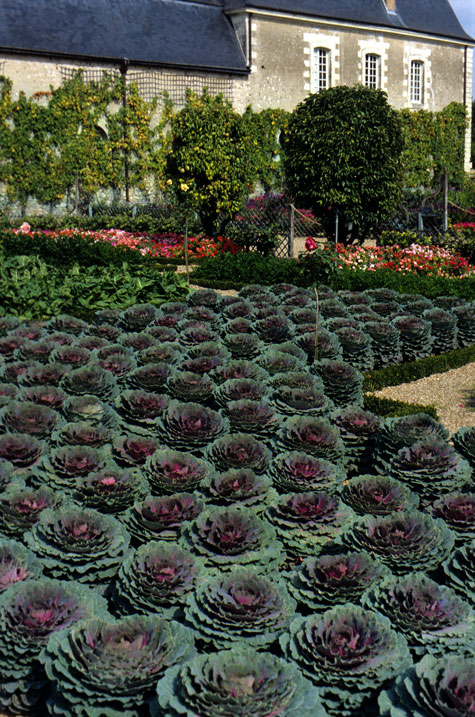
Kale at the Chateau- Villandry
‘Botany, n. The science of vegetables – those that are not good to eat, as well as those that are. It deals largely with their flowers, which are commonly badly designed, inartistic in colour, and ill- smelling.’
Ambrose Bierce ‘The Devil’s Dictionary’ 1911
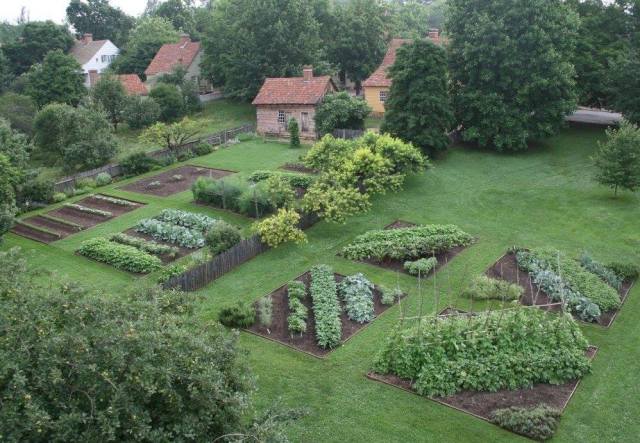
‘Diagonal Veg’ at Old Salem Museums and Gardens via P. Allen Smith
Old School Gardener




 Old School Garden