
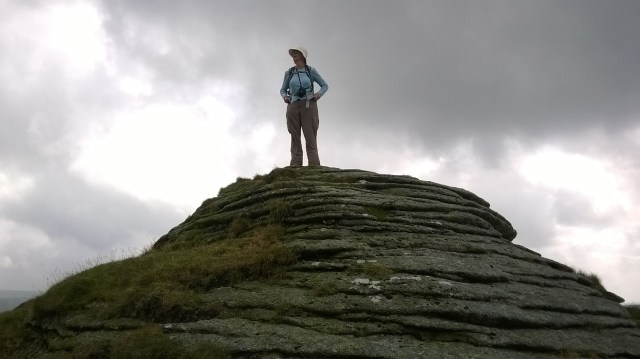
 This was the big one. Day three of our Tor Challenge was billed as an all dayer, packed lunch required. Travelling to the northern edge of Dartmoor at Meldon, near Okehampton, we headed for the reservoir, a beautiful site in itself and the starting point for our day’s walk.

Meldon Reservoir

The Dam

Longstone Hill
It was a long trudge around Longstone Hill and then across valleys and into the (today quiet) firing range, towards Black Down. From here we followed increasingly rugged and harder-to- see paths to the foot of West Mill Tor. A short, steep ascent was rewarded with a tremendous view on another beautifully sunny day. From here we could see our ultimate objectives- High Willhays (the highest point in Devon and southern England) and Yes Tor, slightly lower. It was also from here that we made our first spotting of…….a nude walker! At least that’s what it looked like as a well-tanned male torso was seen stepping out boldly towards the slopes of Yes Tor. Having got over the ‘shock’ of this sight we made our way down to a wide, well trodden path that would take us up to the ridge between the two tors we were left with.
This was steady walking, remembering to pick up a stone or two en route to add to the cairn atop High Willhays. It was here that we saw our nude friend once more, striding out but also rather aimlessly- was he looking for someone to show off to? (we didn’t get close enough to see if he had reason to show off…). Or was he following us? He seemed to be close to our route across to Yes Tor and even waved at me and said ‘Hi’ just after I snapped a picture to prove our point….

Adding a stone to the cairn at High Willhays

The Triangulation point on Yes Tor

View back to West Mill Tor from Yes Tor

Back to Nature- 1
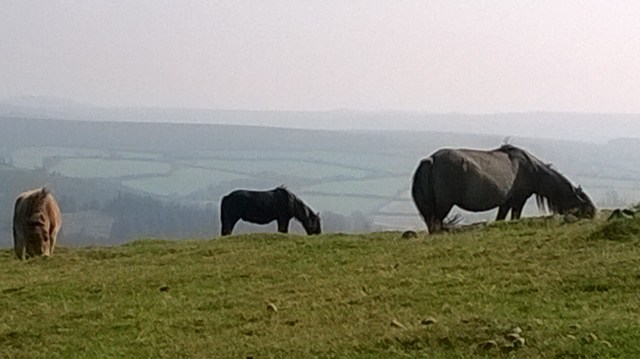
Back to Nature- 2….


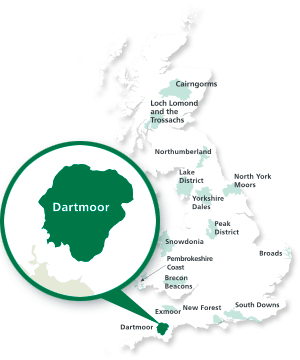
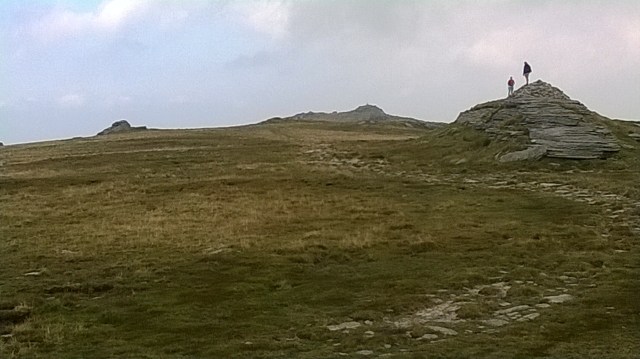 We’re just back from a week in Dartmoor, Devon, walking between some of the well-known, usually prominent rocky features of this beautiful landscape, known as tors.
  The Moor
 Varying climatic conditions occurring over millions of years, along with the cooling of the molten and other materials were the first, mainly chemical factors in the formation of the tors. Most recently, cold conditions in the Ice Age (between 2 million to 10,000 years ago), have caused major mechanical forces to shape the landscape we see today. Of these the most important is the expansion of freezing water. The deeply weathered granite was forced apart and broken up into blocks by being subjected to frequent freezing and thawing during the cold periods of the Ice Age, and gravity was also important, moving the loose material downhill.






 Old School Garden