Tag Archive: topiary


PicPost: Cotoneastersaurus

Seen somewhere in Yorkshire….

Old School Gardener

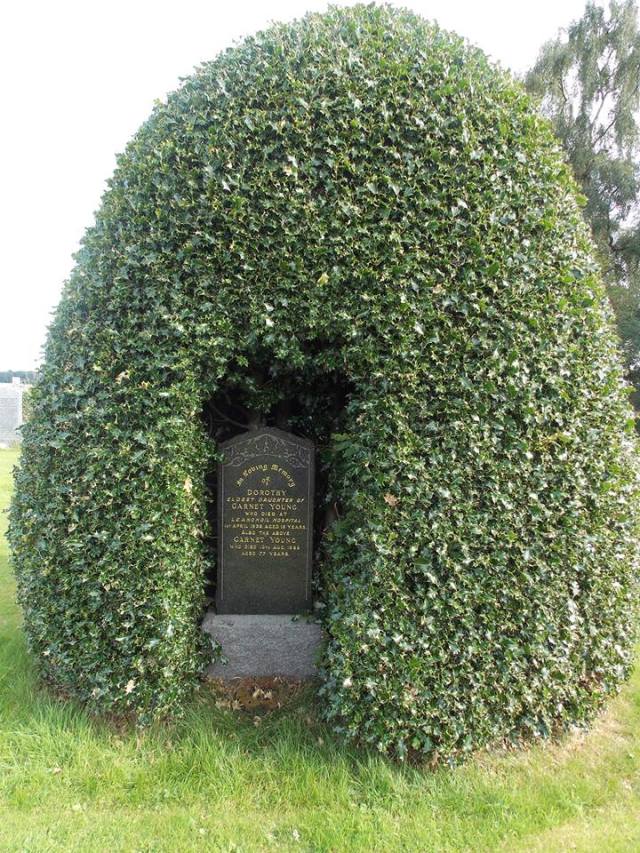
PicPost: Prickly End

Photo of a grave in Norfolk by Kelly Boldero

PicPost: Globe Theatre

Bom Jesus de Mont

Bom Jesus de Mont

I was fortunate to visit the northern Portuguese town of Braga about 10 years ago, though it was a rather cold and wet November, so it wasn’t an ideal time for garden viewing! And as I was on a study visit focused on social enterprise, gardens and gardening were not really on my mind.

Having said that one of my hosts, a lovely lady called Isabelle, did take me to the very impressive religious centre of Bom Jesus do Mont (Good Jesus of the Mount). Braga is a noteable religious centre and this Sanctuary is a famous pilgrimage site with a monumental Baroque stairway that climbs 116 metres and is flanked by several fountains. Pilgrims were traditionally  encouraged to climb the stairs on their knees as they took a journey that contrasted the senses of the material world with the virtues of the spirit. At the same time they experienced tableux scenes of the Passion of Christ (or Stations of the Cross), and the fountains suggested purification.The culmination of their efforts was found in the Temple of God – the church on the top of the hill. This sanctuary was begun in the 18th century and work proceeded over many decades, with the stairway and area around the church being turned into a park in the 19th century.

The other major space I visited was the Garden of Saint Barbara (Jardim de Santa Bárbara). In the early winter weather this was lacking in colour or any significance, but its layout looked interesting and there was some winter structure afforded by the evergreen topiary. Some of the pictures I’ve seen since show what a wonderful colourful oasis this is in summer. The garden was laid out in 1955 and the space was formerly part of the medieval Arch Bishop’s Palace, the remains of which adjoin the garden. The layout consists of geometric designs carved from beds of boxwood, decorated with cedar topiaries and filled with summer flowering plants.

There’s another important garden in Braga – the garden of the Biscainhos Palace (Casa dos Biscainhos – today a museum). I haven’t had the pleasure of visiting this, but it appears a to be a lovely example of a mid 18th century Rococo style garden, created at a time when the area was home to some of Portugal’s finest granite sculptors. The resulting garden is both ‘lighthearted and flamboyant’ (so writes Helena Attlee). Built on three levels it includes a flower garden and some typical Portuguese elements – wall planting troughs, azulejos (colourful tiles), complex box parterres and granite statues. The garden’s most notable feature, though, is its ‘Cool Houses’ (Casa do fresco) sculpted from living Camellias to form summer retreats. I do hope that I can see it, one day.

Other articles in this series:

Portuguese Gardens: Tropical Botanical Gardens, Belem

Portuguese Gardens: Estrela Gardens, Lisbon

Oranges and Azulejos: Portuguese Heritage Gardens

Old School Gardener

If you’ve enjoyed reading this post and others on this blog, why not comment and also join some other people and sign up for automatic updates via email (see side bar, above right ) or through an RSS feed (see top of page)?

This is the third in a series of ‘snippets’ on different garden styles. Today, formal gardens.

A successful formal garden is balanced, the design based on symmetry in its layout and a clearly recognisable ground plan or other pattern. Other features include:

  • Vistas – long channels in which the view is drawn towards a distant point or view

  • Statuary – often used as focal points within formal garden spaces or at the end of vistas

  • Topiary – ‘living statuary’ – small-leaved evergreen plants (Box and Yew, typically) are used to create all year round structure and focal points in the borders or spaces as well as hedges to create edges/ boundaries, parterres and knot gardens

  • Ornament – structures or materials are used which embellish otherwise plain surfaces or features

  • Natural stone – limestone, sandstone, granite, marble are all used to create a rich hard landscape which harmonises with the planting

  • Dramatic planting – specimen tress and shrubs are used as focal points and large expanses of single or limited numbers of species are used in mass effects

Let me know what you think makes a Formal style garden, and if you have some pictures I’d love to see them!

Other posts in the series:

Mediterranean Gardens

Cottage gardens

Old School Gardener

If you’ve enjoyed reading this post and others on this blog, why not comment and join others by signing up for automatic updates via email (see side bar, above right ) or through an RSS feed (see top of page)?

Paco de Sao Cipriano

Paco de Sao Cipriano

The latest meeting of the Norfolk Gardens Trust focused on historic Portuguese Gardens. Postponed from earlier in the year due to bad weather, the talk – which took place at Norwich’s John Innes Centre – was again delayed, this time due to travel problems!

I can say that it was well worth the wait. In a lively talk, gardening writer Helena Attlee explored a ‘cocktail’ of influences that have formed the typical historic portuguese garden. A fusion of historical, cultural and climatic factors has come together over the centuries, with the latest fashions and ideas in garden design being reinterpreted in the unique setting that is Portugal.

The country straddles the atlantic coast of Iberia and so its climate ranges from the warm and moist in the north to the near Mediterranean in the south, with the rocky outcrop of Sintra (just north of Lisbon) providing a microclimate that is particularly prone to damp air deposited from atlantic fronts. These climatic variations have clearly influenced the design and planting of gardens in the country, but arguably of greater impact has been the country’s historical development.

The Romans invaded in around 200 B.C. and stayed for around 500 years. Not surprisingly the gardens from this time show the features you’d expect of a roman garden – enclosed by a colonnade with a central water pool as the focus and with grand mosaics. Though even here, it seems that particularly Portuguese touches are evident – for example the curved niches and planting islands found in the pool of a reconstructed example of a roman garden at The House of Water Jets, in Conimbra.
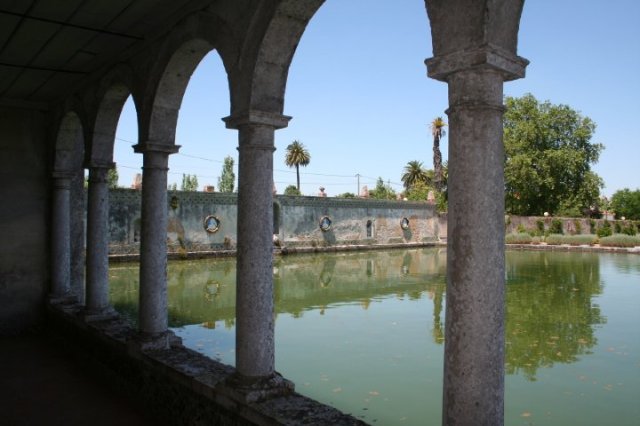
Quinta da Bacalhoa - the Water tank

Quinta da Bacalhoa – the Water tank

Possibly the greatest influence on garden design came from the invasions of arabs and other peoples from north africa – the so-called ‘Moors’. Arriving in the 8th century and remaining for about 400 years they brought with them the traditions of brimming water tanks, high walls to enclose the garden and capture the exotic scents of citrus fruit as well as decorated ceramic tiles – otherwise known as ‘azulejos’ in Portuguese. These citrus trees – bitter oranges and lemons – were introduced from the Himalayas, and it was some centuries later that sweet oranges were introduced into Europe – possibly by the italians (from india), or possibly by the Portuguese (from China).  Interestingly, up until the 20th century sweet oranges were known across europe as ‘Portugals’.

Azulejos at Quinta dos Azulejos!

Azulejos at  Quinta dos Azulejos!

Azulejos began as geometric or botanical designs and used a technique which trapped the coloured glazes in ridged areas on the surface of the tiles – the so-called ‘aresta‘ technique. They were used extensively to cover walls of gardens and buildings. The moorish aesthetic is also evident in the later patterning of box parterres which are more complex than the patterns seen in the grand gardens of France, Italy or Holland.

Even though moorish rule of Portugal ended in the 12th century, many of the skilled craftsmen stayed on and continued to influence garden and house design in the following centuries. However it was not until the growth of Portuguese economic power in the 16th century (based on its exploration and discovery of new lands and leading to the founding of the valuable spice trade) that grand Portuguese gardens started to flourish. Design ideas also travelled from the far east and were absorbed into the Portuguese style of the time – this was when complex parterres, citrus groves and water tanks came into their own, alongside further developments in azulejos. Initially imported from southern Spain by King Manuel I,  the tiles now moved away from repeat patterns of geometrical or botanical themes to assemblies of individual tiles into grand tableaux of  mythical and amusing scenes. The arrival of a new technique – Maiolica’– meant that glazes, and so pictures, could be painted directly onto the tile surface.

Complex parterres at Quinta da Bacalhoa, a superb example of an early renaissance Poprtuguese garden

Complex parterres at Quinta da Bacalhoa, a superb example of an early renaissance Poprtuguese garden. The area beyond was originally an orange grove

Following a period of rule from Spain, Portugal again found its independence in the early 17th century and this heralded a new period of rich garden making, with Delft blue tiles becoming fashionable (the Delft factory had a production line just for Portugal) and the creation of cartoon-like scenes (known as singerie) featuring monkeys and cats mimicking humans in scenes such as going to the barbers and taking piano lessons!

During the 18th century new colonial ventures in Brazil resulted in discoveries of gold and diamonds which fuelled another period of wealth, which once more found expression in the country’s gardens and houses. This second ‘golden age’ put Portugal at the forefront of europe’s economic powers, such that King Juan V was the richest monarch in the continent and could afford to order a solid gold bath for his mistress (who happened to be a nun)!

The dramatic well stairway at the Quinta da Regaleira, typical of the design work of Mannini

The dramatic well stairway at the Quinta da Regaleira, typical of the design work of Manini

This period saw influences from the Italian baroque make their mark in Portuguese gardens. Architects and designers such as Nasoni and Manini added a new flamboyance to the gardens of the wealthy and the latter in particular brought an opera set designer’s skills to create magical spaces where the rich could entertain. Further developments in azulejos also occurred during this period, with new, brighter colours and styles arriving influenced by the French Rococo. Some of these were to provide amusing Trompe d’oeil (visual tricks). The tiled canal at the palace of Queluz is perhaps the zenith of the azulejo. Here, candlelit tableaux lined the walls of the waterway, along which royalty and aristocrats glided by in their gondolas on warm summer evenings.
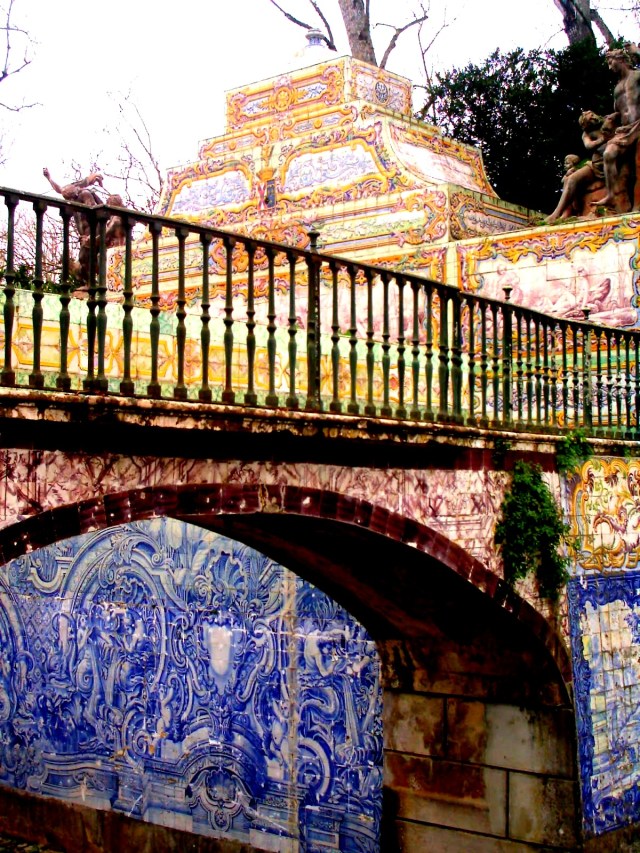
Azulejos lining the canal at Palacio de Queluz

Azulejos lining the canal at Palacio de Queluz

The Lisbon earthquake of 1755 (and ensuing fires and tsunami) wrecked huge areas of the city and its surroundings and so few great houses and gardens of the time inn tht area remained intact. A period of austerity followed during which the country’s Prime Minister, the Marquess of Pombal, removed many of the privileges of the rich aristocracy. Many of the gardens that remained fell into disrepair and few new ones of any note were created.

'Camellia Architecture' at Casa do Campo

‘Camellia Architecture’ at Casa do Campo

During the 19th century a new fashion for Camellia growing was born, centred on Porto and the north of the country where the moist warm climate favoured them. There is much evidence of the splendour of these gardens still in existence today, the Camellia bushes being trained into architectural shapes and even into ‘outside rooms’ which remained in flower between November and March when little else in the garden was of interest. During this time the discovery of new plants in far away places had its impact in Portugal as elsewhere and exotic specimens from Brazil and other countries were imported to some important gardens, including by British emigres involved in the Port trade. Further romantic – style houses and gardens were created, such as Montserrate and the National Palace of Pena at Sintra.

Parque de Serralves

Parque de Serralves

Perhaps not surprisingly, the talk concluded with a single example of a 20th century grand garden (Parque de Serralves), a rather ‘minimalist’ affair  featuring simple clipped box topiary and no other colours but that of the pinkish terracotta of walls and paths and the sky blue tiles lining rills and pools. Another garden (Casa da Pergola in Cascais, near Lisbon), originally created in the 19th century with a house that was renovated in the 1920’s gives a rather more modest ‘cottage style’ example of some of Portugal’s more modern gardens.

Casa da Pergola, Cascais

Casa da Pergola, Cascais

From my own knowledge, the 20th and 21st centuries have seen investment in public gardens and parks, which in their own ways are as important as the grand palace gardens of the earlier periods. I’ll be posting some information on some of my favourites over the coming weeks.

So, how to sum up Portuguese heritage gardens?

Well, as you can see they have absorbed and interpreted fashions, styles and ideas from other cultures and with the particular climatic, social and cultural conditions in the country have made them something uniquely Portuguese. Apart from ‘oranges and azulejos’ the other characteristic features seem to be:

  • Terraces

  • Trough or cavity walls filled with plants

  • Water tanks

  • Topiary, especially complex parterres

As far as planting is concerned, this tends to follow the local climatic conditions so features roses, succulents, palms and colourful annuals , especially in the hotter centre/south, whereas ferns, exotics and of course Camellias are common in the warm, moist north and around Sintra.

A public garden in Braga, northern Portugal.

The Garden of Santa Barbara, a public garden in Braga, northern Portugal

Sources and other information:

‘The Gardens of Portugal’ by Helena Attlee (published by Francis Lincoln, 2008)

Gardenvisit- Portuguese gardens

Article by Helena Attlee

Sheila Sim photography gallery of Portuguese gardens

Old School Gardener

If you’ve enjoyed reading this post and others on this blog, why not comment and join others by signing up for automatic updates via email (see side bar, above right ) or through an RSS feed (see top of page)?

PicPost: One foot in the groove

IMG_5170As I sit and look out of my window this cold January day, the snow has started to fall once more- looks like the heaviest fall will be later today. So the firewood has been stacked and fortunately the week’s shopping was done yesterday…

At this time of year you could be forgiven for thinking there’s not much of interest in the garden. We tend to focus on the other seasons when we think about (or impulse-buy) plants. The weather itself isn’t exactly encouraging us to visit the nursery or garden centre. And anyway, they seem to be rather  forlorn places at this time of year, especially the bigger ones that have ‘diversified’ into Christmas tat- the shelves are either emptying to make way for spring gardening stock or they’re full of half price Christmas cards and tinsel…

Well, we should perhaps think about how our garden looks in every part of the year, especially the important views into it from the house, road etc. In the winter, it’s these views that count, as it’ s less likely you’ll want to venture into the wet or cold garden itself.

The choices are significant – yes you can have:

  • beautiful flowers
  • powerful fragrance
  • colourful fruit
  • vibrant stems
  • interesting bark
  • strong  form
  • fascinating  foliage

Here are seven examples of the sorts of plants that can be a winter wonder in your garden.

Dogwoods provide wonderful winter stem colour

Dogwoods provide wonderful winter stem colour

1. Dogwoods (Cornus species)- vibrant stem colours make this a winner especially where you can group several plants together and maybe combine them for subtle effects (try C. alba ‘Sibirica’ (red) surrounded with C. sanguinea ‘Midwinter Fire’– amber- orangey red). Prune the stems back to the base of the plants in spring or leave one or two stems to grow taller and then pollard it for extra height (prune ‘Midwinter Fire’ less)- you will also get some lovely autumn leaf colour.

Witch Hazels- magical spidery flowers

Witch Hazels- magical spidery flowers

2. Witch Hazel (Hamamelis in many different varieties)- beautiful spidery-like flowers are magical in woodland edges. Grow as specimens or focal points under trees or in open ground – will grow about 2 metres high and wide over time.

Crab apple 'Red Sentinel'- plum-sized fruits that birds seem to avoid

Crab apple ‘Red Sentinel’- plum-sized fruits that birds seem to avoid

3. Crab apple (Malus species and cultivars – but not the ‘orchard’ apple Malus x domestica)- some of these smallish trees are suitable for smaller gardens with their columnar growth – e.g. M. tschnoskii (which can grow to 12 metres high but only 7 metres across). The main reason for growing them, in my view, is their fruit. Plum – sized apples which seem to be just the right size to not interest birds, so you’ll hopefully be left with a great show throughout winter. I particularly like M. x robusta ‘Red Sentinel’ (can grow to 7 metres high and wide). And Crab apples give great spring flowers and autumn colour too.

Mahonia x media- black fruits follow the flowers

Mahonia x media- black fruits follow the flowers

4. Oregon Grape (Mahonia species and some cultivars)- this is a winner on several counts, but mainly through its winter flowers and foliage. It’s evergreen  leaves (some spiky) will burnish orangey-red if exposed to the sun. My favourite is the hybrid M. x media ‘Charity’ which is an erect evergreen shrub with sharply toothed leaves and dense yellow flowers that cascade from the stems. One ideally for part shade, so a woodland edge is perfect.

Viburnum x bodnantense- wonderful scented flowers

Viburnum x bodnantense- wonderful scented flowers

5. Viburnum x  bodnantense ‘Dawn’ there are many different Viburnums, and they make a wonderful addition to the garden for their flowers, fragrance and foliage at different times of the year. This one is a hybrid and is chiefly grown for its wonderful scented flowers which grace the medium-sized deciduous shrub through winter on bare stems.

Box- small leaves make it ideal for strong  topiary shapes

Box- small leaves make it ideal for strong topiary shapes

6. Box (Buxus sempervirens or if you want a slower growing, more compact form go for the variety ‘Suffruticosa’)- one of the great plants for shaping into strong forms that help to carry your garden’s structure through the winter months. Also, don’t forget that some perennials will add form and structure to your garden through their dead stems and shapes. For Box start growing small and gradually develop your desired form, or buy (at some expense) some of the ‘ready- to – rock’  topiary at nurseries and garden centres. There are some wonderful examples of historic topiary in Britain such as Levens Hall, Cumbria.

320px-Paperbark_Maple_Acer_griseum_Bark_3008px

Paper-bark Maple- bark peels into subtle tones

7. Paper bark Maple  (Acer griseum)- a fantastic, slow growing tree which can reach 10 metres high and broad. Like most Acers it gives great autumn leaf colour, but it’s main attraction is the peeling bark which looks especially magical with low winter sun shining through it.

Further information;

Guardian online

Winter containers

Winter vegetables

Quizzicals:

answers to the last two-

  • Our monarch continues to work hard – Busy Lizzie
  • Nasty spot causing urination problems – Bladderwort

A couple of gardening ditties:

‘Whose sorrel now?’

‘Don’t leaf me this way’

(thanks again to buddie Les for these)

Old School Gardener

Finding Nature

Nature Connectedness Research Blog by Prof. Miles Richardson

Norfolk Green Care Network

Connecting People with Nature

Discover WordPress

A daily selection of the best content published on WordPress, collected for you by humans who love to read.

Susan Rushton

Celebrating gardens, photography and a creative life

Unlocking Landscapes

Writing, photography and more by Daniel Greenwood

Alphabet Ravine

Lydia Rae Bush Poetry

TIME GENTS

Australian Pub Project, Established 2013

Vanha Talo Suomi

The Journey from Finnish Rintamamiestalo to Arboretum & Gardens

Marigolds and Gin

Because even in chaos, there’s always gin and a good story …

Bits & Tidbits

RANDOM BITS & MORE TIDBITS

Rambling in the Garden

.....and nurturing my soul

The Interpretation Game

Cultural Heritage and the Digital Economy

pbmGarden

Sense of place, purpose, rejuvenation and joy

SISSINGHURST GARDEN

Notes from the Gardeners...

Deep Green Permaculture

Connecting People to Nature, Empowering People to Live Sustainably

BloominBootiful

A girl and her garden :)