Tag Archive: summer


Eremurus 'Shelford Hybrids'
Eremurus ‘Shelford Hybrids’

With Spring round the corner and thoughts of summer-flowering bulbs, this week’s timely question comes from George White of Walthamstow, London:

‘A friend has some magnificent border plants which he knows only by the name Foxtail Lilies. What are they, and are they easy to grow?’

George, these plants are a glorious addition to summer borders and belong to the genus Eremurus. They are also known as ‘Desert Candles’ and are hardy herbaceous perennials in which tall spikes of star-shaped flowers arise from a ring of narrow, pointed foliage. The best and tallest are the series known as  ‘Shelford Hybrids’, whose flowers vary in colour but are often a pleasing soft, pinky beige. They can reach 2.75 metres tall and bear hundreds of primrose-sized flowers.

Eremurus stenophyllus bungei  is the yellow-flowered parent of these hybrids and reaches 1 metre in height. The other parent E. olgae, is late flowering, bears pink blooms, and reaches a height of 1.5 metres.

Other fine examples are the very tall E. elwesii with soft pink flowers (and it’s white-flowered variety ‘Albus’), and the even taller (up to 3 metres) E. robustus with pinky yellow flowers on spikes up to 1.2 metres long. Eremurus are quite easy to grow as long as they have a free draining soil around their roots and have lots of warm sunshine. Here’s a video on how to plant Eremurus bulbs. It will probably be at least one season before you see any flowers.

If you can’t wait until next year then now’s the time to  think about some other unusual summer flowering bulbs for your borders.

Camassia (Quamash) are easy to grow and are attractive late spring performers that look good with late tulips (I have some whose lavender-purple flower spikes contrast well with the orange tulip ‘Ballerina’). C. cusickii is 200mm tall with lots of pale blue flowers, while C. quamash (syn. esculenta) has spikes of white to deep-blue flowers and grows to 250mm tall. C. leichtlinii, 900mm tall, has white or blue star-like flowers and C. semiplena has semi double creamy flowers on sturdy stems.

Other summer bulbs of interest are Fritillaria persica ‘Adiyaman’ which stands between 800mm – 1.2 metres tall and in May produces unusual, deep -hanging bells of rich plum-purple. Leucojum aestivum ‘Gravetye Giant’ is probably the best of the summer flowering ‘snowflakes’ standing 300-500mm tall and has wide- hanging white bells in April and May.

If you are in a frost free area or able to lift your bulbs to protect them from winter frost, then Watsonia is a colourful spike- flowered border plant. And why not go for a touch of the exotic with a Canna or two? (better make that 3 at least). Summer flowering bulbs are already available to buy online through various well-known nursery companies and should soon start appearing in your local Garden Centre or nursery. Plant them in the spring as the soil begins to warm up.

Further information:

BBC gardening guide – summer flowering bulbs

Foxtail Lilies

How to grow Eremurus robustus

How to grow Eremurus stenophyllus AGM

Old School Gardener

raspberriesAnother guest article by one of the participants in the ‘Grow Your Own Food’ course I ran recently in Foulsham, Norfolk.
Raspberries – A superfood that tastes better than spinach-what’s not to like?!

by Chris Richmond

Health

Antioxidant and anti-inflammatory phytonutrients in Raspberries may have anti-cancer benefits and assist in the management of obesity, though possibly not if eaten with oodles of cream.

However, raspberries are among a small number of foods that contain measurable amounts of oxalates. When oxalates become too concentrated in body fluids, they can crystallize and cause health problems. For this reason, individuals with already existing and untreated kidney or gallbladder problems may want to avoid eating raspberries.

So…everything in moderation, even raspberries- unfortunately.

Varieties

There are two types of raspberry available to the kitchen gardener. Summer-fruiting varieties will crop at any time from the beginning of July to early August on stems of last season’s growth; autumn-fruiters bear their berries over a longer period – from mid-August to the first frosts – on the current season’s growth. Both are similarly easy to care for but require slightly different pruning techniques. As long as you know how to wield your secateurs around them there is little mystery to growing these accommodating fruits and their length of service – up to 12 years – means they give a lot back in return.

‘Glen Ample’ AGM – Delicious, large fruit produced in mid-summer on this extremely heavy-yielding summer cultivar with vigorous, upright, spine-free canes. The berries are produced on long, upright stems, making picking easy.

‘Glen Moy’ AGM – This early summer raspberry bears heavy crops of medium to large berries, which have a good flavour. It may also produce a small crop on the new canes, in autumn. The spine-free canes are compact.

‘Leo’ AGM – This cultivar is one of the latest summer raspberries to ripen, producing large, firm fruits with an excellent flavour. The stems are very long, so harvesting is easy. Site in a sheltered position.

‘Malling Admiral’ – A summer raspberry bearing good yields in mid- to late summer on strong-growing, tall canes, which are best sited in a sheltered spot. The flavour is excellent, and the large berries ripen to deep red.

‘Autumn Bliss’ AGM – The short, sturdy canes of this popular autumn cultivar produce high yields from late summer to mid-autumn. The fruit is large and deep red with a firm texture and excellent flavour.

‘Polka’ – This new autumn cultivar ripens two weeks earlier than ‘Autumn Bliss’, bridging the gap between summer and autumn. It produces very high yields of large, well-flavoured fruit.

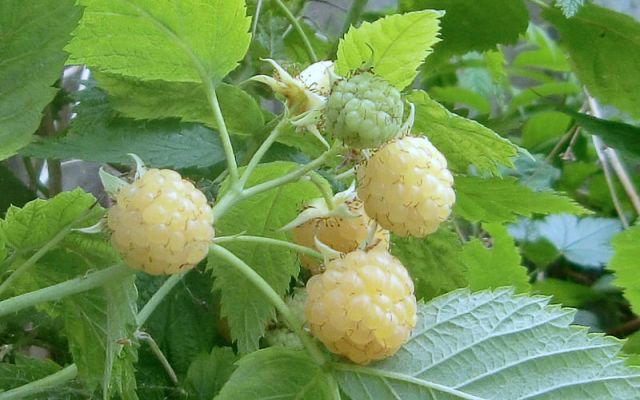
A Golden Raspberry Variety

Preparation

Like most edible crops, raspberries produce a better yield when grown in full sun. However, thanks to their woodland origins, they can be grown in a degree of shade too, as long as they receive at least a few hours of direct sunshine each day. They prefer slightly acidic soils, which is great news for gardeners who struggle to grow plants in these conditions. They like it to be moist as well, so be prepared to water the plants as they establish – but beware of waterlogged winter ground.

Be prepared to put in a bit of effort to get soil conditions just right before planting: thoroughly dig down to a spade’s depth along a row 90cm wide. Turn it over and remove any weeds, especially perennial types (such as bindweed and horsetail) and their roots.

Raspberries are shallow rooted, which means there won’t be much of an opportunity to weed as meticulously once the plants are in place, for fear of damaging their root system. They are also heavy feeders, so for every plant you intend to grow incorporate a bucketful of well-rotted manure or compost while digging, turning it all into the soil. Ideally soil preparation should be complete a month before planting; at the very least you should allow two weeks to give the earth time to settle.

They might play second fiddle to their Wimbledon-associated cousins on shop shelves but on the plot there should be no such bias – raspberry plants crop reliably year-after-year and ask for little in return. They even thrive in partially-shaded areas where few fruit or vegetables would grow. And such is their hardiness that they will produce a bumper crop of their sweet, mildly acidic fruits even in disappointing summers – a valuable trait given the last few we’ve experienced. They’re a great choice for those gardening in cooler, northern climates – as they flower late in the spring there is little danger of them being damaged by unexpected late frosts.

Planting

With a well-prepared growing area in place, planting shouldn’t present any difficulties. Buy in certified disease-free, one-year-old plants (usually called canes) from a reputable nursery or mail-order catalogue. They are usually acquired bare rooted, packaged up into bundles ready for planting. The best to time to plant them is in the autumn, from October through to early December, as the soil still retains a degree of warmth which will help the roots to grow and quickly settle the new introductions into place. If this isn’t possible they can, however, be planted any time up to March.

Position each cane into a shallow hole about 22cm wide and 7cm deep, spreading the roots evenly across the bottom. Backfill and firm in around them as you go, making sure that the soil mark on the canes is at least level with the surface and up to an inch beneath it – this will encourage extra root growth and quickly anchor the plants into place. Space them 45cm apart within the row, leaving 1.8m between further rows to allow room for the roots to spread sufficiently and enough space for picking.

The tall, gangly canes will need to be supported, so set up a suitable support system at planting time. The best system is a simple post-and-wire set-up – hammer in two sturdy, 2.4m-high posts at either end of the row, 60cm into the ground and 3m apart. Stretch three galvanised wires horizontally in-between them at heights of 75cm, 1m and 1.5m.

The top wire can be omitted if you’re growing an autumn-fruiting variety as they are much sturdier and require less support.

Grow your own tip- If you only intend to grow a few plants you can do away with a complete post and wire system and simply position up to two plants at the base of a single post for support. As the stems grow upwards, tie them loosely to the post using garden string.

Growing

Immediately after planting your canes, cut each one just above a bud so that they’re 30cm in height. By spring, new shoots will appear from the base of the old cane and these will need to be tied into the wires as they reach them. The original cane can be cut right down to about 3cm above ground level at this point, again just above a bud. Remove any weak shoots in this first summer and any appearing more than 20cm from the row. Be disciplined and remove any flowers that develop in the initial season too – the object of the first year is to establish a good base and allowing plants to channel energy into setting fruit will compromise this effort. In the following years pruning is simple, although it’s important to use the correct method depending on whether you’ve opted for summer- or autumn-fruiting varieties. The former should be cut right back to ground level as soon as they have finished cropping.

At this stage there will already be plenty of new growth at the base of the plant and these will be the fruiting stems for next year. Tie them into your support system using garden string, so that each stem is spaced around 10cm from the last. Cut down any spindly stems or those growing away from the row. Towards the end of the growing season, loop over and tie in place any really tall stems to prevent them falling over in the wind over winter. In early spring, before growth commences, cut them back to a bud about 15cm above the top wire so that they are uncluttered and in a good position when they start fruiting.

Pruning autumn-fruiters is much more straightforward – just cut back all of last year’s canes to ground level before growth starts in February. New shoots will appear from the base by spring and these should all produce fruit on the upper stem sections.

Crop care

Feeding and watering are pivotal to the success of a raspberry crop. Keep your canes moist and well-fed and, coupled with the correct pruning regime, you should be carrying away punnets full of berries. Watering is particularly important at flowering time, as the fruits swell, and during any dry spells.

Applying a thick layer of organic matter as a mulch in early spring will help to lock-in moisture (make sure the soil is moist beforehand) as well as feed the canes. Be generous – make it at least 5cm deep and more if you can spare it. Any well-rotted organic matter such as compost or manure will do but avoid mushroom compost – it is alkaline and therefore unsuited to the acid-loving plants. Mulches will also help to naturally nourish the soil and stifle weed growth. As raspberry roots are very shallow and can easily be damaged by hoeing, any weeds that make it through the mulch will need to be removed by hand.

New shoots that appear away from the main row or post are called suckers. It will be difficult to tie them in to the support system – instead, you should remove them by lifting them out of the soil, then use secateurs to sever them from the parent plant below ground level.

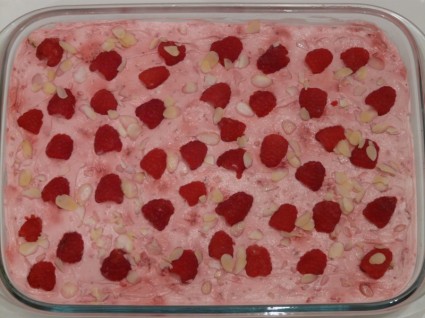
Raspberry curd quark dessert- one of many delicious sweets using raspberries

Raspberry curd quark dessert- one of many delicious sweets using raspberries

Stolen without permission from various websites including:

www.rhs.org.uk

www.growfruitandveg.co.uk

Chandler_strawberriesHere’s the second article in the new series ‘Eat Me’. This one has been written by another of the participants in the ‘Grow Your Own’ course that I ran recently in Foulsham, Norfolk.

Strawberries- a guest article by Colin Ferris

The fruit of the strawberry is not a berry but rather is a pseudo fruit or accessory fruit; some would not even accept the definition as a fruit. Indeed what appear to be the seeds on the outside are achenes, each of which is really a single seeded fruit.

Close up of strawberry

HISTORY

The  wild strawberry Fragaria vesca was the first to be grown and cultivated for its fruit until the hybrid ‘garden strawberry’ Fragaria x ananassa was bred in France in 1750. It is a cross between the North American  F. virginiana and  F. chiloensis  from Chile.

CLASSIFICATION

Fragaria is a flowering plant (Angiosperm) in the family Rosaceae. The Genus Fragaria contains about 20 species plus many hybrids and cultivars. The structure of the strawberry plant is quite typical of a member of the rose family, most noticeably when looking at the flower with its five petals.

Botanical-Fruit-Strawberry-2

CULTIVATION

Whilst generally considered in this country as a very typical British fruit, it is surprising to find that the UK does not even make it in the top ten of the world strawberry producers. By far the biggest producer is the USA, growing about 1.5 million tons of fruit per year. Strawberries grow well in any fertile soil and respond well to the addition of manure or fertiliser. It is not advisable however to grow them in soil that has previously been used to grow potatoes, chrysanthemums or tomatoes, due to the build up of soil pests and diseases. Plants will grow well for four or five years after which they decline and do not fruit well. It is thus best to replace them when four years old but not to grow the new plants in the same soil previously used for strawberries, i.e. employ suitable crop rotation.

Strawberries being grown hydroponically

PLANTING

Plant rooted runners or bought plants in fertile but well drained soil either in the ground, or in any form of container that can be suitably positioned in a sunny place and watered frequently. Plant in autumn or early spring but avoid cold wet weather and avoid areas prone to frost. Space plants about 14 inches apart with 30 inches between rows.  Keep plants well watered especially in dry spells but take care not to rot the crown with too much water given from above.  When fruits begin to form a mulch, typically straw, should be tucked underneath them to prevent rotting from the soil. Keep weed free. After cropping has finished remove old leaves and straw. If you will not be using them runners should be removed to prevent energy being wasted on them.

Strawberry flower
Strawberry flower

PROPAGATION

In order to produce new plants with the same characteristics as the parent plant, it is best to use strawberry runners. The stolons or runners produced by the plant are a form of vegetative reproduction and so produces plants that are genetically identical to the parent. It is important to let the new plants remain on the runner until a good healthy set of roots has formed.

CULTIVARS

Summer fruiting varieties These are the most popular with large fruits over a short but heavy cropping period of a few weeks. There are early, mid-, and late types.

Perpetual varietiesThese have a much longer fruiting season but fruits are smaller and crops not so heavy.

Strawberry display at Chelsea Flower Show 2009

PROBLEMS

Fungus – Botrytis grey mould, powdery mildew, leaf spot, Verticillium wilt, and red core: remove dead material immediately, lower humidity around plants, remove weeds and prevent overcrowding.

PestsRed spider mite, seed beetle and vine weevil: use appropriate sprays or preferably biological control. Birds: use netting or preferably a fruit cage, bird scarers may help but generally are of little benefit.

USES

Strawberries have such a wonderful flavour that they are used in so many recipes that it is impossible to list them. They are best when picked fully ripe (bright red in colour) when the sun has warmed them, and they taste extremely good with a little sprinkling of sugar and some fresh cream. Given that they crop heavily over a short period, strawberries are often used to make jam.

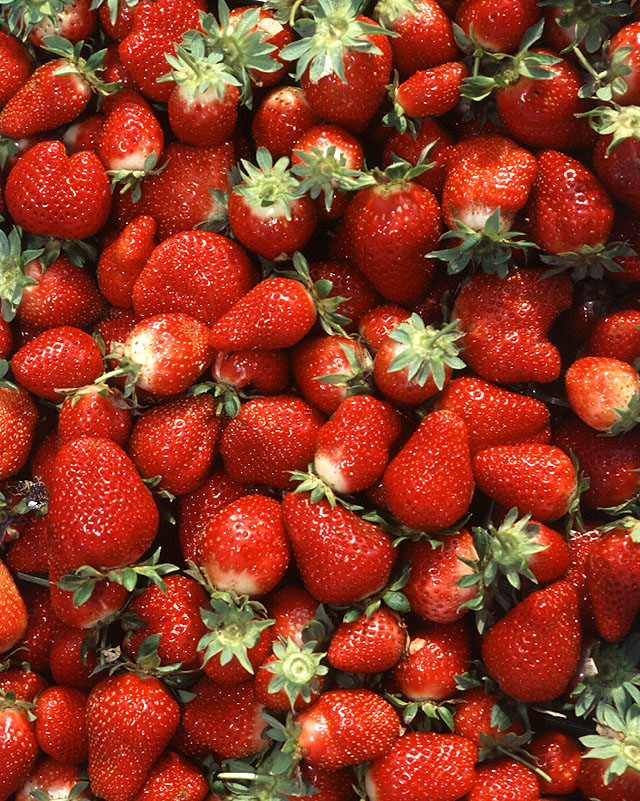
Strawberries and Cream- the tatse of an English summer...
Strawberries and Cream- the tatse of an English summer…

Old School Gardener

Nepeta- soem varieites are called Catnip or Catmint because cats love them!

Nepeta- some varieites are called Catnip or Catmint because cats love them!

Nepeta is a genus of about 250 species of perennials and a few annuals, native to cool and moist to hot and dry habitats in scrub, grassy banks, stony slopes or in high mountains, in non tropical areas of the northern hemisphere. So as you can see, there’s pretty much a Nepeta to suit every garden situation!

Some members of this group are known as catnip or catmint because of their effect on cats – the nepetalactone contained in some Nepeta species binds to the olfactory receptors of cats, typically resulting in temporary euphoria!

They have sturdy stems with opposite heart-shaped, green to grey-green leaves. Nepeta plants are usually aromatic in foliage and flowers. The tubular flowers can be lavender, blue, white, pink, or lilac, and spotted with tiny lavender-purple dots. The flowers are located in ‘verticillasters’ grouped on spikes; or the verticillasters are arranged in opposite groups – toward the tip of the stems.

Nepeta can be drought tolerant, being able to conserve water. They bloom over a long period from late spring to autumn. Some species also have repellent properties to insect pests, including aphids and squash bugs, when planted in a garden. Nepeta species are used as food plants by the larvae of some butterflies and moths and as nectar sources for pollinators like bees.

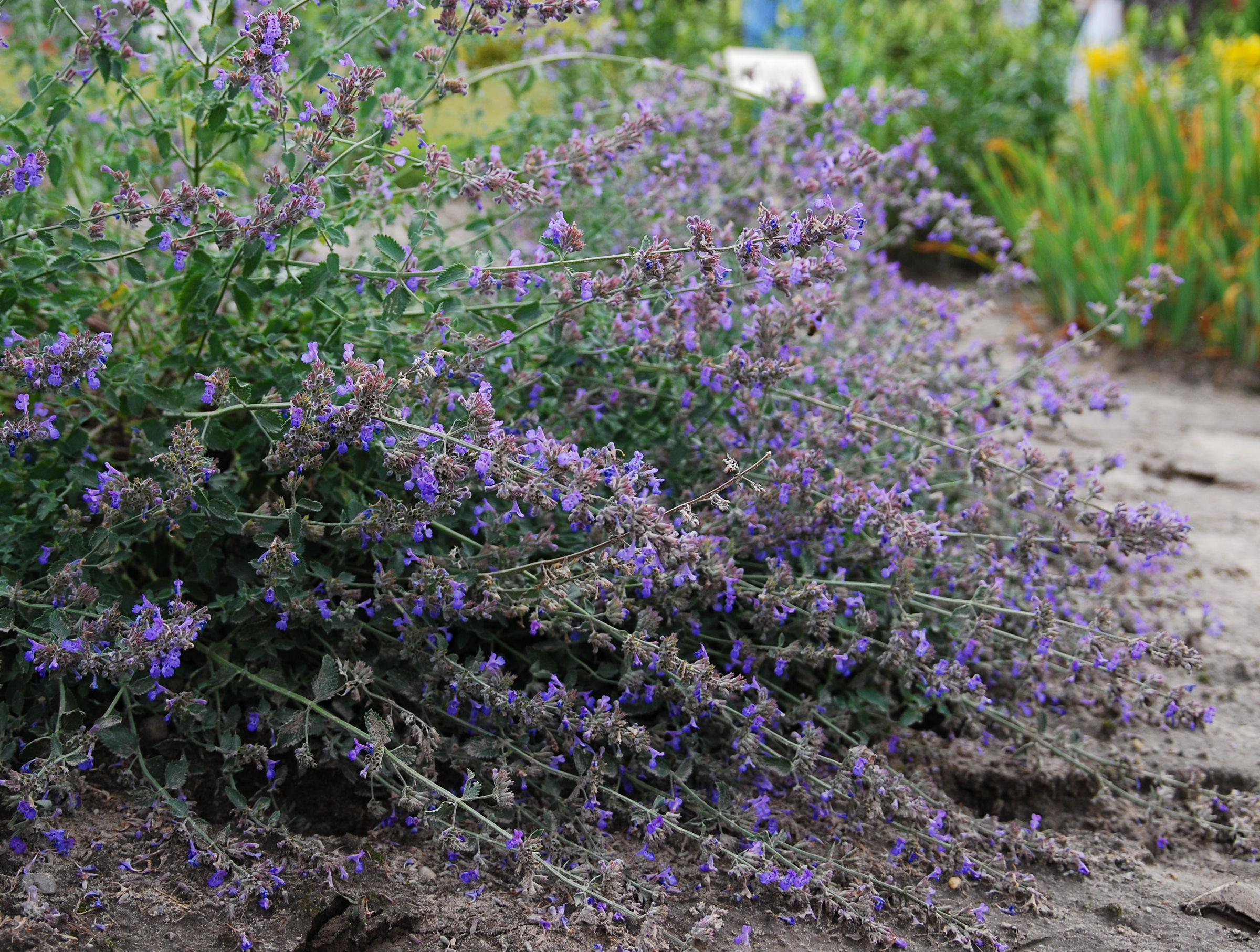
Nepeta makea a wonderful sprawling edge to an informal border

Nepeta makes a wonderful sprawling edge to an informal border

Nepeta can be grown in any well drained soil in full sun or partial shade. Some species, like N. govaniana and N. subsessilis prefer moist, cool conditions, whereas N. sibirica likes it fairly dry. There are a few tall growing varieties, like ‘Six Hills Giant’, with a more upright habit. These need staking or support to see them at their best.  Most Nepetas will rebloom if sheared back after their initial flowering (N. x faassenii and N. nervosa for example). Some won’t provide much of a second show, but their foliage will be refreshed and tidied by the shearing.

Nepeta looks wonderful when covered in flower from early summer. The pale, often lavender-blue flowers perfectly complement the hairy, scalloped and wrinkled, silvery, blue-green leaves. The flowers appear as a haze of blue from a distance. It is often used as an informal, low hedge echoing the colours of lavender (and is used as a substitute where lavender isn’t hardy enough). But it has a rather lax form and will spread itself to cover its allotted space (and more!). Nepeta is best planted at the front of the border, edging a path, so that when you brush past it you will catch the full scent from its aromatic leaves. Nepeta is also a classic underplanting for roses. The colours complement and the foliage hides the ugly ‘knees’ of the rose bush.

We have some here at Old School Garden and this year I’m experimenting with it in some raised planters to try to get a cascading effect, as I’ve seen it used effectively this way on top of an old garden wall in Devon, though I suspect some varieties will have longer stems than others so are better suited to this treatment. The pastel blues of Nepeta combine wonderfully well with pinks and yellows, such as day lilies and yarrow (Achillea). It also looks good with Allium cristophii and Zinnia elegans ‘Envy’.

Some suggested varieties:

  • N. nervosa ‘Felix’ – Compact plant with vivid lavender-blue flowers. (12″ H x 24″ W)
  • N. x ‘Six Hills Giant’ – One of the tallest growing Nepetas, with lavender-blue flowers.(36″ H x 30″ W)
  • N. subsessilis ‘Sweet Dreams’ – Pink flowers with burgundy bracts. Likes a bit more water than most Nepetas. (2′ H x 3′ W)
  • N. racemosa ‘Walkers Low’– has 8″ spikes of lavender-blue flowers.  ( 2 H’ x 2′ W)

Nepeta faassenii 'Six Hills Giant'- foliage

Nepeta faassenii ‘Six Hills Giant’- foliage

Nepeta is one of those plants that thrives on neglect. Too much fertilizer will only make it grow lots of flimsy foliage. A lean soil and somewhat dry growing conditions will encourage both flowers and scent. Many of the newer varieties of Nepeta are sterile, producing no viable seeds. This is a plus if you don’t like the weedy, self-seeding habit of older Nepeta varieties, but it means you will need to either buy plants or make plants from divisions or cuttings.  Division is not a requirement, but if you’d like more plants divide it in spring or in autumn. The Royal Horticultural Society have given it their prestigious Award of Garden Merit.

Nepeta longipes

Nepeta longipes

Sources and further information:

Wikipedia

BBC – Catmint

About.com

One plant 3 ways- Nepeta design tips

Old School Gardener

If you’ve enjoyed reading this post and others on this blog, why not comment and join others by signing up for automatic updates via email (see side bar, above right ) or through an RSS feed (see top of page)?

jasmine-bush OK, I know that Jasmine is technically a shrub or climber and not strictly a ‘perennial’ but it is a perennial plant like all shrubs, so perhaps you’ll allow me some license on a letter of the alphabet that is decidely low on choice of ‘proper perennials’!

Jasmine (Jasminum) is a genus in the olive family (Oleaceae). It contains around 200 species native to tropical and warm temperate regions. Jasmines are widely cultivated for the characteristic fragrance of their flowers. They can be either deciduous or evergreen, and can be erect, spreading, or climbing in habit. The flowers are typically around 2.5 cm (0.98 in) in diameter, are white or yellow in colour, although in rare instances they can be slightly reddish. The flowers are borne in clusters with a minimum of three flowers, though they can also be solitary on the ends of branchlets. Each flower has about four to nine petals. They are usually very fragrant. The berry fruits of jasmines turn black when ripe.  Of the 200 species, only one is native to Europe, but a number of jasmine species have become naturalized in the Mediterranean area. For example, the so-called Spanish jasmine or Catalonian jasmine (Jasminum grandiflorum) was originally from Iran and south western Asia, and is now naturalized in Spain and Portugal.

Widely cultivated for its flowers, jasmine is enjoyed in the garden, as a house plant, and as cut flowers. The flowers are worn by women in their hair in southern and southeast Asia. The delicate jasmine flower opens only at night and may be plucked in the morning when the tiny petals are tightly closed, then stored in a cool place until night. The petals begin to open between six and eight in the evening, as the temperature lowers.

Symbolically, Jasmine was used to mark the Tunisian revolution of 2011 and the pro democracy protests in China of the same year. Damascus in Syria is called the ‘City of Jasmine’ and in Thailand, jasmine flowers are used as a symbol of motherhood.  Several countries have Jasmine as their national flower. ‘Jasmine’ is also a girls name in some countries.

There are many cultivars of Jasmine – for summer and winter. Jasminum officinale (summer jasmine) is perfect for a sunny, sheltered spot in mild regions of the UK. Trachelospermum jasminoides, also known as ‘Confederate’ or ‘Star Jasmine’ is a sweet-smelling vine with small white flowers. It grows quickly up walls, trellises, fences, and even thrives as ground cover, but It is especially well-suited to be grown indoors.

Trachelospermum jasminoides

Trachelospermum jasminoides

The cheery yellow flowers of Jasminum nudiflorum (winter jasmine) will brighten up even partially shaded and cold sites at a time when little else is in flower. A popular and reliable shrub, introduced from China in 1844, and widely grown as a wall shrub, it can be allowed to scramble freely over a low wall or up a bank, or trained up a vertical framework. Unlike many other jasmines, winter jasmine does not twine, so will need tying-in if grown vertically. The stems are bright green and give an evergreen impression, even in winter when the tiny bright yellow blooms appear, weatherproof in all but the coldest snaps. Regular pruning keeps bushes under control and prevents bare patches from appearing. The Royal Horticultural Society has given it the Award of Garden Merit (AGM).


All jasmines need a fertile, well-drained soil in full or partial sun. Summer jasmine needs a sheltered spot, full sun and a south- or south west-facing aspect. Winter jasmine is more tolerant of partial shade and a south east or north west aspect. North and north east aspects are best avoided. Frost hardy species are fine in an unheated conservatory or a cold greenhouse kept frost-free with a small heater. Tender species may require a minimum night temperature of 13-15ºC (55-59ºF). Jasmines make lovely container specimens. Ensure you use a container with good drainage holes, cover the holes with crocks or grit, and fill with John Innes No 2 compost. Leave space at the top for watering, and place the pot in bright but filtered light.

Jasmine plant care is not difficult but does require vigilance.Well worth it to have that wonderful evening fragrance in the summer or some brightness in the dark winter months!


Sources and further information:

Wikipedia

Beginners guide to Jasmine

Royal Horticultural Society – growing Jasmine

How to grow Jasmine

Pruning Star Jasmine

Growing Jasmine indoors

Trachelospermum – RHS

Old School Gardener

If you’ve enjoyed reading this post and others on this blog, why not comment and join others by signing up for automatic updates via email (see side bar, above right ) or through an RSS feed (see top of page)?

Finding Nature

Nature Connectedness Research Blog by Prof. Miles Richardson

Norfolk Green Care Network

Connecting People with Nature

Discover WordPress

A daily selection of the best content published on WordPress, collected for you by humans who love to read.

Susan Rushton

Celebrating gardens, photography and a creative life

Unlocking Landscapes

Writing, photography and more by Daniel Greenwood

Alphabet Ravine

Lydia Rae Bush Poetry

TIME GENTS

Australian Pub Project, Established 2013

Vanha Talo Suomi

The Journey from Finnish Rintamamiestalo to Arboretum & Gardens

Marigolds and Gin

Because even in chaos, there’s always gin and a good story …

Bits & Tidbits

RANDOM BITS & MORE TIDBITS

Rambling in the Garden

.....and nurturing my soul

The Interpretation Game

Cultural Heritage and the Digital Economy

pbmGarden

Sense of place, purpose, rejuvenation and joy

SISSINGHURST GARDEN

Notes from the Gardeners...

Deep Green Permaculture

Connecting People to Nature, Empowering People to Live Sustainably

BloominBootiful

A girl and her garden :)