This ‘snippet on style’ focuses on gardening above ground – roof gardens (including ‘green roofs’), balconies and vertical gardens. Growing plants above ground has been going on for centuries: e.g. the ziggurats of ancient Mesopotamia and the Villa of the Mysteries in Roman Pompeii.
Roof gardens
A roof garden is any garden on the roof of a building. Roof gardens can be of ornamental value – especially in urban locations where no ground level garden is available. They can also play a part in:
providing food – Trent University has a rooftop garden which provides food to the student café and local citizens
temperature control – plants can help to reduce heat absorption on buildings (so reducing the need for artificial air conditioning), achieving a cooling of the environment by between 3.6 and 11.3 degrees Celsius
controlling and harvesting rain water run off – where urban areas are increasingly hard – surfaced, roof gardens can delay peak run off and so help to prevent flooding, as well as retaining moisture for later use by the plants.
adding to the appearance of a building
providing habitats or corridors for wildlife
recreational opportunities
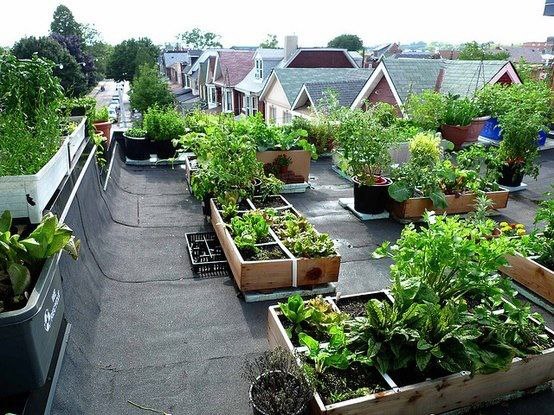
A great place to grow vegetables
Cultivating food on the rooftops of buildings is sometimes referred to as rooftop farming, and is usually done using special systems such as hydroponics, aeroponics/air-dynaponics or in containers. These systems can also help to reduce the stress on the roof that would otherwise have to carry a depth of soil over its whole surface. Sometimes as well as using the space on a roof, additional growing areas are added as ‘air bridges’ between buildings.
Roof Gardens are as old as the hills- this one’s in Assisi, Italy
A modern roof garden by Marigreen Ltd.
Rooftop veggy growing, Jamaican style
Formal raised beds on the roof
The Woodland Garden at the Roof Gardens Centre, Kensington, England
A densely planted roof garden by Bridgman.co.uk
The roof garden designed by Sir Geoffrey Jellicoe
Penthouse roof garden, New York, via Rezpector de Blanco
One person’s vision of how rooftop New York could look
In creating a roof garden there are several important factors to consider:
primarily the bearing capacity of the roof structure – this can be designed to be minimal, so really creating a ‘green roof’ (bearing about 100-300kgs per square metre) or ‘stepable’ (bearing over 300kgs per square metre)
prevention of roots and water penetrating the roof structure
the inclination of the roof (this should not exceed 30°)
the altitude of any attic, etc.
Roof gardens are likely to feature more and more in major cities – 80% of Singapore residents voted for more roof gardens in the City’s future plans. The containers/planters on a roof garden may be designed for a variety of functions and vary greatly in depth to satisfy aesthetic and recreational purposes. These planters can hold a range of ornamental plants: anything from trees, shrubs, vines, or an assortment of flowers. Where aesthetics and recreation are the priority roof gardens may not provide the environmental and energy benefits of a green roof.
A ‘green roof’ made up of various succulent plants
Balconies
Once again you need to be aware of how much weight your balcony can take, so seek structural engineer or architect advice if you’re unsure. Balconies can be used for both ornamental or food plants, but it’s worth thinking about your layout before you start. To maximise growing space, suspend window boxes along the balcony edges, place soil-warming terracotta planters in the sunniest patches, and put lean-to shelves against the wall to accommodate extra pots. Here’s a video about setting up a balcony garden using permaculture principles.
A smart balcony garden in Mumbai
A balcony with a selection of pots for growing herbs and food can look attractive
Vertical Gardens
For those who live in small apartments with little space, ‘square foot gardening’, or (when even less space is available) vertical gardens or ‘living walls’ can be a solution. These use much less space than traditional gardening – square foot gardening is said to use 20% of the space of conventional rows and ten times more produce can be generated from vertical gardens. These also encourage environmentally responsible practices – eliminating tilling, reducing or eliminating pesticides, and weeding, and encouraging the recycling of wastes through composting. Some of the most familiar vertical gardens are called ‘living walls’ – a concept where low growing and small plants are placed into a matrix which is then fixed to a wall. Such designs can be immense in size, covering the entire sides of buildings. They are also increasingly being used inside building spaces, such as foyers and receptions, to create a contemporary and eco-friendly ambiance. There is a trend towards more living walls in people’s homes. This has led to many companies now providing products which create a vertical garden to liven up the side of a house or patio, and platforms of pots which can be planted with herbs and vegetables on a balcony. Some of my own articles feature the use of old pallets for vertical planters and these too can be considered as ‘living walls’ and are a useful addition to conventional ground level gardens as well as homes which lack much outside space.
There are clear advantages to vertical gardens:
creating growing space where normal ground level space is restricted
offering a green outlook to those who want to avoid views of concrete and bricks
creating spaces which are beneficial to both mental and physical health
making it easy to grow food plants such as herbs and salads
If you’ve enjoyed reading this post and others on this blog, why not comment and join others by signing up for automatic updates via email (see side bar, above right ) or through an RSS feed (see top of page)?
This latest ‘snippet on style’ focuses on leaves. You might think that gardens designed around leaves would be boring. Not a bit of it. Foliage comes in all shapes, sizes and many colours (or shades of green). With the occasional splash of floral colour and other focal points thay can provide a wonderfully soothing, and sometimes exotic air. Foliage gardens are typified by the use of leaf and plant texture and shapes as well as subtle variations in leaf colour to provide interest, rather than floral display at different times of the year, which tends to drive other garden styles or at least their planting plans.
Sometimes the whole garden is about foliage, punctuated with flower or other colour (for example The Exotic Garden in Norwich – see link below). Sometimes specific areas in a larger garden are devoted to foliage, with the emphasis on contrasting varieties and plant forms. These gardens are typically organic in shape, with no hard edges and informal in layout and feel. They can also feature items such as sculpture or garden furniture made out of rustic materials and used as focal points set off against the foliage. Other key features of foliage gardens include:
Bold foliage
Colourful highlights
Pools and reflections
Containers
Locally sourced, rough materials
Height and structure
Shades of green and varied leaf shape and texture with splashes of colour at The Exotic Garden, Norwich
Broad leaves contrast with strappy leaf shapes and create a sense of enclosure
Informal path among the ‘leafscape’
Tree house – The Exotic Garden, Norwich
Ccontrasting colour and texture from bamboo canes atThe Exotic Garden, Norwich
Tetrapanax at The Exotic Garden, Norwich
Oriental sculpture provides a focus among the foliage at The Exotic Garden, Norwich
Canna musifolia at The Exotic Garden, Norwich
Vitis cognitiae autumn colour at The Exotic Garden, Norwich
If you’ve enjoyed reading this post and others on this blog, why not comment and join others by signing up for automatic updates via email (see side bar, above right ) or through an RSS feed (see top of page)?
This is the fourth in a series of ‘snippets’ that try to capture the essence of a particular garden style. today, ‘modernist’ gardens – I prefer this term to ‘contemporary’ as it is less laden with connotations of what is deemed to be ‘fashionable’ – so a more neutral term, hopefully!
Modernist gardens are crisp and clean. They rely on scale and proportion to provide a dramatic setting and there is simplicity and an absence of ornamentation or embellishment. They often have a strong geometric layout and are open and uncluttered. Sharp lines – whether straight, angled or curved – reinforce the contrast between verticals and horizontals, which are created by the use of structures (walls, pergolas, arbours, seating etc.) and planting (especially those with strong ‘architectural’ forms). Other key features include:
asymmetry
subtle but clear changes in level
modern materials (e.g. concrete, steel, glass, plastics)
planting in blocks
contemporary furniture
reflective water
Let me know what you think makes a Modernist style garden, and if you have some pictures I’d love to see them!
If you’ve enjoyed reading this post and others on this blog, why not comment and join others by signing up for automatic updates via email (see side bar, above right ) or through an RSS feed (see top of page)?
This is the third in a series of ‘snippets’ on different garden styles. Today, formal gardens.
A successful formal garden is balanced, the design based on symmetry in its layout and a clearly recognisable ground plan or other pattern. Other features include:
Vistas – long channels in which the view is drawn towards a distant point or view
Statuary – often used as focal points within formal garden spaces or at the end of vistas
Topiary – ‘living statuary’ – small-leaved evergreen plants (Box and Yew, typically) are used to create all year round structure and focal points in the borders or spaces as well as hedges to create edges/ boundaries, parterres and knot gardens
Ornament – structures or materials are used which embellish otherwise plain surfaces or features
Natural stone – limestone, sandstone, granite, marble are all used to create a rich hard landscape which harmonises with the planting
Dramatic planting – specimen tress and shrubs are used as focal points and large expanses of single or limited numbers of species are used in mass effects
Want help to create your own Garden of Eden?
Let me know what you think makes a Formal style garden, and if you have some pictures I’d love to see them!
If you’ve enjoyed reading this post and others on this blog, why not comment and join others by signing up for automatic updates via email (see side bar, above right ) or through an RSS feed (see top of page)?
This is the second in a series of snippets of information and pictures that try to capture the essence of different garden styles.
Mediterranean style gardens have undefined pathways, often covered with loose material such as gravel, which is used as a mulch over planting areas- this serves to unify the different elements of the garden. Other key features of this style include:
shady seating areas – pergolas, arbours or under sun awnings
gravel or paved/tiled floors
rills and pools of water and the sound of flowing water
succulents, silver foliage and other drought loving plants
terracotta pots and tiles
mosaic wall/floor features
painted walls
informal planting, painted walls
silver foliage
shady seating areas
Terrracotta pots,water
luxuriant self-sown planting
Let me know what you think makes a Mediterranean style garden, and if you have some pictures I’d love to see them!
Old School Gardener
If you’ve enjoyed reading this post and others on this blog, why not comment and join others by signing up for automatic updates via email (see side bar, above right ) or through an RSS feed (see top of page)?










 Old School Garden