Tag Archive: shrub rose


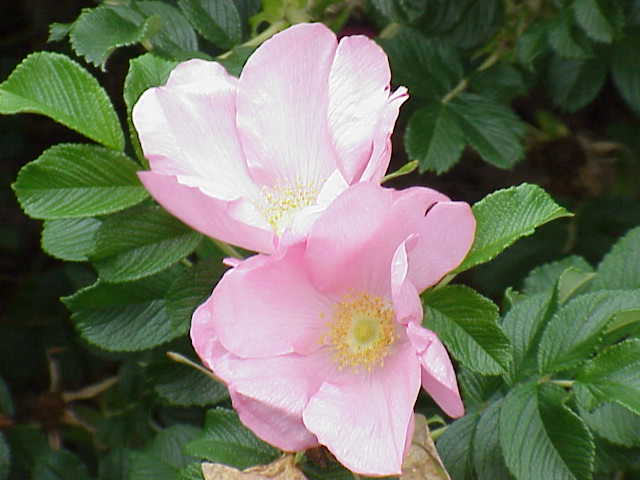
Rosa rugosa 'Frau Dagmar Hastrup'- shrub rose growing at Old School Garden

Rosa rugosa ‘Frau Dagmar Hastrup’- a shrub rose growing at Old School Garden

What an appropriate question for St. Valentine’s Day, from Minah Petaly of Lincoln:

‘I’ve heard that old roses and shrub roses only flower once a year and that shrub roses would be too big for a small garden like mine. And what would you suggest I grow to get large, decorative hips (no sniggering please)?’

Ha, ha, Minah! It’s true that all the old garden roses will flower once a year but there are some notable exceptions: most Bourbons, the hybrid perpetuals and China roses. This is also true of the wild (species) roses, however, a high proportion of modern shrub roses raised during the last 100 years are recurrent flowerers.

As to size, it’s by no means true that all shrub roses are too large for small gardens. Some of the modern ones developed in the past century will reach only 1.2m (4′) high or less. And the varieties ‘Yesterday’, ‘Frank Naylor’, and ‘Saga’ could also be added to these.
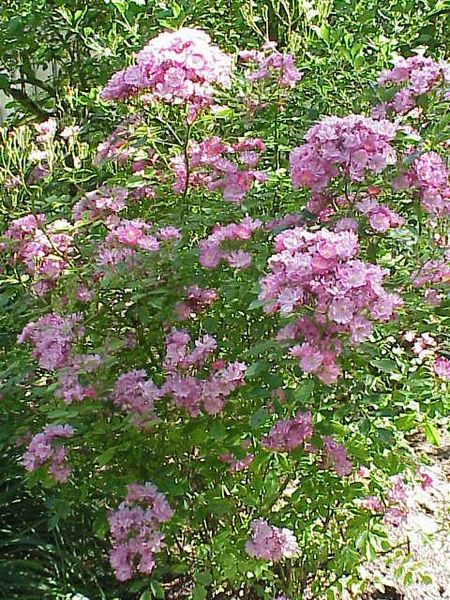
R.'Yesterday'

R.’Yesterday’

Of the older roses, most of the Gallicas and China roses grow within this limit too, as do a few examples from other groups. Particularly suitable for smaller gardens are the alba roses like ‘Felicite Parmentier’ and ‘Konigin von Danemarck’ while the species or wild rose ‘Canary Bird’ (pause for a chant of ‘Come on you Yellows’- the canaries is the nickname of Norwich City F.C.), can be kept to a moderate height if grown as a standard.

Looking at hips (!), for their sheer size and redness, pick members of the rugosa family that have single flowers, such as ‘Frau Dagmar Hartopp’, R. rugosa alba, and ‘Scabrosa’. Another good one, growing here in Old School Garden is ‘Frau Dagmar Hastrup’. As they are recurrent flowerers, the hips from the first flush of flowers appear with later blooms.

A hip on Rosa rugosa

A hip on Rosa rugosa

Many of the wild (species) roses have hips in varying colours from red through to orange and yellow, and some even black. R. roxburghii has prickly hips resembling the fruit of the Horse Chestnut (conkers), while those of R.pomifera resemble large red gooseberries. Perhaps the most spectacular hips are those of R. moyesii and its various hybrids; they are bottle-shaped, bright red and each may be up to 50mm long. To continue with the footballing (soccer) theme, this is perhaps one for Manchester United supporters – both on grounds of colour and name!

Old School Gardener

Rosa rubiginosa- a wild or species rose that needs minimal pruning

This week’s gardener’s question comes from a Miss Flora Dunmore of Argyll, and focuses on roses:

‘I’ve just inherited a big garden with lots of different roses, icncuding bush, climbers and ramblers. Can you tell me why, when and how to prune these, please?’

Flora, what a lovely inheritance! First why do you prune:

  • to remove weak, spindly and diseased shoots

  • to encourage strong new shoots to grow from the base of the plant each year (these bear the best flowers)

  • to open out the centre of the bush to increase air circulation (this helps to check disease)

  • to create a pleasing (usually symmetrical) outline to the plant.

When to prune depends on the types of roses you have:

  • For large-flowered bush roses the traditional months are March in the south and April in the north of England (and possibly even later in Scotland), when growth is just beginning- but pruning can be done safely any time from November  onwards in the south, provided you are prepared, if necessary to remove some frost damaged growth in spring. Most importantly never prune during a frosty spell.

  • For ramblers the best time to prune is after flowering, probably late August (you can dead head throughout the flowering season to achieve much the same result)

  • For climbers, the best time is October, when the recurrently flowering types have finished their show, but it can be done later if the weather is mild.

The techniques for pruning vary according to the type of rose:

For large flowered, bush roses cut away completely any diseased,weak and spindly shoots as well as removing all dead stumps from earlier pruning (use a fine toothed saw if they are particularly woody and thick). If there are many canes criss-crossing in the centre then remove a few to open out the bush. If two shoots are growing so that they rub each other, remove one. Finally, cut the remaining shoots back to about 200-250mm long. Harder pruning than this will produce larger, but probably fewer flowers – but it won’t harm the rose.

For smaller, cluster-flowered roses do the same as for larger flowered varieties but leave  the main shoots 300-350mm long. If the main shoots have side shoots, the latter don’t need to be removed, provided they are fairly thick (say about a pencil thickness), but they should be cut back by about two-thirds of their length.

Climbers should be pruned to establish a permanent framework of significant branches from which flowering stems are produced. To achieve this cut back side shoots to one or two buds from the point where they branch out from the main shoots. If the plant has become bare at the base, cut one of it’s main shoots hard back to encourage new growth from ground level.

Ramblers need to be pruned to encourage flowering on young shoots that grow from the base of the plant each year. To achieve this cut out completely the side shoots that have finished flowering and tie in the new shoots in their place. If in some years there are only a few of these, some of the old shoots (which can still produce flowers) may be left in place, but their side shoots should be shortened by about two-thirds.

Rambling roses need a framework of stems establishing with selctive removal of the oldest to encourage new growth form the base and flowering shoots pruned after flowering

Rambling roses need a framework of stems establishing, with selective removal of the oldest to encourage new growth from the base and flowering shoots pruned after flowering

Miniature Roses which produce a thick tangle of tiny, wiry shoots, require these to be thinned out. Remove dead or diseased shoots and trim back the rest by about two-thirds. It may be difficult to find a bud to cut back to, so just clip them over so that they look neat.

Shrub roses vary enormously in size and type, so it’s difficult to give a general guide to pruning. Wild (species) roses should not be pruned at all, other than for removal of dead or diseased branches. Most of the old garden roses such as Gallicas, Damasks, Albas, Centifolias and Bourbons will give more flowers if they have their side shoots shortened by about two-thirds in winter. Modern shrub roses that are in fact like giant versions of the smaller cluster types should be pruned in a similar way to those – but reduce their height by only about two-thirds. The Rugosa family needs little if any pruning, although for the less dense kinds,  a few older canes cut back every two-three years will encourage bushiness.

If you have newly planted roses then you should prune them even harder than established plants so that a strong framework of new shoots will be built up for the beginning. Leave their shoots only about 50-75mm long. Prune autumn planted roses when you do your established ones and spring planted ones at planting time. But, don’t prune climbers at all in their first year, as they take longer to establish.

Pruning cuts are easiest with secateurs. Ensure that a clean cut is made with clean blades (these should be sterilised with surgical spirit/alcohol to avoid passing on diseases from plant to plant). Cuts should be made about 6mm above a bud on a shoot; the cut should slope down towards the side away from the bud. Cutting to an outward- facing bud encourages the bush to spread outwards, but don’t worry if you can’t find one exactly where you want to cut- often a bud lower down will grow away more vigourously in the direction you want, and you can always trim it back later.

Clean secateurs with surgical spirit or alcohol before pruning each rose plant

Old School Gardener

Finding Nature

Nature Connectedness Research Blog by Prof. Miles Richardson

Norfolk Green Care Network

Connecting People with Nature

Discover WordPress

A daily selection of the best content published on WordPress, collected for you by humans who love to read.

Susan Rushton

Celebrating gardens, photography and a creative life

Unlocking Landscapes

Writing, photography and more by Daniel Greenwood

Alphabet Ravine

Lydia Rae Bush Poetry

TIME GENTS

Australian Pub Project, Established 2013

Vanha Talo Suomi

The Journey from Finnish Rintamamiestalo to Arboretum & Gardens

Marigolds and Gin

Because even in chaos, there’s always gin and a good story …

Bits & Tidbits

RANDOM BITS & MORE TIDBITS

Rambling in the Garden

.....and nurturing my soul

The Interpretation Game

Cultural Heritage and the Digital Economy

pbmGarden

Sense of place, purpose, rejuvenation and joy

SISSINGHURST GARDEN

Notes from the Gardeners...

Deep Green Permaculture

Connecting People to Nature, Empowering People to Live Sustainably

BloominBootiful

A girl and her garden :)