
 Here’s the final article by one of the participants in a ‘Grow Your Own Food’ course I ran recently in Foulsham, Norfolk. I’m planning to run another course starting in February (Tuesday mornings for 6 weeks) as well as another one focused on helping participants use design to reshape their own gardens (Monday evenings at Reepham, Norfolk). More details can be found at www.reephamlearningcommunity.co.uk
Cherry Trees
Guest article by Ann Blezard
Choose a sunny spot for your tree (approx. 6 hours direct sunlight a day). Acid cherries will tolerate some shade. Cherries grow particularly well in southern and central England.
Cherries will grow well in almost any kind of soil, but avoid soil that stays soggy for extended periods. Spreading a layer of mulch over the soil around your tree will help it grow better.
Some cherry trees cannot pollinate themselves and will need pollination partners. Others are self- fertile.
 Cherries can be grown as different sized trees, dependign on the root stock you choose. Here’s a dwarf Stell
  Here’s the dwarf Stella one year after planting showing a bird guard to protect fhe fruit
Cherries can be grown as different sized trees, dependign on the root stock you choose. Here’s a dwarf Stell
Here’s the dwarf Stella one year after planting showing a bird guard to protect fhe fruit
It is preferable to grow cherries from a rootstock as it can take 10 years or more to obtain the first fruits from a cherry grown from seed.
Cherries are now available as a dwarf rootstock, growing to approx. 10ft, instead of the usual 40ft, allowing you to cover the tree with bird netting to protect your crop.
Cherry trees should be planted between November and March. Mulch in late February with well-rotted organic matter. Keep trees well watered during the early stages of fruit development. Apply potash if fruiting is poor.
Cherry trees flower early in the year, the flowers will need protecting from frost. Cover with horticultural fleece if frost is predicted, however remove during the day to allow access to pollinating insects.
 Stella- a popular sweet variety that is self fertlile
Stella- a popular sweet variety that is self fertlile
Sweet cherries will fruit on one-year old and older wood. Formative pruning takes place in spring as the buds begin to open. Established trees are pruned from late July to the end of August.
Cherries are not totally disease free. Sweet cherries are susceptible to a disease called brown rot. This can be prevented by pruning in between branches to allow good air flow, be scrupulous about cleaning up blossoms, fruit and leaves that might have been affected. Sulfur is an organic method for brown rot. Spray when the flower buds are pink, when the flowers are open, when the petals fall and once again about 14 days later.
Cherries can also be affected by Silver Leaf, a fungal disease of the wood and leaves, causing a silvering of the leaves and death of the branch. The fungus produces most of its infectious spores in autumn and winter. Prune susceptible plants in summer when not only are there fewer spores, but pruning wounds, the main point of entry for the spores, heal more quickly.
Cherry blackfly is an aphid that sucks sap from the foliage of fruiting cherries during spring and early summer. Attract natural predators like blue tits or use soap based sprays before the leaves curl. Cherry blackfly will not affect fruiting, but looks unsightly
Cherries will shed fruit that they do not have the resources to bear, known as cherry fruit drop or cherry run off. Pruning trees to give an open canopy, maximising light to the leaves and increasing the photosynthetic rate is likely to minimise the fruit drop. Thinning the cherries is also an option, creating a balance between the supporting leaf and the fruit, thus increasing fruit retention.
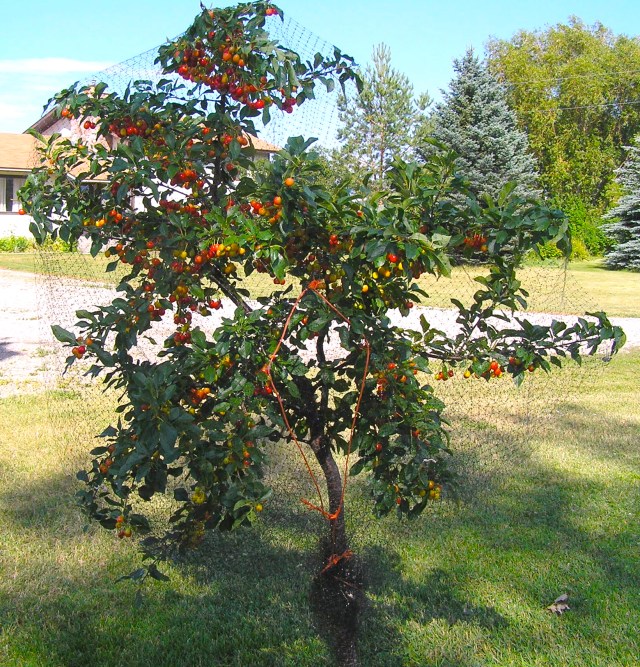
- The Evans Cherry variety showing ripening fruit
Examples of cherry varieties are:-
Sweet Cherry- ‘Stella’ : Black, large , rich, high quality fruits, regular heavy crops; self-fertile. Late season; harvest in July.
Acid Cherry- ‘Morello’: Self-fertile , dark red fruits, excellent for preserves and tarts. Attractive blossom, heavy crops, late season; harvest July and early August.

Morello cherry fan

Morello or sour cherries

Botanical illustrations of the Morello cherry

Ripe sour or Morello cherries
SWEET CHERRY COBBLER
(Serves 8)
Ingredients
350g Caster Sugar
45g Butter, melted
125g Plain Flour
¼ tsp Salt
1 tsp Baking Powder
120ml Milk
1 tbsp Cornflour
225ml Boiling Water
500g Fresh Cherries, stones removed (frozen cherries may be used)
Method
Preheat oven 180 deg C/Gas 4
1) Mix 150g sugar, butter, flour, salt, baking powder and milk together. Place cherries in bottom of 23cm square tin. Spread topping over cherries.
2) In small bowl combine 200g sugar and cornflour, stir in boiling water, pour mixture over topping.
3) Bake for 45 minutes, serve warm with vanilla ice cream.

-
Bing cherries- the most widely grown variety of sweet cherry in the U.S.A.
 Note: This is the first of a series of articles on how to grow and use different food plants. It’s one of a number produced recently by particpants in a ‘Grow Your Own’ course I’ve been running in the village of Foulsham, Norfolk. I thought the work deserved a wider audience and hope that you find it useful. I’ll post other articles in coming weeks.




 Old School Garden