Tag Archive: pruning


PicPost: A Cut Above

raspberriesAnother guest article by one of the participants in the ‘Grow Your Own Food’ course I ran recently in Foulsham, Norfolk.

Raspberries – A superfood that tastes better than spinach-what’s not to like?!

by Chris Richmond

Health

Antioxidant and anti-inflammatory phytonutrients in Raspberries may have anti-cancer benefits and assist in the management of obesity, though possibly not if eaten with oodles of cream.

However, raspberries are among a small number of foods that contain measurable amounts of oxalates. When oxalates become too concentrated in body fluids, they can crystallize and cause health problems. For this reason, individuals with already existing and untreated kidney or gallbladder problems may want to avoid eating raspberries.

So…everything in moderation, even raspberries- unfortunately.

Varieties

There are two types of raspberry available to the kitchen gardener. Summer-fruiting varieties will crop at any time from the beginning of July to early August on stems of last season’s growth; autumn-fruiters bear their berries over a longer period – from mid-August to the first frosts – on the current season’s growth. Both are similarly easy to care for but require slightly different pruning techniques. As long as you know how to wield your secateurs around them there is little mystery to growing these accommodating fruits and their length of service – up to 12 years – means they give a lot back in return.

‘Glen Ample’ AGM – Delicious, large fruit produced in mid-summer on this extremely heavy-yielding summer cultivar with vigorous, upright, spine-free canes. The berries are produced on long, upright stems, making picking easy.

‘Glen Moy’ AGM – This early summer raspberry bears heavy crops of medium to large berries, which have a good flavour. It may also produce a small crop on the new canes, in autumn. The spine-free canes are compact.

‘Leo’ AGM – This cultivar is one of the latest summer raspberries to ripen, producing large, firm fruits with an excellent flavour. The stems are very long, so harvesting is easy. Site in a sheltered position.

‘Malling Admiral’ – A summer raspberry bearing good yields in mid- to late summer on strong-growing, tall canes, which are best sited in a sheltered spot. The flavour is excellent, and the large berries ripen to deep red.

‘Autumn Bliss’ AGM – The short, sturdy canes of this popular autumn cultivar produce high yields from late summer to mid-autumn. The fruit is large and deep red with a firm texture and excellent flavour.

‘Polka’ – This new autumn cultivar ripens two weeks earlier than ‘Autumn Bliss’, bridging the gap between summer and autumn. It produces very high yields of large, well-flavoured fruit.

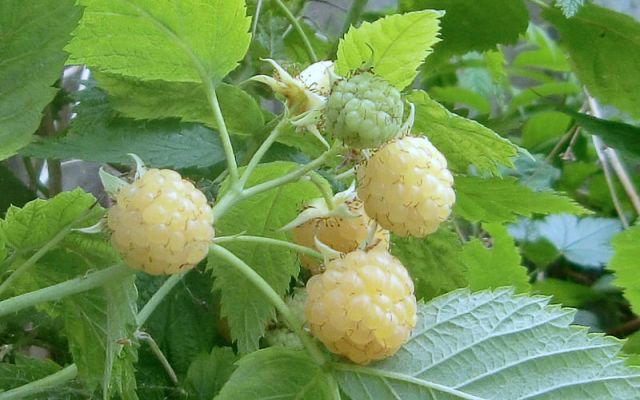
A Golden Raspberry Variety

Preparation

Like most edible crops, raspberries produce a better yield when grown in full sun. However, thanks to their woodland origins, they can be grown in a degree of shade too, as long as they receive at least a few hours of direct sunshine each day. They prefer slightly acidic soils, which is great news for gardeners who struggle to grow plants in these conditions. They like it to be moist as well, so be prepared to water the plants as they establish – but beware of waterlogged winter ground.

Be prepared to put in a bit of effort to get soil conditions just right before planting: thoroughly dig down to a spade’s depth along a row 90cm wide. Turn it over and remove any weeds, especially perennial types (such as bindweed and horsetail) and their roots.

Raspberries are shallow rooted, which means there won’t be much of an opportunity to weed as meticulously once the plants are in place, for fear of damaging their root system. They are also heavy feeders, so for every plant you intend to grow incorporate a bucketful of well-rotted manure or compost while digging, turning it all into the soil. Ideally soil preparation should be complete a month before planting; at the very least you should allow two weeks to give the earth time to settle.

They might play second fiddle to their Wimbledon-associated cousins on shop shelves but on the plot there should be no such bias – raspberry plants crop reliably year-after-year and ask for little in return. They even thrive in partially-shaded areas where few fruit or vegetables would grow. And such is their hardiness that they will produce a bumper crop of their sweet, mildly acidic fruits even in disappointing summers – a valuable trait given the last few we’ve experienced. They’re a great choice for those gardening in cooler, northern climates – as they flower late in the spring there is little danger of them being damaged by unexpected late frosts.

Planting

With a well-prepared growing area in place, planting shouldn’t present any difficulties. Buy in certified disease-free, one-year-old plants (usually called canes) from a reputable nursery or mail-order catalogue. They are usually acquired bare rooted, packaged up into bundles ready for planting. The best to time to plant them is in the autumn, from October through to early December, as the soil still retains a degree of warmth which will help the roots to grow and quickly settle the new introductions into place. If this isn’t possible they can, however, be planted any time up to March.

Position each cane into a shallow hole about 22cm wide and 7cm deep, spreading the roots evenly across the bottom. Backfill and firm in around them as you go, making sure that the soil mark on the canes is at least level with the surface and up to an inch beneath it – this will encourage extra root growth and quickly anchor the plants into place. Space them 45cm apart within the row, leaving 1.8m between further rows to allow room for the roots to spread sufficiently and enough space for picking.

The tall, gangly canes will need to be supported, so set up a suitable support system at planting time. The best system is a simple post-and-wire set-up – hammer in two sturdy, 2.4m-high posts at either end of the row, 60cm into the ground and 3m apart. Stretch three galvanised wires horizontally in-between them at heights of 75cm, 1m and 1.5m.

The top wire can be omitted if you’re growing an autumn-fruiting variety as they are much sturdier and require less support.

Grow your own tip- If you only intend to grow a few plants you can do away with a complete post and wire system and simply position up to two plants at the base of a single post for support. As the stems grow upwards, tie them loosely to the post using garden string.

Growing

Immediately after planting your canes, cut each one just above a bud so that they’re 30cm in height. By spring, new shoots will appear from the base of the old cane and these will need to be tied into the wires as they reach them. The original cane can be cut right down to about 3cm above ground level at this point, again just above a bud. Remove any weak shoots in this first summer and any appearing more than 20cm from the row. Be disciplined and remove any flowers that develop in the initial season too – the object of the first year is to establish a good base and allowing plants to channel energy into setting fruit will compromise this effort. In the following years pruning is simple, although it’s important to use the correct method depending on whether you’ve opted for summer- or autumn-fruiting varieties. The former should be cut right back to ground level as soon as they have finished cropping.

At this stage there will already be plenty of new growth at the base of the plant and these will be the fruiting stems for next year. Tie them into your support system using garden string, so that each stem is spaced around 10cm from the last. Cut down any spindly stems or those growing away from the row. Towards the end of the growing season, loop over and tie in place any really tall stems to prevent them falling over in the wind over winter. In early spring, before growth commences, cut them back to a bud about 15cm above the top wire so that they are uncluttered and in a good position when they start fruiting.

Pruning autumn-fruiters is much more straightforward – just cut back all of last year’s canes to ground level before growth starts in February. New shoots will appear from the base by spring and these should all produce fruit on the upper stem sections.

Crop care

Feeding and watering are pivotal to the success of a raspberry crop. Keep your canes moist and well-fed and, coupled with the correct pruning regime, you should be carrying away punnets full of berries. Watering is particularly important at flowering time, as the fruits swell, and during any dry spells.

Applying a thick layer of organic matter as a mulch in early spring will help to lock-in moisture (make sure the soil is moist beforehand) as well as feed the canes. Be generous – make it at least 5cm deep and more if you can spare it. Any well-rotted organic matter such as compost or manure will do but avoid mushroom compost – it is alkaline and therefore unsuited to the acid-loving plants. Mulches will also help to naturally nourish the soil and stifle weed growth. As raspberry roots are very shallow and can easily be damaged by hoeing, any weeds that make it through the mulch will need to be removed by hand.

New shoots that appear away from the main row or post are called suckers. It will be difficult to tie them in to the support system – instead, you should remove them by lifting them out of the soil, then use secateurs to sever them from the parent plant below ground level.

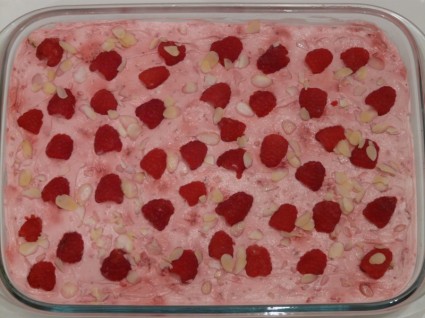
Raspberry curd quark dessert- one of many delicious sweets using raspberries

Raspberry curd quark dessert- one of many delicious sweets using raspberries

Stolen without permission from various websites including:

www.rhs.org.uk

www.growfruitandveg.co.uk

Rosa rubiginosa- a wild or species rose that needs minimal pruning

This week’s gardener’s question comes from a Miss Flora Dunmore of Argyll, and focuses on roses:

‘I’ve just inherited a big garden with lots of different roses, icncuding bush, climbers and ramblers. Can you tell me why, when and how to prune these, please?’

Flora, what a lovely inheritance! First why do you prune:

  • to remove weak, spindly and diseased shoots

  • to encourage strong new shoots to grow from the base of the plant each year (these bear the best flowers)

  • to open out the centre of the bush to increase air circulation (this helps to check disease)

  • to create a pleasing (usually symmetrical) outline to the plant.

When to prune depends on the types of roses you have:

  • For large-flowered bush roses the traditional months are March in the south and April in the north of England (and possibly even later in Scotland), when growth is just beginning- but pruning can be done safely any time from November  onwards in the south, provided you are prepared, if necessary to remove some frost damaged growth in spring. Most importantly never prune during a frosty spell.

  • For ramblers the best time to prune is after flowering, probably late August (you can dead head throughout the flowering season to achieve much the same result)

  • For climbers, the best time is October, when the recurrently flowering types have finished their show, but it can be done later if the weather is mild.

The techniques for pruning vary according to the type of rose:

For large flowered, bush roses cut away completely any diseased,weak and spindly shoots as well as removing all dead stumps from earlier pruning (use a fine toothed saw if they are particularly woody and thick). If there are many canes criss-crossing in the centre then remove a few to open out the bush. If two shoots are growing so that they rub each other, remove one. Finally, cut the remaining shoots back to about 200-250mm long. Harder pruning than this will produce larger, but probably fewer flowers – but it won’t harm the rose.

For smaller, cluster-flowered roses do the same as for larger flowered varieties but leave  the main shoots 300-350mm long. If the main shoots have side shoots, the latter don’t need to be removed, provided they are fairly thick (say about a pencil thickness), but they should be cut back by about two-thirds of their length.

Climbers should be pruned to establish a permanent framework of significant branches from which flowering stems are produced. To achieve this cut back side shoots to one or two buds from the point where they branch out from the main shoots. If the plant has become bare at the base, cut one of it’s main shoots hard back to encourage new growth from ground level.

Ramblers need to be pruned to encourage flowering on young shoots that grow from the base of the plant each year. To achieve this cut out completely the side shoots that have finished flowering and tie in the new shoots in their place. If in some years there are only a few of these, some of the old shoots (which can still produce flowers) may be left in place, but their side shoots should be shortened by about two-thirds.

Rambling roses need a framework of stems establishing with selctive removal of the oldest to encourage new growth form the base and flowering shoots pruned after flowering

Rambling roses need a framework of stems establishing, with selective removal of the oldest to encourage new growth from the base and flowering shoots pruned after flowering

Miniature Roses which produce a thick tangle of tiny, wiry shoots, require these to be thinned out. Remove dead or diseased shoots and trim back the rest by about two-thirds. It may be difficult to find a bud to cut back to, so just clip them over so that they look neat.

Shrub roses vary enormously in size and type, so it’s difficult to give a general guide to pruning. Wild (species) roses should not be pruned at all, other than for removal of dead or diseased branches. Most of the old garden roses such as Gallicas, Damasks, Albas, Centifolias and Bourbons will give more flowers if they have their side shoots shortened by about two-thirds in winter. Modern shrub roses that are in fact like giant versions of the smaller cluster types should be pruned in a similar way to those – but reduce their height by only about two-thirds. The Rugosa family needs little if any pruning, although for the less dense kinds,  a few older canes cut back every two-three years will encourage bushiness.

If you have newly planted roses then you should prune them even harder than established plants so that a strong framework of new shoots will be built up for the beginning. Leave their shoots only about 50-75mm long. Prune autumn planted roses when you do your established ones and spring planted ones at planting time. But, don’t prune climbers at all in their first year, as they take longer to establish.

Pruning cuts are easiest with secateurs. Ensure that a clean cut is made with clean blades (these should be sterilised with surgical spirit/alcohol to avoid passing on diseases from plant to plant). Cuts should be made about 6mm above a bud on a shoot; the cut should slope down towards the side away from the bud. Cutting to an outward- facing bud encourages the bush to spread outwards, but don’t worry if you can’t find one exactly where you want to cut- often a bud lower down will grow away more vigourously in the direction you want, and you can always trim it back later.

Clean secateurs with surgical spirit or alcohol before pruning each rose plant

Old School Gardener

hedge archwayThis week’s Gardeners’ Question Time looks at how and when to trim hedges. The question comes from Anne Elk who lives in West Devon:

‘I never seem to be able to get an even, level cut on my hedge when I give it its annual trim. How can I achieve a really neat appearance?’

Well Anne, first you need to check on whether in fact your hedge is of a variety that does just need only one clip, or whether it should have several (see below). If it’s the latter, it will be difficult with only one cut to keep it smooth and sharp as so much material will have to be removed, so you should perhaps be trimming it more frequently.

In general though, to get a sharp, level shape when cutting, stretch a string line tightly between two posts along the top, at the height you want the hedge to be, and clip exactly to this level – however, be prepared to repair any accidental cutting of the string! For the sides, put in canes vertically at intervals along the hedge, and sight along these as you cut. Alternatively some people can do this by eye and achieve a satisfactory result, especially if the hedge is fairly low.
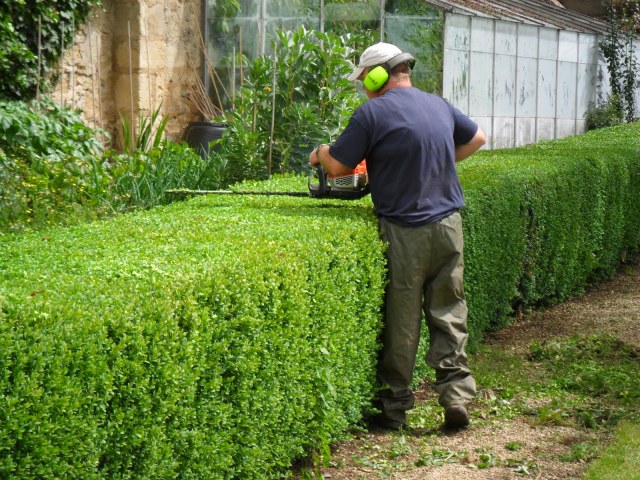
Lowish hedges can eb trimmed by eye as long as a good original line has been established

Lowish hedges can be trimmed by eye as long as a good original line has been established

So how and when should you cut different types of hedge?

Established deciduous hedges that are moderately fast growing (e.g. Beech, Hornbeam, Hazel and Tamarisk) should be trimmed once in August – however, if they are growing particularly well, they might need two trims – one in late July the other (lighter trim) in early October.

Deciduous hedges which tend to be fast growing (e.g. Blackthorn, Myrobalan Plum, Hawthorn) will need about three clippings at about six weekly intervals during the summer- this also applies to some fast growing evergreen hedges such as Lonicera and Gorse.

Some slower growing evergeen hedges such as the various Laurels, Elaegnus and Sweet Bay require just one cut in early autumn, though faster growing evergreens such as confiers are best trimmed once in August – or possibly twice if particularly vigourous (once in July and then again in early October). For Yew, trim once a year in the summer.

For slow growing, smaller – leaved evergreen hedges such as Box, you should be cutting in early summer (June- July) and again in late summer/early autumn (including topiarised shapes).  Box hedges should be cut in overcast weather as if they are cut in the hot and dry their half cut leaves will desiccate and turn brown. For Privet (Ligustrum) you will need at least two and possibly more cuts in a season to maintain its shape.

Mazes are often created from Yew hedging - usually an annual cut will keep it looking trim

Mazes are often created from Yew hedging – usually an annual cut will keep it looking trim

If you have an informal flowering hedge, in general this should be pruned rather than generally cut over. This is best done in spring if it flowers in between mid summer and autumn and in mid summer if it flowers in the spring or early summer. In both cases take off the shoots which have flowered, thin out the growth if it is crowded and remove completely any old growth which is straggly and flowering badly.

For most hedges try to establish sloping sides with a taper inwards towards the top (known as a ‘batter’) – this encourages growth lower down the hedge which if the sides were vertical (or even worse sloping inwards towards the bottom), would result in thin growth at the base where less light reaches the leaves.

Not all hedges are meant to be level and straight- 'cloud pruned' forms such as this are more a work of art than a geometric challenge!

Not all hedges are meant to be level and straight- ‘cloud pruned’ forms such as this are more a work of art than a geometric challenge!

I hope that you find this of help, and if you have any gardening questions that you think I might help with, then please email me at nbold@btinternet.com

Old School Gardener

If you’ve enjoyed reading this post and others on this blog, why not comment and join others by signing up for automatic updates via email (see side bar, above right ) or through an RSS feed (see top of page)?


Time to prune your blueberries: early March is ideal, as it is usually easier to see the fruit buds. Start by taking out your 3 Ds (dead, diseased and dying). Then remove the ends of the branches which fruited last year, taking them back to a strong bud or branch. Finally, remove a third of the oldest stems from the base, to open up the bush and encourage new growth. If it’s newly planted just do your 3 Ds!

More info here: http://apps.rhs.org.uk/advicesearch/Profile.aspx?pid=85

– Becky, RHS Members Advisory (who is now craving blueberries!!)

Echeveria- overwintering in Old School Garden Greenhouse

Echeveria- overwintering in Old School Garden Greenhouse

To Walter Degrasse:-

Dear Walter,

It’s been a while since we were in touch, and as it’s windy and wet outside, I thought I’d drop you a line about what’s been going on in ‘my gardening life’. I hope all is well with you and your beautiful garden. It seems ages since I was in my garden for any time to get a sweat up, but it’s that time of year when the pace of things is rather slow, very much focused on ‘basic maintenance jobs’, I suppose. Anyway I’ve used the time in other ways, not least getting my blog up and running, which I’m pleased to say I’m enjoying and also the new relationships it’s bringing with gardening fans around the world!

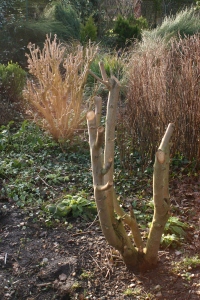
More practically, I’ve more or less finished my pruning jobs, those new Felco secateurs I had for Christmas are a real joy to use! I’ve got one more Buddleja to do and I’ll need to get the ladders out to do my Fremontodendron, which, on a south-facing wall, has romped away – I think last year’s wet weather gave it a surge of growth, so it’s now over 5 metres tall! The Dogwoods have all been laid low so hopefully we’ll get a good flush of new stems in the summer that give us that wonderful ‘winter glow’. I’ve done my annual cut back of the Eucalyptus to encourage large, colourful new leaves – it always looks forlorn after this major hack back (photo enclosed), but is such a swift grower.

Eucalyptus & Buddleja - pruned

Eucalyptus & Buddleja – pruned

I’ve also been tilling over the beds in the kitchen garden. Did you read my blog post about planning the crops here? It has a layout of what I’m intending to grow and where, trying to rotate crops as best I can in a complex border layout and thinking about succession crops too. You may remember that I put on a layer of leaf mould over most of them (as well as the fruit trees) in the autumn as well as digging in some green manure I grew towards the end of last season – we’ll see if this latter experiment has any marked effect on the crops to come.

I’ve been lightly turning over the topsoil and incorporating the remains of the leaf mould etc., in preparation for some of my friend Rob’s horse manure, which I’m able to collect from his paddock about 2 miles way. It really is lovely stuff, so I’ll use it to mulch my roses, clematis, shrubs, fruit trees and bushes etc. as well as putting a good load down for the potatoes and some of the other vegetables.

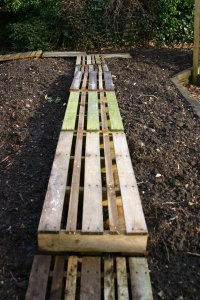
New boardwalk made of old wooden pallets

New boardwalk made of old wooden pallets

You know how poor my carrots were last year – the rotten weather didn’t help, I know, but I think that the bed I grew them in is still a little heavy (in contrast to the rest of the soil) and they don’t respond well to this and over – rich soil (I mistakenly put manure on the area a short time before the new season began). This encourages them to fork, whereas by keeping the soil relatively under – fed early on you apparently encourage them to grow straight and true as they seek out the nutrients further down – at least that’s what I heard Bob Flowerdew say on ‘Gardeners’ Question Time’ last week! Oh, and you remember I’d been collecting a load of old pallets? I’ve finally got round to making good use of them. They cut up nicely into sturdy 500mm – wide board walks which I’ve lain over the top border – this means that I have two manageable – width beds and don’t have to walk on the soil between them.

I’ve also been clearing out a side bed which was becoming choked with a Lilac that was suckering all over the place. This border is a bit on the edge of the kitchen garden and is not ideal for food growing, so I think that I might use it for flowers to attract insects etc. I’ve a good supply of Marigold seeds from last season, so they can go in there.

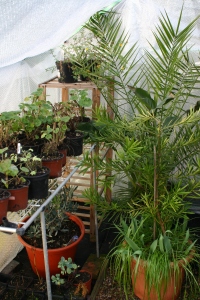
Over-wintering plants in the Old School Garden greenhouse

Over-wintering plants in the Old School Garden greenhouse

The greenhouse seems to be working well at over wintering my pelargoniums and ‘exotics’ and the pots of broad beans and sweet peas I put out a week or two ago are starting to push new growth through. I’ve sown some other seeds in my propagators – just some brightly – coloured Cosmos, Iceland Poppies and Leeks – these seem to be doing well, and hopefully I can pot them up shortly. I’m also chitting two varieties of early potato. You know how much I love ‘Charlotte’, the waxy ‘second early’ and alongside this I’m growing ‘Pentland Javelin’.

It looks like the weather is going to be a bit warmer in the coming week – in fact as I’m writing the rain has stopped and the sun is out! Hopefully I can get out tomorrow and catch up with a few more jobs that need doing – for example putting some pesticide on a couple of Hosta- filled containers to eradicate Vine Weevil (didn’t quite manage to get rid of these last year through a soil change), spraying my dwarf Peach tree with Bordeaux Mixture to help prevent ‘Peach leaf curl’, replanting the many Nerine bulbs I dug up recently from the kitchen garden and getting some more seeds into the propagators.

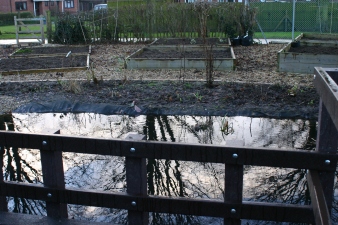
The primary school garden from the new pond dipping platform

The primary school garden from the new pond dipping platform

On the broader front my work with Norfolk ‘Mastergardener’ seems to be picking up once more. I’m helping the local Primary school with their School Garden, as you know. I’m shortly going off to meet with their garden coordinator to discuss plans for the coming year. I’ve offered to go into school one day per week to work with different classes and I’m looking forward to helping them get the most out of the garden, which is now starting to look really good. You may recall that we (staff, parents and children) managed to get a new wildlife pond installed over the summer and I also installed a pond dipping platform for them (made from recycled plastic), so the children will have this new resource for nature study in the coming months.

Yesterday I visited a new food grower I’m supporting for Norfolk Mastergardener. She lives in the next village and has recently moved to a large house with a super plot. I was impressed with the 2 polytunnels she has as well as a fenced off, structured vege growing area. She’s a keen animal lover and has this enormous pig (which her granddaughter rides like a pony!) as well as chickens, ducks, cats, dogs etc! The pond has a large number of enormous Carp in it too.

Any way, she’s a beginner when it comes to gardening and wants me to advise her about food growing for her large family. I’ve suggested she looks at the range of seeds she’s bought (as well as inherited from the previous house owners) and does a rough plan of what she wants to grow and where this might go in her plot. I’ll then talk this through with her and some of the basics about manuring and preparing the soil, sowing seeds, potting up etc. I’ve suggested that she keeps things simple this year and just goes for one crop in each area, rather than think about succession planting, until she sees the amount  of time she’ll need to put in and what her garden will generate in terms of food. We’ll see how it goes, but it’s a wonderful setting and with the polytunnels (one plastic – covered, one netted) she has some great growing areas to play with.

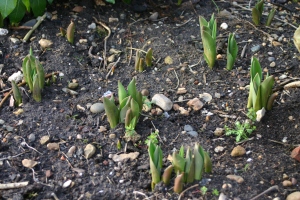
Tulips starting to show themselves in Old School Garden

Tulips starting to show themselves in Old School Garden

Well, I see the time has ticked on and I must be out to my meeting at the School. I’ll drop you another line in a week or two to let you know how I’m getting on, and hopefully we’ll also stay in touch via my blog or by email? By the way I’d welcome any comments or suggestions you might have about the blog, as I’m still finding my way!

Very best wishes from

Old School Garden

If you’ve enjoyed reading this post and others on this blog, why not comment and join others by signing up for automatic updates via email (see side bar, above right ) or through an RSS feed (see top of page)?

Finding Nature

Nature Connectedness Research Blog by Prof. Miles Richardson

Norfolk Green Care Network

Connecting People with Nature

Discover WordPress

A daily selection of the best content published on WordPress, collected for you by humans who love to read.

Susan Rushton

Celebrating gardens, photography and a creative life

Unlocking Landscapes

Writing, photography and more by Daniel Greenwood

Alphabet Ravine

Lydia Rae Bush Poetry

TIME GENTS

Australian Pub Project, Established 2013

Vanha Talo Suomi

The Journey from Finnish Rintamamiestalo to Arboretum & Gardens

Marigolds and Gin

Because even in chaos, there’s always gin and a good story …

Bits & Tidbits

RANDOM BITS & MORE TIDBITS

Rambling in the Garden

.....and nurturing my soul

The Interpretation Game

Cultural Heritage and the Digital Economy

pbmGarden

Sense of place, purpose, rejuvenation and joy

SISSINGHURST GARDEN

Notes from the Gardeners...

Deep Green Permaculture

Connecting People to Nature, Empowering People to Live Sustainably

BloominBootiful

A girl and her garden :)