Tag Archive: plants


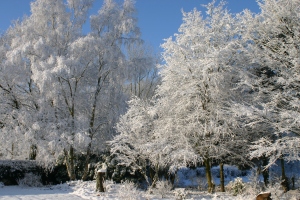
IMG_5170As I sit and look out of my window this cold January day, the snow has started to fall once more- looks like the heaviest fall will be later today. So the firewood has been stacked and fortunately the week’s shopping was done yesterday…

At this time of year you could be forgiven for thinking there’s not much of interest in the garden. We tend to focus on the other seasons when we think about (or impulse-buy) plants. The weather itself isn’t exactly encouraging us to visit the nursery or garden centre. And anyway, they seem to be rather  forlorn places at this time of year, especially the bigger ones that have ‘diversified’ into Christmas tat- the shelves are either emptying to make way for spring gardening stock or they’re full of half price Christmas cards and tinsel…

Well, we should perhaps think about how our garden looks in every part of the year, especially the important views into it from the house, road etc. In the winter, it’s these views that count, as it’ s less likely you’ll want to venture into the wet or cold garden itself.

The choices are significant – yes you can have:

  • beautiful flowers
  • powerful fragrance
  • colourful fruit
  • vibrant stems
  • interesting bark
  • strong  form
  • fascinating  foliage

Here are seven examples of the sorts of plants that can be a winter wonder in your garden.
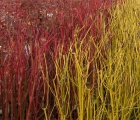
Dogwoods provide wonderful winter stem colour

Dogwoods provide wonderful winter stem colour

1. Dogwoods (Cornus species)- vibrant stem colours make this a winner especially where you can group several plants together and maybe combine them for subtle effects (try C. alba ‘Sibirica’ (red) surrounded with C. sanguinea ‘Midwinter Fire’– amber- orangey red). Prune the stems back to the base of the plants in spring or leave one or two stems to grow taller and then pollard it for extra height (prune ‘Midwinter Fire’ less)- you will also get some lovely autumn leaf colour.

Witch Hazels- magical spidery flowers

Witch Hazels- magical spidery flowers

2. Witch Hazel (Hamamelis in many different varieties)- beautiful spidery-like flowers are magical in woodland edges. Grow as specimens or focal points under trees or in open ground – will grow about 2 metres high and wide over time.

Crab apple 'Red Sentinel'- plum-sized fruits that birds seem to avoid

Crab apple ‘Red Sentinel’- plum-sized fruits that birds seem to avoid

3. Crab apple (Malus species and cultivars – but not the ‘orchard’ apple Malus x domestica)- some of these smallish trees are suitable for smaller gardens with their columnar growth – e.g. M. tschnoskii (which can grow to 12 metres high but only 7 metres across). The main reason for growing them, in my view, is their fruit. Plum – sized apples which seem to be just the right size to not interest birds, so you’ll hopefully be left with a great show throughout winter. I particularly like M. x robusta ‘Red Sentinel’ (can grow to 7 metres high and wide). And Crab apples give great spring flowers and autumn colour too.

Mahonia x media- black fruits follow the flowers

Mahonia x media- black fruits follow the flowers

4. Oregon Grape (Mahonia species and some cultivars)- this is a winner on several counts, but mainly through its winter flowers and foliage. It’s evergreen  leaves (some spiky) will burnish orangey-red if exposed to the sun. My favourite is the hybrid M. x media ‘Charity’ which is an erect evergreen shrub with sharply toothed leaves and dense yellow flowers that cascade from the stems. One ideally for part shade, so a woodland edge is perfect.

Viburnum x bodnantense- wonderful scented flowers

Viburnum x bodnantense- wonderful scented flowers

5. Viburnum x  bodnantense ‘Dawn’ there are many different Viburnums, and they make a wonderful addition to the garden for their flowers, fragrance and foliage at different times of the year. This one is a hybrid and is chiefly grown for its wonderful scented flowers which grace the medium-sized deciduous shrub through winter on bare stems.

Box- small leaves make it ideal for strong  topiary shapes

Box- small leaves make it ideal for strong topiary shapes

6. Box (Buxus sempervirens or if you want a slower growing, more compact form go for the variety ‘Suffruticosa’)- one of the great plants for shaping into strong forms that help to carry your garden’s structure through the winter months. Also, don’t forget that some perennials will add form and structure to your garden through their dead stems and shapes. For Box start growing small and gradually develop your desired form, or buy (at some expense) some of the ‘ready- to – rock’  topiary at nurseries and garden centres. There are some wonderful examples of historic topiary in Britain such as Levens Hall, Cumbria.

320px-Paperbark_Maple_Acer_griseum_Bark_3008px

Paper-bark Maple- bark peels into subtle tones

7. Paper bark Maple  (Acer griseum)- a fantastic, slow growing tree which can reach 10 metres high and broad. Like most Acers it gives great autumn leaf colour, but it’s main attraction is the peeling bark which looks especially magical with low winter sun shining through it.

Further information;

Guardian online

Winter containers

Winter vegetables

Quizzicals:

answers to the last two-

  • Our monarch continues to work hard – Busy Lizzie
  • Nasty spot causing urination problems – Bladderwort

A couple of gardening ditties:

‘Whose sorrel now?’

‘Don’t leaf me this way’

(thanks again to buddie Les for these)

Old School Gardener

The Small Tortoiseshell- under threat

The Small Tortoiseshell- under threat

The latest ‘Wider Countryside Butterfly Survey’ reveals that some butterfly species- notably the Meadow Brown- seem to have benefitted from last year’s wet summer, whereas others- such as the Common Blue and Small Tortoiseshell– were around 50% down on the previous year.

The Small Tortoiseshell was once prolific in Britain’s gardens, but it seems to have been one of the big losers in 2012. Last year’s weather  is only partly to blame, as wider agricultural policies and practices are a key driver behind a longer term decline in butterfly species and numbers and parasitic flies may also be part of the story. Around three quarters of the 59 native British species are now in decline.

So what can gardeners do to arrest this trend?

1. Think about providing year- round sources of food for emerging and mature butterflies. Examples of plants which feed butterfly caterpillars are: Dill, Antirrhinum, Columbine, Berberis, Marigold, Ceanothus, Cercis, Cornus, Foxglove, Wallflower, Ivy, Hop, Holly, Jasmine, Honesty, Ragged Robin, Crab Apple, Oregano, Cowslip, Rudbeckia, Thyme, Nasturtium, Verbascum and Pansy.

Species which are food sources for mature butterflies are: Achillea, Anthemis tinctoria, Bergamot, Buddleja, Columbine, Coreopsis lanceolata, Red Valerian, Ceanothus, Marigold, Echinacea, Globe Thistle, Knautia, Lavender, Tobacco plant and Hop.

2. Try to plant butterfly-attracting plants in groups– butterflies prefer to visit stands of brightly coloured flowers.

3. If you have room, choose a quiet but sunny area of lawn where the grass can be left to grow long – some butterflies such as the Meadow Brown prefer to lay eggs in long grass.

4. Allow a small patch of nettles (Urtica dioica) to grow unfettered– these will provide food for some of the more common butterflies such as Red Admiral, Painted Lady and Milbert’s Tortoiseshell.

5. If you have fruit trees, don’t be too tidy about windfalls– leave some rotting fruit as a source of food for some butterflies.

6. Try to provide a shallow, muddy puddle in a sunny spot– many butterflies love to drink from these and they also provide essential minerals and salts.

7. Avoid using chemical sprays to deal with insect pests and weeds– many will harm beneficial insects and butterflies as well as the pests.

Groups of butterfly- friendly plants such as Bergamot are better than single specimens

Groups of butterfly- friendly plants such as Bergamot are better than single specimens

Sources and further information:

Guardian online

Butterfly Conservation

UK butterflies

‘Wildlife Friendly Plants’- Rosemary Cresser

Quizzicals- two more cryptic clues to plant, fruit or veg names:

  • Our monarch continues to work hard
  • Nasty spot causing urination problems

Old School Gardener

ImageGarden Design Course in Norfolk

Following the successful pilot of ‘Your Garden- by Design’ last autumn, I’m pleased that Reepham Learning Community have agreed to run an extended version of this course beginning at the end of the month. 8 two-hour sessions (including one garden visit) will use a variety of methods and materials to help those who want to improve their own gardens through design.

Based at Reepham College in central Norfolk, the course is a step-by-step walk through the design process, showing how to apply this to your own garden (big or small) from basic surveying and appraisal techniques, forming ideas about what the garden is for and how it might look, to outline plans and 3-D visions of  different ideas as well as the important things needed to ensure successful delivery of attractive, practical plans.

Group review and discussion of the evolving designs will enable participants to develop a critical and creative approach to garden design and a large number of reference books will be on hand as well as links to other sources of information. Case studies and in-class exercises will help participants to develop their skills.

Green (and its many shades) is one of the most important colours in garden design (arguably it’s a more important feature than the ‘white’ in Vita Sackville-West’s garden at Sissinghurst). Gardens which feature plants with bold, contrasting foliage can be really effective and the Course will introduce colour, texture and form as three key ideas in planting design. The contribution that ‘hard’ landscaping (paths, walls, furniture and built structures) makes to successful garden design will also be covered.

Participants don’t need to have any particular skills- the course and associated support should lead to practical ideas which can be put into action. The eight sessions will cover:

  • Starting out- what do I want from my garden?IMG_4931
  • Surveying and appraising your garden and functional layouts
  • Garden Styles and Forms
  • Structure in your Garden- the third dimension
  • Planting- the fourth dimension
  • Garden visit (day time)
  • Final designs
  • Delivering your Design

Check out the link to the Reepham Learning Community for more information- I’m looking forward to meeting a new group of enthusiastic garden makers!

Quizzicals- answers to the last two:

  • Morrisey’s mother’s mother- Granny Smith
  • Someone who is out get you – Anemone

A couple of gardening ditties for you:

‘Livin’ Dill’

‘Juke Box Chive’

(note to self= must move away from herbs and spices for a while…)

Old School Gardener

Hellebore_flowers

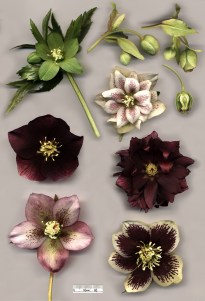
Some of the wide range of Hellebore flowers

‘Killing food’ seems to be the literal translation of the ancient Greek form of Helleborus (Helein= ‘killing’ and Bora = ‘for food’), referring, perhaps to the legend that witches used it’s roots to drive out evil spirits! In fact any part of the plant, if ingested, can cause discomfort at the least and it’s sap is a skin irritant. The Greeks were probably referring to the species H. cyclophyllus (from the Greek ‘kyklos’  for ‘circle’ and the Latin ‘pilosus’ for ‘hairy’ , describing the flower).

Helleborus niger is commonly called the Christmas Rose, due to an old legend that it sprouted in the snow from the tears of a young girl who had no gift to give the Christ child in Bethlehem.

In Greek mythology, Melampus of Pylos used Hellebore to save the daughters of the king of Argos from a madness, induced by Dionysus, that caused them to run naked through the city, crying, weeping, and screaming (sounds a bit like Norwich city centre on a Friday night).

During the Siege of Kirrha in 585 BC, Hellebore was reportedly used by the Greek besiegers to poison the city’s water supply. The defenders were subsequently so weakened by diarrhoea that they were unable to defend the city from assault. And an overdose of medication containing Hellebore has been suggested as a possible cause of the death of Alexander the Great.

Members of the genus Helleborus comprise approximately 20 species (and many hybrid varieties) of herbaceous or evergreen flowering plants in the family Ranunculaceae, originally from grassy, woodland, scrub and rocky sites on limestone or chalky soils in central, southern and eastern Europe and western Asia. They are divided into two main groups:

  • Caulescent– having leaves on their flowering stems
  • Acaulescent (stemless)- these species have basal leaves. They have no true leaves on their flower stalks (although there are leafy bracts where the flower stalks branch).

Some of the different species are:

H. argutifolius/ H. lividus (leaves bluish or lead- colour) subspecies corsicus –  the ‘Corsican Hellebore’

H. caucasicus– Caucasian

H. colchidus– of Colchis (an ancient kingdom which went on to form part of modern day Georgia in the Caucasus)

H. foetidus = fetid – the ‘Stinking Hellebore’

H. guttatus = spotted

H. niger = black(the root)- the ‘Christmas Hellebore/Rose’

H. orientalis = eastern – the ‘Lenten/ Oriental Rose’

H. versicarius = from the latin for ‘bladder’, referring to its inflated seed follicles

H. viridis = green (the flowers)

hellebores massed planting-thumb

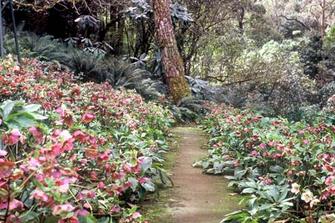
Hellebores in a woodland setting

Sources and links for further information:

Wikipedia

Helleborus.us

Hellebores.org

Hellebore.com

The Poison Garden.com

merriam-webster.com

‘Plant Names simplified’– A.T Johnson and H.A. Smith

Encyclopedia of Garden Plants’– Royal Horticultural Society

Quizzicals:- answers to those in the last post

  • Someone who patrols the observation points in bird sanctuaries = Hydrangea
  • Cockney bigot + flash Italian Car = Alfalfa

(do I hear a groan….)

                                                       Old School Gardener

Finding Nature

Nature Connectedness Research Blog by Prof. Miles Richardson

Norfolk Green Care Network

Connecting People with Nature

Discover WordPress

A daily selection of the best content published on WordPress, collected for you by humans who love to read.

Susan Rushton

Celebrating gardens, photography and a creative life

Unlocking Landscapes

Writing, photography and more by Daniel Greenwood

Alphabet Ravine

Lydia Rae Bush Poetry

TIME GENTS

Australian Pub Project, Established 2013

Vanha Talo Suomi

The Journey from Finnish Rintamamiestalo to Arboretum & Gardens

Marigolds and Gin

Because even in chaos, there’s always gin and a good story …

Bits & Tidbits

RANDOM BITS & MORE TIDBITS

Rambling in the Garden

.....and nurturing my soul

The Interpretation Game

Cultural Heritage and the Digital Economy

pbmGarden

Sense of place, purpose, rejuvenation and joy

SISSINGHURST GARDEN

Notes from the Gardeners...

Deep Green Permaculture

Connecting People to Nature, Empowering People to Live Sustainably

BloominBootiful

A girl and her garden :)