Tag Archive: plant


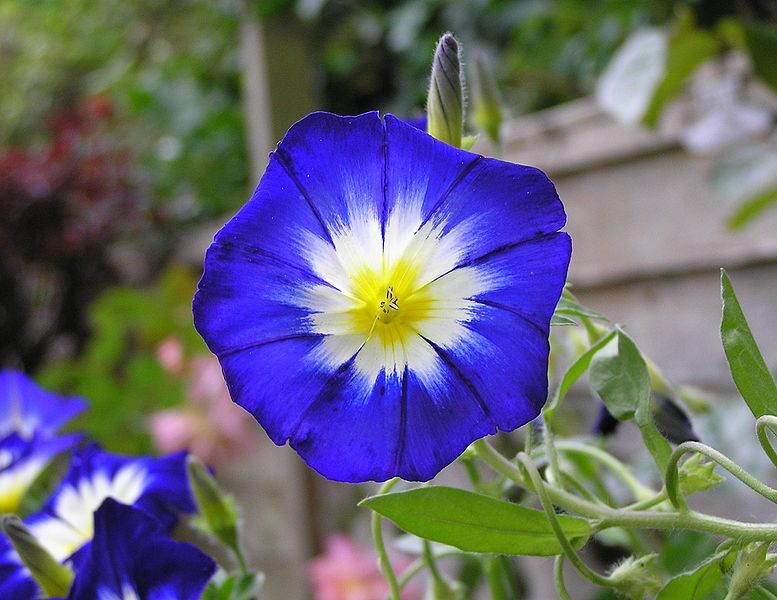
Convolvulus tricolor

A genus of about 200-250  shrubby annual, perennial herbaceous and rock plants, the name Convolvulus comes from  the latin convolvo, referring to the twining habit of some species. It is widely distributed around the world and is commonly known as Bindweed and Morning Glory, both names shared with other closely related genera.

Growing to 0.3–3 m tall, their leaves are spirally arranged, and the flowers trumpet-shaped, mostly white or pink, but blue, violet, purple or yellow in some species.

Many of the species are problematic weeds, which can swamp other more valuable plants by climbing over them, but some are also cultivated for their attractive flowers. Some species are globally threatened. Convolvulus species are used as food plants by the larvae of some Lepidoptera.

Other species names include:

C. althaeoides – like an Althaea (hollyhock)- referring to the flowers

C. cantabrica Cantabria, Spain

C. cneorum – meaning is obscure, from the greek Kneoron, a plant

C. lineatus – with lines

C. mauritanicus – of Mauretania (Morocco)

C. nitidus – somewhat glossy

C. soldanella – leaves like a Soldanella

C. tenuissimus – most slender

C. tricolor – three- coloured

C. althaeoides- from Flora Graeca

Sources and further information:

Wikipedia

RHS- growing C. sabatius

RHS- growing C. cneorum

Old School Gardener

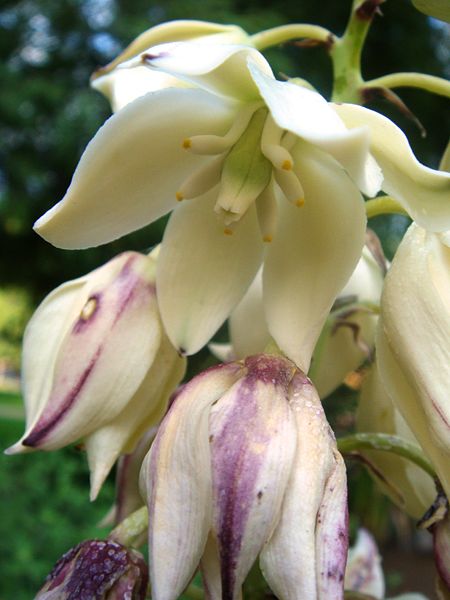
Yucca aloifolia flowers

Yucca aloifolia flowers

A genus of about 40 species of perennial evergreen shrubs or trees, Yucca is rosette-forming or woody- based and comes from hot, dry places such as deserts. sand dunes and plains in north and central America and the West Indies. It is also colloquially known in the Midwest United States as “ghosts in the graveyard”, as it is commonly found growing in rural graveyards and when in bloom the cluster of (usually pale) flowers on a thin stalk appear as floating apparitions. So striking are these flowers that early settlers of the south-western United States called them “Lamparas de Dios” or “Lanterns of God”. 

A member of the Agavae family, the yucca is closely related to the lily and has its origins in Mexico and Central America where it was prized by indigenous peoples for the medicinal and nutritional properties of the yucca flower.

North American natives, too, found the plant useful, using it to make clothing and soap (yucca roots are rich in saponins).

Cultivated for their bold, linear to lance shaped leaves and their erect (sometimes pendent) panicles of, usually white bell-shaped flowers. Many species also bear edible parts, including fruits, seeds,flowers, flowering stems and more rarely roots. References to yucca root as food often stem from confusion with the similarly pronounced, but botanically unrelated, yuca, also called cassava (Manihot esculenta).

They tolerate a range of conditions, but are best grown in full sun in subtropical or mild temperate areas. In gardening centres and horticultural catalogues they are usually grouped with other architectural plants such as Cordylines and Phormiums.

Joshua trees

(Yucca brevifolia) are protected by law in some American states. A permit is needed for wild collection. As a landscape plant, they can be killed by excessive water during their summer dormant phase, so are avoided by landscape contractors.

Several species of yucca can be grown outdoors in mild temperate climates where they are protected from frost. These include:-

Y. filamentosa

Y. flaccida

Y. gloriosa

y. recurvifolia

Yuccas are widely grown as architectural plants providing a dramatic accent to landscape design. They can be used as specimen plants in courtyards or borders and in frost prone areas can be grown in a cool or temperate greenhouse or conservatory. Pollination and proper yucca care are necessary for the formation of these flowers on indoor plants.

Be careful to site them away from paths or other places people could be scratched by their sharp leaves. Free-draining soil and sun is all yuccas require.They are fully frost hardy to frost tender and can be propagated by seed sown in spring. Rooted suckers can also be removed in spring and root cuttings can be taken in the autumn. They can be susceptible to leaf spot and aphid attack.

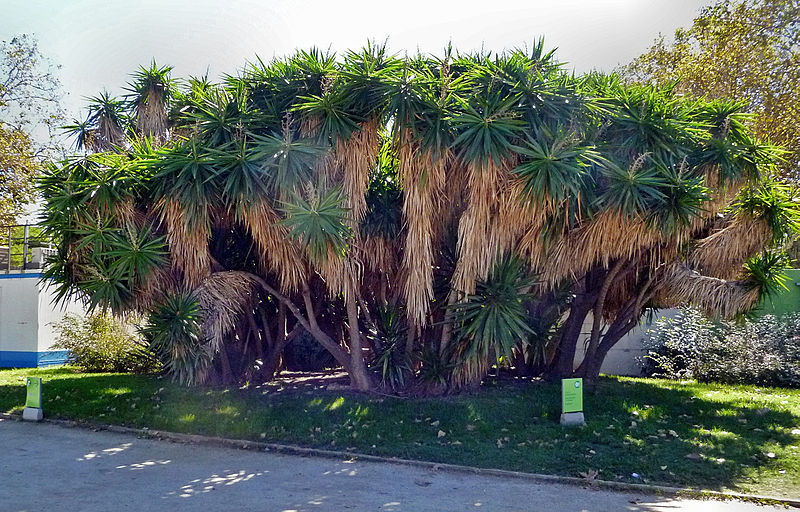
Yucca guatemalensis (syn Yucca elephantipes)

Yucca guatemalensis (syn Yucca elephantipes)

Further Information:

Wikipedia

Yucca filamentosa- RHS guide

How to Grow Yucca

Yucca Care

Yucca- Plant Encyclopedia

Old School Gardener

single_red_rose‘It will never rain roses; when we want to have more roses we must plant more trees’

(George Eliot)

So, male readers (73% of those buying flowers for Valentine’s Day are men), with about a week to go to that feast of romance, you may have started to think about a suitable card and flowers for your loved one. Unless, of course, you forget and pay through the nose on the day itself for a sad-looking bouquet as you fill the car’s tank at your local garage (not guilty m’lord!).

The ‘modern’ celebration of St. Valentine’s day seems to have begun in France and England – the first box of chocolates was proffered in the 1800’s but the first card was sent way back in 1415 by the Duke of Orleans to his wife! The first recorded association of Valentine’s Day with romantic love is in  Parlement of Foules (1382) by English poet Geoffrey Chaucer:

For this was on seynt Volantynys day
Whan euery bryd comyth there to chese his make.

[“For this was on Saint Valentine’s Day, when every bird cometh there to choose his mate.”]. And he may have been referring not to February 14th but May 3rd!

Traditionally the Rose and the Cacao are the ‘patron saint plants’ of Valentine’s Day, but have you thought about  how your roses have been grown and where they’ve come from? On the one hand the UK cut flower market is worth around £2 billion per annum, and Valentine’s Day is an important element in that business. Roses account for more than half of the flowers bought for the day.

Why think of an alternative to cut roses?

Antique Valentine - 1909
Antique Valentine – 1909

Dick Skeffington of the Open University says that over 90% of the roses bought for Valentine’s Day are imported – most from Colombia (for the US market) and Kenya (for the UK). The debate about Kenyan roses goes beyond the ‘flower miles’ generated by their import from Africa to Europe. For instance, there’s the carbon released from fossil fuels involved in fertilisation and cultivation. The flowers also need refrigerating  and methane is released from flowers that are rejected and binned.  Some of the other issues to consider are:

  • Lake Naivasha, the complex eco system around which most of the Kenyan rose production is focused, has suffered from pollution and has seen water levels drop due to rose production

  • During 2007-8, following a disputed election in Kenya, it was said that the Army and police turned their attention to protecting the rose industry at the expense of local people – some 100 deaths and the displacement of 300,000 people resulted

  • Rose production may have resulted in significant increases in miscarriages, birth defects and other health problems associated with the toxic chemicals used in rose production

Some Kenyan rose growers have sought to improve things by adopting Fairtrade status which is a mark of a more sustainable production cycle, and one which brings money back into the local workforce as well as subsidising local welfare and community improvements.

So what to do this coming Valentine’s Day?

Dick says:

‘The best advice this St Valentine’s Day is to purchase flowers with a certified Fairtrade logo clearly marked. That way you can be sure that the flower growers receive a premium to invest in their communities, or you could circumvent the ethical minefield and purchase seasonal British flowers. But do beware of mixed bouquets as the flowers in them can come from a range of sources, some of dubious ethical credentials.’

Alternatively, why not think about a lasting plant gift, something that will continue to grow with the love you have for your partner, rather than get wasted after a few days?! So, a new rose bush for the garden, perhaps (and an extra large box of chocs to make up for the lack of immediate flowers) – or maybe some packets of vegetable seeds?

A rose bush for Valentine's Day? She'll be 'Tickled Pink'!
A rose bush for Valentine’s Day? She’ll be ‘Tickled Pink’!

Further information:

Wikipedia

Fun facts about St. Valentine’s Day

Brief history and facts about St. Valentine’s Day

Old School Gardener

If you’ve enjoyed reading this post and others on this blog, why not comment and also join some other people and sign up for automatic updates via email (see side bar, above right ) or through an RSS feed (see top of page)?

seedlingsIt’s that time of year to get some seeds sown and new growth underway- but how do you ensure your new babies stand the best chance of survival? Here are some ideas for your ‘transfer window’- turning your newly born into successful seedlings…

1. Right pricking out time

For seeds sown in trays or small modules, once the seeds have germinated and you can see growth above the soil, keep a close eye on their leaves. Once the first ‘true’ leaves have formed (these will look more like the final leaf of the plant and follow on from the ‘seed leaves’ that are simpler in shape, like those in the picture above) it’s time to prick out these little seedlings and transplant them, usually into pots or larger modules. If you leave the plants longer they risk becoming spindly and overcrowded as they fight for what little nutrients are left in the seed compost.

2. Right tool

You need some sort of thin implement to tease out the seedlings – I find a chop stick or wooden BBQ skewer is useful. Or use a dibber or pencil – but these might be a bit too thick for some smaller seedlings. Gently prise the individual plants out of the compost so that they bring their roots and possibly a little compost with them.

3. Right handling

Gently take hold of the leaves of the seedling to help it on its way – don’t hold it by the delicate stem as crushing this will deprive the plant of its main channel for water and nutrients. Place your plant into a hole big enough to take the roots comfortably, settle the plant slightly deeper than it was in the original seed tray/module.


watering-vegetable-seedlings
Watering in the transplants

4. Right Pot

Use clean pots and in general a smallish pot (3″ diameter) or modular tray is probably OK for this stage. A guide is that the pot should be about twice as wide as the roots of the plants you’re dealing with. If you want to avoid several potting on stages and you have the room, then go for a bigger size pot/modular tray. Make sure that you clearly label the plants and possibly keep a note of when you transplanted them.

5. Right compost mix

The compost mix you use for potting up needs to have the nutrients the plant is looking for and the right consistency to allow drainage and air around the developing  roots. You can opt for a particular mix for the plants you’re growing but for most I find a general purpose peat free compost (e.g. ‘New Horizon’) is nice and ‘open’. But it can be improved by sieving (to remove bigger bits of organic material), and adding some horticultural grit or ‘perlite’ in the ratio of 1 part grit to 3 parts compost. Or you can make up your own mix.  If you keep your transplants in the same pot for a few weeks you might need to apply some liquid fertiliser to make up for the nutrients that are gradually depleted from the compost.

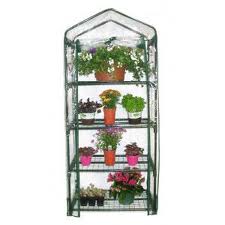
tall plastic greenhouse
A portable greenhouse like this one can be used to grow on seedlings

6. Right environment

Different plants will have different environmental requirements, but in general they need to be thoroughly watered in to their new pots/modules and moved into a light, cooler place than they were in for germination – but avoiding drafts and direct sunlight. For the first few days, the plants might benefit from covering with plastic to lessen the ‘transplant shock’ they experience. Make sure you keep the plants watered so that the compost is just moist – avoid over watering as this can lead to diseases.  Gently brushing the tops of your transplants with your hand or a wooden stick will help control their height and increase stockiness. Ideal transplants are as wide as they are high. Gradually acclimatise the plants to outside conditions – a cold frame or greenhouse after being in the house, for example. Then give them a couple of hours in the outside each day (as long as it’s not too cold or windy) before they are fully ‘hardened off’.

7. Right potting – on time

Keep an eye on your new fledglings and occasionally look underneath the pots – when you see roots  emerging from the bottom it’s probably time to ‘pot them on’ into larger pots. This is broadly the same procedure as for ‘potting up’ and may mean that some plants are transplanted two or three times before they are finally placed in the garden. ‘Keep them moving’ and don’t allow them to become pot bound.

Further information:

Capel Manor College video on pricking out

Garden of Eaden video etc.

Old School Gardener

If you’ve enjoyed reading this post and others on this blog, why not comment and also join some other people and sign up for automatic updates via email (see side bar, above right ) or through an RSS feed (see top of page)?

PicPost: From Fork to Plate

Ranunculus asiaticus - Persian Ranunculus

Ranunculus asiaticus – Persian Ranunculus

Yesterday was sunny but breezy, so my wife and I and two friends went out for a delightful walk in the local countryside, followed by Sunday lunch at a local pub. On the walk we came across signs to a ‘bluebell event’ and passed by the house and garden where this was taking place, but alas, could not spot any but a couple of rather weak looking bluebell blooms. Having been attracted out to another such event publicised a week or so ago (when in a ‘normal’ spring the Bluebells should have been well into flower) and been disappointed, I was skeptical that there was any real show on offer, especially as the bluebells at ‘Old School Garden’ were nowhere to be seen other than making a few clumps of lush foliage!

So, the late spring was once again (not) in evidence! We did, however, see some patches of Wood Anemone (Ranunculus nemorosus, meaning found in groves) amongst larger swathes of Lesser Celandine (Ranunculus ficaria, meaning fig like, referring to the heart- shaped leaves), that reliably invasive yellow – flowered creeper. According to Gilbert White, the famous diarist writing around 1800, the Lesser Celandine flowers came out on February 21, but it is more commonly expected between March and May these days, and is sometimes called the “spring messenger”.

Ranunculus ficaria, Lesser Celandine

Ranunculus ficaria, Lesser Celandine

The name Ranunculus comes from the latin for “little frog,” (rana = frog and a diminutive ending). This probably refers to many species being found near water –  just like frogs! It is a large genus of about 600 species in the similarly named family Ranunculaceae. Members include buttercups, spearworts, water crowfoots as well as the lesser Celandine. According to the Oxford English Dictionary, Celandine comes from the latin chelidonia, meaning swallow: it was said that the flowers bloomed when the swallows returned and faded when they left. The common name Celandine is used to describe three different plants; as well as Lesser Celandine (a Ranunculus) there is Greater Celandine (Chelidonium majus, in the poppy family) and the Celandine Poppy (Stylophorum diphyllum, also in the poppy family).
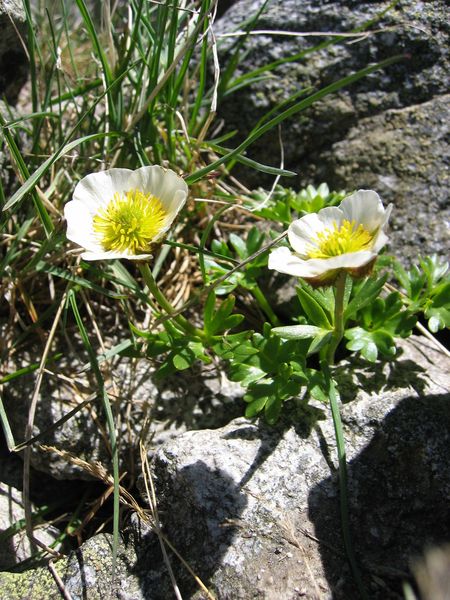
Ranunculus glacialis

Ranunculus glacialis

Ranunculus repens or Creeping Buttercup

Ranunculus repens or Creeping Buttercup

Other Ranunculus species names are:

R. aconitifolius = aconite (aconitum) – like leaves

R. acris = sharp or bitter – the Meadow Crowfoot or Buttercup, a double flowered variety is grown in gardens

R. amplexicaulis = leaves, stem clasping

R. anemonoides = anemone – like

R. asiaticus = Asian, the Persian Ranunculus

R. crenatus = leaves crenated or scalloped

R. glacialis = icy, a high alpine plant

R. gramineus = grassy – the leaves

R. lingua = a tongue – the shape of the leaves

R. lyallii = after David Lyall (a 19th century Scottish botanist), the Rockwood or Mount Cook Lily

R. nivalis = snowy, or lofty regions

R. nyssanus = from Nyssa (an ancient city in Turkey)

R. parnassifolius = leaved like Parnassia

R. repens = creeping or crawling, the Creeping Buttercup

R. rutaefolius = rue (Ruta) – leaved

Most Ranunculus are herbaceous perennials, with bright yellow or white flowers (if white, they still come with a yellow centre), though some are annuals or biennials. A few species have orange or red flowers. There are usually five petals, but sometimes six, numerous, or none, as in R. auricomus. The petals are often highly lustrous, especially in those with yellow flowers (e.g buttercups).

Ranunculus lyallii- the Mount Cook lilly

Ranunculus lyallii– the Mount Cook lily

A forming Ranunculus fruit or seed head (achene)

A forming Ranunculus fruit or seed head (achene)

Buttercups usually flower in the spring, but flowers may be found throughout the summer, especially where they are unwelcome garden weeds! The name buttercup may derive from a false belief that the plants give butter its characteristic yellow hue (in fact it is poisonous to cows and other livestock). A popular children’s game involves holding a buttercup up to the chin; a yellow reflection is supposed to indicate a fondness for butter!

In the interior of the Pacific Northwest of the United States the buttercup is called “Coyote’s eyes”. In the legend behind this the Coyote was tossing his eyes up in the air and catching them again when the Eagle snatched them. Unable to see, Coyote made eyes from the buttercup!

Ranunculus' Double Orange'

Ranunculus’ Double Orange’

Ranunculus ficaria 'Brazen Hussy'

Ranunculus ficaria ‘Brazen Hussy’

Ranunculus species are used as food plants by the larvae of some butterflies. Some species are popular ornamental flowers, and many cultivars have large and brightly coloured flowers. When Ranunculus plants are handled, a naturally occurring substance, ranunculin is broken down to form a toxin known to cause dermatitis in humans and care should therefore be taken when handling large numbers of the plants. The toxins are degraded by drying, so hay containing dried buttercups is safe.

The Lesser Celandine plant used to be known as Pilewort because it was used to treat haemorrhoids. Supposedly, the knobbly tubers of the plant resemble piles, and according to the ‘doctrine of signatures’ this resemblance suggests that Pilewort could be used to cure piles! The German vernacular Scharbockskraut (“Scurvyherb”) derives from the use of the early leaves, which are high in vitamin C, to prevent scurvy. The plant is widely used in Russia and is sold in most pharmacies as a dried herb.

A woodland floor of Lesser Celandine

A woodland floor of Lesser Celandine

Further information:

Wikipedia

Planting guide

Growing Ranunculus

Ranunculus ficaria ‘Brazen Hussy’

Quizzicals:

answers to the two clues given in Plantax 9…

  • Substandard animal limb = Pawpaw
  • West Indies batsman + Food superstore = Vivaldi

..and 2 more cryptic clues to the names of plants, fruit or veg…

  • Evader of women

  • Oriental busybody

(thanks to Les Palmer, answers in the next Plantax!)

Old School Gardener

If you’ve enjoyed reading this post and others on this blog, why not comment and join others by signing up for automatic updates via email (see side bar, above right ) or through an RSS feed (see top of page)?

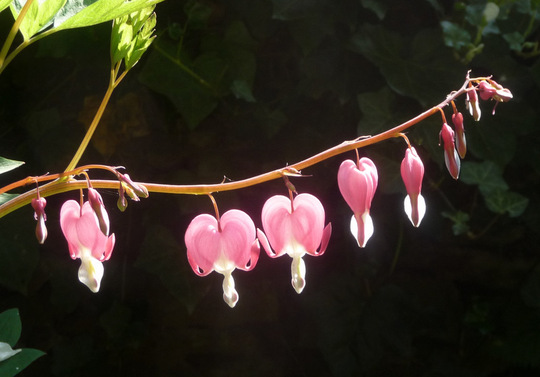
Dicentra Dicentra is a genus of about 20 annuals and perennials (of which about 8 are perennial) and many cultivars. They are native to both Asia and North America (though possibly an ‘honorary native’ in the latter, dating from colonial times), mainly in woodland habitats.

Their roots vary between rhizomes,tubers or fleshy tap roots. All varieties are reliably hardy. Most are deciduous but some are evergreen and have fern-like, divided foliage, some of a silver – grey colour.

Flowers – which come in shades of red,pink and white – hang as pendents on racemes or panicles and are very distinctive – two outer petals are pouched, giving a heart-shaped outline with the two inner petals forming a hood over the anthers. Not surprisingly this arrangement has led to many descriptive common names such as:

  • Bleeding heart (most usually used for D. spectabilis)
  • Showy bleeding heart
  • Dutchman’s breeches
  • Chinaman’s breeches
  • Locks and keys
  • Lyre flower
  • Seal flower
  • Old-fashioned bleeding heart

Flowering time is late spring into early summer. The flowers and foliage are useful in flower arrangements, the flowers lasting well in water.

Dicentra canadensis (Squirrel Corn)

Dicentra canadensis (Squirrel Corn)

Dicentra cucullaria (Dutchman's breeches)

Dicentra cucullaria (Dutchman’s breeches)

Dicentra formosa oregona 'PEARL DROPS'

Dicentra formosa oregona ‘Pearl Drops’

Dicentra formosa pink

Dicentra formosa

Dicentra formosa

Dicentra formosa – close up of flowers

Dicentra peregrina (Komakusa)

Dicentra peregrina ‘Komakusa’

Dicentra spectablis

Dicentra spectablis

Most of the perennial Dicentra make good border plants, though a couple are rather invasive (spectabilis and formosa) and are best used in a woodland garden, where seedlings or spreading rhizomes can be allowed to expand or be easily removed. D. spectabilis is not long-lived. All Dicentra are low in allergens, but all parts of the plant are poisonous and a skin irritant.

Most varieties prefer growing in half shade in moist fertile soil – but they are drought tolerant so can be useful in drier shaded positions.

Most varieties grow to between 25cm and 45cm tall, though D. spectabilis is taller and the white form (‘Alba’) and ‘Gold Heart’ (with striking yellow foliage) grow to 90cm tall and spread to around 50cm.

Further information:

Dicentra spectabilis

Varieties and growing Dicentra

Dicentra ‘Stuart Boothman’ AGM

National Dicentra collection

Dicentra photographs

Old School Gardener

If you’ve enjoyed reading this post and others on this blog, why not comment and join others by signing up for automatic updates via email (see side bar, above right ) or through an RSS feed (see top of page)?
Daffodil flower close up

Narcissus is a genus of bulbous perennials in the Amaryllis family. They are in the  main hardy and most flower in the spring. There are various common names used to describe all or some of the genus – daffodil, narcissus, and jonquil. Narcissus are native to meadows and woods in Europe, North Africa and West Asia, centred in the Western Mediterranean.

There is disagreement about the number of distinct species (these range from 26 to more than 60 depending on who you ask) – as some are very similar and others have hybridised. All Narcissus cultivars are split into 13 divisions (using a combination of flower form and genetic background). New cultivars are registered by name and color with the Royal Horticultural Society, which is the international registration authority for the genus.

More than 27,000 names were registered as of 2008!

Narcissus flowers

Narcissus flowers

The name “daffodil” is derived from an earlier word  “affodell”, a variant of Asphodel (another group of Mediterranean plants). The reason for the addition of the  initial “d” is not known, although it could be a ‘slip of the dutch tongue’ – the merging of the main word with the Dutch article “de”, as in “De affodil”. Playful synonyms  “Daffadown Dilly”, “daffadown dilly”, and “daffydowndilly” appeared as early as the 16th century. Everyday use of the term Daffodil tends to refer to the wild daffodil (N. pseudonarcissus).

The name Narcissus comes from the same latin word, which in turn is based on an ancient greek word – but its meaning is unknown. It could be a word loaned from another language. The most common explanation is based on the Greek myth of Narcissus, a Thespian hunter renowned for his beauty. He became so obsessed with his own reflection in a pool of water that as he knelt and gazed into it, he fell into the water and drowned. Some variations of the myth say that he died of starvation and thirst. In both versions the Narcissus plant sprang from his remains. However, this is by no means a certain derivation and it could be the that the hunter’s name was derived from the flower rather than the other way round!

Another explanation for the name comes from Pliny who stated that the plant was named because of its narcotic properties (the greek word means ‘to grow numb’). There’s no evidence to support this idea and it seems to have fallen out of favour. However,  all Narcissus species do contain the poison lycorine (mostly in the bulb but also in the leaves). The bulbs can often be confused with onions, thereby leading to incidents of accidental poisoning.

On 1 May 2009 a number of schoolchildren fell ill at Gorseland Primary School in Martlesham Heath, Suffolk, England, after a daffodil bulb was added to soup during a cookery class.

Another problem is what florists call, “daffodil itch” – a skin problem often found on the hands after contact with the plant’s sap. Some cultivars seem more likely to cause this kind of dermatitis; eg  ‘Actaea’, ‘Camparelle’, ‘Gloriosa’, ‘Grande Monarque’, ‘Ornatus’, ‘Princeps’ and ‘Scilly White’.

Narcissus geranium

Narcissus geranium

The Narcissus is used quite widely as a symbol:

  • of unrequited love (after the Narcissus myth)
  • of vanity (the West)
  • of wealth and good fortune (the East).
  • of the new year (Kurdish and Chinese cultures).
  • of beautiful eyes (Persian culture)
  • of the nation (Wales – where the daffodil is known as ‘Peter’s Leek’)
  • of Easter (the German for daffodil is Osterglocke or ‘Easter Bell’)
Cornwall daffodils- traditionally the place (along with the Scilly Isles and Channel Islands) where early supplies of cut flowers are sent out to the rest of Britain.

Cornwall Daffodils- traditionally the place (along with the Scilly Isles and Channel Islands) where early supplies of cut flowers are sent out to the rest of Britain.

Some of the species names are:

N. bulbocodium = probably greek for ‘bulb’ (bolbos) and ‘a little fleece’ (kodion) – referring to the covering of the bulb – the ‘Hoop Petticoat Daffodil’

N. cyclamineus = like a Cyclamen flower

N. incomparabilis = incomparable

N. jonquilla = probably from ‘juncus’ (a rush) – the leaves being rush-like. The ‘Jonquil’

N. juncifolia = like Jonquil, rush – leaved!

N. major = larger

N. maximus = largest

N. minor = smaller

N. odorus = sweet-scented

N. poeticus = poet’s – the ‘Poets’ Narcissus’

N. pseudonarcissus = the false Narcissus. The ‘English Daffodil’

N. tazetta = an old name for the ‘Polyanthus Narcissus’

N. triandrus = having three stamens

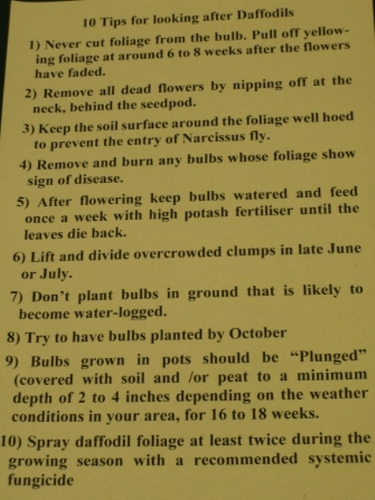
Daffodil growing tips

Daffodil growing tips

Both species and hybrids are used extensively in gardens and grounds, looking good planted in borders or in naturalized drifts at the base of deciduous trees. Propagation is mainly from bulbs which are very easy to grow. They require little maintenance, but with some minimum care they can be more vigorous and floriferous, and they’ll multiply much more quickly, improving the show they provide each year. (see ‘Ten tips for looking after Daffodils’ above). Narcissus grows almost anywhere, although it does prefer well-drained soils with a sunny or light shade environment. The Narcissus species types are more specific in their requirements.

Naturalised Daffodils

Naturalised Daffodils

Source and further information:

Wikipedia

Growing Narcissus

Kew Gardens- Narcissus pseudonarcissus

Daffodil classification

Old School Gardener

If you’ve enjoyed reading this post and others on this blog, why not comment and join others by signing up for automatic updates via email (see side bar, above right ) or through an RSS feed (see top of page)?

PicPost: Purple Rain...

Bougainvillea?

Anthemis tinctoria 'E.C.Buxton'

Anthemis tinctoria ‘E.C.Buxton’

There are around 100 mat or clump-forming species in the genus Anthemis.

They make very useful border plants, with a long flowering season from late spring – end of summer.

Most grow between 30 -60 cms high and have a similar spread.

Beautiful filigree, aromatic evergreen foliage when not in flower.

Smaller types suitable for rock gardens.

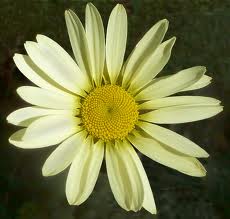
Flower heads are daisy-like; with white or yellow ray florets or yellow disc florets- some make good cut flowers.

Though many species are not long lived (A. tinctoria especially so), they are all easily propagated from seed or cuttings.

The plant’s life can be extended by shearing over in autumn just after flowering – this encourages new basal growth which takes the plant through the winter. Shearing also helps to prevent mildew.

They need sunny, well-drained sites and wet winters are generally not favourable.

They do not transplant well, but should anyway be divided regularly in spring.

Anthemis maritima

Anthemis maritima

The orangey- yellow varieties look well woven in and out of mixed borders, and complement warmer coloured flowers; e.g. Crocosmia ‘Lucifer’, Dahlias, Hemerocallis etc. The yellow varieties look well with blue flowers such as Nepeta or Agapanthus. The pale lemon variety ‘E.C. Buxton’ (or ‘Golden Marguerite’- one of my favourites)  works well with wispy grasses such as Stipa tenuissima and the darker Lavenders (e.g. ‘Hidcote’).

Further information:

Wikipedia

How to grow Anthemis- Telegraph article

Anthemis marschalliana– silver foliage

Quizzicals: answers to the two in the post ‘Gypsies, tramps and thieves…’

  • The scourge of female chickens – Henbane
  • Cheap goods in a pile of dung – Potato

Old School Gardener

If you’ve enjoyed reading this post and others on this blog, why not comment and join others by signing up for automatic updates via email (see side bar, above right ) or through an RSS feed (see top of page)?

Finding Nature

Nature Connectedness Research Blog by Prof. Miles Richardson

Norfolk Green Care Network

Connecting People with Nature

Discover WordPress

A daily selection of the best content published on WordPress, collected for you by humans who love to read.

Susan Rushton

Celebrating gardens, photography and a creative life

Unlocking Landscapes

Writing, photography and more by Daniel Greenwood

Alphabet Ravine

Lydia Rae Bush Poetry

TIME GENTS

Australian Pub Project, Established 2013

Vanha Talo Suomi

The Journey from Finnish Rintamamiestalo to Arboretum & Gardens

Marigolds and Gin

Because even in chaos, there’s always gin and a good story …

Bits & Tidbits

RANDOM BITS & MORE TIDBITS

Rambling in the Garden

.....and nurturing my soul

The Interpretation Game

Cultural Heritage and the Digital Economy

pbmGarden

Sense of place, purpose, rejuvenation and joy

SISSINGHURST GARDEN

Notes from the Gardeners...

Deep Green Permaculture

Connecting People to Nature, Empowering People to Live Sustainably

BloominBootiful

A girl and her garden :)