Tag Archive: parterre


WP_20140928_17_26_24_ProThis last ‘garden’ from our recent trip to Portugal, is a bit of a cheat. The main attraction is the gothic splendour of the monastery and associated cathedral, but there are some wonderful outdoor spaces too, so I think its worth sharing.

The monastery was founded by the first Portuguese King, Afonso Henriques, in 1153, and has maintained a close association with the Kings and Queens of Portugal throughout its history, housing several royal tombs and the national pantheon.

The church and monastery were the first gothic buildings in Portugal, and, due to its artistic and historical importance, was listed by UNESCO as a World Heritage Site in 1989. The Cathedral is the largest church building in Portugal and has a relatively simple undecorated interior- I was fully expecting golden baroque splendour on entering, but was pleasantly surprised.

The Cathedral is perhaps most famous for housing the tombs of King Pedro I and his mistress, Ines de Castro, assassinated, in 1355, under the orders of Peter’s father, King Afonso IV. After becoming King, Pedro ordered the remains of his beloved to be transferred to her tomb in Alcobaça and, according to a popular legend, had her crowned as Queen of Portugal and ordered court members to pay her homage by kissing her decomposing hand.

This pair of Royal tombs, of unknown authorship, are among the best works of gothic sculpture in Portugal. The tombs are supported by lions, in the case of the King, and half-men half-beasts, in the case of Ines, and both carry the recumbent figures of the deceased assisted by a group of angels. The sides of Pedro’s tomb are magnificently decorated with reliefs showing scenes from Saint Batholomew’s life, as well as scenes from Pedro and Ines’ life. Her tomb is decorated with scenes from the life of Christ.

The monastery complex provides an interesting, and, as expected, relatively simple series of rooms and spaces where the monks went about their everyday business.

This slideshow requires JavaScript.

Outside, the cloister is a most inspiring space, simply furnished (and with some sympathetic conservation) with a few trees and close-cut box bushes- I was fortunate to capture it in the afternoon sun. The monastic gardens- not open to the public- are a fine example of box-edged parterres enclosing a series of beds that once were used for growing food and herbs. This important site lies about an hour’s drive north of Lisbon and is an area I hope to visit again as there are other landscapes and historical sites nearby, that we didn’t have time to visit.

Source and further information: Wikipedia

 Old School Gardener

IMG_0851Our recent visit to Portugal included a longer trip 1 hour north from Lisbon to a fascinating park (it is too big to be called a garden)- in fact it is billed as the biggest oriental park in Europe, stretching to around 35 hectares.

Developed within the Quinta dos Loridos vineyard, the Buddha Eden Peace Park was inspired as recently as 2001, when wealthy Portuguese investor and art patron José Berardo was shocked by the Taliban government’s destruction of the Giant Buddhas in Afghanistan.  In response to the demolition of these masterpieces of the late Gandhara period, Berardo initiated the Buddha Eden in an homage to these cultural and spiritual monuments.

Buddhas, pagodas, terracotta statues and carefully placed sculptures (modern and western) can be found throughout the park. It is estimated that some six thousand tons of marble and granite were used to create this monumental work of art.

This slideshow requires JavaScript.

It is certainly an impressive achievement and one which has been laid out to a monumental scale. There are beautifully framed views and a wide range of interesting features to capture your attention as you wander round the clearly defined pathways. The planting, as you might expect at this scale, is simple and must look dramatic earlier in the season when masses of Agapanthus are in flower.

The central staircase is the focal point of the park, where the reclining golden Buddha, despite its size, creates a sense of calm.

At the central lake, Koi (Japanese carp) fish can be seen, and sculpted dragons rise out of the water.

This slideshow requires JavaScript.

There are seven hundred hand-painted terracotta soldiers, each of them unique copies of those which were buried some 2,200 years ago in China. These looked to be in need of repainting (and in one or two cases more significant repair), but being able to walk among them (they were all well over 6 feet tall) was a strangely unnerving (but enjoyable) experience.

The park is certainly a fantastic visitor experience, though by the end of our visit I was feeling a little ‘over buddhad’ and almost overwhelmed by the monumentality of everything. Perhaps some thought needs to be given to creating some smaller, more human scale spaces which can complement the rest of the Park – and in doing so, perhaps making the experience of this even more intense.

The park seems to be unsure of what it is trying to be, perhaps at a stage of transition from one man’s passionate and bold move to preserve a cultural legacy to something akin to a modern-day theme park- nicely captured by the electric train that ferries visitors unwilling or unable to walk around the site!

Old School Gardener

Plant Patterns #2

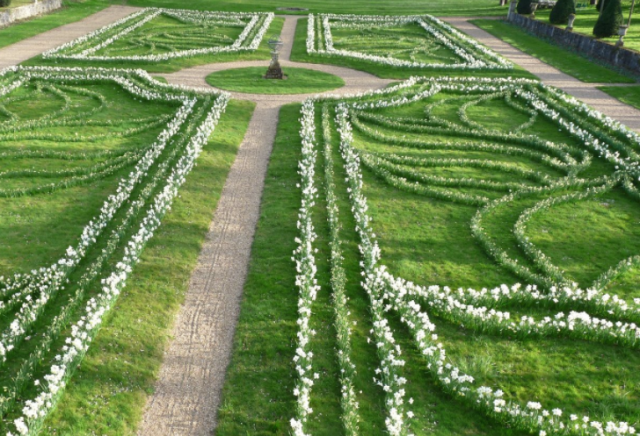
Narcissus parterres

Old School Gardener

WP_20140322_056

Last weekend, whilst staying in Chester, we took a little trip out to Wales, specifically to the elegant house and gardens at Erdigg, near Wrexham. It was well worth the effort as we found a beautiful formal garden stemming from the 18th  century and showing evidence of later period garden design fashions.

Erddig was owned by the Yorke family for 240 years. Each of them was called either Simon or Philip. The first Simon Yorke inherited the house in 1733 from his uncle, John Meller. Erddig’s garden was begun in 1685. Each of Erddig’s owners has altered and added to it, but each has respected their predessors work. Today you can still see evidence of the gardens of the past. Erddig’s walled garden is one of the most important surviving 18th century formal gardens in Britain.

The gardens contain rare fruit trees, a canal, a pond, a Victorian era  parterre and are home to the NCCPG  National Plant Collection of Hedera (ivy). The arrangement of alcoves in the yew hedges in the formal gardens may be a form of bee bole – a cavity or alcove in a wall or a separate free-standing structure set against a wall (the Scots word ‘bole’ means a recess in a wall). A skep is placed inside the bee bole. Before the development of modern bee hives, bee boles were a practical way of keeping bees in some parts of Britain, although most beekeepers kept their skeps in the open covered by, for example, old pots, or sacking. The bee bole helped to keep the wind and rain away from the skep and the bees living inside.

Further information:

National Trust Website

Wikipedia

Old School Gardener

IMG_8032Our October visit to Portugal concluded with a day packed with garden visits to the west of Lisbon and in the regal suburb of Sintra to the north- home to many a splendid palace and garden.

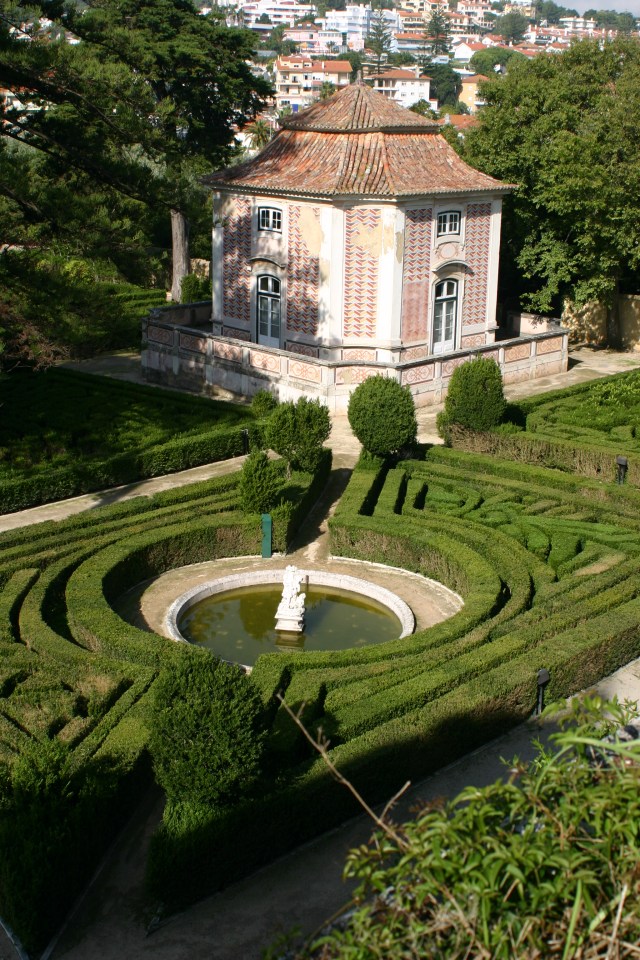
We began at a restored baroque garden in the riverside  town of  Caxias. The Quinta Real de Caxias is located quite close to the train station (direct services to and from Lisbon). It was a leisure residence of Queen D. Maria I, as well as the home of King Luís for a few weeks, before he moved to the Ajuda Palace (which we’d visited a few days before).

Inspired by the gardens at the Palace of Versailles, the formal parterres- woven in intricate patterns – are interspersed with various water features, statuary and tall Brazilian pine trees.

The waterfall, ornamented with terracotta statues (of the Machado de Castro school), is the centre piece. Set out at the end of the principal avenue the fountain itself (made out of weather – beaten limestone), is flanked by two wings of tiered terracing, accessed by staircases at either end – the perfect spot form which to view the patterns of the box parterres.

Awarded a European Prize for the Recovery of Historical Gardens, the local Council has done a superb job in restoring much of the baroque splendour of this ‘off the beaten track’ haven. I could have spent hours here ‘chilling out’ – and it would have been even more alluring if the water features had been in operation. Maybe that’s something for the next phase of restoration?

Old School Gardener

PicPost: Amazing

Maze Gardens at Ruspoli Castle Northern Lazio, Italy

Tiered Box hedging in the lower garden

My recent trip to Lisbon, Portugal, was very much a ‘Garden Fest’ (even though it was really about seeing our Daughter and Son-in-law who live there). I seem to have found several more superb gardens and parks to add to those old favourites covered in earlier articles in the category ‘Portuguese Gardens’. The Jardim Botânico d’Ajuda (Ajuda Botanical Garden) was the first we visited, after an interesting tour of the nearby Royal Palace of Ajuda – richly decorated and with some ‘garden’ interest of its own- (more on that in a later article!).

History

The Ajuda Botanical Garden was a real find. The first and oldest botanical garden in Portugal, it is also without doubt one of the most beautiful I’ve visited in Lisbon. It was created in the 18th century for the Portuguese royal family.When the earthquake of 1755 hit Lisbon, the royal family was living in the palace of Belém (just down the hill next to the River Tagus), and which sustained relatively little damage. However, fearing more tremors, they camped in tents outside the palace for some time, and later, as the king refused to live in a brick building, the Marquis of Pombal (a powerful statesman who led the reconstruction efforts after the earthquake), had a wooden residence built for the royal family furtehr up the valley side. However (and how unlucky must the King have felt), a fire destroyed this building in 1791. So it was later replaced with the Palace of Ajuda.

In 1765, the King ordered naturalist Domingos Vandelli to create a botanical garden near the, then wooden, residence of the royal family. The king wanted to create a garden for his grandchildren, where they could play and learn about horticulture. Vandelli constructed the garden over the course of the following three years with the help of Júlio Mattiazi, who was master gardener of Europe’s oldest botanical garden in Padua, Italy.

About 25 years later Domingos Vandelli was appointed director of the Royal Botanic Gardens and in this position he collected some 5.000 different plant seeds from all over the world. During the 18th until the late 20th century, the garden was maintained by a number of different institutions, and more often than not it was neglected. In 1993, with the support of funds from the EU and the Lisbon Tourist Association, a reconstruction effort started, and the garden regained its earlier glory in 1997.


The Design

The garden is designed in Baroque style with a strict geometric layout and decorated with monuments. Occupying some 3.5 hectares on the side of the river valley, the garden is divided into two terraces connected with each other by a monumental Baroque staircase, the Escadaria Central.

The lower, bottom terrace, has an Italianesque layout with a geometric pattern of paths and long hedges of boxwood arranged around flower beds. Plenty of tall trees provide some welcome shade. At the center of the lower level stands a monumental fountain, the Fonte das Quarenta Bicas (Fountain of the Forty Spouts). The 18th century fountain actually has 41 water spouts, disguised as serpents, fish, sea horses. Other statues of frogs, shells and ducks decorate the fountain that is placed at the center of a large basin with water plants.

At the western end of the lower level there are some exotic plants as well as a small rock garden, but the most interesting exotic plants are housed on the upper level where there are some remarkable specimens, most notably a 400 year old dragon tree and an equally large Schotia Afra. There is also a fair number of smaller plants such as the colorful Tecoma Capensis and the Japanese Camellia.

As a bonus, there are not just plants in the botanical gardens; plenty of peacocks strut around the gardens, doing their best to ignore the visitors!

I also had a pleasant time chatting to one of the gardeners, who was setting out leaf cuttings in one of the large glasshouses, this one devoted to a wide ranging collection of succulents, many beautifully arranged in naturalistic table top settings. This gardener was hugely complimentary of Kew Gardens, where she had worked and  was, she said, trying to recreate something of that wonderful exotic collection here. She was doing a grand job, and I told her so.


Look out for the next instalment in this latest ‘Gardens Tour of Lisbon’!

Source: A View on Cities

Related articles:

Oranges and Azulejos: Portuguese Heritage Gardens

PicPost: Great Garden @ Pena Palace Park

PicPost: Great Garden @ Praça do Império Garden, Belem, Portugal

PicPost: Great Garden @ Buddha Eden, Portugal

Portuguese Gardens: Tropical Botanical Gardens, Belem

Portuguese Gardens: Braga

Portuguese Gardens: Estrela Garden, Lisbon

Old School Gardener

PicPost: Geometric Progression

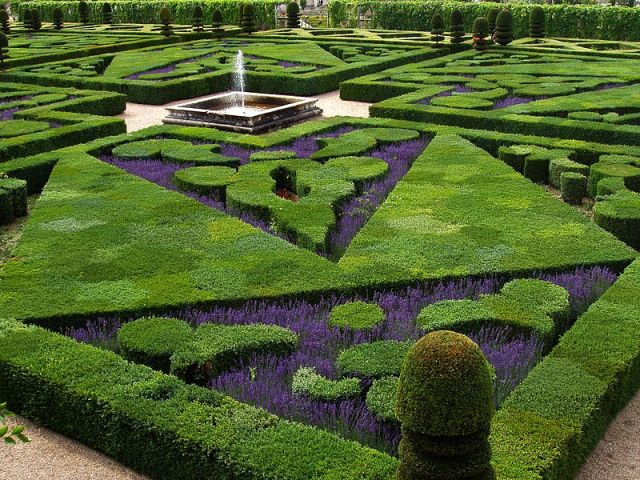
Villandry, France via Jean Aernoudts

PicPost: Designer Stubble

Chateau de Hautefort, Dordogne, France – via Richard Wright

PicPost: Knotted

Finding Nature

Nature Connectedness Research Blog by Prof. Miles Richardson

Norfolk Green Care Network

Connecting People with Nature

Discover WordPress

A daily selection of the best content published on WordPress, collected for you by humans who love to read.

Susan Rushton

Celebrating gardens, photography and a creative life

Unlocking Landscapes

Writing, photography and more by Daniel Greenwood

Alphabet Ravine

Lydia Rae Bush Poetry

TIME GENTS

Australian Pub Project, Established 2013

Vanha Talo Suomi

The Journey from Finnish Rintamamiestalo to Arboretum & Gardens

Marigolds and Gin

Because even in chaos, there’s always gin and a good story …

Bits & Tidbits

RANDOM BITS & MORE TIDBITS

Rambling in the Garden

.....and nurturing my soul

The Interpretation Game

Cultural Heritage and the Digital Economy

pbmGarden

Sense of place, purpose, rejuvenation and joy

SISSINGHURST GARDEN

Notes from the Gardeners...

Deep Green Permaculture

Connecting People to Nature, Empowering People to Live Sustainably

BloominBootiful

A girl and her garden :)