
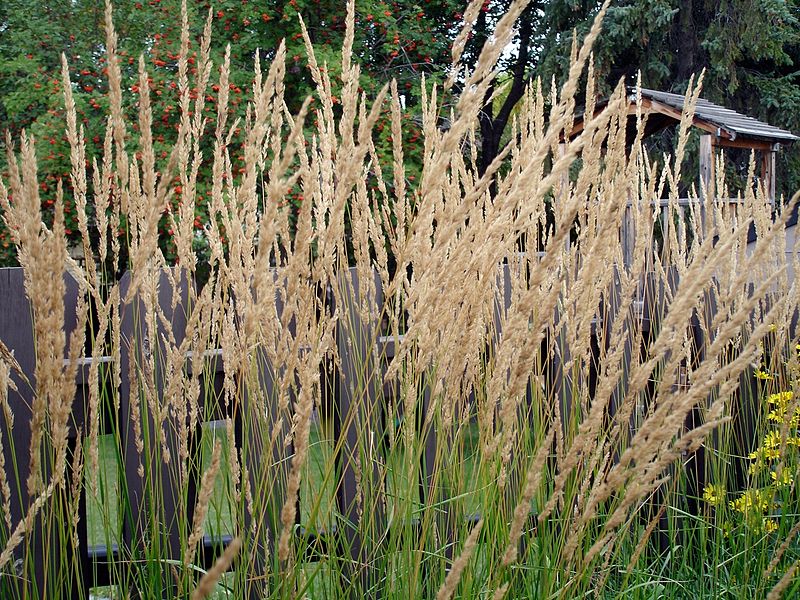
Flowers of Calamagrostis x acutiflora ‘Karl Foerster’
OK, when you think ‘grass’ in the garden you’ll probably think ‘lawn’. Though they’re hard work to keep looking good and not the most environmentally friendly form of gardening, I do like the way a nice green sward sets off colourful and interesting borders. I’ve just given a part of my own lawn here at Old school Garden a bit of TLC, scarifying, aerating and treating with an Autumn ‘weed and feed’. However, living in one of the driest parts of the UK, means that lawn care can be rather disheartening, as it quickly turns brown in the summer.
But I’m not really here to talk about lawns. This and the next article in my new series aiming to help you with design tips for your garden, are focused on another use of grasses- in the border. When you think about it, grasses are probably the plant that humanity has cultivated the longest, albeit originally it was for food rather than aesthetic reasons. Grasses have been rather slower coming into our gardens, and then they have often been treated as ‘alien invaders’ to be pulled out and ‘dealt with’ as all ‘weeds’ are.
I suppose ornamental gardening did not really start in earnest until the seventeenth century and it was then that the first grass was listed as an ornamental plant- ‘Feather grass’ (Stipa pennata), grown for its long, feathery awns (needle thin bristles attached to the flowers of grasses and the things that often give them their golden glow as they catch the sunlight). This English native was listed in John Kingston Galpine’s Catalogue of 1782. A century later the famous ‘naturalistic’ gardener William Robinson was listing nearly 30 varieties in his classic book, ‘The English Flower Garden’. However only about twelve of these were used in gardens, and then as curiosities, as specimens amid the wider swathes of lawn grass.
Robinson, and later Gertrude Jekyll, were the founders of the Edwardian ‘naturalistic garden within formal bounds’ style (not forgetting my architectural and landscape designer hero, Sir Edwin Lutyens). Jekyll was specific about the placing of grasses – often close to water, but also in borders (e.g. Blue Lyme Grass or Elymus arenarius) and Luzula sylvatica (Common Woodrush) in woodland, used as ground cover.

Stipa gigantea
Both Robinson and Jekyll were influential in America, where some grasses such as Miscanthus and Pampas grasses were proving popular, fitting in well in large American landscapes. This was the birth of the ‘prairie style’ of garden design in America where designers such as Jens Jensen and Frank Llloyd Wright led the way.
After a dip in popularity the style returned in the 1950’s, and at about the same time, on continental Europe nurserymen like German Karl Foerster (who’s given his name to one of my favourite grasses, Calamagrostis x acutiflora ‘Karl Foerster’), were assembling plants from around the world and associating them with the naturalistic style of garden design. Foerster was followed by another group of nurserymen who advocated the use of grasses in forming natural, self sustaining plant communities where pesticides and herbicides would not be necessary. Another stimulus was the growing awareness of climate change and the increased frequency of drought conditions, so choosing plants that could withstand these harsher times were a logical response.

Leaves of Miscanthus sinensis ‘Zebrinus’- Zebra grass
The combination of interest in North America and continental Europe led to the modern ‘new wave’ garden of designers like the Oehem van Sweden partnership in east coast America. From here the ideas of naturalistic planting spread to South America under the patronage of designer Burle Marx and in more modern times via Dutchman Piet Oudulph, who has created some classic gardens in the UK and been very influential in the use of grasses and other ’prairie plants’ as stand alone designs, as well as leading to the increased use of grasses within traditional herbaceous and mixed borders.
This is how I use grasses in Old School Garden and in some of my designs for other gardens, e.g. the entrance border at Gressenhall Farm and Workhouse Museum, Norfolk.
So that’s the background to grasses in the garden – what are the design tips to follow? My next article will tell all….

Part of the Piet Oudolph – designed beds at RHS Wisley Gardens







 Old School Garden